
Introduction
Like fungible tokens, NFTs have many use cases and benefits — they represent digital property rights and can direct ownership to users. They can be used for fundraising, marketing, and governance. However, unlike fungible tokens, which capture value from products but don’t create value directly, NFTs are often the products themselves — consider Fidenzas, CryptoPunks, and music NFTs.
This makes the token distribution model an even more critical factor in determining the success (or failure) of an NFT project. Token distribution models represent supply, which should be designed with the expected demand in mind. If supply and demand match, it can lead to a stable and rising price. If there is a significant mismatch in supply and demand, there will be lots of price volatility and unhappiness among the community.
The most harrowing period for NFT projects is often the launch. It involves a combination of getting the NFTs into the hands of the right people (users instead of speculators) and raising funds to achieve the founder’s vision. A failed mint leads to a loss of momentum and poor morale. Hence, it is paramount for teams and investors to study the different distribution models and understand their nuances so as to have the best chance of succeeding.
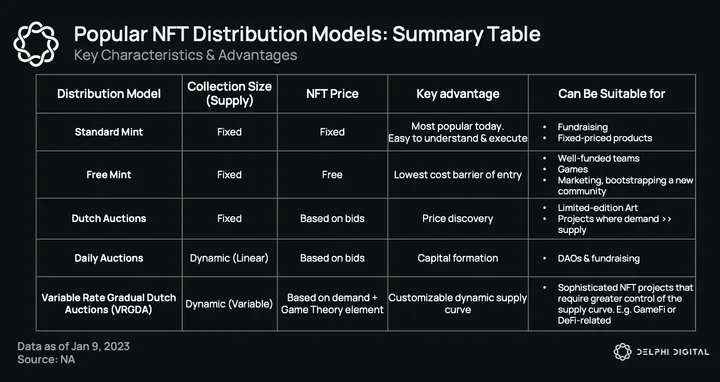
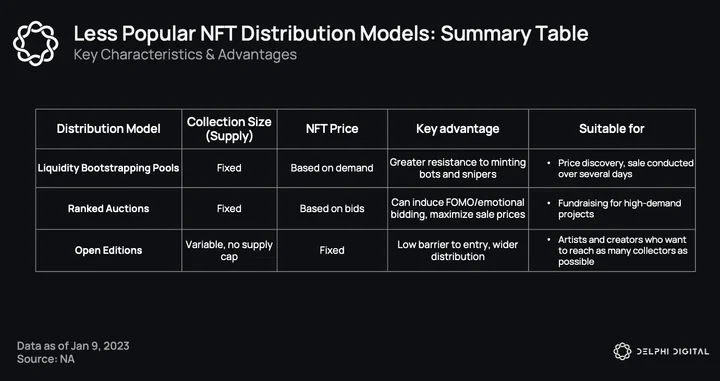
NFT Distribution Models
Over the past 2-3 years, NFT teams have experimented with a variety of distribution models. Some models are simple to understand, while others involve a greater degree of complexity (e.g., VRGDA). This is a core component of NFT “tokenomics” and is important for a few reasons:
-
Building a vibrant, engaged community is usually a top goal for NFT teams, so it’s important to get the NFTs into the hands of the right people that believe in the vision or are active contributors.
-
NFTs are often used as a fundraising mechanism for developing teams, so there is an incentive for teams to maximize their selling price. However, maximizing price also leads to less potential upside for the community and a higher risk of a “death spiral” in floor prices. It is commonly believed that the strongest communities have been built on making everyone in the community rich (e.g., BAYC).
Because NFTs are highly varied, there is no one-size-fits-all model for distribution. Some questions that can impact the choice of model:
-
What will the initial supply be? A larger supply means more potential funds raised and more NFT owners, but it can be harder to sell out. An estimate of market demand is crucial.
-
Will the supply be fixed or dynamic? Daily auctions or gradual Dutch auctions allow the supply to grow at a specific rate over time, unlike standard mints.
-
Is fundraising a key objective? Dutch auctions optimize for price discovery, while free mints do not raise any funds.
Landscape Overview
Before we dive into each distribution model in detail, let’s take a high-level view of today’s NFT environment.
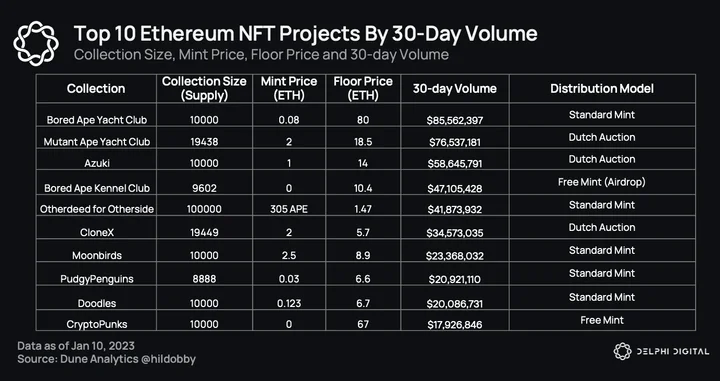
We looked at the top 100 NFT projects by 30-day volume between Dec. 9th, 2022 and Jan. 9th, 2023. To give you an idea of the projects that were included, the table above shows the top 10 projects among the 100 we reviewed.
We focused on Ethereum projects, as they currently generate the majority of trading volume and liquidity. While this sample represents only a tiny portion of all NFT projects (estimated to be 100,000+), we believe it represents the majority of attention on NFTs today. We can use this information to identify a number of trends worth discussing.
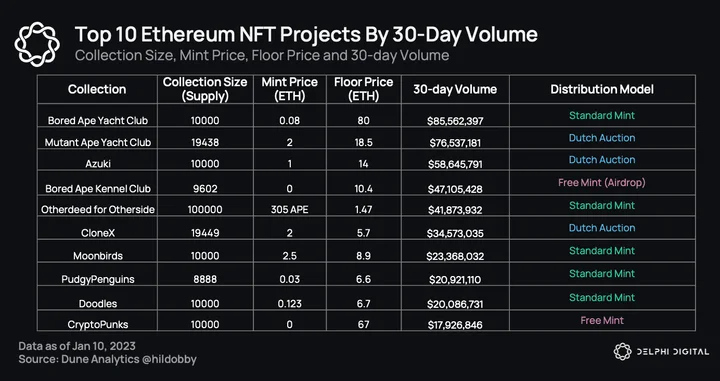
Among this sample, most of the top NFT projects (60%) launched via a standard minting process — a fixed supply and fixed price per mint, usually with some form of allowlist. 25% were free mints that were either airdropped to holders of existing NFT collections (e.g., RTFKT’s MNLTH) or given away to early participants (e.g., DigiDaigaku).
Standard mints and free mints are basic models for NFT distribution that are simple to understa
Read the full report
This report is part of Delphi Pro.
- 800+ Pro reports across every major sector
- Talk directly with our analysts
- Private community of funds and builders
Already a Pro member? Log in
0 Comments