Introduction
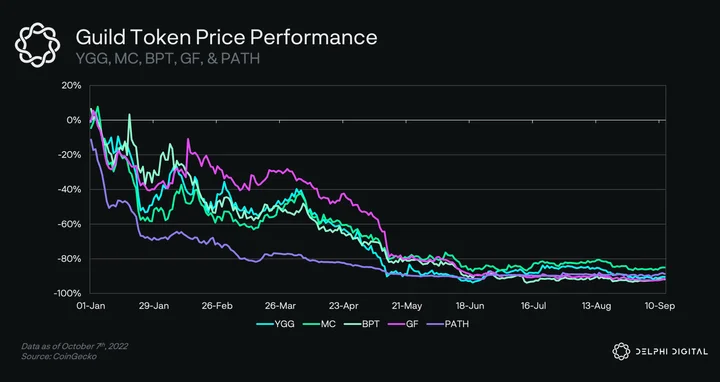
Holding gaming guild tokens has been max pain for crypto investors in 2022. Every token in this comparison is down more than 80% year-to-date. Certainly, many sectors of crypto have been hit hard in recent times, but gaming-related tokens have felt the full wrath of the unforgiving bear. It begs the question; do crypto gaming guilds have product-market fit in the absence of hyper-growth play-to-earn games?
If our definition of a guild is limited to “play-to-earn scholarship provider” then the answer is probably not. However, many guilds are strapped with investor cash and have retained tens of thousands of members with varying degrees of loyalty despite the gloomy market conditions. For guilds fortunate enough to find themselves in this position, the souring sentiment around play-to-earn and the simultaneous bear market need not imply game-over. What it does mean however is that surviving guilds must embody the ‘pivot,’ or at least a change in direction if they are serious about playing the long game in crypto gaming.
In this report we cover six guilds, highlighting how they’ve fared in the markets this year, what their financials look like, and how they are adapting to the evolving crypto gaming landscape.
Head-to-Head Comparisons
The table below puts the guilds head-to-head in terms of features they share and those that differentiate themselves from the pack.
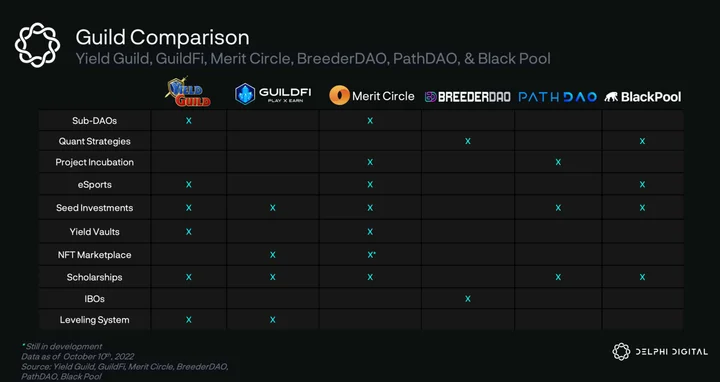
Guilds share some common fundamental characteristics. In a practical sense, a guild is a group of individuals formed around shared interests, values, and goals, for the mutual benefit of members. In the context of crypto gaming guilds, gaming is obviously their focal point. How they differ is in the specific features and strategies they employ — some of which are outlined in the table above.
The most commonly shared characteristic is scholarships, with the exception of BreederDAO all the mentioned guilds offer this. This makes sense given the focus crypto gaming guilds have had on play-to-earn and the scholarship model historically. However, this is slowly changing and we are likely to see a gradual shift away from these offerings from guilds. Another strategy common to most guilds is seed investing. Interestingly, guilds have increasingly become pseudo-venture firms, investing in early stage gaming projects to help support the sector and of course make a profit.
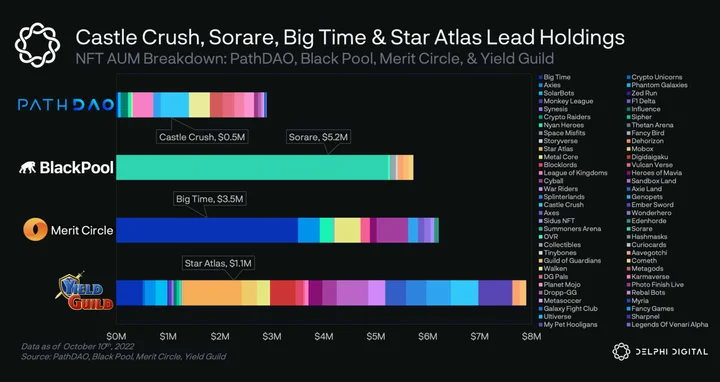 Comparing current guild NFT AUM (chart above) with that of almost a year ago (chart below), we can make a few interesting observations. None more obvious than the fact that both BlackPool and Yield Guild are — to put it bluntly — down bad. The NFT portfolios of both guilds have taken a beating since we last covered them in the below chart, taken from our previous report Dawn Of The Guilds.
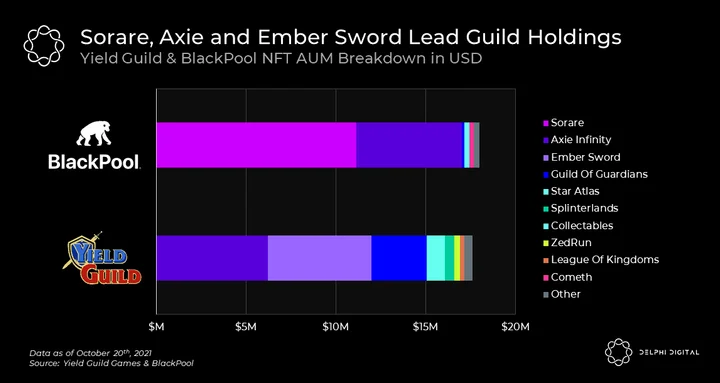
This is unsurprising given the state of the NFT market and markets more broadly this year, in the face of a persistently grim macro backdrop. Another observation we can make is the change in portfolio weightings of the two guilds. Most notably, the small presence of Axie Infinity in both portfolios in comparison to last year. Although not completely absent, Axie has gone from being BlackPool’s second-largest holding and Yield Guild’s largest to making up a relatively insignificant share of each portfolio.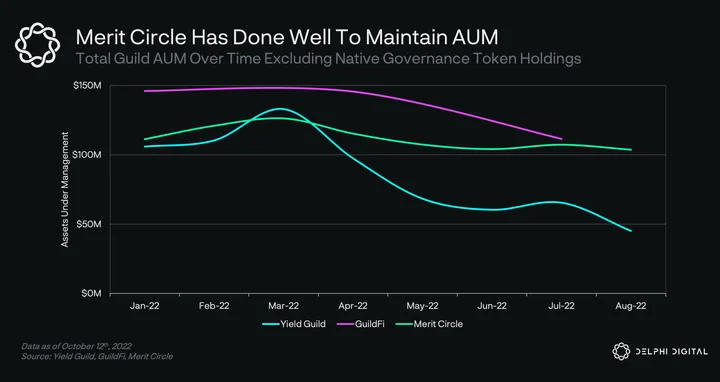
Total AUM has universally taken a hit this year, with Yield Guild, GuildFi, and Merit Circle down -57.3%, -23.6%, and -7.5% respectively. Merit Circle has maint
Read the full report
This report is part of Delphi Pro.
- 800+ Pro reports across every major sector
- Talk directly with our analysts
- Private community of funds and builders
Already a Pro member? Log in
0 Comments