Introduction
The Ethereum Layer-2 (L2) wars are rapidly intensifying.
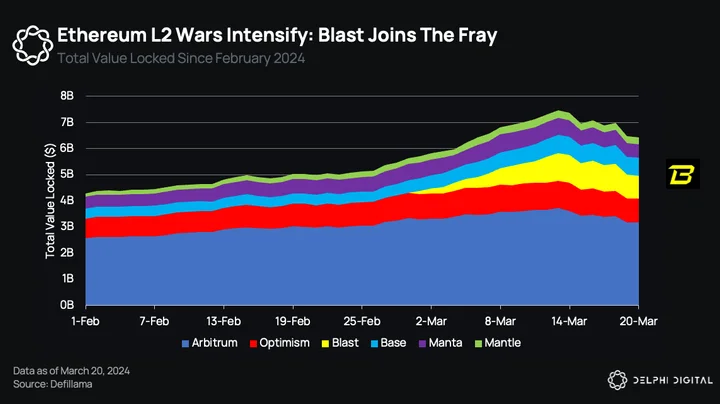
Optimism, Arbitrum, Base, Mantle, and Manta are just some of the popular L2s today. Not to mention a whole host of alternate L1s like Solana, Aptos, Sui, and Polygon competing for developer and user attention. Are we doomed for liquidity to fragment into a million different pieces, limiting the promise of on-chain capital efficiency and composability?
Probably not.
The adoption of L2s is likely to follow a power law distribution driven by network effects, where an increase in users and liquidity leads to further growth. This cycle is fueled by the expanding variety of activities available to blockchain users, making the platform more attractive to new participants. The key to success in this competitive landscape will be an L2’s ability to master user distribution.
While it is still early to tell, Blast could be a real contender in the L2 space. Pacman, the founder of Blast, has demonstrated a keen strategic understanding of the crypto metagame, evidenced by his previous success with Blur, the NFT marketplace that overtook Opensea’s dominant lead. Creative strategies, such as a multi-level marketing (MLM)-inspired referral program tailored for crypto enthusiasts to deposit their ETH into Blast, alongside engaging ‘Spin for points’ features reminiscent of lootbox mechanics, were key components of its approach.
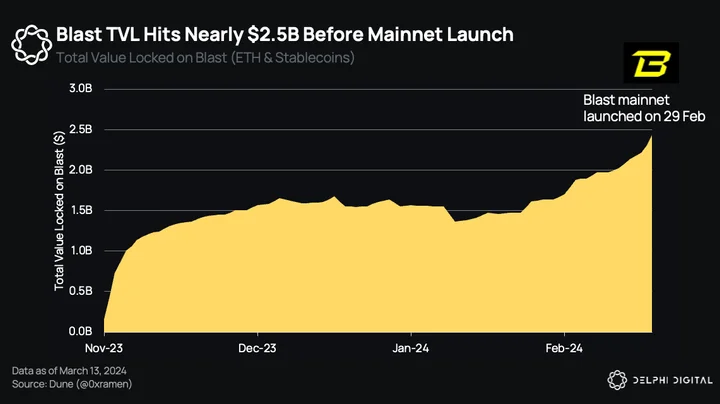
The effectiveness of these strategies is underscored by securing over $2 billion of locked deposits in a multi-signature wallet — Crypto Twitter seethed over the audacity of this — prior to mainnet launch. This sparked considerable controversy and discussion within the community.
The anticipated BLAST token launch in May is expected to generate significant interest and contribute to the platform’s momentum.
Blast in a Nutshell
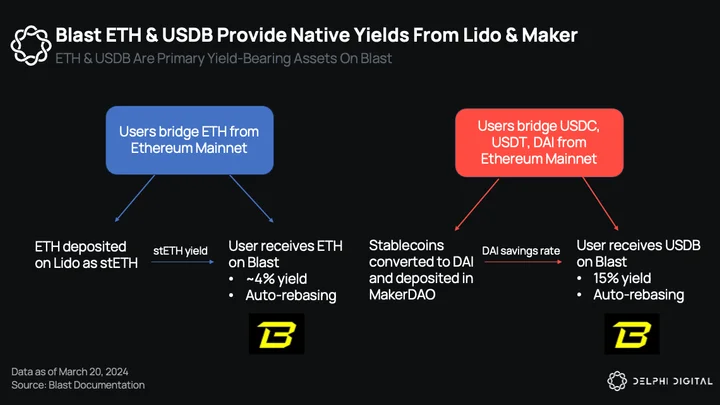
Blast offers native yields on ETH and stablecoins, unlike other L2 platforms that offer 0% default interest rates on native assets. Blast provides a ~4% yield for ETH and 15% for stablecoins directly to its users.
Developed from the ground up to integrate these yields natively, Blast features an EVM-compatible, Optimistic rollup architecture. Native yields can enable new business models for decentralized applications that are not feasible on other L2s.
The key unique features of Blast include:
- Auto Rebasing: Native rebasing for both ETH and Blast’s native stablecoin, USDB, for end-users and smart contracts, with smart contracts having the option to opt-in or opt-out. ETH balances are updated approximately daily.
- Staking Yield for Blast ETH: Direct transfer of Ethereum L1 staking yields to users on L2, with potential for future community-led integration of native or third-party solutions. Practically, all of the ETH that is locked in the Blast bridge contract on Ethereum Mainnet is converted into yield-generating stETH and passed on to the users on Blast.
- Staking Yield for Blast Stablecoins: Stablecoins like USDC and USDT which are bridged to Blast (as USDB) are converted to DAI. The DAI gets deposited to MakerDAO, earning a 15% APR from its stablecoin program.
- Gas Revenue Sharing: Sharing of net gas revenue with dApp developers, allowing them to retain revenue or subsidize user gas fees. Existing L2s like Optimism and Arbitrum keep sequencer fees for themselves. Blast redirects sequencer fees to the dapps that induced them, allowing smart contract developers to have an additional source of revenue. We saw a similar economic mechanism with Canto.
Blast has stated that in the future, the Blast community will have the power to supplement, or even fully replace, @LidoFinance or @MakerDAO with other native solutions or other third-party protocols.
Estimating Blast’s Valuation
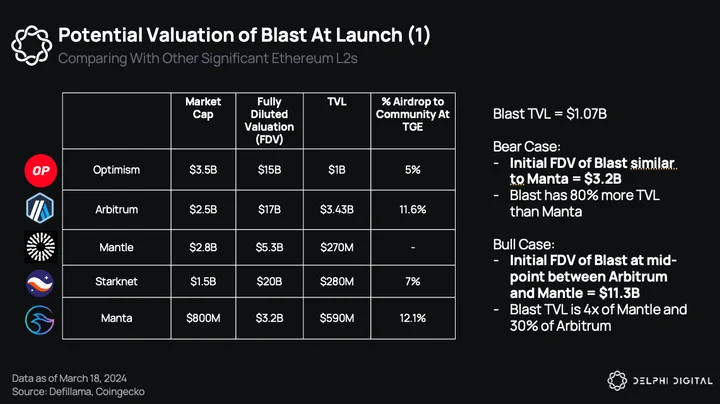
In this section, we estimate a range of potential valuations for Blast upon its token launch in May 2024. This aims to provide insights into the magnitude of the opportunity that lies ahead.
To approach this valuation, we draw comparisons with existing Ethereum L2s. Optimism and Arbitrum lead the pack today with circulating market caps of $3.5B and $2.5B, respectively. Comparing Total Value Locked (TVL) offers a broad brushstroke indicator of user engagement and capital attraction.
For a conservative or “floor” scenario, we posit that Blast’s Fully Diluted Valuation (FDV) at launch could align with that of Manta, which stands at $3.2 billion. Notably, Manta has only 60% of Blast’s TVL and lesser mindshare, so it is likely that Blast’s FDV will be significantly higher. Manta emulated Blast’s market entry strategy with its New Paradigm farming program and launched its token earlier this year.
In a more optimistic outlook, we believe Blast’s FDV could be nestled between that of Arbitrum and Mantle, suggesting a potential valuation of around $11 billion (averaged). This scenario anticipates a substantial market reception and investor interest in Blast, given its association with Pacman, one of the strongest founders in the space.
One caveat: The utility of FDV as a valuation metric is somewhat contentious, given its dependency on tokenomics, which, in Blast’s case, remains under wraps. The actual potential will significantly hinge on these yet-to-be-revealed details.
BLAST Airdrop Calculations
It is interesting to model how much users could get from the Blast airdrop.
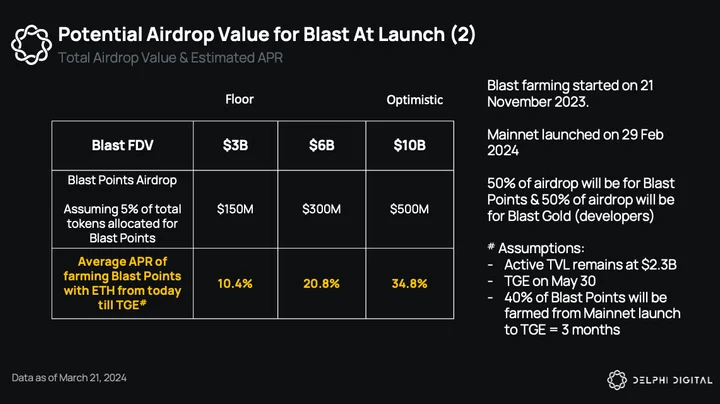
Let’s assume:
- 10% of tokens will be airdropped at TGE via Blast Points & Blast Gold, which would be similar to Arbitrum and Manta’s initial airdrop. Since this will be split 50:50 between Blast Points and Blast gold, 5% of tokens will be allocated for Blast Points in this case.
- Blast points farming started in late November (~3 months before mainnet launch) at a TVL of $2B+. A portion of this TVL subsequently transitioned back to Ethereum mainnet after the unlocking of ETH. Let’s assume 40% of Blast points are to be farmed after mainnet launch on 29 Feb.
- If TGE happens on 30 May, there will be three months of farming after the mainnet launch.
- There is ~$2.3B in ETH and Stablecoins in wallets & protocols combined, earning Blast points.
Based on various potential FDVs of Blast, we can expect an average APR of 10 – 34% from Blast Points alone for someone who just holds his ETH on Blast L2. This is in addition to the
Read the full report
This report is part of Delphi Pro.
- 800+ Pro reports across every major sector
- Talk directly with our analysts
- Private community of funds and builders
Already a Pro member? Log in


0 Comments