If the ETF Era Made Bitcoin Investable, the 401(k) Era Could Make It Unavoidable
NOV 18, 2025 • 22 Min Read
President Trump’s August 2025 Executive Order directing the Department of Labor (DOL) to expand 401(k) access to alternative assets could reshape Bitcoin’s demand structure more profoundly than ETFs ever did.
By allowing crypto exposure inside retirement plans, the policy effectively links Bitcoin to $9 trillion in long-term savings that buy every pay cycle regardless of market sentiment. Unlike ETF flows which may be highly sensitive to price action and investor sentiment, 401(k) contributions are programmatic, recurring and rarely sold.
Even a modest 0.5% allocation would nearly double total spot BTC ETF assets, but more importantly it would introduce a steady, automatic bid that doesn’t exit in downturns.
What the 401(k) Executive Order Does and Why It Matters

In August 2025, President Trump signed an Executive Order (EO) directing the Department of Labor (DOL) to expand permissible 401(k) investment options to include alternative assets such as private credit, real estate and digital assets like Bitcoin. This marked the first explicit federal action to integrate crypto exposure within the U.S. retirement system.
The order instructs the DOL to revise fiduciary guidelines that previously discouraged crypto investments in employer-sponsored plans. While the EO doesn’t force inclusion, it removes the regulatory chill that kept plan sponsors from offering crypto products, even indirectly. The result is a green light for asset managers and recordkeepers (Fidelity, Vanguard, Schwab, Empower) to incorporate Bitcoin ETFs and related funds within plan menus or brokerage windows.
Why this matters is scale.
As of September 2025 the U.S. 401(k) system held approximately $9.3 trillion in assets (out of about $43.4 trillion in total U.S. retirement assets). If annual contributions approached the low-to-mid hundreds of billions of dollars, even minor shifts in allocation – fractions of a percent – represent material inflows to a relatively small asset class like Bitcoin.

With automatic enrollment now present in roughly 60% of all 401(k) plans (and nearly 80% among large employers), most participants contribute on autopilot via steady, recurring flows. In essence, the EO turns the world’s largest retirement system into a national-scale DCA machine, programmed to buy Bitcoin every pay cycle regardless of price.
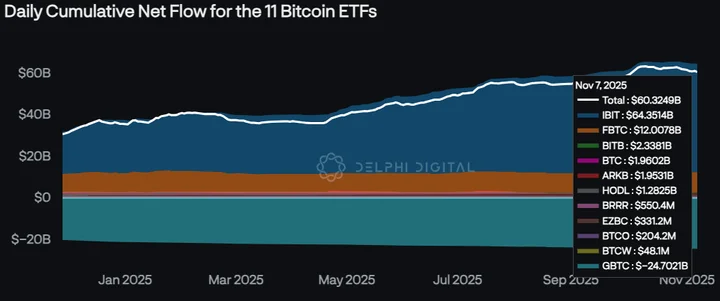
For perspective, total assets in all U.S. spot BTC ETFs as of November 7th hover around $60 billion, meaning that even a 0.5% allocation from 401(k)s would nearly double that figure overnight.
Plan Design and Access Points
Every 401(k) plan is built around a lineup of funds – typically target-date funds (TDFs), mutual funds, or collective investment trusts (CITs). Employees select allocations during enrollment or default into a TDF. Once a fund is available, contributions flow in automatically through payroll.
This structure is crucial: once crypto funds are added to that lineup (either directly as ETFs or via TDF sleeves), Bitcoin becomes a recurring line item in paycheck deductions.
Fidelity, Schwab, Empower, and Principal dominate this system. Together, they manage roughly 80% of 401(k) assets and already have crypto ETF infrastructure in place. The Executive Order removes the regulatory friction that stopped them from integrating Bitcoin ETFs into plans. Once the Department of Labor issues its updated fiduciary guidance, these recordkeepers can:
- Add spot BTC ETFs through brokerage windows (a feature already offered by 40% of plans).
- Create CIT wrappers that blend Bitcoin exposure into diversified products.
- Integrate crypto options within managed accounts or “inflation hedge” portfolios.
How Bitcoin Exposure Enters the System
Each of these pathways automatically channels recurring payroll contributions into BTC-linked vehicles. But the decision to buy Bitcoin doesn’t come from the 401(k) system itself. Rather, it depends on how these access points are structured and who controls allocation decisions inside each.
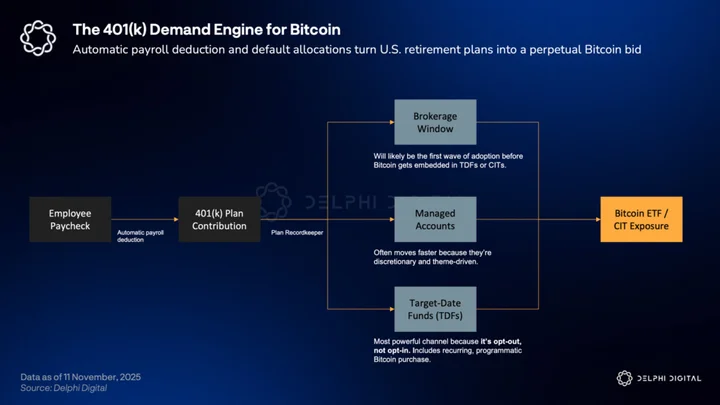
Once Bitcoin ETFs or CITs are integrated into plan menus, payroll contributions can reach Bitcoin exposure through three distinct access points: Target-date funds, Managed Accounts or Brokerage Windows. Each pathway determines who makes the allocation decision and how automatic the flow becomes.
- Target-Date Funds (TDFs)
These are the default option for most workers, capturing the majority of new contributions through automatic enrollment. If a TDF includes even a small Bitcoin sleeve (for example, a 0.5-1% allocation), every participant in that fund gain
Read the full report
This report is part of Delphi Pro.
- 800+ Pro reports across every major sector
- Talk directly with our analysts
- Private community of funds and builders
Already a Pro member? Log in
0 Comments