
Report Summary
Intuition Protocol proposes a decentralized trust layer for the internet, addressing the core problem of how information is discovered, validated, and shared. Unlike Web2 platforms that centralize discovery and prediction markets that reduce nuance to binary outcomes, Intuition introduces Token Curated Graphs powered by Atoms (unique data identifiers) and Triples (relationships between them).
By aligning economic incentives, social capital, and portable data structures, Intuition transforms knowledge into an asset class, enabling individuals, communities, and AI agents to interact with information that is verifiable, composable, and owned by users. With strong early traction and a successful beta test, Intuition is positioned to become the definitive hub for decentralized discovery and reputation.
Key Takeaways
1. The Internet’s Trust Problem
-
Current Web2 platforms (Google, Reddit, Amazon, etc.) centralize control, shaping discovery and truth.
-
AI-driven search will intensify this centralization, flattening perspectives into a single “truth.”
-
Crypto has solved trustless settlement (DeFi, NFTs) but not decentralized discovery.
2. Beyond Prediction Markets
-
Prediction markets like Polymarket incentivize truth-finding but reduce complex issues into binary outcomes.
-
Intuition introduces multi-contextual information markets, allowing communities to signal nuanced truths.
-
TRUST tokens replace binary bets with degrees of confidence and context, enabling multiple perspectives to coexist.
3. Core Data Primitives
-
Atoms → Unique identifiers for data (people, concepts, ideas), forming the building blocks of a universal data standard.
-
Triples → Relationships between Atoms (subject-predicate-object), capturing both truth and relevance.
-
Together, they form a Token Curated Graph, a decentralized, semantic knowledge base.
4. Signal Economics
-
TRUST tokens staked on Atoms and Triples determine their relevance and credibility.
-
Bonding curves incentivize continuous curation and ranking.
-
Users earn fractional ownership (“equity stakes”) in the data they contribute or signal on.
5. Incentives & Reputation
-
Users earn from data they contribute, building knowledge portfolios.
-
Developers benefit from holding TRUST, aligning their incentives with protocol success.
-
Trust circles create contextual reputation systems, portable across apps.
-
AI agents can use Intuition’s graph to establish provenance and credibility in their interactions.
6. Developer & User Experience
-
Developers avoid reinventing databases/authentication → can build directly on a shared, composable data layer.
-
Users gain data sovereignty: portable identity, preferences, and social graphs across platforms.
-
Discovery shifts from siloed apps to a fluid, interoperable ecosystem.
7. Early Traction
-
Beta on Base Mainnet: 244K participants, 5.3M transactions, 5.1M+ attestations.
-
Demonstrates real demand for portable reputation and knowledge curation.
-
Preparing for mainnet with audits, data migration, and scaling tests.
Conclusion
Intuition aims to finish what crypto started: moving beyond “trustless” money rails to trustful discovery systems. By making trust visible, measurable, and tradable, Intuition turns information itself into an asset class.
If successful, Intuition could redefine the internet’s foundation — shifting from centralized platforms and opaque AI black boxes to an open, verifiable trust layer where people, communities, and AI agents navigate knowledge that is transparent, composable, and truly owned by its creators.
-
Introduction
The internet has a trust problem. Right now, our digital lives and information landscape are fragmented across dozens of platforms. Each of these platforms is holding pieces of our identity hostage.
Google decides what you discover. Reddit curates what you see. Amazon controls what you buy. These giants operate as walled gardens, each with its own data and its own biases. They trap you in their echo chambers while algorithms, acting as black boxes, decide your reality. We can’t simply plug a different algorithm into Twitter or switch to someone else’s feed.
But here’s what’s worse: we’re heading straight into an AI-dominated future where people will increasingly rely on a single prompt to get their so-called “truth.” By 2028, it’s estimated that AI-driven search will surpass traditional search entirely. When that happens, the “truth” becomes whatever a handful of models decide to surface, determined by algorithms and controlled by centralized companies.
In other words: your worldview will be shaped by corporate interests. And the irony? We’ve been busy decentralizing the “rails” of transactions, perfecting how we move money and assets without bureaucracy. DeFi protocols handle billions in volume. NFT marketplaces operate across chains. Global programmable settlement works flawlessly. Yet we’ve largely ignored the other half of the equation: Decentralizing how we discover what we want to consume.
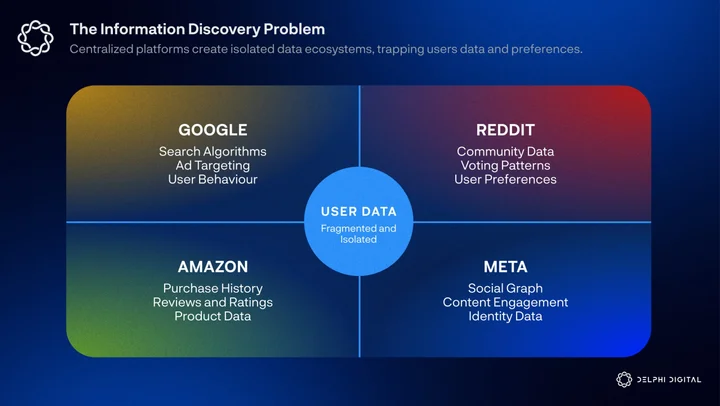
The internet’s hardest problem isn’t settlement, but rather judgment. Which claims should we believe? Which identities should we weigh? Which relationships should we trust? Even the most “trustless” systems still rest on human judgment and social consensus.
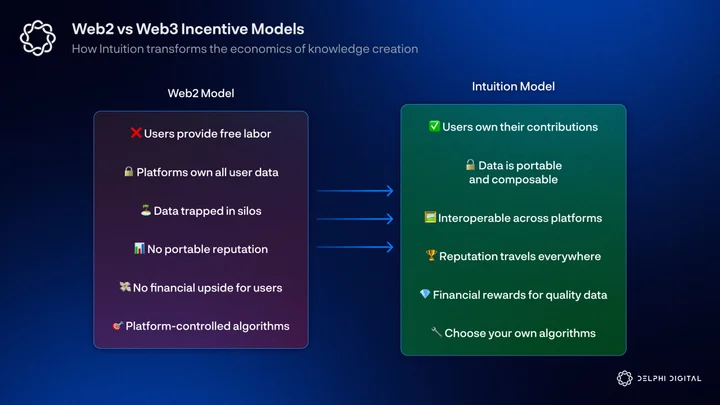
To finish what crypto started, we must decentralize discovery itself. The way information is surfaced, structured, and evaluated across the web needs the same treatment we gave to money. That is the gap Intuition Protocol is designed to close: a public, portable, and composable trust layer for interoperable knowledge and reputation. The contrast between the current Web2 models and what Intuition enables couldn’t be starker.
The Rise of Prediction Markets
The rise of prediction markets like Polymarket marked a new paradigm. These markets showed us the power of “information markets” by incentivizing people to converge on a single, binary truth. Take last year’s political scene: hundreds of millions of dollars flowed into markets to predict the presidential election winner. Prices updated in real-time as new information emerged. But the real world isn’t binary. It’s filled with nuance and complexity. Not to mention context and competing perspectives. Different communities often hold different versions of the “truth.”
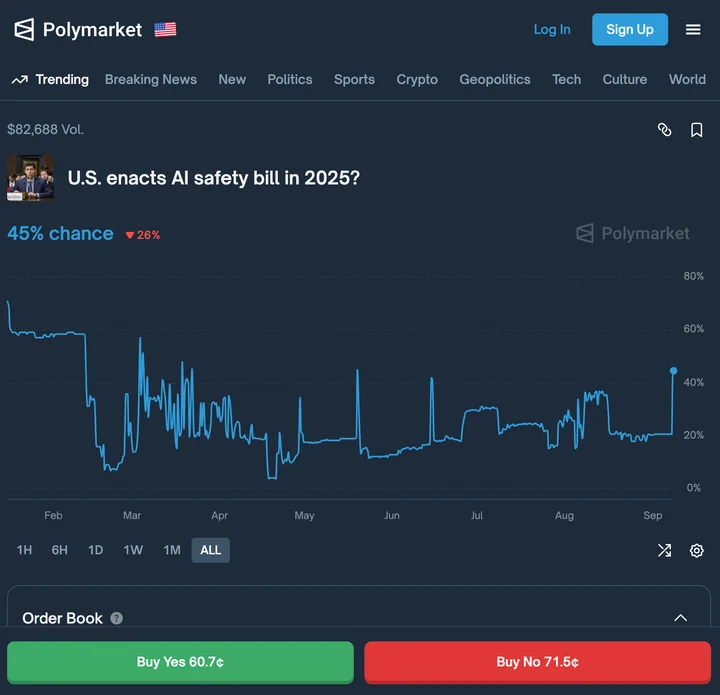
Consider the recent talk around AI safety regulations. A simple yes/no prediction market spun up around the question “Will the U.S. enact an AI safety bill in 2025?”
Sure, that’s straightforward, but it skips over all the real meat of the issue. Tech entrepreneurs are laser-focused on how regulations might stifle innovation. Ethicists are sweating the risks of AI going off the rails without proper alignment. Regulators? They’re grinding over how to actually enforce any of this without breaking the system. Each side needs its own lens to make sense of the same big question, and forcing it into a yes/no box loses that depth.
Why does this nuance matter? Because flattening complex issues into binary choices strips away the very context that makes information useful. When you force multifaceted problems into binary boxes, you lose the ability to capture why different communities reach different conclusions based on values and expertise. You end up with a “winner” on the bet, but no real understanding of why different groups landed where they did based on their values, expertise, or even biases. That’s where prediction markets fall short: they’re great at converging on one truth, but they don’t map out the full landscape of truths that coexist.
To drive this home, let’s look at how information markets play out in practice. On a site like Polymarket, users simply buy shares on binary questions like “Will the US enact an AI safety bill in 2025?” It’s straightforward but limiting. Compare this with Intuition. Instead of just buying shares, users stake TRUST tokens (Intuition’s native currency that powers the entire protocol) on what they believe is most relevant and accurate. Intuition’s process introduces nuance that prediction markets can’t handle. Users can express degrees of confidence and context rather than just picking a side. Continuous trading takes place as new information emerges. However, unlike Polymarket’s binary resolution, multiple perspectives can coexist and be rewarded.
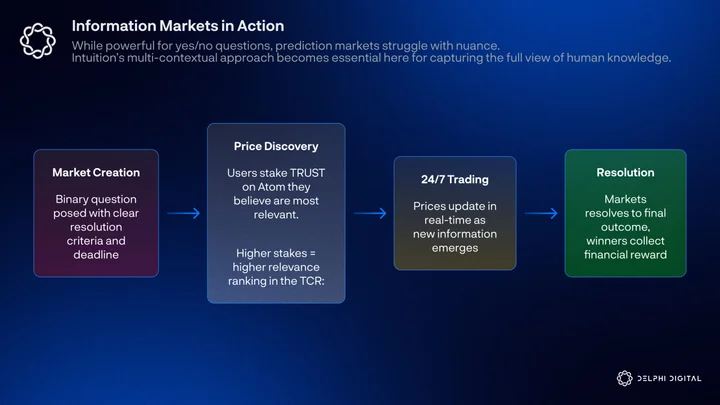
Polymarket’s approach creates a clean loop that rewards accuracy. However, notice how it’s all geared towards that yes/no binary resolution. For us in crypto, this shows the power of economic incentives in truth-finding, but it also highlights the limits. This is precisely why we need protocols like Intuition that can handle multiple contextual realities, systems that let different communities curate their own perspective.
This shift from binary to multi-contextual thinking represents a fundamental evolution in how we handle information markets. The comparison becomes even clearer when you look at the state of the information scene, comparing Web2 platforms, prediction markets, and the Intuition Protocol across key features. Web2 obviously doesn’t portray any confidence in decentralization, but it also fails to handle nuance or multiple perspectives. It’s all centralized control. Prediction markets have some incentives and decentralization, but they still struggle with portable data and community usage. Enter Intuition: It nails nuance and multiple viewpoints, keeps the incentives but makes them work for decentralized, portable data, and even builds in community governance. As a crypto user, one can think of this as an upgrade. Taking what prediction markets do well and layering on the composability we love from DeFi, so you can actually build and trade on contextual truths, not just flip a coin on binaries. The Intuition Protocol is built on the belief that we need to move beyond simple “trustlessness” to create a foundation for “trustful interactions.”
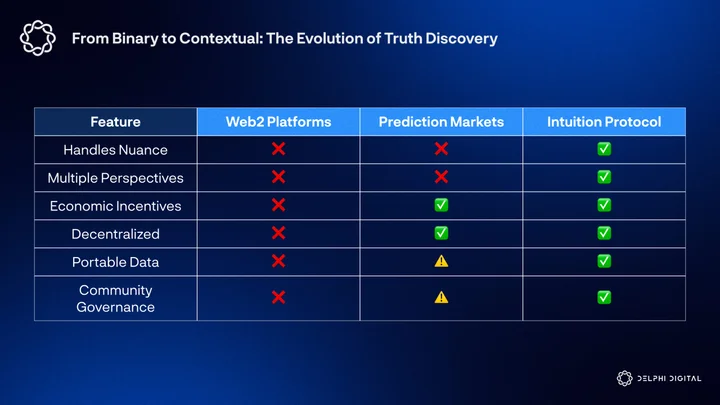
A Shift from Prediction to Proof
The concept of a Token Curated Registry (TCR) is central to this. For years, crypto has used game-theoretic mechanisms to achieve consensus on the state of a ledger, making networks like Ethereum secure and reliable. These same mechanisms can be applied to the very structure of our information.
Similarly, game theory can be applied to the very structure of our information. By using a decentralized consensus model, we can converge canonical, decentralized identifiers for everything – from people and places to abstract concepts. The core idea? Applying the game theory of L1 blockchains to information discovery.
A universal standard for data is created that is economically incentivized, not centrally mandated. Just as the ERC-20 standard enabled a whole new token ecosystem by giving developers a common token standard, Intuition aims to create a universal data standard. This makes information truly composable and interoperable.
The above approach connects directly with Web3’s superpower: composability. By creating a standard for the “state of the state,” the way data is structured on top of the ledger, Intuition enables a fluid, frictionless ecosystem. Here, developers can build new apps without having to start from scratch. They can also choose to adopt a standard or create a new one, all while being economically incentivized to converge on the most useful and widely available data structures.
Intuition – The Trust Machine
At its heart, Intuition functions as a foundational layer for the internet, a structured and interlinked network of the world’s data. Think of it as a decentralized social and knowledge graph. The collective wisdom of the crowd is used to build a verifiable, open, and permissionless system.
This vision takes inspiration from Tim Berners-Lee’s idea of a “Semantic Web,” but reimagined for Web3, where data is not just linked but also owned and valued by its creators. Intuition does this by turning information into an asset class, where discrete pieces of data can be owned and monetized — a crucial distinction from older approaches that bundled data together and sold it in bulk. Intuition allows for the explicit ownership of individual pieces of data within the larger graph. The system is based on two core primitives: Atoms and Triples.
Atoms
Atoms are the most fundamental unit of knowledge in the Intuition system. They are discrete, uniquely identifiable data units. These can be either a word, a concept, or a complex piece of information. Their purpose is to create a consensus around a unique, globally persistent, decentralized identifier (DID) for all things.
For example, imagine a single, canonical DID for the concept of “Ethereum.” This identifier would be decided by the market, much like how the market decides which contract address is the “real” $PEPE. It allows for the world’s data to be linked up and associated across any platform using a single identifier. Since DID creation is permissionless, the system provides a way for people to converge on a standard.
An Atom is not just an identifier, but also a referenceable unit of data. It has a DID and some associated information that provides context. The uniqueness of an Atom is enforced by a hash of this underlying data.
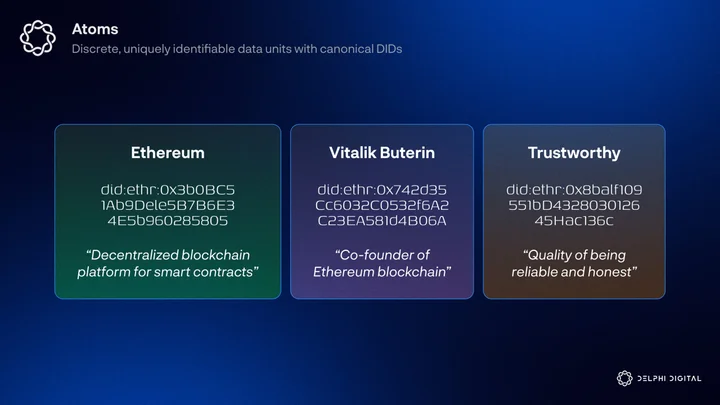
By taking any piece of data and assigning it a DID, Intuition allows us to:
- Reference data universally across the web
- Grant users “equity” in that data as they signal its relevance
- Reward users for their contributions
The framework is best described as a “Token Curated Graph.” On top of this graph, you can build any number of Token Curated Registries (TCRs). The Atom TCR, for example, ranks Atoms based on relevance, which is signaled by user engagement and total value locked (TVL) on that Atom. As users interact more with a particular Atom, it rises in relevance, much like a trending Reddit post.
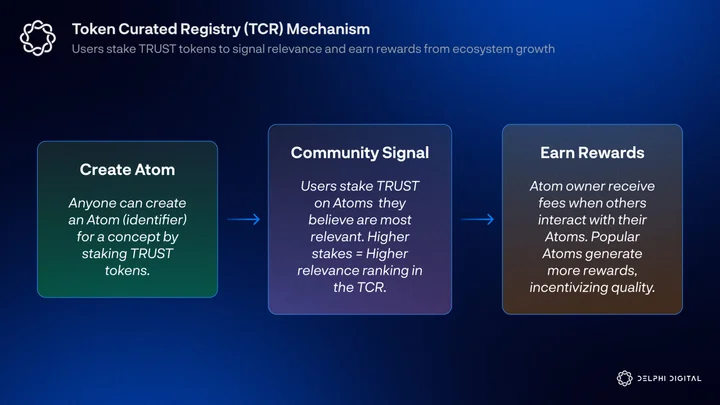
The mechanism facilitates convergence on the most valuable and widely accepted Atoms for a given concept, ensuring that developers and users can easily find the canonical identifier for anything they need.
Triples
With Atoms established as the building blocks, Intuition uses Triples to define the relationships between them. A Triple is a semantic statement structured in the form of a Subject-Predicate-Object. Each of these three elements is an Atom. For example, a Triple could be:
[The New York Times][is][a reliable news source]
This structure allows for complex, fractal data representations, where a Triple can itself be an Atom in a more complex statement, allowing for the expression of nuance and subjectivity.
Triples are also where the “truth” of a statement is signaled. Users can engage with a Triple to signal its relevance and its veracity, similar to how communities on Reddit upvote or downvote content.
The key distinction here is that Triples can also signal relevance in addition to being true or false. Something can be true but irrelevant, which would lead to less economic interest and therefore less signaling. An economically incentivized system is created for curating and validating information.
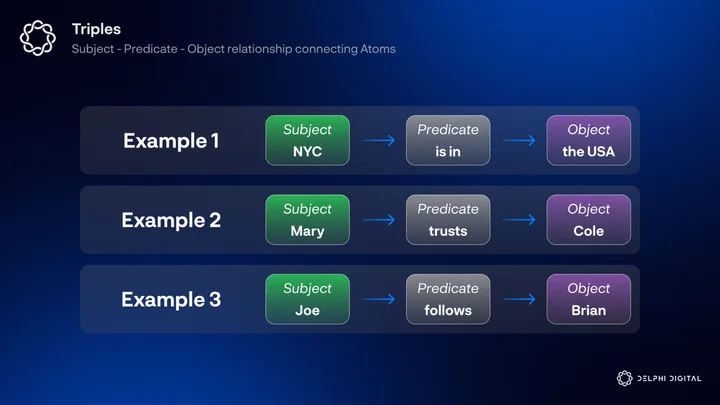
Think of Triples as more than just statements about data. They can also be owned, just like Atoms. Whenever you interact with a Triple, you gain a stake in it and receive a portion of the fees generated by future interactions. This makes Triples behave like living assets.
The setup also creates an incentive for people to propose and back common ways of structuring data for things like a “Follow,” “Like,” or “Tag” feature. Instead of launching a new protocol every time, developers can rally around a shared structure. The result? Features work seamlessly across apps without anyone needing to start from scratch.
Token Curated Graph
By combining Atoms and Triples, Intuition creates a Token Curated Graph upon which a decentralized, semantic, and highly flexible knowledge base can be built. The system is a collection of interconnected pieces of information, with the collective wisdom of the crowd. The TCR helps establish both the relevance of concepts and the credibility of relationships between them. It embraces subjectivity to establish a true web of trust. In doing so, it moves beyond a single, imposed reality and allows for a richer, more nuanced digital experience.
Signal Economics
With Atoms and Triples as the foundation for a new semantic web, the next logical question is: how does the system know which Atoms are the most important or which Triples are true? Intuition’s “signal economics” comes into play here. It is a novel application of game theory and crypto-economic incentives designed to curate and rank the world’s information. It’s the engine that drives the entire protocol.
At the heart of this system are bonding curves, familiar to anyone in crypto. These are economic models used to signal the value of an asset. In Intuition, bonding curves are applied to both Atoms and Triples, but for different purposes. For an Atom, a bonding curve is used to signal its relevance. The more people lock up native TRUST tokens on a specific Atom, the higher the Atom’s relevance.
A continuous feedback loop is formed: as an Atom becomes more relevant, it attracts more TRUST, which in turn increases its relevance. This is how the system achieves consensus on the canonical identifier for a concept. The Atom holding the most TRUST is collectively considered the most relevant.
For Triples, the mechanism is a bit different. Here, the bonding curve signals both the Triple’s relevance and its truth value. Users can signal whether a statement is true or false by locking up TRUST on a specific side of the Triple. This acts as a prediction market for data, where participants are betting on the validity of a semantic statement. It’s a powerful mode because it allows for a nuanced, community-driven approach to truth. When the market resolves, correct predictors receive proportional rewards from the losing side’s stakes. A Triple can be factually correct but completely irrelevant, which would be reflected in the amount of TRUST looked up on it.
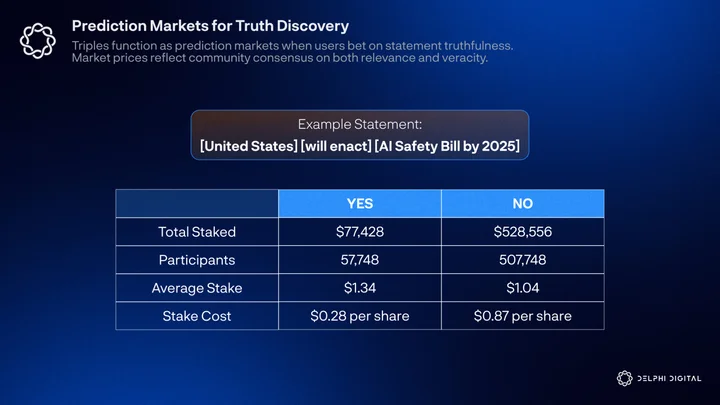
The system is closer to the game-theoretic consensus of Layer 1 blockchains than to a simple DeFi protocol. It’s about using economic incentives to arrive at a shared understanding of a piece of data.
Interactions within this system (creating Atoms, signaling on Triples) involve fees, much like Ethereum’s gas fees. A portion of these fees is automatically funneled back to the creators of the data, creating a continuous, real-time value flow to those who contribute. The design choice creates a powerful incentive for quality contributions at scale.
The entire framework culminates in the concept of TCRs for both Atoms and Triples. An Atom TCR is a ranked list of Atoms, ordered by relevance (or Total Value Locked). You might find it similar to the trending tab on Reddit, where popular content rises to the top based on user engagement. The Atom TCR provides a clear, decentralized way to discover the most relevant and widely accepted identifiers.
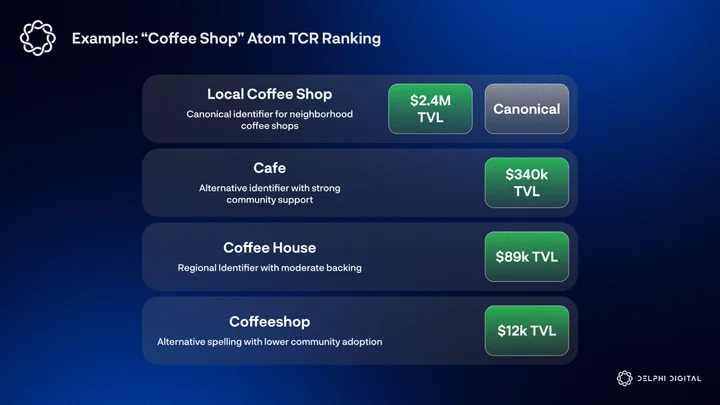
Similarly, a Triple TCR ranks Triples based on their signaled relevance and truth. Users and applications can easily identify the most credible statements within the network.
Underpinning everything is a network architecture that can handle the complex flow of information. The protocol uses a Directed Acyclic Graph (DAG) structure to represent the interconnected relationships of Atoms and Triples. An indexer, acting as a unified API for the graph, organizes this data. It pulls in both on-chain and off-chain information (like from IPFS). In addition, developers and users can build their own filters and algorithms to query the graph. They can then create their own personalized “reality tunnels,” or as we’ll discuss later, their own unique perspective on the data.
The Role of Incentives in Building Trust Networks
Think about the last time you left a review on Amazon or tried to help someone navigate a crypto project. Chances are, you didn’t get paid for it. You probably didn’t even build lasting reputation capital that you could use elsewhere. That’s the problem Intuition is solving. Right now, contributing valuable information to the internet is essentially charity work.
Intuition flips this dynamic completely. Every time you interact with data – whether you’re creating an Atom, signaling on a Triple, or just engaging with existing information – you earn fractional ownership in that piece of knowledge. Think of it as a small equity stake in a concept or a statement. As that data becomes more valuable, and as more people use and signal on it, the value of your ownership stake appreciates, giving motivation for users to contribute and curate valuable data. Users are not just contributing to a public good, but also building a personal portfolio of information assets.
Such a financial model is especially powerful for developers. It’s radically different from the traditional Web2 model, where developers pay a centralized company a subscription fee to access data. Instead, developers building on Intuition buy the native TRUST token upfront based on the expected usage volume. These tokens aren’t consumed like gas fees, they function more like collateral that enables interactions.
The real shift happens with token delegation. Developers delegate these tokens directly to their user base. Users never have to buy anything or deal with the wallet friction of purchasing TRUST themselves, in order to interact with applications.
What makes this model brilliant is that developers become genuine stakeholders in Intuition’s success. SaaS companies charge you more as your usage grows. Basically, your success becomes their profit center. With Intuition, developers who buy TRUST tokens early and help drive valuable data creation see their holdings appreciate. The protocol’s growth directly enriches the developers building on it.
This alignment changes everything about how devs approach their users. Instead of viewing users as monthly recurring revenue sources to extract from, developers are now motivated to help users generate the most valuable, widely adopted data possible. Every quality contribution from their user base strengthens the entire network and increases the value of the developer’s TRUST holdings.
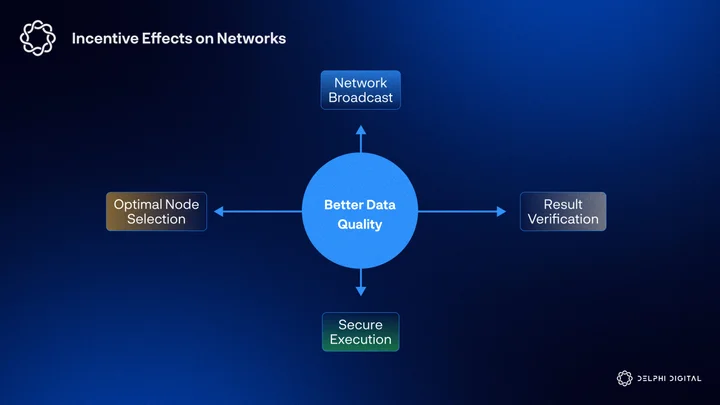
But incentives in Intuition are not just financial, there is also a powerful “soft” layer of incentives centered on identity and social capital. As you contribute to the network, your identity becomes connected to the information you curate. “Trust circles” are formed, which are essentially contextual reputational systems. You can create a filter that shows you what people you trust have signaled on. This creates a valuable layer of social capital and reputation. It acts as an additional motivator for high-quality contributions.
The combination of hard and soft incentives has a massive ripple effect. It makes the developer experience better by providing a communal database to build on, abstracting away the need for a developer to create their own database, schema, and authentication system. It also makes the user experience better by giving them sovereign, portable data. A user’s interests, filters, preferences, and social graphs can move seamlessly from one application to another. No more rebuilding your profile every time you try a new platform. Your digital identity and connections move with you. The switching costs decrease, resulting in a more fluid, real-life-like experience on the internet.
And this doesn’t just stop with people. As AI agents become more common online, they’ll need a way to establish trust, prove their history, and interact with each other in reliable ways. Intuition’s structured data and reputation systems provide that foundation. By giving agents a decentralized record of their interactions, the protocol allows future AI-driven apps to work not just with raw information, but with context and credibility built in. It’s an early step towards the “agentic web” and Intuition has the right pieces in place to help make that shift possible.
TRUST
Everything within Intuition runs on the TRUST token. Without it, nothing moves. But unlike standard transactional tokens, TRUST has a more meaningful role. It ties directly into the system of signaling, making sure information is both relevant and credible.
Why does it matter? In an open protocol where anyone can add data, you need to keep the noise out. Otherwise, the network would be spammed with low quality entries. To create a new Atom, add a Triple, or signal on existing data, you must stake beforehand. That small cost ensures that only those with real conviction participate. But the design doesn’t just financially incentivize high-quality entries. The design also rewards valuable data, resulting in a dual mechanism to deter spam.
The real power of TRUST shows up in how it shapes consensus. When users back an Atom through a token, they are basically giving that Atom an endorsement. Over time, the Atom with the most backing emerges as the accepted “identifier” for that idea. The same goes for Triples, except here the token doesn’t just measure relevance but also community sentiment. In practice, this creates a living market of ideas, where tokens act as votes backed by real economic weight.
User involvement is crucial for token success. Every network interaction generates small fees. It’s a steady drip of rewards that turns good data into something you can actually earn from. The more useful your contribution, the more often it will be engaged with, and the more rewards you earn. And because TRUST’s value ties directly to how much the network gets used, the more people build on Intuition, the stronger the token becomes. In effect, TRUST transforms knowledge itself into an asset class, something you can own a stake in.
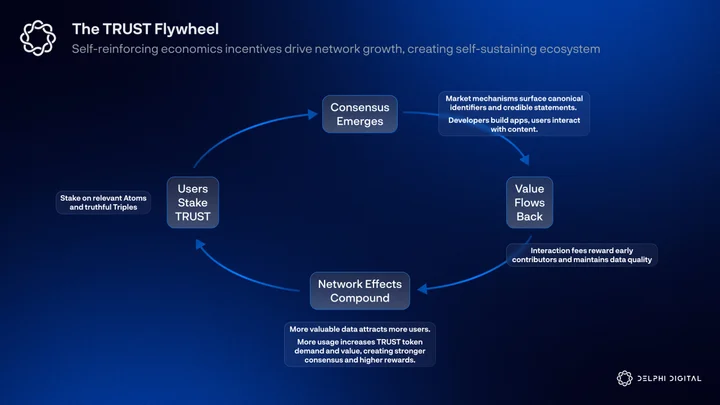
This is what makes TRUST different from “trustless” models crypto has focused on for years. Instead of removing trust from the system, Intuition makes it visible, measurable, and tradable. TRUST becomes something you can see on-chain, not just feel.
Building the Definitive Hub for Discovery
So far, we have looked at how Intuition organizes information into Atoms and Triples, how incentives align behavior, and how TRUST serves as the protocol’s lifeblood. But the question that matters most for users and developers is this: what does it feel like to actually use Intuition?
The answer lies in the application layer. Just as most people don’t think about an Internet Protocol or a Transmission Control Protocol when they open Instagram, the same applies to Intuition. The average person won’t ever need to think about Atoms or Triples. Instead, they’ll interact with simple, intuitive apps that sit on top of the protocol.
Intuition’s vision really comes alive here. We talked a lot about a Reddit-style feed in the previous sections, where you browse statements and see how communities signaled on them. Or an app where your “trust circle” shapes what information is shown first. Or even AI assistants that surface information not from one company’s siloed dataset, but from an open, verifiable graph of knowledge. These experiences feel simple, but under the surface, they are powered by Intuition’s semantic data model.
For developers, this changes the game. In the Web2 world, building an app meant several grueling steps: setting up a database, writing a schema, and handling user authentication from scratch. Intuition flips that script. Developers tap into a communal, structured knowledge graph that already handles data ownership, context, and reputation.
That lowers costs and shifts competition away from hoarding data towards building better interfaces. With lower switching costs and a shared data layer, innovation moves faster.
For users, the benefits are just as clear. Today, when you move through different apps, your preferences and social graph don’t come with you. Every platform is a reset.
With Intuition, your information doesn’t stay locked inside one app. The preferences you set, the voices you trust, and the reputation you build can move with you wherever you go online. Instead of starting over every time you join a new platform, you carry those things with you. Discovery stops feeling like opening a fresh account on a website and starts feeling like an extension of real life, where your identity and relationships are part of the journey.
This also positions Intuition strategically for the AI era. The numbers are already striking. According to Semrush, AI Overviews appeared in 13.14% of all Google searches in March 2025, up from just 6.49% in January. The full stats show a nearly 102% growth rate from January to March 2025, with 72% of the growth being in one month alone, from February to March 2025. The bottom line: instead of clicking through websites, most people will rely on AI-generated answers.
Convenient? Sure. But it concentrates power even further. If LLMs are the gatekeepers of discovery, then the “truth” becomes whatever a handful of models decide to surface, determined by the algorithms of a handful of centralized companies. Sources are often hidden, and perspectives flattened into one response. For categories like politics, health, or finance, that’s a risky concentration of influence.
Intuition offers a way out of this trap by building a new way altogether. Structured data, such as Atoms and Triples inside a public, composable graph, creates a foundation that AI systems can plug into. Instead of scraping and guessing, agents can draw from verifiable data with provenance, context, and community-driven reputation built in. Think of it like AI agents carrying “agent cards.” These are portable reputations and histories that can be discovered across platforms. Instead of a black box, you get AI discovery built on open infrastructure.
In short: Intuition is not just building a new tool for crypto users. It’s building the definitive hub for discovery on the internet, one where people, communities, and even AI can interact with information that is portable, credible, and owned by its creators.
Early Traction and Progress
All the theoretical benefits we’ve discussed might sound compelling, but what matters in crypto is whether a protocol actually works when real users start interacting with it. Intuition has already crossed that bridge. The beta testing phase on Base Mainnet just wrapped up, and the numbers tell a convincing story about genuine adoption.
The beta drew in more than 244,000 participants, who together carried out over 5.3 million transactions. Although some automated activity can never be ruled out, the nature of these interactions points toward strong organic engagement. Perhaps the clearest sign came from the 5.1 million+ attestations verified during the trial. Users weren’t simply experimenting with the system. They were putting in effort, adding knowledge, and backing the accuracy of data with their own reputational stake. Taken together, these results suggest that the incentive design is doing its job and that the community is motivated to begin shaping the semantic data structures that will drive the protocol forward.
However, the team isn’t resting on beta success. Right now, they’re pushing through the final phases before mainnet launch, including an important security audit and the data migration from the beta. This period will also include a stress test on all the systems at scale, to give developers their last chance to integrate before mainnet.
Given crypto’s track record with rushed launches, this methodical approach feels refreshing to the average crypto person. Beta testing validated user behavior and incentive mechanisms. The security audit addresses the technical risks. Data migration preserves community value. The testnet launch handles scaling challenges. By the time mainnet goes live, most of the major risks should be behind them.
For crypto natives considering whether to pay attention to Intuition, these metrics matter more than any whitepaper promises. The beta results demonstrate that real people will actually use information markets when the incentives align properly. That’s been the big question mark hanging over reputation and knowledge protocols for years.
The fact that users created millions of attestations during beta testing suggests the fundamental PMF is there. People want ownership of their data, portable reputation, and ways to monetize their knowledge. Intuition appears to have figured out how to turn those abstract desires into concrete user behaviors.
Conclusion
We’ve spent the last decade perfecting the “trustless” side of crypto by building the rails for money and assets to move without a bureaucratic middleman. But the real game-changer for the internet isn’t just about money. It’s about what we believe, who we trust, and how we find what we’re looking for. That’s the deeper problem, and it’s a problem that’s only getting worse as a few big platforms decide what’s true for everyone. And AI-powered answers threaten to narrow our worldview even more.
That’s where Intuition comes in. This protocol is the next logical step. It’s about applying the same principles that secure a blockchain (the game theory, the economic incentives) to the messy, human problem of trust and knowledge. Intuition is not just building a new tool, they’re building the definitive hub for discovery. A place where information is no longer a commodity to be hoarded, but a shared, composable resource.
Imagine a world where the reputation you build, the voices you follow, and the data you care about aren’t trapped inside a single app. With Intuition, they’re not. Your digital identity and your curated perspective become portable. You can move seamlessly from one platform to another, and everything that makes your experience yours (your social graph, your trust circles, your preferences) moves with you. This isn’t just about a better user experience, but about giving you true data sovereignty.
And for the builders among us, the game has changed. Instead of starting from zero, setting up your own databases, and reinventing the wheel, you can plug directly into a living graph of knowledge approved by the community. This lowers the cost of building by shifting the competition from who can hoard the most data to who can build the most innovative, intuitive interfaces on top of it.
This is Intuition’s big bet: moving beyond the simple “trustless” mindset to build a system of “trustful” interactions. It’s about making trust visible, measurable, and community approved. By turning knowledge into an asset, and rewarding those who contribute, Intuition is poised to become the foundational layer for the next era of the internet. A place where people, communities, and even AI agents themselves can navigate a world of information that is transparent, verifiable, and truly theirs.
0 Comments