
 You may have heard the Fuel pitch; the fastest modular execution layer ever. Bold claim. Unfortunately, as the Fuel chain is not live yet, we can’t put this claim to the test. Besides, that would take away the fun part anyway. Instead, in this post, we stress-test this promise by diving into Fuel’s design.
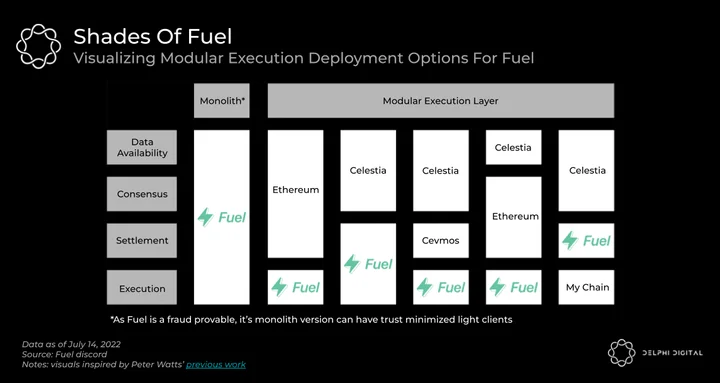
First, it’s worth noting what is meant by modular execution. A core pillar of modular execution layers is to be verifiable. This can be done through the use of fraud or validity proofs. Fuel’s current execution is designed to be fraud provable by the EVM, making it suitable to be run as a rollup on Ethereum. However, modular execution layers encompass a broader definition than rollups as they don’t subscribe to any particular data availability, consensus, or settlement configuration. As such, we can see Fuel getting deployed as a rollup, celestium, or even a side-chain / L1.

 The biggest differentiator of Fuel from today’s optimistic rollups is that it runs a brand new VM architecture coined FuelVM with its toolchain and language. FuelVM carries traits from WASM, EVM, and Solana’s SeaLevel. Potentially the most striking aspect of FuelVM is that it executes over a UTXO-based data model.
If your knee-jerk reaction to UTXOs is to think of P2P payments then you are not completely wrong. Indeed, the first version of Fuel has its use case around payments. It has been live on Ethereum mainnet since 2020 and to date is still the only rollup with fraud proofs, immutable smart contracts, and permissionless block production. But what interests me – and most likely you – is Fuel V2, which promises Ethereum-style smart contracts on UTXOs.
It’s easier to reason about a custom VM for an app-specific payments rollup like Fuel V1, but less obvious to do so for a general purpose rollup like Fuel V2 given EVM’s existence. After all, EVM incompatibility means dapps on EVM can’t copy-pasta their code into Fuel. It also means Fuel won’t be leveraging the existing EVM developer community and its toolings. What about smart contracts on UTXOs…wasn’t that impractical to begin with?
Before we dive into the nitty gritty of FuelVM we should first understand the motivations behind building a new VM for general-purpose computation. To cover this in-depth, we take a step back to see where the rollup space is headed.
The main value proposition of today’s rollups is to scale Ethereum and potentially extend its capabilities. Rollups scale Ethereum in 2 major ways;
- They push state (and execution) off-chain; ie. move it from L1 to L2.
- Parallelism; ie. multiple rollups can run simultaneously on Ethereum.
The current bottleneck that limits Ethereum’s throughput is state growth. Ethereum nodes today run at near capacity when it comes to state size. Rollups alleviate the state growth problem of
Read the full report
This report is part of Delphi Pro.
- 800+ Pro reports across every major sector
- Talk directly with our analysts
- Private community of funds and builders
Already a Pro member? Log in
0 Comments