
Introduction
Perhaps “Solana Summer,” which first gained traction in 2021, was just delayed by two years. In 2023, the Solana NFT ecosystem is flourishing more than ever. Numerous protocols are launching their tokens on the platform and NFT floor prices are experiencing an upward trend.
In Part I of our Solana NFT deep dive released earlier this year, we looked at the ecosystem metrics that have propelled Solana to its current status as the second-largest NFT ecosystem, standing just behind Ethereum. Our analysis led us to believe that NFT development and trading activity on Solana will not only continue to thrive, but also maintain its strong position as the second-largest NFT ecosystem after Ethereum throughout 2023.
We further delved into the NFT marketplace landscape, identifying emerging platforms such as Tensor which show great potential to dominate their respective verticals in the near future.
In this follow-up report, we shift our focus to the realm of NFT finance, specifically examining lending and borrowing protocols on the Solana blockchain. In addition, we go into an in-depth analysis of NFT collections hosted on Solana, shedding light on their unique characteristics and potential for growth in this market.
Section 1: NFT Finance & Borrow/Lend Protocols
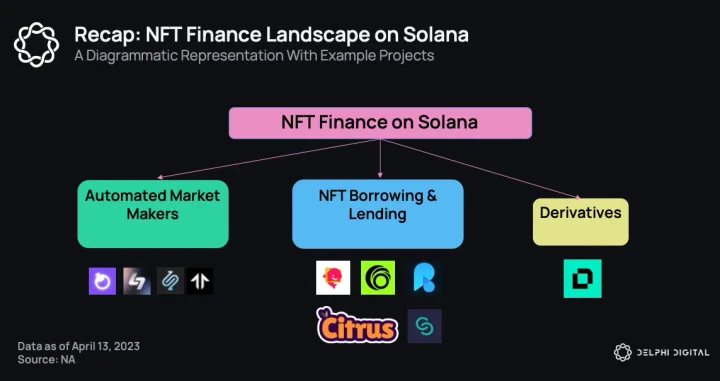
The majority of NFT finance on Solana is presently associated with borrowing/lending protocols and automated market makers. As for derivatives, no NFT perpetual platforms are currently live on Solana as far as we know. However, projects such as Tensor have indicated that they plan to introduce these platforms, so it is likely that we will see them launch in the coming months. The only NFT options protocol on Solana is DeCalls, but its trading volume remains minimal.
In our exploration, there are a number of stark differences between NFT lending on Solana and Ethereum:
-
Solana lending protocols primarily employ a pooled approach, enabling borrowers to obtain instant liquidity for their NFTs. This aligns with the Solana ecosystem’s emphasis on speed, as users expect loans to be processed quickly.
-
NFT loans on Solana tend to be short-term, with 7-day loans being the most common, followed by 14-day and 21-day loans. The negligible transaction fees on Solana make these short-term loans viable, as users are not burdened with significant costs.
-
Loan interest rates (APY) on Solana are typically much higher, often exceeding 100%. Loan-to-value (LTV) ratios are also higher, with 60-80% being commonplace.
As highlighted in our previous report, the typical Solana NFT user is a trader or “degen.” High LTVs and APYs for NFT loans have found a strong product-market fit within this target audience.
There are 3 major NFT lending/borrowing protocols on Solana — Sharky, Citrus, and FRAKT. Among these, Sharky is the most widely used protocol with 70-80% of the market share. Citrus is the next largest with ~10-15% share and FRAKT is in third place with 5-10% share.
Sharky
Sharky is the largest NFT lending/borrowing protocol on Solana today. Sharky utilizes a hybrid peer-to-peer (P2P) and peer-to-pool (P2Pool) NFT lending protocol, with liquidity pools designated per collection and individual loans settled on a P2P basis. The protocol determines fixed APR and loan duration.
Key metrics as of April 13th:
-
TVL of
Read the full report
This report is part of Delphi Pro.
- 800+ Pro reports across every major sector
- Talk directly with our analysts
- Private community of funds and builders
Already a Pro member? Log in
0 Comments