
🌅 Welcome!
A stablecoin is being offered across 24,000 ATMs in South America’s largest country and the U.S. charges two Chinese officials with bribing a U.S. government employee using Bitcoin.
Today, we take a look at fan tokens issued by football clubs as the FIFA World Cup 2022 draws closer. Yes, we know it’s also called soccer. Our Research Team also offers a preview of our latest report on GMX, an oracle-based DEX on Arbitrum.
This is the Delphi Daily. Let’s dive in.
🚨 In Case You Missed It
- Two Chinese intelligence officers are charged with bribing a U.S. government employee with Bitcoin.
- Tether will make USDT tokens available across 24K ATMs in Brazil.
- Super PACs backed by Sam Bankman-Fried and Anthony Scaramucci plan last-minute ad blitz for U.S. midterm elections.
- FTX allocates $6M to compensate users affected by a phishing attack.
- Crypto staking platform Freeway which promised users up to 43% in annual awards halts withdrawals citing market volatility.
📊 Is the Football Fan Token Space Heating Up?
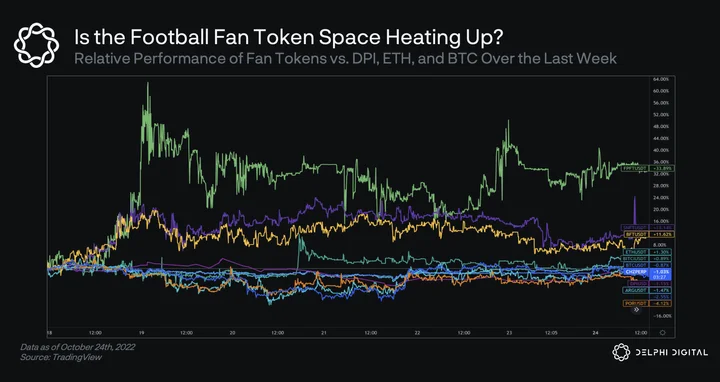
- One of the most anticipated sporting events of the year, the FIFA World Cup 2022, is set to begin on Nov. 20, 2022. This may bring renewed interest and attention to fan tokens issued by football clubs.
- While fan tokens don’t represent any ownership of the football team, they confer benefits such as VIP experience, the ability to design banners, exclusive meet and greets, and other loyalty rewards to their holders.
- The two leading platforms to issue fan tokens are Socios and Bitci. There are several fan tokens issued by football clubs but only a few have been issued by national teams.
- Over the past 7 days, fan tokens for the national teams of Brazil (BFT: +12%), Peru (FPFT: +34%), and Spain (SNFT: +13%) have outperformed BTC, ETH, and the DeFi Pulse Index.
- Over the same period, fan tokens for Argentina (ARG: -2%) and Portugal (POR: -4%) have struggled to keep up.
⚡GMX’s Success Spawns Competition, But Can They Keep Up?
- Perpetual futures are one of the most traded instruments within crypto, with volumes that dwarf spot trading. These instruments enjoy greater parity with spot prices relative to futures and enable capital efficiency through leverage.
-
However, most perp volume resides on CEXs. Despite the multitude of designs to try and bring perpetuals to DeFi, most still lack strong adoption. dYdX is an outlier, but they use a cheat code of sorts – a centralized order book and matching engine rather than an on-chain one.
- GMX – an oracle-based spot and leveraged trading DEX – flipped the game by bringing the simplicity of perpetuals to leveraged trading. Of late, GMX has found a strong product-market fit with traders and liquidity providers alike.
-
GMX’s success has resulted in competitors attempting to replicate it with designs inspired by GMX. Mycelium (previously TracerDAO) and MUX (previously MCDEX) are two protocols designed very similarly to GMX.
- Mycelium is a direct fork of the GMX codebase with some changes, while MUX is not a fork – it’s using an adjusted codebase from a previous iteration of its product (MCDEX v3). With that being said, the current design is inspired by and competes with GMX.
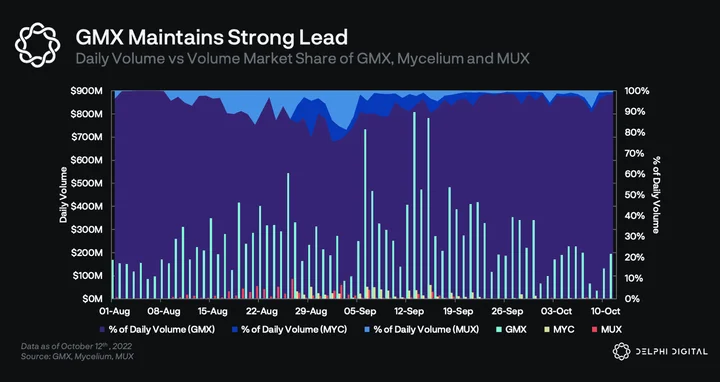
- GMX has performed well over the past few months, with volumes reaching a high of $808M on Sep. 13, 2022.
- Mycelium and MUX initially gained significant traction, capturing 18% and 19% of volume share at one point. Mycelium volumes peaked at ~$60M on Sep. 15, 2022, while MUX volumes hit a peak of ~$86M on Aug. 26, 2022.
- Most protocols bootstrap their liquidity and users through token incentives. This has proven to be unsustainable, as the tokens are usually sold upon farming, and mercenary liquidity migrates to greener pastures once it finds more lucrative places to yield farm.
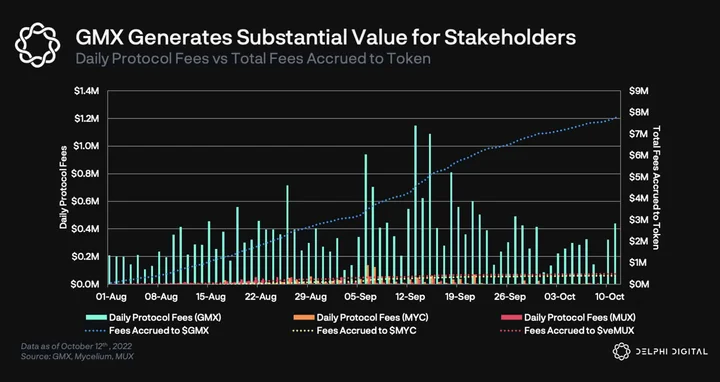
- GMX has proven that its model can generate lucrative real yields for its token holders and LPs. These fees are generated organically through spot swap fees and leveraged trading fees. Consequently, that’s why attempting to replicate this success is worthwhile.
- From Aug. 2022 through mid-Oct. 2022, GMX has consistently grown its daily protocol fees, earning ~$7.8M for GMX stakers over that time. On the other hand, MYC and veMUX stakers earned $394K and $478K over the same time period.
- For more on GMX forks, Delphi members can read our Delphi Pro report here.
🐣 Notable Tweets
U.S. Macro: What Will Break?
Macro is a mess. Here’s some clarity:
The Fed wants to see something really crack before pausing.
They are focused on the labour market- but it is still strong!
Because labour participation rate is low and most balance sheets ok, its likely that something else breaks first👇
Learnings from 22 Years of Trading
22 years trading.
Here are some of the most important things I’ve learnt (Part 1/2):
0 Comments