
Table of Contents
- The Rise of Zeta
- Problems With On-Chain Options and Zeta’s Answer
- The Secret Sauce
- Demystifying Strategy Accounts
- Zeta FLEX
- Conclusion
The Rise of Zeta
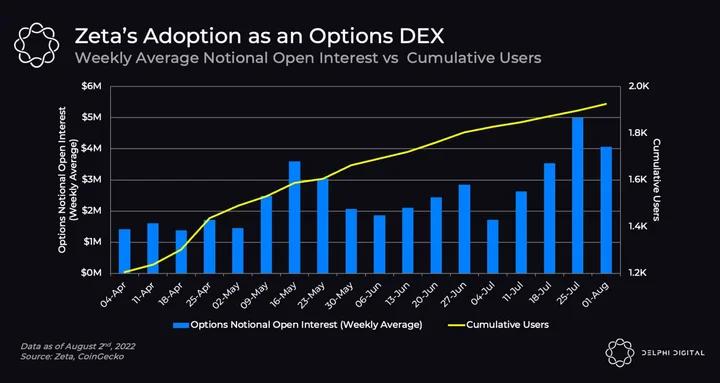
Within DeFi, option protocols have represented a largely untapped opportunity, until now. Enter – Zeta Markets, an options DEX that has continued to see increased traction in recent months despite challenging market headwinds. Zeta DEX grew its weekly average notional open interest from ~$1.4M in April to ~$4M in August. Cumulative users on Zeta DEX have also grown from ~1.2k users to ~1.9k users. While these are certainly still small figures in absolute terms, they’re worth paying attention to. The success thus far hasn’t been by chance, in fact its DEX design offers a compelling place for option traders to transact outside of CEXs.
So, what is Zeta’s secret sauce for their DEX design?
Problems with On-Chain Options and Zeta’s Answer
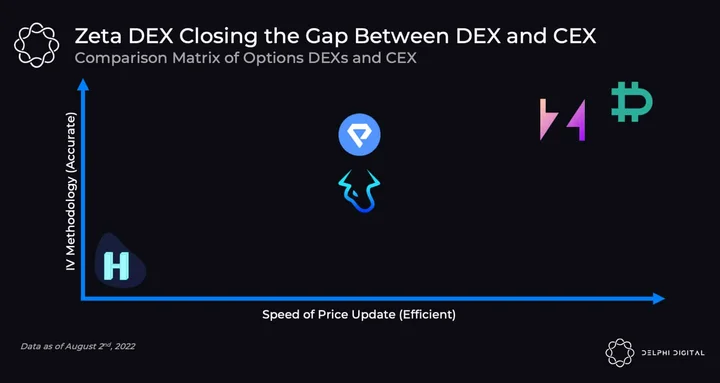
A few option DEXs have been built out in recent years. However, almost all of them have flaws that make user onboarding a nightmare. In return, this means it’s virtually impossible for them to reach a larger scale of volume. Some of the most critical flaws are:
-
Accurate and efficient options pricing – Oracles serve as an important data feed to price options on-chain using price and/or implied volatility. However, due to the slow block times on some blockchains, oracle updates are often slow, affecting price discovery and trade efficiency.
-
Full collateralization of options – Most options platforms require full collateralization when selling options, making them capital inefficient since users post a large sum of collateral that sits idle in a pool.
-
Liquidity – Liquidity pool participants can be affected as inefficient updates of options pricing can bring about arbitrage attacks and lead to principal erosion. This disincentivizes deep liquidity from being built up.
-
Hedging Mechanisms – Options dealers will not engage with a market that is difficult to hedge. Sure, you could take on-chain positions and hedge them using a CEX, some certainly do, but that introduces different obstacles with respect to capital efficiency. In our opinion, futures to match every option’s expiry are a necessity to allow dealers to hedge their delta and gamma exposures. Most on-chain options platforms disregard this need.
These flaws prevent DEXs from competing with CEXs in pricing accuracy, trade execution, and capital efficiency. Since these platforms sett
Read the full report
This report is part of Delphi Pro.
- 800+ Pro reports across every major sector
- Talk directly with our analysts
- Private community of funds and builders
Already a Pro member? Log in
0 Comments