Report Summary
Summary
This report explains why traditional KYC (Know Your Customer) is an outdated, costly, and privacy-risking system — and how Zero-Knowledge Transport Layer Security (ZK-TLS) could revolutionize identity verification. Instead of collecting and storing sensitive user data repeatedly, ZK-TLS enables users to prove facts about themselves (like age, balance, or identity) without revealing the actual data. This aligns privacy, compliance, and efficiency — solving a fundamental trust and usability bottleneck for crypto and traditional finance alike.
Key Takeaways
1. Traditional KYC Is Broken
-
KYC began with the US Bank Secrecy Act (1970) and expanded with the Patriot Act (post-9/11).
-
Compliance costs keep rising — over $64B/year in the US & Canada alone.
-
Current KYC is duplicative: users share the same sensitive info with every service repeatedly.
-
Centralized KYC creates honeypots for hacks and identity theft.
2. What Is ZK-TLS?
-
ZK-TLS combines Zero-Knowledge Proofs (ZKPs) with Transport Layer Security (TLS).
-
ZKPs prove data is valid without revealing the data itself.
-
TLS keeps the data encrypted during transport — ZK-TLS attests both transport and correctness.
-
Net effect: Users can prove compliance without revealing private info, while services remain compliant.
3. How ZK-TLS Works — 3 Models
a) TEE-Based:
-
Uses hardware enclaves (Intel SGX, ARM TrustZone).
-
Fast and scalable.
-
Trusts hardware security; risks if hardware is compromised.
b) MPC-Based:
-
Secure Multi-Party Computation distributes trust among multiple nodes.
-
Highly decentralized; no single point of failure.
-
More complex and slower than TEE.
c) Proxy-Based:
-
Uses an HTTPS proxy that signs session data.
-
Efficient and simple.
-
Centralized trust in the proxy; risk if the proxy is compromised.
4. Real-World Use Cases
-
Reclaim Protocol: Proxy-based ZK-TLS to prove facts about Web2 accounts (e.g., bank balance, social following) on Web3.
-
ZKPass: Combines MPC and proxy for flexible KYC proofs (credit scores, age checks, etc.).
-
Onflow: “ZK on-chain passport” for one-time KYC that can be re-used trustlessly anywhere.
5. Regulatory Fit
-
ZK-TLS can align with global AML/KYC laws if credentials are issued by trusted entities (banks, governments).
-
Proof formats must be standardized and compatible with legal audits.
-
Selective disclosure ensures only necessary info is shared.
-
Regulators are beginning to explore ZK-compliant identity systems.
6. Bigger Picture
-
ZK-TLS can eliminate repeated KYC onboarding friction.
-
Empowers users to own their identity.
-
Reduces risk of large-scale data breaches.
-
Shifts compliance from trusting companies to trusting math.
-
Could become standard for DeFi, TradFi, Web3, and AI-driven identity systems.
Conclusion
ZK-TLS is a trustless, privacy-preserving KYC evolution: it combines cryptographic proofs and secure transport to let us prove anything about identity or compliance without giving away raw data.
If adopted widely, ZK-TLS could kill the ancient KYC dinosaur, save billions in compliance costs, and finally bring real privacy and user ownership to the global digital economy.-
Introduction
Most people in the crypto space don’t care about Know Your Customer (KYC); they care about speed, friction, and ease of use. I would argue that Hyperliquid gained a massive market share predominantly due to these factors, rather than being a non-KYC entity. If so, this begs the question:
Why has KYC never been improved upon?
Why, in 2025, on the forefront of technology, AGI, and quantum computing, do we still use a verification system that feels like getting your license at a DMV? KYC, as we know it today, is an ancient relic of a bygone era dominated by TradFi & Forex.. Thankfully, emerging breakthroughs in the form of ZKTLS systems seek to make the KYC dinosaur extinct.

For starters, Zero-Knowledge Transport Layer security, or “ZKTLS” for short, is an emerging solution to updating/upgrading the ancient technology of Know-Your-Customer (KYC) verification. ZKTLS functions as a protocol that merges zero-knowledge proof technology with Transport Layer Security.
In simpler terms, ZK-TLS enables cryptographic proofs about data to be exchanged over a Transport Layer Security (TLS) connection without revealing any of the embedded or underlying data. This means that users of protocols or exchanges can provide proof of their identity without actually revealing their identity. This creates vast, unprecedented opportunities for safe, private, and verifiable data transmission. ZKTLS addresses the fundamental limitations in current blockchain infrastructure, as well as tearing down the data monopolies of Web 2.0 corporations.
Furthermore, verifiable data will become increasingly pertinent as Artificial Intelligence becomes more indistinguishable from humanity. Such a convergence of use cases means ZKTLS is poised to break down the data silos of Web2 monopolies, enhance privacy, and ensure that the truth is the truth.
A Quick History of KYC
To fully comprehend the value proposition of a shift towards ZKTLS verification, it’s worth understanding the history of KYC and how it came to dominate the modern-day financial landscape.
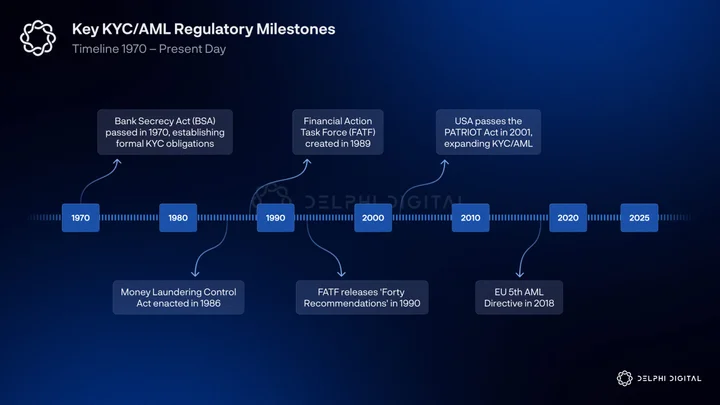
The Know Your Customer (KYC) regulations originated with the U.S. Bank Secrecy Act (BSA) in 1970. The Act specifically mandated that all banks would have to report cash transactions exceeding $10,000, correctly identify the individuals behind such transactions, and maintain a paper trail by keeping a record of all transactions. These mandates established the first formal Know Your Customer (KYC) obligations in the financial sector.
At the time, increasing cases of fraud and money laundering prompted the government to enact these types of laws, dubbed “AML” or Anti-Money Laundering Laws. Throughout the 1980s, following the BSA, numerous additional AML laws, such as the Money Laundering Control Act of 1986, were enacted, further solidifying the precedent of KYC obligations..
At the international level, the Financial Action Task Force (FATF) was formed in 1989 shortly after the USA’s enactment to develop more global AML standards. A year later, in 1990, the FATF released its “Forty Recommendations,” which served as a guideline for implementing KYC and customer due diligence in all member countries. Despite the AML laws in the USA and the FATF’s efforts to ensure nations enforce KYC standards, implementation and record-keeping varied drastically, with some banks still only applying the most basic background checks before the 2000s.
This leniency and laziness all changed post 9/11, when the USA PATRIOT Act was passed. . The Patriot Act significantly expanded KYC/AML enforcement, now requiring Customer Identification Programs for all customers, as well as ongoing monitoring. Banks and other financial institutions were now needed to gather beneficial owner information, cross-check all customers against all relevant sanction lists, and share this data with regulators. The Patriot Act is essentially what made KYC what it is today, with other countries and the FATF following our example and making the robust KYC process into the global standard.
With the PATRIOT Act now over 20 years old, traditional Know Your Customer (KYC) processes are cumbersome, outdated, duplicative, and costly. A recent study in 2024 revealed that financial crime compliance costs in the United States and Canada totaled $64 billion. Furthermore, every institution must re-collect all compliance data for every user from scratch, resulting in the repeated collection of the same personal documents. This waste of time and money, combined with a lack of global standardization, proves that KYC has become inefficient, slow, and unsafe. KYC’s shortcomings pave the way for ZK-TLS to take center stage.
Dissecting ZK-TLS
Before delving into the use-cases and technical architecture of ZK-TLS as a combo, it is worth understanding first what Zero Knowledge and Transport Layer Security are:
In cryptography, ZK refers to Zero-Knowledge proofs, which are a method used to prove knowledge about some piece of data without actually revealing the data. One of blockchain technology’s main selling points is the transparency it provides as an open ledger. While, for most financial purposes, an open ledger is a net positive, with specific use cases (such as Know Your Customer, or KYC), privacy remains essential to the process.
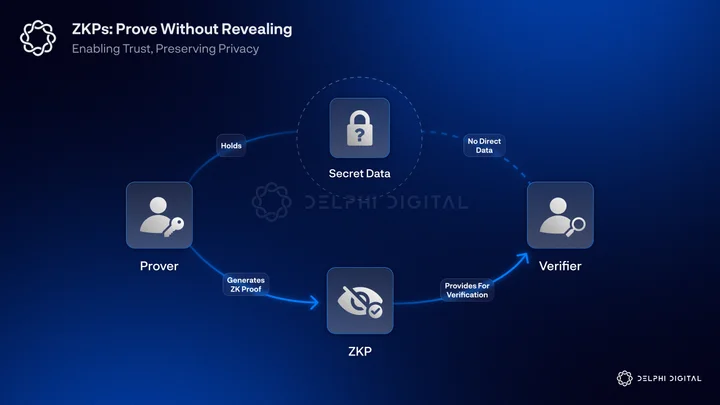
A Zero Knowledge Proof appears on the blockchain’s public ledger as a “stamp of validity” for the hidden information. In essence, these proofs work by having the overseer of the proof ask the “prover” to do a certain number of specific tasks that only the “prover” would be able to perform. Utilizing ZKPs provides everyone with the benefits of an open ledger’s transparency without compromising the actual contents of their data –“I can trust that this data is true and sound without actually knowing what the data contains.”
The second piece of ZK-TLS, the “Transport Layer Security” portion, refers to a ubiquitous security protocol that protects the privacy and security of internet and blockchain communications. In essence, it ensures that no eavesdroppers, wiretappers, or hackers can intercept what you transmit, making it perfect for sensitive information like your personal details, credit card numbers, passwords, and more. You know something is using TLS whenever you see the little lock icon in the top left of your browser, indicating that your connection is secure.
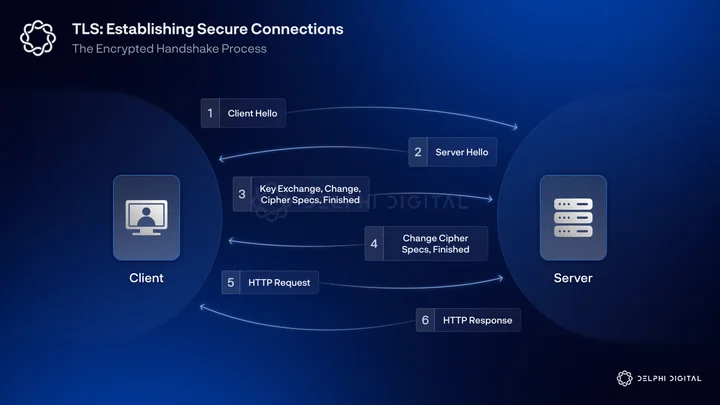
However, TLS does not secure data sent at its endpoint; it only secures the delivery, which is precisely why ZK-TLS brings us the best solution. ZK-TLS reconciles trust and privacy: regulators and crypto services alike benefit from valid, legitimate sourced data without becoming honeypots for private information. It serves as a perfect middle ground in the age-old debate between privacy and compliance in crypto.
ZK-TLS Technical Architecture & Implementation
The intersection of the two cryptography practices, creating Zero-Knowledge Transport Layer Security, provides the perfect solution for data transport and verification in crypto protocols. TLS alone can’t provide proof that the data being transported securely is true or false, leading to the long wait times and friction in verifying your identity. However, with the addition of zero-knowledge proofs, not only is the data transported privately and safely, but it is also verified as accurate, enabling a world where users can prove their data without revealing the actual content.
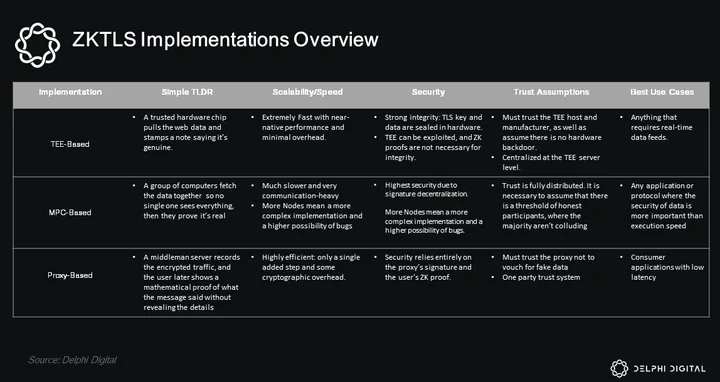
Currently, there are three main architectures for ZKTLS implementation, each utilizing different technologies to create varying levels of decentralization, safety, cost, and performance. These three models are: Trusted Execution Environment (TEE)-based, Multi-Party Computation (MPC)-based, and Proxy-based models. These three all have the same end goal: an attestation of a TLS session’s contents, but achieve it through different means, each of which is explored in depth below.
TEE-Based ZKTLS
TEE-Based ZKTLS utilizes hardware security models, known as Trusted Execution Environments, such as Intel SGX or ARM TrustZone. A TEE is essentially a CPU that is isolated and can’t be messed with. This isolated CPU executes its code in private and produces a cryptographic signature, or attestation, that confirms the code was executed correctly. In ZKTLS specifically, the TLS “handshake” and data retrieval are performed within a TEE, with the user providing their encrypted information to a TEE-hosting server where the information can only be decrypted within the isolated environment. The TEE then starts the TLS connection to the target website on the user’s behalf. Since the entire TLS session resides in the isolated environment, the TEE can then issue an attestation proving that it retrieved the data from the website. In practice, the TEE would come back and vouch that they “connected to (website) and confirmed the account balance was $X,” without revealing any of the user’s login details or credentials.
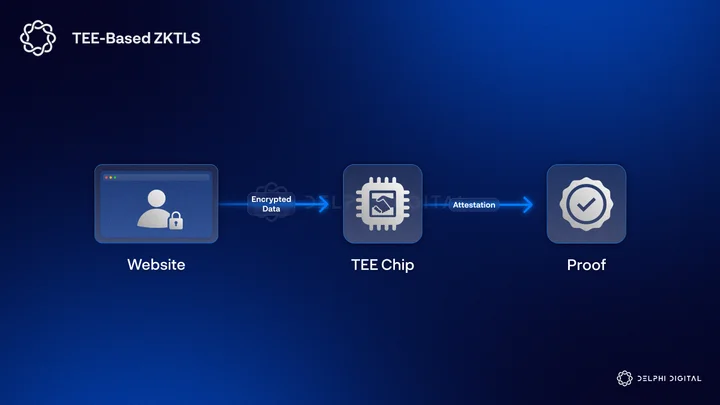
The biggest strength of TEE-based solutions is their efficiency. They add near-zero overhead to the normal TLS process because all computation is done in already existing hardware at normal speeds. A normal Intel SGX enclave of TEEs can perform the TLS handshake and data decryption very quickly, and then create a proof. This speed makes TEE-based solutions incredibly scalable without sacrificing latency. Recently, protocols like Clique have been utilizing Trusted Execution Environments (TEEs) to perform tasks such as fetching data from the web and then outputting attestations as zero-knowledge proofs.
The primary drawback of TEE-based solutions is the concern over trust and security. Users and protocols must trust the security of the main hardware and its provider (like Intel). If the TEE environment is compromised, attestations could then be faked. In reality, this risk is far lower than that of normal data breaches; however, several vulnerabilities have been identified in SGX and adjacent enclaves of TEEs over the years. Another such drawback is that the TEE-based solutions aren’t pure cryptographic approaches, as they don’t use an accurate zero-knowledge proof for integrity but rather rely strictly on the protection of the TLS key. In summary, TEE-based solutions are best suited for high-throughput systems where performance and speed are critical.
MPC-Based ZKTLS
MPC-Based ZKTLS refers to the use of secure Multi-Party Computation to distribute the TLS handshake across multiple entities. No single party or entity ever has access to the complete TLS session key; instead, each party must jointly compute it. In practice, a client collaborates with a group of MPC nodes to create a TLS client. This network of nodes makes its encryption key in pieces instead of picking a random one. Each node within the party then only sees its piece of the key, having to collaborate to perform the actual encryption and decryption layer by layer. Ultimately, the server receives a response that no single party can read alone. After the session is complete, the MPC network produces an attestation proving that it followed the instructions and acquired the encrypted response. Then, the user can generate their ZKP that holds a valid decryption of the response without revealing the actual TLS key.
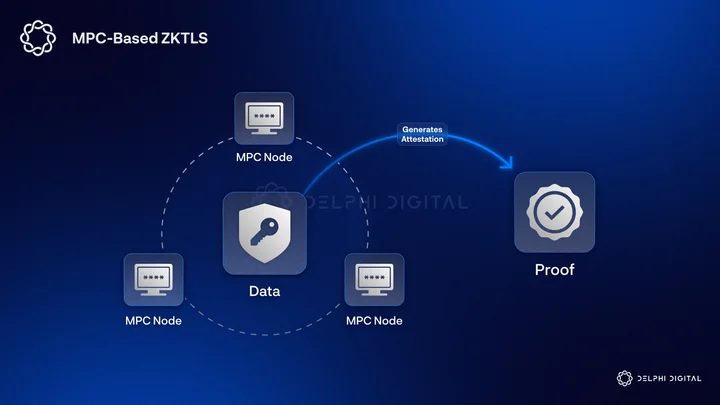
MPC’s main advantage is its decentralized nature. Users and clients no longer have to trust a single entity or hardware, as seen in TEE-based systems. Instead, trust lies in the non-collusion of the nodes. The core idea is that if at least one of the MPC parts is honest, the protocol can never leak data or falsify proofs. This type of decentralization meshes well with Crypto’s culture. Furthermore, MPC’s security level is extremely high, as the TLS key is never fully exposed and the decentralized structure prevents any tampering.
The primary drawbacks of MPC-based systems are their speed and complexity. Due to the collaborative nature of MPC, proof generation does not scale effectively. The more data that needs to be processed, the slower an MPC-based system typically becomes. Not only is setting up a decentralized network of nodes slower, but it is also more expensive for the protocol. MPC-based ZKTLS sacrifices some performance and simplicity in exchange for a fully decentralized and secure design, making it a better fit for protocols and systems that seek to avoid a single point of failure at the cost of more overhead and slower proof generation.
Proxy-Based ZKTLS
Lastly, the proxy-based model of ZKTLS is the simplest out of the three in concept. Proxy ZKTLS uses a basic HTTPS proxy as the middleman in the TLS connection. The user simply configures their interface (dApp, browser, etc.) to route their HTTPS requests through an attestor proxy server. The proxy sees all the encrypted traffic between the user and the website, but can’t decrypt it. Since the proxy sits in the middle of the workflow, it can record the encrypted transcript of the entire TLS session and then vouch that the data was never modified. In reality, the proxy would then sign a statement online that includes the client’s request, the server’s response, and metadata that confirms the process took place. This statement signature serves as the attestation that the TLS session was accurate and secure.
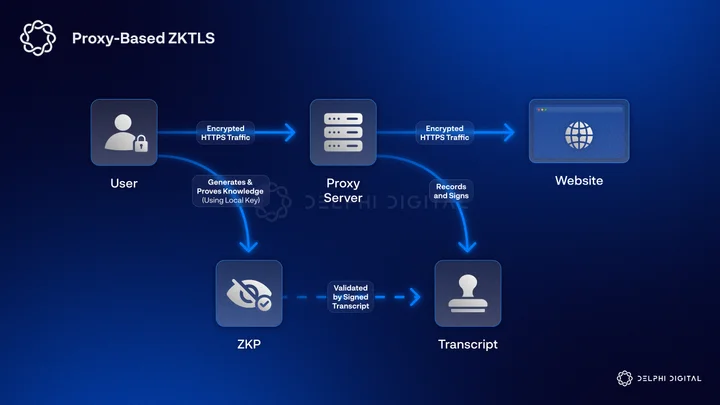
To complete the proof, the user would then store the TLS session key that decrypts the server’s response locally to extract the necessary data. Instead of revealing the key themselves (which would violate all privacy), they generate a Zero-Knowledge Proof (ZKP) that proves they possess a key that decrypts the proxy-signed statement into a message containing the original claimed value. For example, this ZKP might say,“In the decrypted HTTP response, at X location, the substring ‘Balance: $69,000′ appears.” The verifier of the ZKP, which could be another user or a smart contract, would then check the proxy’s signature to verify that the data came from a real server and check the Zero Knowledge portion to ensure that the user isn’t lying about the content, all without seeing any portions of the page or TLS key.
The proxy model’s strengths lie in its computational and network efficiency. It relies only on a standard TLS combined with a sprinkle of extra signing and proofs. The tradeoff for this unencumbered speed is that you must trust a “centralized” entity – the proxy provider. If the proxy were to collude with the prover or user, it could compromise the entire security chain. However, an actual attack would require physical or root access to the proxy’s server to extract the TLS keys, which would be a highly effortful and challenging task.
The main drawback of the proxy model is called the “key commitment” issue. Since the proxy doesn’t know the TLS key, how can it ensure that the user’s provided data corresponds with the server’s response and not a fabricated one? Most answers involve the proxy attesting some TLS handshake details or the structure of the user data, so the user can’t cheat the system.
At-A-Glance Comparison Table
Case Studies: ZK-TLS at Work Solving KYC and Verification
Several protocols and projects have begun implementing ZKTLS to address the long-standing issues posed by traditional AML compliance and KYC user flows. This section will highlight three such protocols: Reclaim, ZKPass, and Onflow, and examine how they each implement ZKTLS, as well as their success so far.
Reclaim Protocol
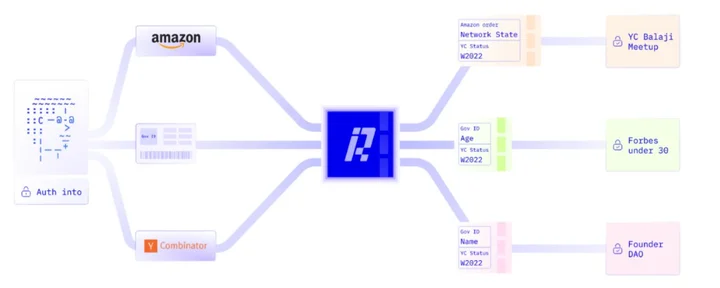
Reclaim Protocol is pioneering the proxy-based ZKTLS model by enabling anyone to create verified credentials from any website. In essence, Reclaim enables anyone to transform Web2 data into proof statements that can then be utilized on Web3 protocols without revealing sensitive information. Reclaim achieves this by using an HTTP proxy attestor that converts a user’s web requests into proofs. For example, a user could prove their X following or bank balance via Reclaim:
- The user selects a data source (e.g., Bank account or Twitter) in Reclaim’s application and then enters their credentials in a secure form.
- The Reclaim proxy attestor logs into the target site on the user’s behalf and forwards the encrypted credentials to the site.
- Proxy sees the TLS handshake and exchange between the user and the data source’s servers, then signs the encrypted response.
- The user’s device then runs a zkSNARK to comb through the relevant pieces of the decrypted data and produce a proof of that fact while hiding the rest of the content
- The result of this process is a secure, verifiable package of credentials that confirms the user indeed is truthful about their data claim. The client doesn’t need to trust the user or Reclaim itself, just the proof.
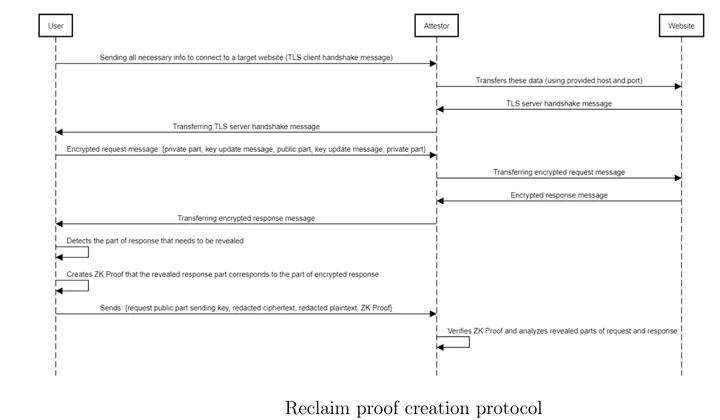
Via: https://forum.trondao.org/t/reclaim-protocol-bringing-web2-data-to-tron-ecosystem-using-zktls/32921
Reclaim’s approach is efficient and scalable, with many crypto protocols like 3jane utilizing it for their verification. Reclaim is incredibly fast, with proof generation taking under 4 seconds, and users do not need to download any extra plugins, extensions, or software. Reclaim’s success so far in various use cases demonstrates the real demand and validity of ZK-TLS in both Web2 and Web3.
ZKPass

ZKPass is another ZKTLS-focused protocol that specializes in private data verification with an emphasis on user-controlled identity and credentials. It utilizes a hybrid approach, combining the MPC and proxy-based models in something they call “Three-party TLS” or “3P-TLS.” This innovation involves a network of decentralized MPC nodes, with the added flexibility to switch to a direct proxy “mode” as required by the scenario. This enables the system to adapt to changing network conditions and server requirements, expanding ZKPass’s TAM significantly.
In ZKPass, when a user wants to prove something, the system creates a TLS session either via the MPC decentralized network or a proxy to then generate a proof. For example, if you need to prove you are over 18 without revealing your details, ZKPass allows this by retrieving an ID document over TLS and then generating a proof that the age condition is met.
The strengths of the 3P-TLS model lie in its security and compatibility. ZKPass works with any standard HTTPS website without special integration or add-ons, meaning a user can prove data from essentially any site, not just specific providers. Moreover, the MPC portion enables ZKPass to maintain a high level of security due to its decentralized nature, ensuring that no single user or node can forge a session. ZKPass has already been utilized in various applications, including private credit scoring, financial transactions, and online voting. ZKPass demonstrates the versatility of ZKTLS by not boxing itself into one model, proving that you can mix and match proxy/MPC to meet different client needs.
Onflow

Onflow (by Sundial) is a newcomer offering a zero-knowledge identity verification product designed to streamline and privatize the Know Your Customer (KYC) process. It describes itself as a “ZK on-chain passport” solution, allowing platforms to verify users’ credentials and compliance without exposing data. Onflow seeks to address the common pain points of the dated KYC system by enabling users to complete KYC once and then sign in with a single click, anywhere.
Onflow achieves this through the creation of on-chain, attestable identities, which they refer to as “Sundial passports.” Users control these passports themselves, which can be universally recognized. This means that a user would only have to complete KYC once via Onflow, and then subsequently satisfy KYC checks with a simple click. Onflow achieves this by combining client-side zero-knowledge proof (ZKP) generation, credential attestations, and zero-knowledge transaction ledger (ZKTLS) techniques to provide seamless one-click functionality. One of Onflow’s strengths is that all sensitive operations occur exclusively on the user’s device, ensuring that personal data never leaves the user’s device during proof generation and verification. By running all processes locally, Onflow ensures that all verifiers and protocols learn nothing beyond the proof they need to verify that the user meets compliance.
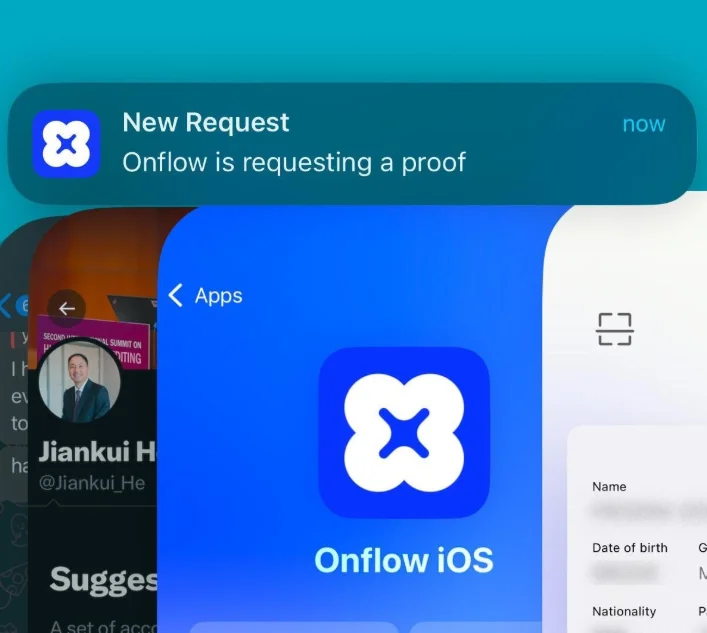
Via: https://x.com/onflowxyz/status/1909556875328188920
Regulatory Strategies for Adopting ZKTLS
The most significant hurdle ZKTLS must overcome is aligning with KYC/AML regulations. Regulatory entities worldwide mandate that all financial institutions verify identities and monitor transactions. The challenge then is to fulfill these obligations while utilizing ZKTLS in a manner that satisfies both auditors and the law.
For example, in Zk-KYC systems, users would first verify their identity through a trusted institution and then receive a cryptographic credential proving their KYC status. This credential could be either an actual certificate or a soulbound token stored in a user’s wallet. Then, when the user wants to sign up for a platform, they wouldn’t need to submit their credentials again; instead, they would simply present their token/certificate and the zero-knowledge proof of their Know Your Customer (KYC) information. If ever required by law enforcement, the platform in question could coordinate with the original KYC provider to unmask the identity behind the proof; however, such a reveal could only occur under a proper legal process.
More globally speaking, regulators are beginning to acknowledge such solutions. The idea of identity attestations is already being discussed in the EU and US regulatory circles. The Australian Financial Regulator even considered using zk-proofs and self-owned identities for KYC. In summary, a compliant ZKTLS solution would need:
- Accredited Identity Providers: Banks, government agencies, etc.
- Standardized Proof Formats: Ensures cross-compatibility for compliance
- Selective Disclosures: ZK systems can provide only the needed information
- Backdoor for Lawful Access: If a court order is presented, identity can be retrieved from the original provider
Adopting ZKTLS requires more updates to compliance manuals. Regulators would first need to be educated on the benefits of a zero-knowledge proof (ZKP)- based system. Zero-Knowledge approaches would enhance compliance, as they rely on concrete math and aren’t exposed to human errors. Aligning ZKTLS with regulations involves standardization and regulator acceptance. Although such a process of adoption may take time, the result —a safer, more efficient system that we can trust —is priceless.
However, with Coinbase set to launch CFTC-compliant perpetual futures to US customers, and massive exchanges like Bybit backing new on-chain DEXes, it appears that lawmakers will be forced to inevitably come to a verdict on identity verification as more and more users move to Decentralized Finance over their cumbersome centralized counterparts.
Conclusion
Zero-Knowledge Transport Layer Security is poised to become a cornerstone technology for both Web2 and Web3 applications. Previously, the PO world of finance struggled to meet KYC/AML regulations while maintaining user privacy and efficient onboarding. ZKTLS, by comparison, offers a comprehensive solution: platforms can obtain proof of compliance without exposing user information or creating data silos. The evolution, or lack thereof, of KYC regulations explored above highlights why innovation is so necessary: the current system works, but it’s cumbersome and poses risks. ZKTLS is also flexible, with three main implementations each bearing their use cases and merits.
Protocols like Reclaim, ZKPass, and Onflow demonstrate to us that ZKTLS isn’t just a theoretical concept, but is already enabling private verification and new DeFi possibilities in real-time. On the regulatory side, ZKTLS can easily be framed to satisfy authorities through the incorporation of standard proofs and trusted issuers. For us traders and market participants, the implications of such an innovation are significant. We may soon no longer have to fear for our safety when massive identity leaks occur or when data silos are hacked.
We won’t have to re-verify every time we join a new compliant protocol; instead, we will just need to show proof of our compliance. ZKTLS technology gives us a glimpse into the future, where “Don’t trust, verify” becomes practically applicable across all facets of the internet, while simultaneously giving individuals back ownership of their data. As ZKTLS technology improves, we can expect to see it become commonplace, ensuring our digital interactions remain secure, private, and verifiable.
0 Comments