Summary
Hyperliquid has built a successful exchange, but its broader onchain economy remains underdeveloped. Kinetiq’s Elysium aims to address infrastructure constraints that make some financial applications difficult or uneconomical to operate. Its proposed capabilities and announced ecosystem support give the supply-side case credibility, while sustained demand remains unproven. If Elysium and Kinetiq’s social trading app, Markets, succeed, Kinetiq could become a core provider of infrastructure and distribution across Hyperliquid. That expansion beyond liquid staking makes Kinetiq a potentially asymmetric bet on the wider economy developing around an already successful exchange.
A Proven Exchange and an Unfinished Ecosystem
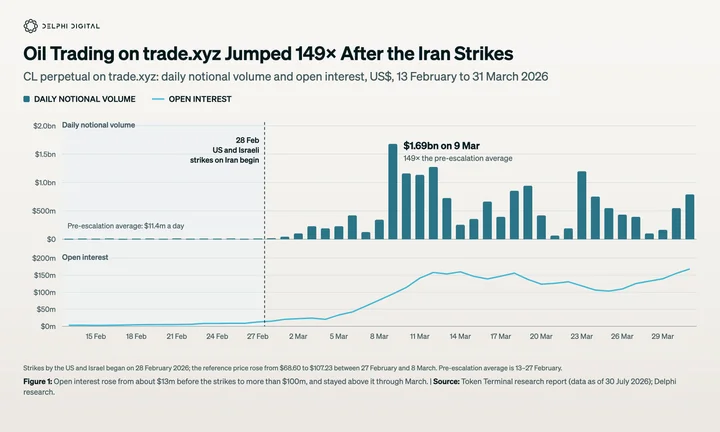
When the U.S.-Iran war began on Saturday, 28 February 2026, benchmark oil futures markets were closed. Hyperliquid’s HIP-3 oil markets kept trading.
Through HIP-3, independent operators can launch perpetual contracts using Hyperliquid’s trading infrastructure. On 9 March, TradeXYZ’s CL oil contract alone reached $1.69 billion in daily volume, 149 times its pre-war daily average. Bitcoin perpetual volume on Hyperliquid, meanwhile, remained broadly unchanged, averaging 0.98 times its pre-war level. The divergence suggests oil’s surge reflected real-world macro risk repricing rather than broader crypto momentum.
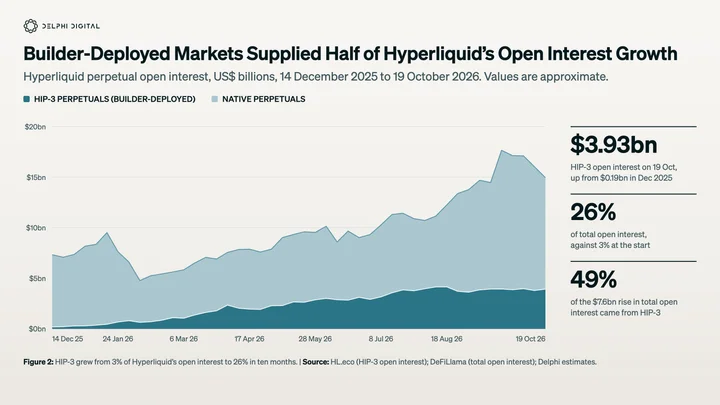
Oil illustrates a broader development: outside builders are expanding the business conducted on Hyperliquid. HIP-3 has opened its infrastructure to markets spanning equities, commodities, and other assets. By 8 November 2026, just over a year after launch, HIP-3 accounted for approximately 30.5% of Hyperliquid’s total perpetual open interest.
Hyperliquid’s expansion into traditional asset markets is also attracting established financial institutions. S&P Dow Jones Indices licensed the S&P 500 to TradeXYZ for an official perpetual contract. ICE, the NYSE’s parent, subsequently announced an investment in TradeXYZ and plans for a U.S. market and clearing structure, subject to regulatory approvals.
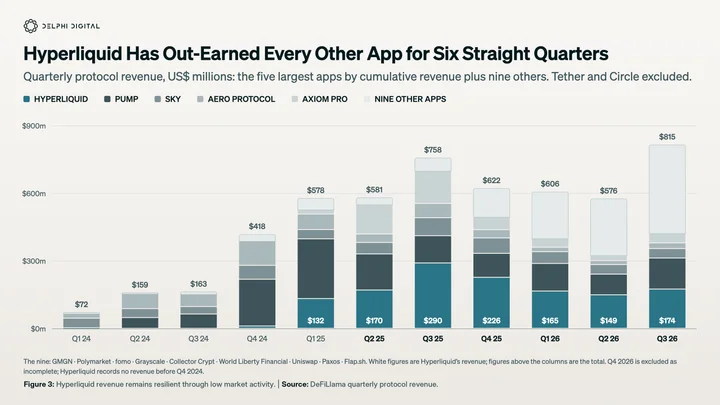
That institutional interest builds on a business that generated approximately $818 million in protocol revenue in 2025. Excluding Tether and Circle, Hyperliquid led onchain applications in revenue for six consecutive quarters, from Q2 2025 through Q3 2026.
Yet Hyperliquid’s ambition extends beyond a larger exchange: it aims to provide infrastructure that can “house all finance.”
HyperEVM was intended to support that ambition by providing a general-purpose environment for protocols. It operates alongside HyperCore, which runs Hyperliquid’s native spot and perpetual exchanges and staking for HYPE, the network’s token. Think of them as a catamaran’s two hulls: distinct execution environments within one blockchain, secured by the same validators through HyperBFT consensus.
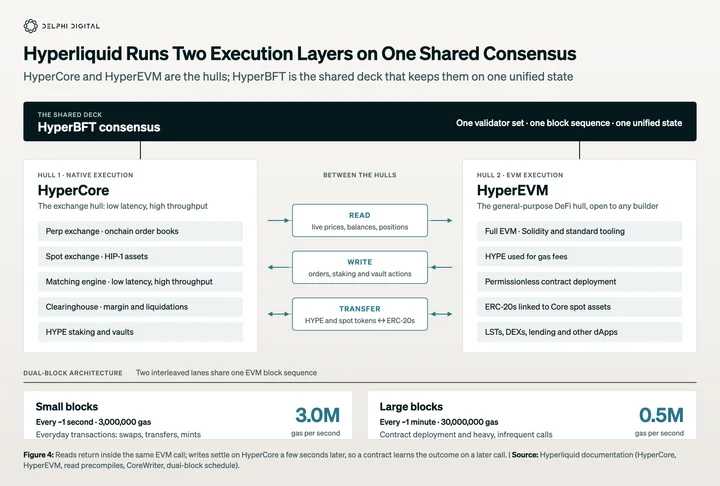
Composability with HyperCore is a distinctive advantage for protocols building on Hyperliquid. HyperEVM contracts can read HyperCore prices, balances and positions, and submit orders or staking instructions through CoreWriter. Kinetiq already leverages this composability to stake HYPE on HyperCore and issue kHYPE on HyperEVM. Holders can then use the liquid-staking token across DeFi.
So far, HyperEVM has fallen short of delivering that broader application economy. Staking and lending have attracted substantial capital, but activity across the wider ecosystem remains limited.
Infrastructure is part of the problem. Limited execution capacity, fee spikes and complex integration with HyperCore make applications harder to build and operate economically. Such an environment can discourage builders and limit the range of products capable of attracting sustained activity.
Enter, Elysium.
Kinetiq aims to address this gap and is building Elysium, a general-purpose L2 for Hyperliquid, to provide more affordable execution and shared tools for integrating HyperCore. Just as HIP-3 opened Hyperliquid’s exchange infrastructure to outside operators, Elysium aims to make a broader range of EVM applications practical.
What Is Holding HyperEVM Back?
HyperEVM has given HYPE a financial ecosystem of its own. The challenge is extending that ecosystem beyond its native asset. Its lending markets show how concentrated the capital base remains.
As of date, WHYPE, kHYPE and wstHYPE accounted for 94% of HyperLend’s $320 million net TVL. These assets also represented 90% of Morpho’s $130 million HyperEVM TVL. By comparison, SOL and its staking derivatives accounted for approximately 43% of Kamino Lend’s net TVL on Solana.
Spot trading volumes also trail those of incumbent ecosystems. Year-to-date, HyperEVM DEXs and launchpads processed approximately $38 billion in spot volume, compared with $264 billion on Base and $777 billion on Solana.
But HyperEVM has not always been quiet, and August gave us a peek at what it could be. After Trump said the CFTC was working to bring Hyperliquid onshore on 19 August, HYPE rallied, and onchain trading surged alongside it. Average daily volume reached $286m that week, up from $58m the previous week. Average gas prices rose from 3.8 to 25.2 Gwei. Participation became more expensive just as activity accelerated.
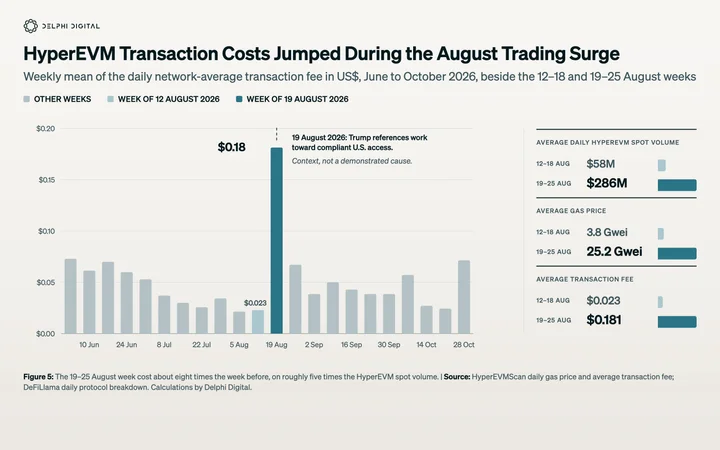
August repeated a pattern seen during earlier activity surges in 2025. Keeping frequent activity economical has been a recurring challenge.
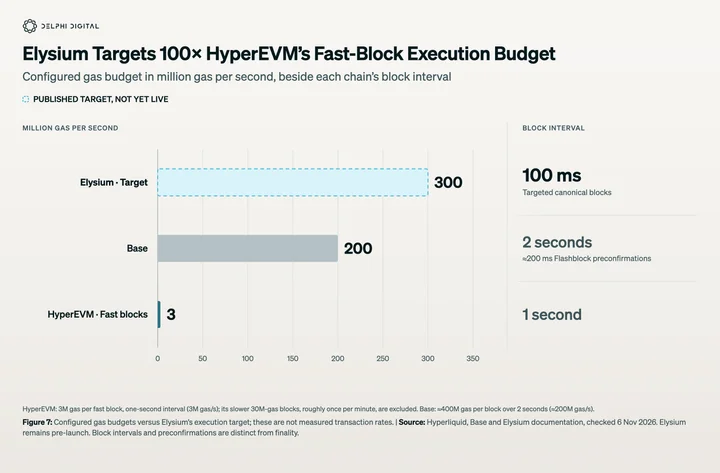
The rise in gas prices reflects competition for limited execution capacity. HyperEVM’s fast blocks provide a shared budget of 3 million gas roughly every second. Gas measures computational work, so swaps, deposits and other contract operations compete for that budget. When a block’s gas usage exceeds the network’s target, the base fee rises for subsequent blocks. This makes execution more expensive and discourages marginal transactions. Larger blocks provide roughly 30 million gas per minute. That slower capacity cannot replace fast execution for applications that trade or refresh quotes every second.
For comparison, Base’s configured maximum provides approximately 200 million gas per second, roughly 67 times HyperEVM’s maximum fast-block budget. Hyperliquid chose these conservative limits to protect HyperCore’s performance while gradually expanding HyperEVM’s capacity.
For a market maker, keeping quotes current means paying gas each time prices need adjusting. Cutting back on updates leaves outdated quotes that other traders can exploit. Wider spreads offer some protection, but customers get worse prices and less reason to trade. These recurring costs are especially difficult to absorb on small trades and thin margins.
For applications using HyperCore, execution costs are only part of the problem. Developers must also manage financial operations that cannot be completed together in one transaction.
Consider a vault that accepts wrapped BTC on HyperEVM and opens a Bitcoin short on HyperCore to offset its price exposure. Orders sent through CoreWriter face a deliberate delay of a few seconds. Prices and available liquidity can change during that interval, so the hedge may fill only partly or fail to execute.
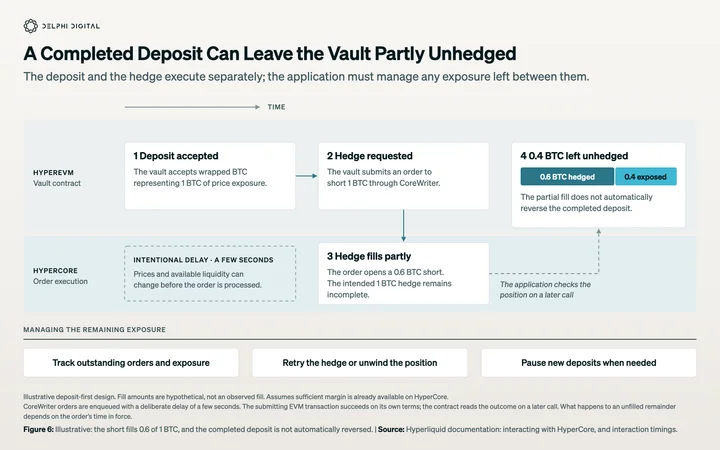
If the vault accepts one BTC-equivalent deposit before confirming its hedge, a short that fills only 0.6 BTC leaves 0.4 BTC unhedged. Partial fills are a general trading risk. Here, the completed deposit does not automatically reverse if the hedge falls short. The application must manage that exposure until it completes the hedge or unwinds the position.
The vault must track outstanding orders and unhedged exposure, with rules for pausing deposits, retrying hedges, or unwinding positions. Existing libraries simplify HyperCore interactions and provide local testing tools, but developers still need to implement and test those application-specific decisions.
In our view, these constraints can reinforce one another. Expensive quote updates weaken market-making economics, while execution delays and integration work make some applications harder to operate reliably. Less competitive products can struggle to retain users, limiting the trading activity available to support liquidity providers and developers. Shallower liquidity and weaker application revenues can then discourage further investment. We see infrastructure as a key bottleneck for developers and users interacting with HyperEVM.
But better infrastructure does not guarantee demand. HyperEVM’s costs and constraints have made it a difficult environment for builders and traders to experiment. Limited activity under those conditions is an incomplete test of appetite for a broader application economy. Elysium could provide a more conducive environment. The test is whether better conditions translate into applications people keep using and sustained EVM activity on Hyperliquid.
Elysium and a Larger Hyperliquid Economy
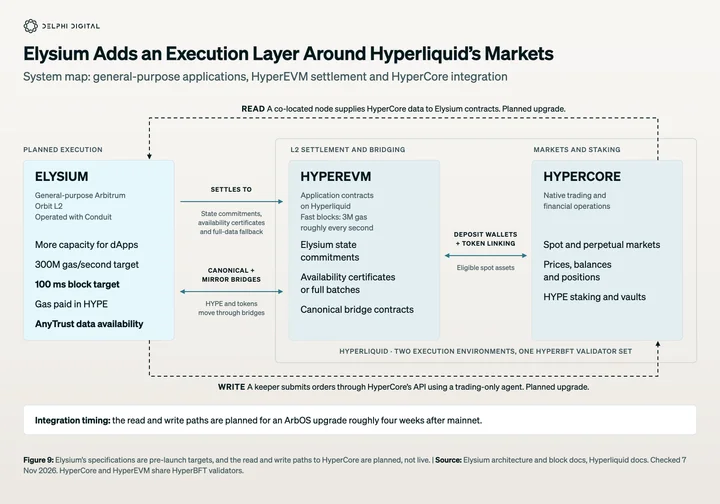
Elysium is designed to give applications a separate execution environment while supporting composability with HyperCore. Built using Arbitrum Orbit, the general-purpose L2 will settle to HyperEVM and use HYPE for gas.
The network targets 300 million gas per second, roughly 100 times HyperEVM’s fast-block execution budget, with blocks every 100 milliseconds. Greater capacity gives applications more room to operate; shorter block intervals let them act more frequently.
For applications using HyperCore, Elysium also proposes richer market data and tools for submitting orders and returning execution results to application contracts. Mainnet was announced for 9 November, with these integration tools planned roughly four weeks later.
So, another L2 to make execution cheaper? Haven’t we been down this road before?
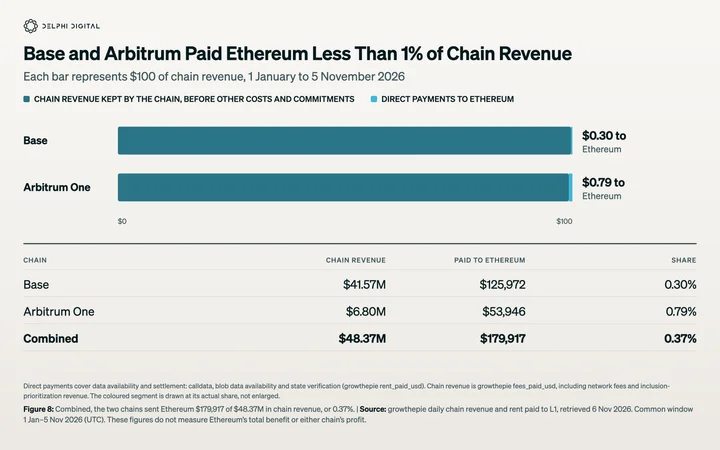
The familiar criticism is that L2s are parasitic: they can build thriving application economies while returning little direct fee revenue to their parent chains. Year-to-date, Base and Arbitrum’s payments to Ethereum each amounted to less than 1% of their chain revenue. Low settlement payments leave limited direct value accrual to ETH through fee burn.
Elysium’s
Read the full report
This report is part of Delphi Pro.
- 800+ Pro reports across every major sector
- Talk directly with our analysts
- Private community of funds and builders
Already a Pro member? Log in
0 Comments