
Introduction
Are CDP stablecoins toast? They have a rich history in DeFi, but have fallen out of fashion over the past few years. For better or worse, we have eased our staunch stance on decentralization in favor of more practical solutions. As onchain economies become more vibrant, it is increasingly difficult to justify the resource-intensive liquidity pools necessary for decentralized stablecoins with niche utility. CDPs have become confined to the closed-loop ecosystems they are born in, unable to compete with the ease of borrowing USDC on money markets.
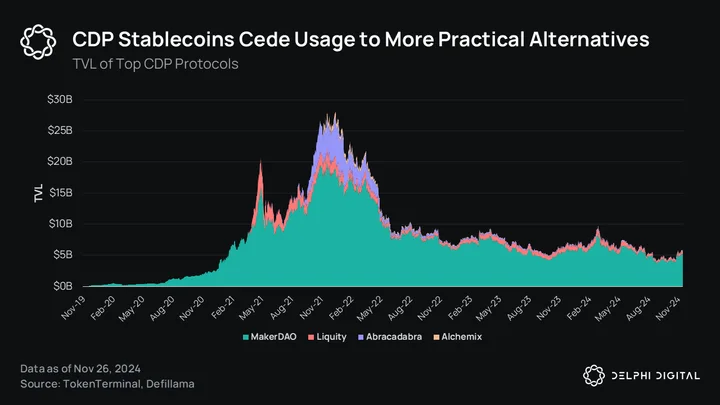
CDPs are highly efficient at generating value, offering some of the best returns in DeFi last cycle. Innovative CDPs that stick out from the crowd could be well-positioned to outperform in a sustained bull market as the appetite for leverage increases. Liquity appears to be a strong contender for CDP resurgence with its upcoming v2 release. It boasts fresh ideas from a well-respected team after a close-but-not-quite v1.
This memo will discuss the new dynamics at play with Liquity v2, as well as its obstacles, success factors, and the potential impact on LQTY.
Liquity v2 Crash Course
Liquity v1 was unique in its ability to embrace the crypto ethos of decentralization and immutability, while successfully bootstrapping liquidity for its stablecoin, LUSD, and maintaining its peg through several black swan events. The one-time borrow fee offered a unique value proposition for long-term oriented borrowers, and the token structure was effective for incentive alignment. Liquity’s immutability partially contributed to its status as one of the most forked protocols, and its usage began to taper off as LSTs gained traction and L2 activity picked up.
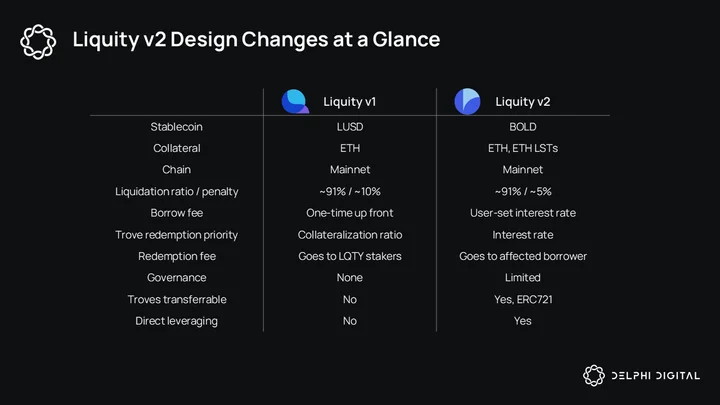
Liquity v2 will exist separately from v1 and have its own stablecoin, BOLD. Liquity v2 will accept ETH and ETH LSTs as collateral. The core design of Liquity v1 remains intact: the stability pool absorbs debt from liquidated loans, and users may redeem their BOLD for $1 of collateral at any time, which helps to support a strong peg. BOLD is redeemed against user loan positions, known as troves. Redemptions can be thought of as friendly liquidations: the redeemee’s loan position is partially or fully closed against their will, but they are not penalized.
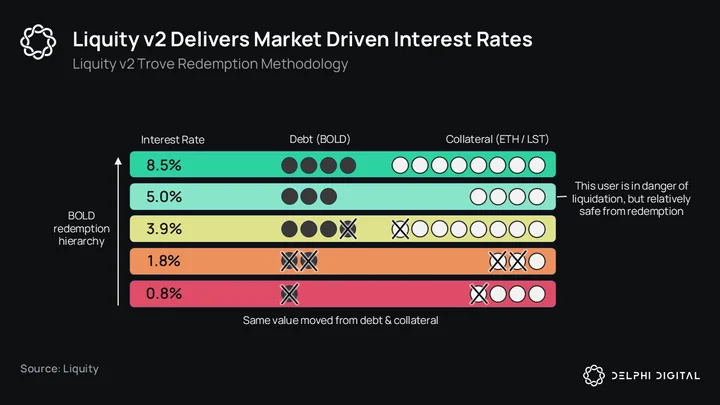
Liquity v2’s biggest design differences are its interest rate and redemption methodology. In Liquity v1, borrowers pay a one-time borrow fee up front, and troves with the lowest collateralization ratio are the first to be redeemed against. In v2, borrowers set the interest rate they are willing to pay. If BOLD falls below peg, the troves with the lowest borrow rate are redeemed against first.
Risk-tolerant borrowers may be willing to borrow at a low interest rate to save on costs, while users prioritizing trove safety may set an interest rate higher than the benchmark. Users can delegate interest rate management to third parties or use automated strategies to manage their borrow rate.
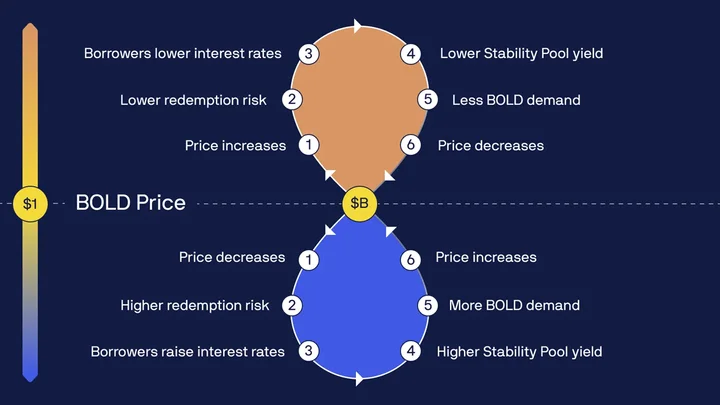
Natural arbitrage dynamics and backstop mechanisms have been sufficient for Liquity and Maker to weather black swan events in the past. BOLD’s user set interest rates introduce an additional lever to support a strong peg.
BOLD interest rates will react to price, further incentivizing course-correcting activity. When BOLD trades above $1, borrowing will carry lower perceived risk, putting downward pressure on rates and making leverage more attractive. When BOLD is below $1, increased redemption risk pushes borrow rates up, making borrowing less appealing and BOLD a more attractive purchase.
BOLD’s strong peg could inspire strong confidence in BOLD stability and r
Read the full report
This report is part of Delphi Pro.
- 800+ Pro reports across every major sector
- Talk directly with our analysts
- Private community of funds and builders
Already a Pro member? Log in

0 Comments