Executive Summary
Mantle Network, an Ethereum L2, has evolved immensely from its inception as the BitDAO initiative into a rebranded ecosystem that has aligned itself closely with the leading centralized exchange Bybit. Mantle was first conceived as an Ethereum scaling solution by community members. However, over the past couple of years, it has grown through a token merger, a rebrand, a full L2 chain launch, and a massive realignment with Bybit, which has essentially taken the helm.
This report details Mantle’s history and beginnings as BitDao up to the rebranded Mantle 2.0 Vision unveiled this month (August 2025), analyzing its technology stack, tokenomics, governance, and role shifts throughout its lifetime. It will also cover the most recent developments, notably that of ByReal (a DEX platform for real-world assets) and the appointments of Bybit executives Helen Liu and Emily Bao as key advisors.
Mantle 2.0 represents a significant shift in focus for the project, as Bybit’s increased resources and involvement bring more institutional-grade liquidity, exchange integration with Layer 2 rails, and a more explicit focus on bringing real-world tangible assets on-chain (see my securitization report for more details on what this means). This shift is not without its fair share of concerns, as it raises questions regarding the decentralization and governance of the chain and its autonomy. Mantle’s journey is a representation of the convergence of CeFi and DeFi, a very pertinent one at that, as we see more centralized entities integrating on-chain rails into their products (Robinhood Arbitrum stylus L2, Stripe L1, etc.) However, given the success of Binance’s BNB chain and token, it is very much worth keeping MNT and Mantle on your radar, given Bybit’s standing as one of the leading centralized exchanges in crypto, commanding over 25B in daily derivatives volume and 3-5 billion in daily spot volume.
Introduction
Mantle Network is an Ethereum L2 that emerged from the BitDAO community, a prominent DAO known primarily for its massive treasury and backing by some well-known funds such as Pantera, Founders Fund, Dragonfly, and more. This means that Mantle is the first L2 solution launched from a DAO. BitDAO itself was created in 2021 with the mission of providing funding and support for various Web3 endeavors. The likes of Bybit, Founders Fund, Pantera, and Dragonfly initially funded it, giving it enhanced credibility from the onset. Bybit committed a portion of its trading revenue towards BitDAO’s treasury, giving it a boost to become one of the largest war chests in the industry at the time. Thus, Mantle was initially born as a DAO proposal to build an Ethereum scaling solution leveraging their resources and decentralized governance.
In 2023, Mantle Network’s development reached critical mass. The BitDAO approved the proposal to unify the BitDAO and Mantle brands, doing so under the campaign slogan of “One Brand, One Token.” This proposal culminated in a consolidation of BitDAO’s $BIT tokens into Mantle’s $MNT. The initial aim of this merger was to streamline tokenomics and combine ecosystems ahead of Mantle’s official mainnet launch, which went live in July 2023 during EthCC in Paris.
Fast forward a year to 2024-2025, Mantle has now entered a new phase in its lifecycle, one that has thus far been characterized by a deeper consolidation with Bybit’s strategy, leadership, and financial rails. This new phase, known as Mantle 2.0, has begun with ByBit executives being installed as key advisors, an alignment of roadmaps with Bybit’s infrastructure, and an unveiling of new initiatives to combine CeFi and DeFi. While Mantle is still formally governed by token holders via the original DAO model, Bybit’s influence is now deeply ingrained. This report seeks to provide a comprehensive overview of Mantle, its history, and its future with Bybit as the broader crypto industry pushes more towards RWAs and rail adoption.
Origins in BitDAO
The Birth of BitDAO and Its Vision
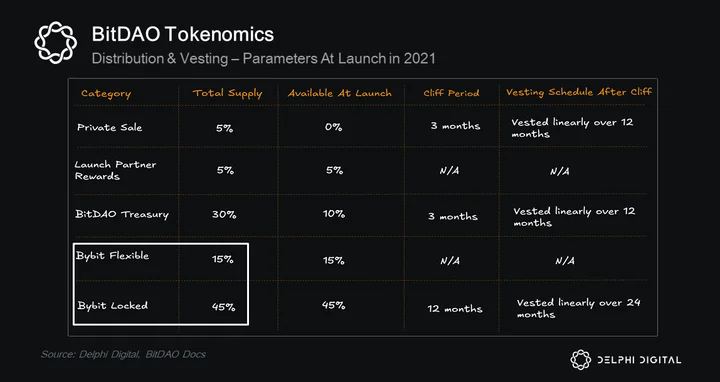
BitDAO was founded in 2021 with a mandate to support the growth of the decentralized economy. From the outset, it was one of the largest DAO-governed treasuries ever established, raising over 230 million from the get-go. The DAO’s treasury was primarily funded by none other than Bybit, which allocated a portion of its exchange fees towards the DAO, signalling its partnership from the very beginning. Bybit received around 60% of the initial $BIT supply in return for their treasury help, making Bybit both the most significant stakeholder and the number one treasury funder.
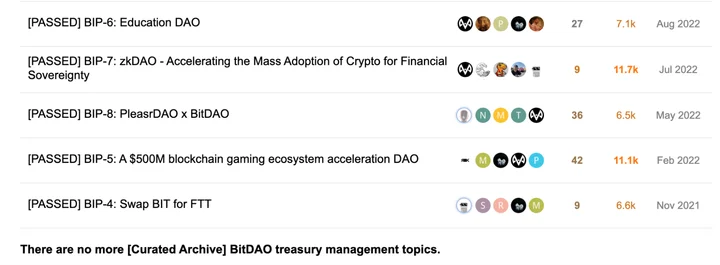
BitDAO’s original vision was to act as an incubator and decentralized investor in the DeFi sector at large. Its DAO structure gave $BIT holders the power to vote on all proposals for funding, partnerships, tokenomics, and more. BitDAO deployed its treasury into various projects and protocols, such as buying FTT (ouch), funding a web3 game called Game7, investing in education platforms like EduDAO, and investing 6.5 million into Ethereum NFT PleasrDao. BitDAO represented a new type of venture fund, one governed by a community, albeit a community where a few large holders held significant sway.
The Birth of Mantle
Mantle was first conceived as one such BitDAO incubation aimed at building out an L2 on Ethereum. The proposal was initially brought forth by community members, most notably Ben Zhou (Bybit CEO). The proposal suggested that BitDAO could utilize its capital to solve Ethereum’s need for lower-cost, faster transactions, as well as provide $BIT with additional utility as the native L2 token. Thus, BitDAO was trying to create the first DAO-governed blockchain network. The idea was accepted
Read the full report
This report is part of Delphi Pro.
- 800+ Pro reports across every major sector
- Talk directly with our analysts
- Private community of funds and builders
Already a Pro member? Log in
0 Comments