
Introduction
Mantle Network is a modular Layer 2 (L2) solution developed on the OP stack. It incorporates multiple fresh design elements in an attempt to enhance scalability and the chain’s user experience. Mantle’s core strategy is to try and establish the network as the premier native yield chain, facilitating effortless yield generation for users on the L2. It also takes on a differentiated approach to ecosystem building. Beyond just a chain, Mantle has pursued a strategic approach to assets, to ensure high standards of quality, rewards, liquidity, capital efficiency, and adoption across applications.
This report will examine Mantle’s native yield offerings, delineate its competitive differentiation from other yield chains, analyze the incentives for native yield generation, and identify potential gaps/areas for improvement.
Overview on mETH
Mantle’s Liquidity Staking Protocol (LSP) pools together ETH deposits from users and stakes it on their behalf, issuing mETH in return. This ETH is utilized to establish validator nodes on the Beacon Chain, thereby earning validator rewards. mETH is a yield-bearing asset, with the goal being yield generation + appreciation in underlying ETH over time. Presently, Mantle’s LSP is deployed on Ethereum Mainnet, with governance controlled by MNT token holders.
mETH Architecture
The Mantle LSP operates similarly to other liquid staking protocols, where ETH is deposited into a staking contract in exchange for mETH – a liquid staking derivative representing the staked ETH amount. Deposited ETH is then allocated to various node operators to establish 32-ETH validators to generate rewards. Mantle LSP levies a 10% fee on the yields generated, which is distributed between node operators and Mantle LSP itself.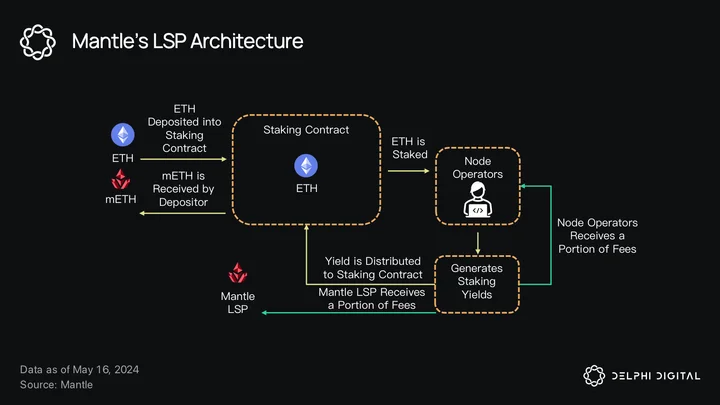
By developing its proprietary LSP, Mantle strategically mitigates value leakage to external protocols, such as Lido. This approach enables Mantle to capture returns by investing its treasury directly into its own products.
Mantle LSP to Split from Mantle’s Governance
On 30 Apr, 2024, a new proposal was introduced to the community, initiating a discussion on the future trajectory of mETH. This proposal includes two pivotal developments:
- The separation of mETH Liquidity Staking Protocol (LSP) from Mantle’s governance, coupled with the launch of its own dedicated token.
- The implementation of an opt-in strategy within the Mantle LSP to capitalize on higher-yielding opportunities, such as EigenLayer Restaking.
These proposed changes aim to enhance the autonomy and utility of the Mantle LSP, fostering greater flexibility and potential for yield optimization.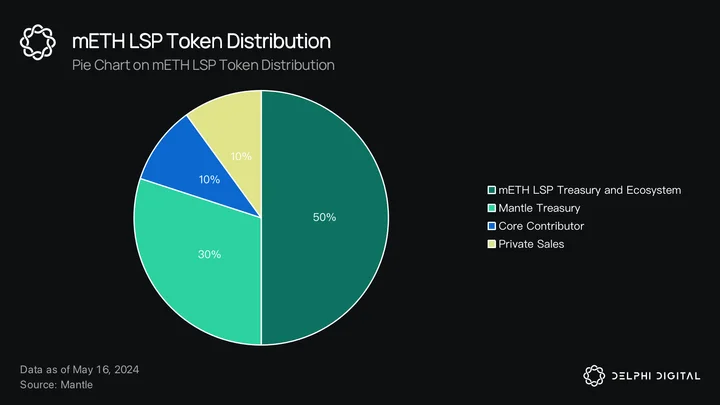
The proposed token distribution for the mETH Liquidity Staking Protocol (LSP) is outlined as follows:
- Mantle LSP Treasury and Ecosystem: at least 50%
- Mantle Treasury: a minimum of 30%
- Core Contributors: a maximum of 10%
- Private Sales: a maximum of 10%
This governance structure is designed to fortify mETH’s standalone value and market position by ensuring a significant allocation towards its treasury and ecosystem. With at least 50% of the tokens dedicated to mETH treasury and ecosystem, the protocol can implement various incentive programs, such as rewards for liquidity provision, a points program, or benefits for simply holding mETH. These initiatives are expected to not only stimulate demand and adoption of mETH but also significantly enhance Mantle’s Total Value Locked (TVL) as mETH becomes increasingly utilized with decentralized applications (dApps) on Mantle L2.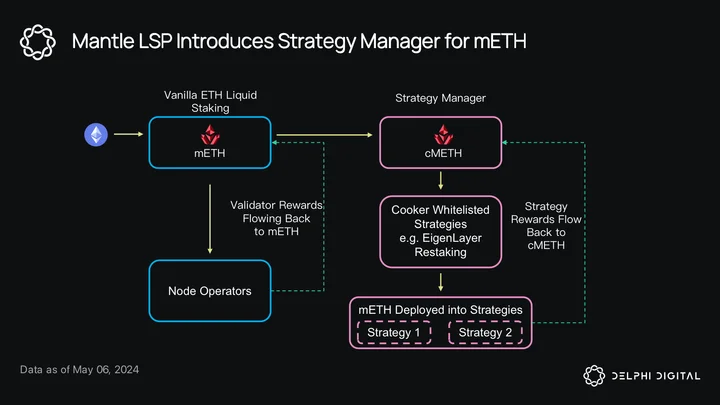
Mantle LSP is also set to introduce a feature known as the “Strategy Manager.” This function will enable mETH holders to deposit their tokens into a strategy contract that allocates mETH within the pool across various yield-generating strategies, supplementing the traditional staked ETH rewards. Users that deposited mETH into the strategy contract will receive cmETH. This addition provides mETH holders the option to engage with higher-yield strategies at their discretion, accommodating preferences for risk, such as participating in securing Actively Validated Services (AVS) through EigenLayer restaking.
The Strategy Manager operates similarly to Yearn vaults, where assets are dynamically allocated across different strategies to optimize yield generation. By adopting this model, mETH positions itself as a player in the liquid restaking token (LRT) sector, potentially drawing significant capital inflow through new tokens. This approach mirrors successful strategies seen in other LRT protocols like Renzo and Ether.fi, where incentive programs have significantly boosted protocol growth.
Furthermore, with Pendle already operational on Mantle, the approval of this proposal could lead to the next strategic move: integrating mETH into Pendle pools. This will unlock additional utility for mETH holders by enabling them to provide liquidity, hedge future yields. or speculate on mETH yields and rewards.
mETH Adoption Metrics
Since its launch in Dec, 2023, mETH has achieved substantial growth, capturing approximately 3.1% of the liquid staking market in just over six months. 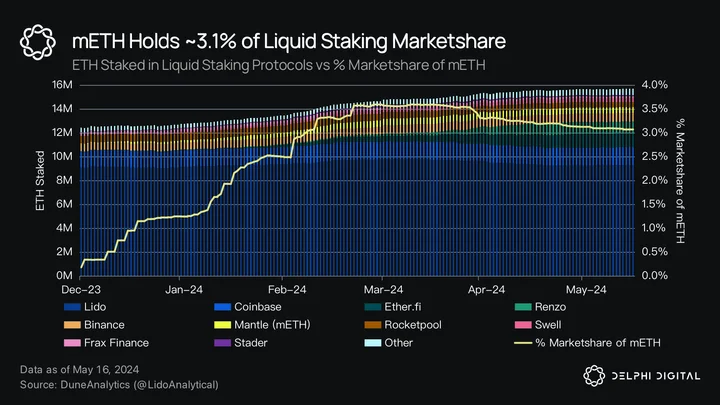
This growth places mETH among the top five protocols in the LST sector, positioning it just slightly behind established players like RocketPool.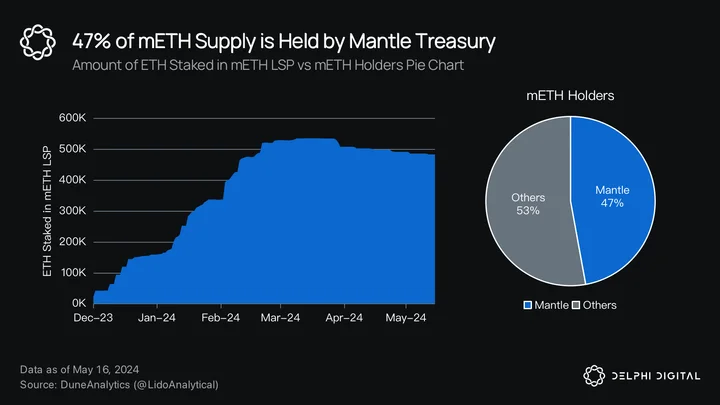 At its peak, mETH received ~528K ETH in deposits. Since then, there have been some withdrawals, with current ETH deposits now standing at around ~475K ETH. This change coincides with the launch of new LRT protocol tokens, suggesting that this is a function of capital rotation to take advantage of potential airdrops from these emerging protocols.
Additionally, Mantle has strategically employed mETH to generate staking yields on its treasury assets, depositing 218K ETH, representing 47% of the total ETH staked with mETH. This substantial investment serves multiple purposes: it bootstraps demand for mETH, provides liquidity support, and significantly enhances the protocol’s stability and attractiveness. The large-scale deployment of treasury assets into their own product not only demonstrates Mantle’s confidence in mETH’s robustness but also underscores their commitment to the protocol by giving them considerable “skin in the game.”
Mantle LSP Potential Revenue
Since Oct, 2023, the Mantle LSP has accrued 607 ETH in revenue through fees.
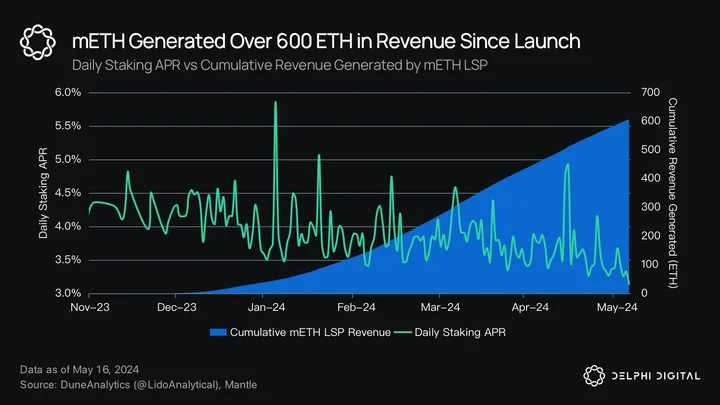
Based on the 30-day average of fee revenue, Mantle LSP is projected to generate approximately 1,740 ETH, equivalent to $5.38M in fee revenue. Assuming that 50% of these earnings are distributed to node operators, the protocol stands to gain $2.69M in annual earnings.
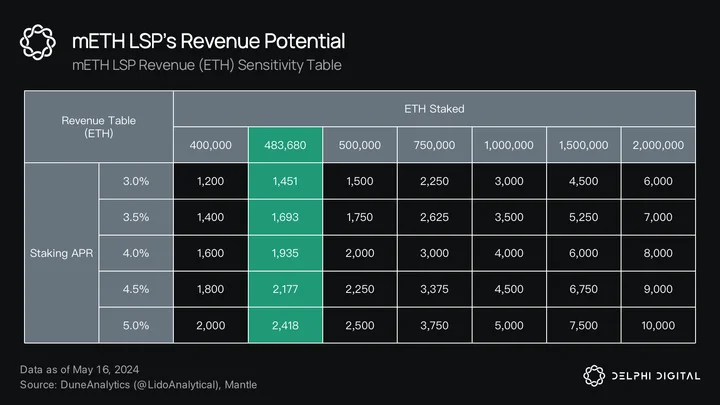
The Mantle LSP product will have the potential to generate significant revenue if they’re able to attract depositors. In its current state, mETH will generate ~1.4k to 2.4k ETH in annualized revenue. With mETH’s new token and strategy vault implementations, there is potential for further growth, given the right incentives. This underscores the financial viability and revenue-generating capacity of the Mantle LSP.
Overview of Stablecoin Equivalents on Mantle
Mantle has integrated three yield-generating stablecoin equivalents: USDY, mUSD, and USDe, each offering distinct mechanisms and benefits: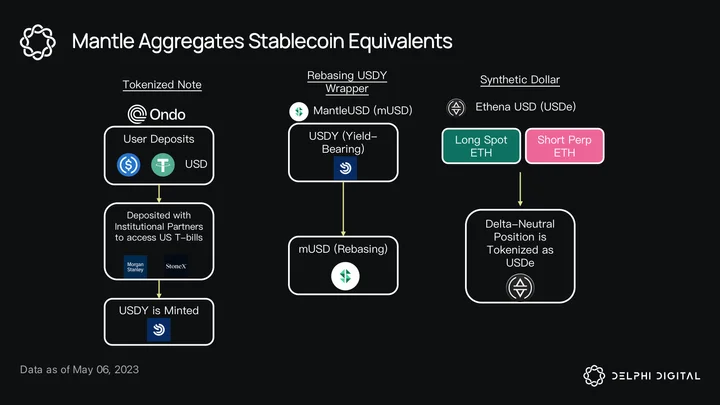
- USDY: Originating from Ondo, USDY is a tokenized note backed by U.S. T-bills, providing access to US Treasury yields. USDY is a yield-bearing token, accruing yields directly towards USDY and hence price is always >$1.
- mUSD: Acting as a rebasing wrapper for USDY, mUSD enhances the functionality of USDY by allowing it to seamlessly rebase, distributing yield earnings directly to holders.
- USDe: Developed by Ethena, USDe is a synthetic USD token that generates yields through a combination of long spot positions and short perpetual positions on ETH/BTC. To access these yields, USDe must be staked as sUSDe. However, staking for sUSDe is not natively available on Mantle and must be accessed from the Ethereum network. While both USDe and sUSDe can be bridged to Mantle, only USDe currently integrates with DeFi dApps on the platform.
Among these, USDe boasts the most extensive integration within Mantle’s DeFi ecosystem, with platforms like IntentX, Merchant Moe, and INIT Capital integrating USDe.
Stablecoin Adoption Metrics
USDY initially experienced significant growth, reaching a peak TVL of $60M. However, it has since become stagnant, with the current TVL at $41.3M. Conversely, USDe has been the primary growth driver for stablecoin equivalents on Mantle, largely due to the launch of Pendle and Mantle’s incentives involving EigenLayer points. USDe’s TVL surged to a high of $220M and currently maintains a robust position at $170M TVL. This dynamic underscores USDe’s substantial impact and popularity within Mantle Ecosystem.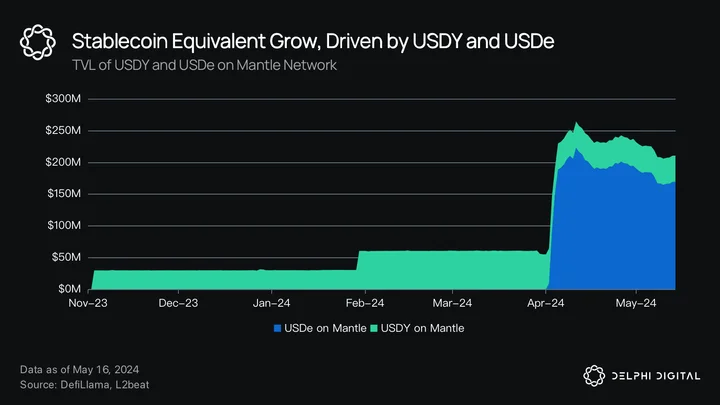
Comparing Native Yield Chains
Native Yield Comparison (ETH)
Though staked ETH on native yield chains may appear similar at first glance, their underlying mechanics differs: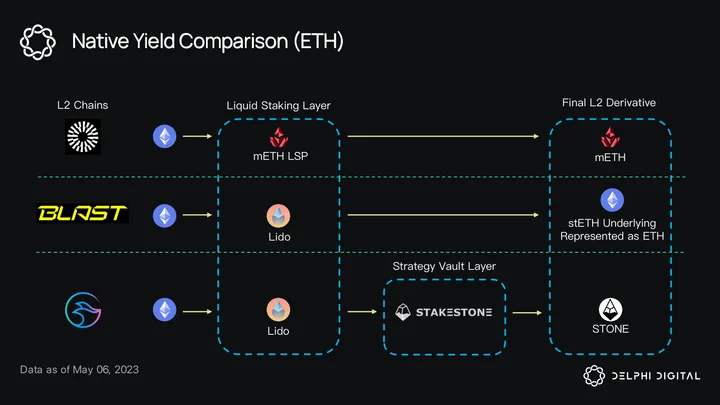
- Mantle: Mantle operates its own L1 on Ethereum. ETH is staked into mETH on L1, and mETH must then be canonically bridged onto Mantle to be utilized within the ecosystem.
- Blast: In the case of Blast, ETH is initially deposited onto the Blast bridge and subsequently staked into Lido to obtain stETH. This stETH is then represented as ETH within the Blast platform, allowing it to be utilized across various applications on the platform.
- Manta: When depositing ETH through the Manta bridge, users have the option to receive STONE, the liquid staking token (LST) from Stakestone. ETH deposited into Stakestone is deployed into whitelisted yield-generating strategies, predominantly involving staking into Lido to back STONE, which is then minted on the Manta Layer 2 (L2) network.
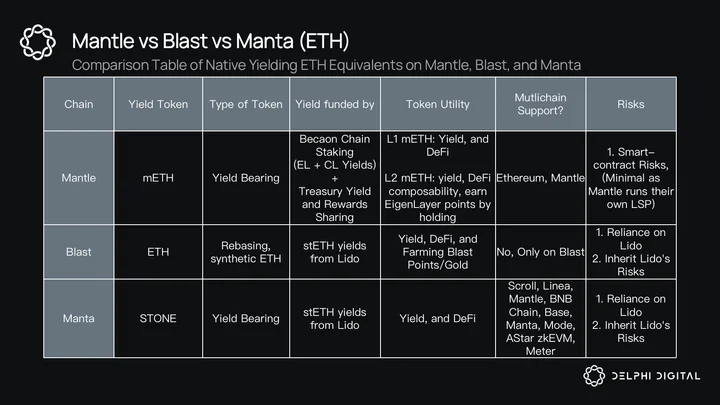
Mantle and Manta both provide yield-bearing options, whereas Blast operates with a rebasing synthetic ETH derived from stETH.
Yields:
- Mantle: Yields from mETH are directly derived from validator rewards. Additionally, mETH holders on Mantle L2 can benefit from unique incentives such as double boosts and EigenLayer points.
- Blast and Manta: Both platforms utilize Lido’s infrastructure for their yield mechanisms. However, unlike mETH, they generate yields indirectly through Lido.
Utility:
- mETH is primarily utilized to capture yield on Mantle L2 through DeFi integrations. Mantle enhances its attractiveness by offering additional incentives like EigenLayer points for holders on L2.
- Blast enriches user engagement by providing Blast points and rewards like ‘Gold’ for participating in dApps on the Blast platform.
- StakeStone currently doesn’t have a token yet, so holding STONE could potentially result in an airdrop for the holder
Multichain Accessibility:
- mETH: Available on Ethereum and Mantle.
- Blast: Restricted to the Blast ecosystem on Ethereum.
- STONE (on Manta): Widely available across over 10 chains as an Open Financial Token (OFT), it is not native to the Manta ecosystem.
Risk Profiles:
- mETH: Faces smart contract risks inherent to its validator operations.
- ETH on Blast: Subject to reliance on Lido, inheriting Lido’s systemic risks, plus additional smart contract risks associated with bridging to an externally owned account (EOA) contract.
- Manta: Also reliant on Lido, inheriting similar systemic risks. Furthermore, it carries additional smart contract risks from its use of StakeStone for its yield strategies.
Each platform offers a distinct approach to integrating staked ETH, which influences their respective risk profiles and utility within the broader DeFi landscape.
Native Yield Comparison (Stablecoins)
While all three chains offer stablecoin exposure to U.S. T-bills to generate yields, they each utilize different protocols and mechanisms: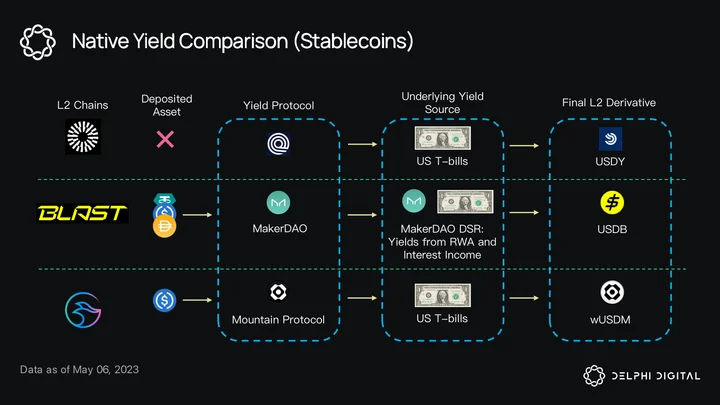
- Mantle: Mantle integrates Ondo’s USDY, a tokenized note backed by U.S. T-bills, which can be canonically bridged onto Mantle Layer 2 (L2). This allows users to directly access yields from U.S. T-bills through USDY on the platform.
- Blast: Blast offers a unique bridge that accepts popular stablecoins such as USDC, USDT, or DAI. These are either converted into DAI or deposited into the Dai Savings Rate (DSR) to generate yield. From these operations, Blast mints USDB, a native rebasing stablecoin that automatically allocates accrued yield to its holders, enhancing its utility and attractiveness.
- Manta: On Manta, users can deposit USDC, which is then routed through the Mountain Protocol, a Real-World Asset (RWA) protocol that generates yields by investing in U.S. T-bills. Manta then issues wUSDM, a wrapped and yield-bearing version of USDM, on its L2 to represent these holdings and yield opportunities.
Differences in Conversion and Bridging:
- Blast and Manta provide a direct conversion of stablecoins like USDC into their native yield-bearing derivatives, USDB and wUSDM, respectively, streamlining the process for users to engage with yield opportunities on their platforms.
- Mantle, in contrast, does not offer a direct conversion into native stablecoins but enables the use of stablecoin equivalents such as USDY, which need to be bridged onto Mantle L2. This approach offers direct exposure to U.S. T-bills yields but involves an additional step for users to access these assets on Mantle’s platform.
These strategies reflect the diverse approaches each platform employs to attract stablecoin deposits into yield-generating opportunities, tailored to their specific ecosystem dynamics and user preferences.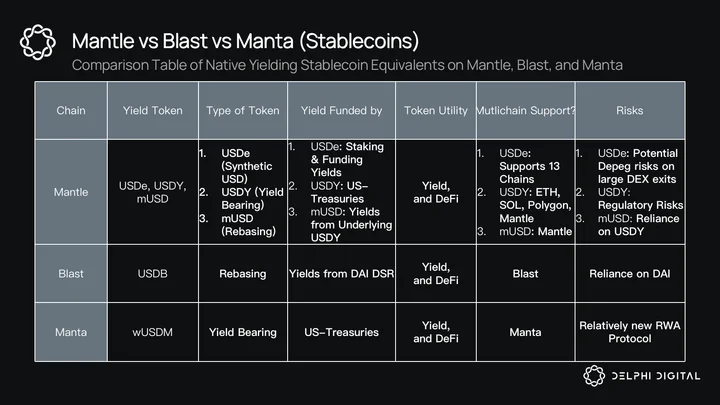
Mantle provides three stablecoin options:
- USDe by Ethena: A synthetic USD collateralized by long spot ETH/BTC positions and short perpetual ETH/BTC positions. It generates yields through staked ETH rewards and funding income, though its staked version, sUSDe, has limited adoption on Mantle.
- USDY from Ondo: A yield-bearing stablecoin backed by U.S. Treasury bills, offering direct access to secure, interest-bearing assets.
- mUSD: A rebasing version of USDY that is available on Mantle, adjusting its supply to distribute yield directly to holders.
Blast features the rebasing USDB, which is backed by DAI staked in the Dai Savings Rate (DSR). Yields generated are automatically rebased into the holders’ balances, simplifying the yield accumulation process.
Manta offers wUSDM, a wrapped version of USDM that is inherently yield-bearing. This stablecoin is designed to facilitate ease of use and integration within the Manta ecosystem.
Availability and Integration:
- Blast and Manta’s stablecoins are exclusive to their respective chains, focusing on enhancing their native ecosystem utilities.
- Mantle’s stablecoins, except for mUSD, are not native to Mantle and support multichain operations, broadening their usability and integration potential across various blockchain networks.
Risk Profiles:
- USDe: Faces potential short-term depegging risks, especially during large DEX swaps.
- USDY: Carries regulatory risks associated with RWA, which may affect its operation or valuation.
- mUSD: Dependent on the performance and stability of USDY, inheriting its risks and benefits.
- USDB: Tied to the performance and risk profile of DAI, including any systemic risks associated with DAI.
- wUSDM: Like USDY, it involves regulatory risks related to its backing by real-world assets, and faces additional challenges as a relatively new protocol.
These offerings highlight the varied strategic approaches to stablecoin yield generation and risk management, tailored to the specific needs and conditions of each blockchain platform.
Additionally, Mantle is deepening its involvement in the Bitcoin Ecosystem. Mantle is a core contributor to FBTC, an omnichain Bitcoin asset pegged 1:1 to BTC. FBTC is designed to enhance BTC accessibility and utility by providing seamless interoperability and diverse yield opportunities. This initiative is supported by robust expertise and a broad network to ensure long-term resilience and viability.
FBTC is optimally positioned to enable users to maximize yield returns on their idle BTC holdings, tapping into the expanding Bitcoin finance (BTCFi) scene. For more details, visit FBTC on X and FBTC on Medium.
How Mantle’s Treasury Benefits Mantle L2?
Unlike other L2s, Mantle benefits from a substantial treasury that has facilitated the foundational development of its platform and provides unique support to its ecosystem.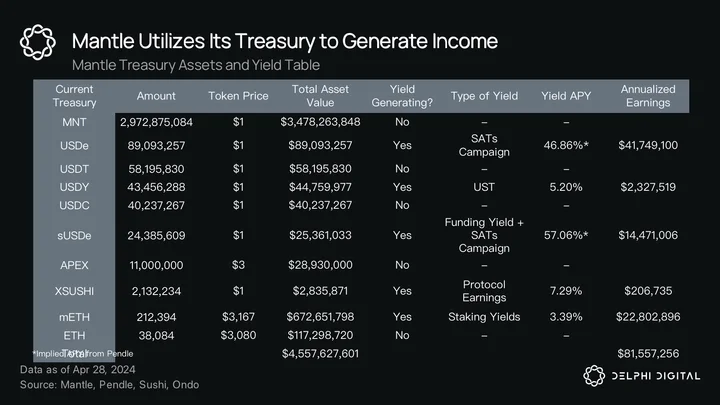
Mantle’s treasury is currently valued at approximately $4.55B, generating an estimated annualized yield of $81.6M. This significant financial resource has been strategically utilized to bolster Mantle’s own products, particularly the Mantle LSP. Notably, Mantle holds 212K mETH, which represents a significant portion of the total mETH supply, illustrating their substantial commitment and investment in the success and stability of their proprietary offerings.
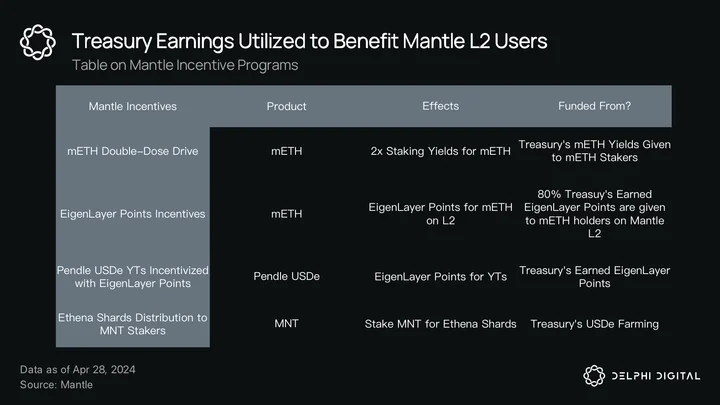
Mantle strategically utilizes its treasury to generate yields that are then channeled back to users through various incentive programs. Here’s an overview of how Mantle has implemented these incentives:
- mETH Double-Dose Drive: This program offers mETH stakers on Layer 2 (L2) double the base staking yield, positioning it as one of the highest-yielding liquid staking tokens (LST). The additional yield is funded by the treasury, which redirects earned yields towards mETH stakers, thereby enhancing their returns.
- EigenLayer Points Incentives: Mantle has restaked 100,000 mETH to EigenLayer, and 80% of the resulting points are distributed to mETH holders on L2. This arrangement allows users to benefit from the restaking rewards without direct exposure to additional smart contract risks, albeit at a lower rate compared to direct staking.
- Pendle USDe Incentives with EigenLayer Points: Although Ethena and EigenLayer are not directly linked, Mantle Treasury has incentivized the USDe pool with 0.0012 EigenLayer points per USDe per day. This generous incentive aims to boost participation and liquidity in the pool.
- Incentives from ENA’s Launch: Prior to the launch of ENA, Mantle Treasury purchased USDe and earned Ethena Shards, which are now distributed to MNT stakers. This strategy has resulted in an average of 48.8% APY for MNT stakers, significantly enhancing their investment returns.
These initiatives highlight Mantle’s proactive approach to using its treasury to support its ecosystem, drive user engagement, and provide substantial rewards to its stakeholders.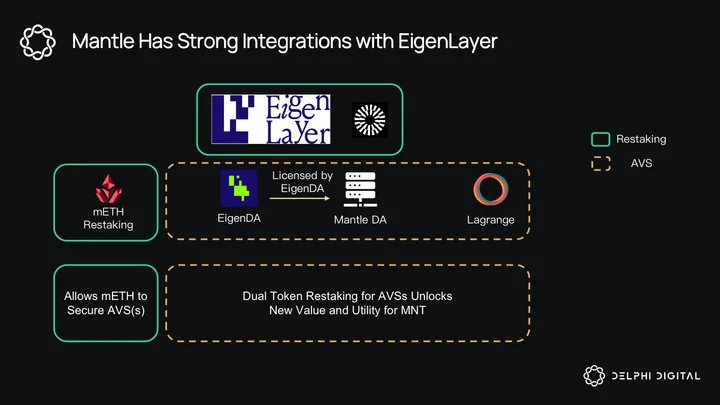
Mantle has strategically aligned itself with EigenLayer to enhance its offerings and ecosystem:
- Integration with EigenLayer for LST Restaking: Mantle’s mETH has been integrated with EigenLayer, enabling LST restaking. This integration highlights Mantle’s commitment to leveraging new offerings to enhance yield opportunities for its users.
- Distribution of EigenLayer Points: Mantle Treasury actively distributes EigenLayer points through various incentive programs, aligning user interests with EigenLayer exposure. This not only incentivizes user participation but also integrates Mantle more deeply with the EigenLayer ecosystem.
- Adoption of Mantle DA and EigenDA Technologies: Mantle L2 was initially launched with the vision to be a modular layer 2 with its Data Availability (DA) layer utilizing EigenDA technology. Subsequent upgrades led to the introduction of Mantle v2 Tectonic, which employs Mantle DA. This is powered by and licensed from EigenDA technology provided by EigenLabs. Although Mantle DA is a temporary solution, it is planned to transition to EigenDA following the launch of its mainnet.
- Investment in Lagrange: Mantle has invested in Lagrange, an EigenLayer Automated Validator Service (AVS), and also committed $10M in MNT for its deployment on Mantle Network. Lagrange’s state committee serves as a light client for optimistic rollup state, enabling cross-chain applications to operate without the typical seven-day fraud-proof waiting period.
These initiatives demonstrate Mantle’s proactive approach in integrating and collaborating with EigenLayer to drive innovation and user benefits within its network.
Conclusion
Mantle is strategically leveraging its extensive treasury and diverse product offerings to position itself as a leading L2 for yield across various assets, including BTC, ETH, and stablecoins.
The ability to bootstrap its own products, such as the Mantle LSP, while simultaneously using its treasury to generate yield income, ensures the initial success and sustainability of its offerings.
This comprehensive approach not only enhances user confidence but also cements Mantle’s reputation as a dynamic and reliable platform for diversified yield opportunities. As Mantle continues to expand its suite of products, it is set to attract and retain a broad user base, eager to capitalize on the robust yield opportunities it provides.
0 Comments