Report Summary
Summary of “MegaETH: Performance to Compete With TradFi” Report
The report explores MegaETH’s innovations in blockchain infrastructure, positioning it as a high-performance Layer 2 (L2) solution designed to compete with traditional finance (TradFi). The document highlights how MegaETH optimizes for ultra-low latency, making it an attractive platform for algorithmic trading, high-frequency trading (HFT), and institutional adoption.
Key Takeaways:
1. Market Landscape & Need for Performance
- DEX Growth: Decentralized exchanges (DEXs) are capturing an increasing share of trading volume, with DEX-to-CEX volume ratios reaching 20% in early 2025.
- Institutional Demand: TradFi participants require low-latency infrastructure to migrate to on-chain trading. MegaETH addresses this gap by offering execution speeds 1-2 orders of magnitude faster than existing blockchain networks.
- Deregulation Tailwinds: Shifts in U.S. regulatory policy (such as President Trump’s executive order) could provide clearer legal frameworks for institutional adoption of decentralized markets.
2. MegaETH’s Key Technical Innovations
- Ultra-Low Latency Architecture:
- Single Rotating Sequencer reduces consensus overhead, enabling 1-10ms latencies, significantly faster than Ethereum or Solana.
- Co-location Advantage allows market makers and HFTs to position themselves closer to the sequencer, mirroring TradFi infrastructure.
- Predictable Latency Profile ensures more stable execution speeds compared to L1 blockchains, where randomness in leader selection impacts performance.
- Optimized Execution & Storage:
- Ahead-of-Time (AOT) Compilation converts smart contracts to low-level machine code, reducing execution time.
- Parallel EVM Processing eliminates strict transaction ordering, maximizing hardware efficiency.
- In-Memory Processing stores “hot state” in RAM, eliminating disk I/O delays and accelerating state transitions.
- Consensus-Free Transactions reduce communication rounds between nodes, further minimizing delays.
- Data Availability (DA) & Scalability:
- EigenDA Integration: MegaETH uses alternative DA solutions like EigenDA instead of Ethereum blobs, unlocking 100K+ TPS scalability.
- No Gas Limits: Transactions are executed before being packed into blocks, allowing complex operations without artificial gas constraints.
3. Addressing Trade-offs & Challenges
- Centralization Concerns:
- A single sequencer raises censorship and liveness risks.
- Solution: Sequencers post Ethereum-based collateral, with slashing mechanisms to deter malicious behavior.
- Standby Sequencer: A backup system ensures network continuity in case of failures.
- MEV & Market Fairness:
- FIFO ordering is explored to prevent unfair MEV extraction.
- The platform is considering SGX (Secure Enclave) attestations for ensuring order integrity.
- Bridging & Liquidity Fragmentation:
- L2 adoption remains low (~3% of ETH is bridged).
- UX barriers in cross-chain transactions remain a challenge.
4. Ecosystem & Applications
- MegaMafia & MegaForge: A curated ecosystem of builders focused on high-performance applications.
- Key Applications on MegaETH:
- GTE (Decentralized Exchange): A CEX-like DEX benefiting from MegaETH’s low-latency execution.
- Euphoria (Mobile Derivatives Trading): “One-tap trading” aimed at simplifying derivatives for retail users.
- AWE (Autonomous World Engine): A web-based 3D gaming engine leveraging MegaETH’s real-time capabilities.
5. Competitive Landscape & Future Outlook
- Challenges for L2s: Most rollups struggle with DA saturation and high fees, limiting scalability.
- MegaETH vs. Solana: Solana currently leads in trading volume and stablecoin activity, but MegaETH’s low-latency innovations could attract institutional adoption.
- Future Growth: MegaETH’s strategic bet on performance-first blockchain infrastructure could make it the preferred platform for TradFi migration.
Conclusion
MegaETH is pioneering an ultra-fast, institutional-grade L2 optimized for HFT, algorithmic trading, and real-time applications. By prioritizing low latency and co-location advantages, it aims to bridge the gap between TradFi and DeFi. While concerns about sequencer centralization and liquidity fragmentation remain, MegaETH’s architecture is well-positioned to capture significant market share in the emerging on-chain financial ecosystem.
Performance, Deregulation & a Bull Market
Algorithms dominate modern financial markets. In traditional finance, these sophisticated systems operate at microsecond latencies which need infrastructure to match it. This has historically given CEXs their edge – only they could provide the ultra-low latency execution these systems demand.
But recently, the ratio between decentralized and centralized exchange volume has reached historic highs, with DEX/CEX volume hitting 20% in January 2025. This isn’t just an incremental improvement – it signals a structural shift in how markets operate. This growth of DEXs is also due to increased demand for long tail pairs which are on-chain compared to larger pairs which are more dominant on the CEXs. The growth of memecoins on Solana has helped Raydium capture a large market share in the spot DEX market. The success of Hyperliquid and Raydium demonstrates the massive untapped demand for institutional-grade DEX infrastructure. The bull market, demand for long tail assets, improved performance has led to increased appetite for DEXs.
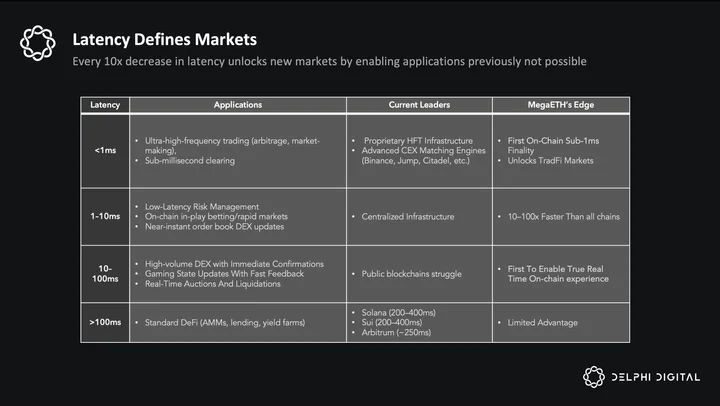
In this landscape, MegaETH has made design choices which allow it to achieve latencies of 1-2 orders of magnitude lower than existing chains like Solana, which are already very fast. Co-location with the sequencer allows market makers and HFTs to position themselves optimally, enabling hundreds more trades per time window compared to other chains with consensus. This velocity can drive more efficient price discovery and tighter spreads, benefits that flow to all market participants. This latency is one of the major differentiators and emergent properties of the tradeoffs available only to an L2, under-explored before. It’s perfectly suited to the needs of sophisticated market makers who drive efficient onchain price discovery.
Removing the latency gap between CeFi and DeFi will be a key driver for the mass adoption of DeFi applications.
You can now build dapps that are as fast as CEXs. https://t.co/VxdzrdOR5v
— Cem | Sovereign (@cemozer_) January 29, 2025
MegaETH’s market timing also aligns perfectly with the shift towards broader deregulation, the bull market, increased institutional & retail volumes and a higher appetite for risk. President Trump’s executive order is a strong catalyst towards regulatory clarity. This removes barriers to institutional participation, which will unleash significant trading activity into decentralized markets, which is generally algorithmic. Having infrastructure that allows these institutions to make trades is an important ingredient for a smart contract platform.
4/ Banking access for all – end of Operation Chokepoint 2.0!
The administration is mandating fair access to banking services for law-abiding individuals and businesses in the digital asset space.
No more blacklisting by financial institutions of crypto businesses or people.
— Avichal – Electric ϟ Capital (@avichal) January 23, 2025
MegaETH sits at a confluence of these forces
- Reduced regulatory barriers, increased demand and institutional participation
- Algorithmic trading demands institutional-grade infrastructure having ultra-low latencies and high throughput
- DEX adoption increasing and ratio of DEX to CEX at all time high, signaling strong demand
- Bull market conditions that need real scalability and stress tests the infrastructure
Ultra-Low Latency: Only Possible On MegaETH
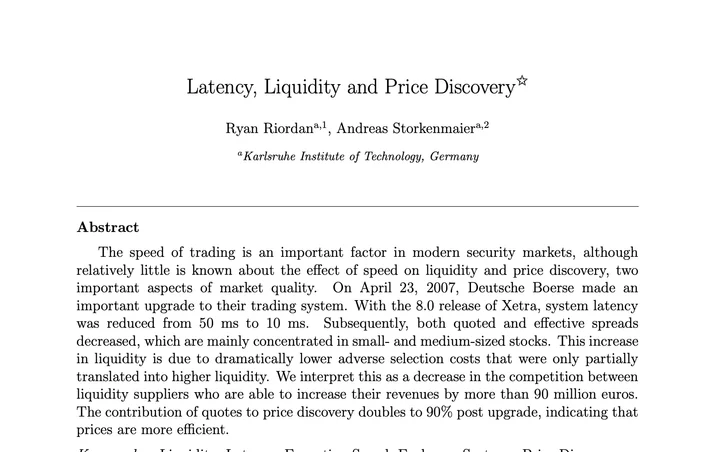
Market speed and latency fundamentally shapes how prices form and how markets handle stress. Once systems cross a certain threshold in latency, price discovery shifts from depending on actual trades to flowing through quote updates. This creates a feedback loop – faster quotes lead to more accurate prices, which enable even better quotes, transforming how information enters the market. At the same time, this speed acts as a stabilizing force during turbulent periods, letting markets maintain quality even under stress.
The impact of latency is not just important in financial markets, but also gaming, where the evolution from arcade machines to modern esports shows how crucial immediate responsiveness is for engaging and “fun” experiences. The multi-billion dollar esports industry proves that ultra-low latency makes games engaging and competitive. L1s and Rollups have struggled to meet these performance demands, with relatively longer block times and finality ranging from 200ms to several seconds hindering the developers ability to build fun games.
Latency is one of the stronger differentiations for MegaETH and a result of its unique positioning – an L2 squeezing out hardware optimization and scale to its maximum. And it’s not just scaling the hardware, it’s also about making it efficient. MegaETH’s use of software and hardware to efficiently provide low latencies is unique and a product of a bold acceptance of L2 tradeoffs. To appreciate MegaETH’s solution, we must first understand the inherent latency challenges of traditional architectures and then explore how MegaETH changes this.
If we look at transaction latency, it is a compounding issue which accumulates across network propagation, consensus, block construction, and state updates. Each stage introduces delays, and optimizations in one area often create bottlenecks elsewhere. For example, faster block times can lead to issues like state bloat. However, MegaETH takes different design decisions, which fit in today’s financial markets, where latency is the ultimate competitive weapon.
Technical Innovations
MegaETH brings in a number of architectural innovations to reduce latency and increase throughput for applications. What’s most impressive about MegaETH’s solution is that they took a first principles approach by profiling the execution and discovered bottlenecks in a data driven manner. This allowed them to come up with in-memory processing, a new database, new MPT structure, AOT compilation and a number of other technical innovations to address each of them.
 MegaETH architecture
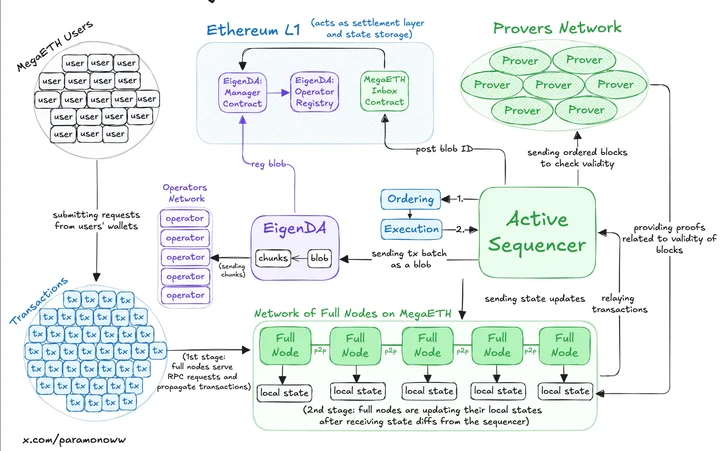
First is MegaETH’s sequencer which is the biggest shift in its design. In an L1, consensus and frequent communication between geographically dispersed nodes is a source of its latency. MegaETH uses a single, rotating sequencer. This is not about centralization; it’s about optimization specifically designed for
- Co-location Advantage for Market Makers and HFTs: By enabling market makers and HFTs to co-locate directly with the sequencer, it offers a two orders of magnitude reduction in latency. This is not just an incremental improvement; it provides algorithms with a competitive edge that would lead to better price discovery and transform it into the algorithmic trading venue of choice. This co-location advantage becomes even more critical as deregulation potentially unleashes a flood of TradFi capital, demanding infrastructure that mirrors their existing low-latency systems.
- Predictable Latency Profiles: The single sequencer also gives a predictable latency profile, in contrast to random leader selection in Layer 1s. This predictability is essential for sophisticated algorithmic strategies.
- Software optimizations: During its execution, the sequencer takes smart contract code and turns it into machine code before running. During execution, this can take up more time than the execution itself, becoming the bottleneck. “Ahead of time” (AOT) compilation means the code is already in a form of low level machine code which the computer understands directly. This reduces the time for execution. The Sequencer also combines this with parallel processing. Parallel EVM in MegaETH is different compared to others. Generally transactions are ordered and have to be executed ensuring the order is preserved. But in MegaETH’s implementation, the EVM is fed with a stream of transactions which are executed to maximize the hardware utilization. It doesn’t need to adhere to any order. This allows them to have more freedom and exploit parallelism better.
- Consensus-Free: One of the most opinionated decision by MegaETH is not to add consensus to the sequencer. Since consensus requires multiple trips between nodes and physically bounded by speed of light, there is no way to eliminate or improve it using any software improvements. Removal of consensus reduces the number of rounds, which help it achieve 1-10 ms latencies.
Another interesting addition is that they have removed gas limits. The sequencer executes transactions first before ordering and packing them in blocks. This means arbitrarily large transactions can use whatever compute they need and get packed into blocks when they finish – no more artificial gas limits. This opens up some interesting possibilities, especially for compute-heavy operations like TEE attestations that typically wouldn’t fit within traditional gas constraints. Since this design space is so new, we’re likely to see builders come up with innovative ways to leverage this capability.
Next, the management of state, which is the biggest bottleneck for MegaETH. MegaETH uses in-memory processing where “hot state” resides directly in RAM. This has huge implications
- Immediate State Access: By completely eliminating disk I/O latency, it provides instantaneous state access which unlocks the potential for truly high-frequency strategies on-chain
- Direct Memory Manipulation: Near-Instantaneous State Transitions – Direct memory manipulation enables near-instantaneous state transitions. The difference between disk and RAM access is 3-4 orders of magnitude, which directly translates to reduced latencies.
Building on this, the database layer in MegaETH is a custom-engineered, ultra-low latency system. MegaETH’s database competes with recent innovations like LayerZero’s QMDB.
This combination creates a compounding effect. The latency reduction benefits sophisticated algorithms, market makers, and HFTs, enabling them to execute hundreds of times more trades within the same timeframe, maximizing profitability. While not directly perceptible to average users, this algorithmic activity has downstream effects of tighter spreads and enhanced price discovery, ultimately benefiting all users. This also improves responsiveness across all the applications to the point they feel web2.
Trading, which is one of the defining use cases for blockchains, is significantly enhanced on MegaETH. Its latency advantage positions it to further accelerate the shift towards DEXs. As deregulation lowers barriers for TradFi institutions, MegaETH’s infrastructure could become a compliant and performant on-ramp to absorb this flow of capital into on-chain markets.
The other side of the tradeoffs are concerns of sequencer centralization since there is just a single sequencer. MegaETH addresses this in few ways. First, the sequencers must post bonds on Ethereum, incentivizing against malicious behavior. Malicious actions trigger slashing which ensure sequencer accountability. Liveliness is also addressed by maintaining a standby sequencer which keeps running in case the active sequencer goes offline. Since the sequencer computes in memory, the team has devised a way to flush it into longer term storage frequently so that disruptions with RAM have a fallback.
Censorship resistance is another concern, especially with a beefy single sequencer. But recent Soneium experience proves that Censorship resistance against a malicious sequencer works.
since i’ve seen a lot of bad takes regarding L2s and their censorship resistance, here’s how i bypassed @soneium‘s sequencer and bought a banned token with a forced tx through L1 🧵 https://t.co/4BzveajLkw pic.twitter.com/5Mfop9I9M3
— donnoh.eth 💗 (@donnoh_eth) January 14, 2025
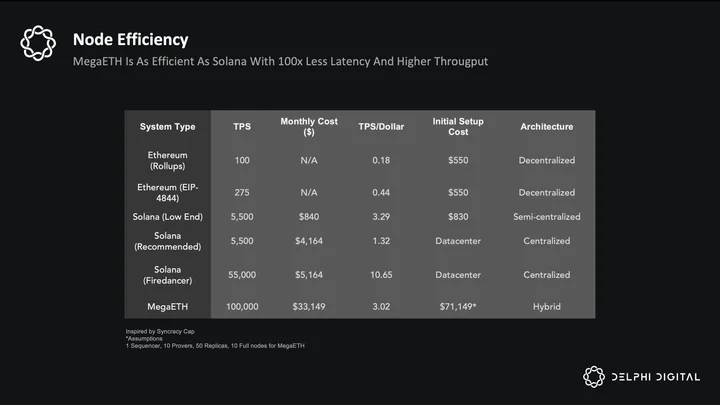
To not compromise on decentralization, MegaETH has regular full nodes and have also deconstructed the traditional full node into prover and replica nodes. A network of Prover nodes receive individual blocks from the sequencer, re-execute the transactions and generate validity proofs for them. So instead of all prover nodes re-executing and needing more hardware for it, the load is divided into the network. The replica nodes maintain the state after receiving the state diffs from sequencer and proofs from provers. This node specialization reduces hardware requirements for individual participants, allowing broader participation and while still keeping it performant.
A single beefy sequencer also raises concerns about unrestrained MEV capture. MegaETH would use FIFO ordering and are exploring the use of SGX for proving the integrity of the ordering. But trusting hardware enclaves is also a trade-off, as any flaw in Intel SGX or a leaked attestation key could undermine that guarantee. If MEV is not handled properly, this could be an issue as applications like DEXs generating demand would need high participation from market makers and extracting MEV on their transactions would discourage and erode value prop. Having centralized sequencer and co-location could also lead to centralization in searchers and market makers and capture of value by few players similar to Ethereum Builder market. These are generally important questions for all L2s and particularly important for MegaETH to address.
Current state of L2s and how MegaETH fits
The Layer 2 landscape is at a crucial point. Most rollups are pursuing a standardized playbook of using Ethereum for their DA, decentralized sequencers, lack of parallel execution and are indistinguishable from one another. Apart from a few like Aztec, Arbitrum with WASM and a few others, most rollups are not adding new execution capabilities. This is one of the criticisms from Solana community and their attempt to break away from this by renaming L2s as ‘Network extensions’. These are supposed to bring innovation and add functionalities which are not possible on the L1.
Sure. Apps that move their users to their own L2 or L1 in a zero sum way are obviously moving revenue of the L1. That’s no good either.
It makes no difference to me if they inherit solana security or not. wtf would I care, I want to use the mainnet version.
— toly 🇺🇸 (@aeyakovenko) September 2, 2024
MegaETH breaks away from this convergent thinking. It is prioritizing performance like Solana and accepts the tradeoffs that come with it. The differentiation doesn’t come from incremental improvements, but from fundamentally rethinking what’s possible.
Where others are focused on decentralized sequencing (which is important), MegaETH is opting for ultra-low latency through a single rotating sequencer. MegaETH keeps hot state in memory instead of disk. It also enables features for market makers like co-location – bringing traditional finance capabilities on-chain for the first time.
MegaETH is not trying to be another generic general-purpose L2. Instead, its technical components, tradeoff choice is primarily meant for applications that want to focus on high performance.
Ethereum Rollups are dealing with a serious handicap: DA saturation and the increasing costs that come with it. Because the current blob capacity is not sufficient, the ability to scale and compete with high-performance L1s like Solana is severely limited, even all of them taken cumulatively. Solana has captured the high-volume, low-cost market segment, consistently leading in trading volume, revenue, and user activity with recent token launches like MELANIA and TRUMP. Solana’s success with TRUMP and MELANIA wasn’t just short term. It has increased the Stablecoin supply on Solana by almost double. This will probably lead to increased activity in serious DeFi. In contrast, rollups—despite their supposed technical advantages—are failing to match Solana’s throughput and cost metrics even when all are taken together. Rollups are collectively doing less than 300TPS today and unless DA capacity is pushed to maximum, will always less than monolithic L1s in coming years.
Not enough DA. This will leave Ethereum rollups in 2027 handling less capacity than (FD-enabled) Solana this year.
The Numbers:
DA Capacity has been at it’s limits since November, which equates to ~214 cumulative TPS across all rollups before median fees increase (also across… https://t.co/1udP0dIANx pic.twitter.com/aLukqzZIWm— BREAD | ∑: (@0xBreadguy) January 8, 2025
Ethereum’s current blob DA limit of about 32 KB/s is already used to its max. Base alone, averaging roughly 20 MGas/s, uses about 11 KB/s—fully one-third of the total supply. This not only leaves minimal room for other L2s but also triggers Ethereum’s blob-pricing mechanism, causing exponential fee hikes as usage surpasses 50% of capacity. Base and Worldcoin together consume 55% of the blob supply, and are expecting to 10x their usage in coming years which needs blob supply to increase of some serious improvements in compression.
Two chains in the Superchain (@base @worldcoin) already comprise 55% of blobspace, and we’re only growing.
At projected Superchain growth rates, we’ll hit congestion again in May after Pectra.
Let’s continue making Ethereum DA strong and competitive. What’s the soonest blob… https://t.co/ORHwFCyOAP
— Optimist Prime (@jinglejamOP) January 17, 2025
The upcoming Pectra upgrade, which aims to double blob capacity, would only provide a temporary relief. For high-throughput L2s like MegaETH or Eclipse which are designed for orders of magnitude more transactions and gas usage—Ethereum DA is fundamentally insufficient and economically unsustainable for large-scale, long-term competitiveness. Blobs on Ethereum simply cannot support L2s aiming for genuine performance and cost superiority over monolithic L1s like Solana. Pushing toward 1 GGas/s or higher, which is critical for algorithmic finance and advanced real-time applications, is unachievable without a decisive break from Ethereum’s limited DA layer.
In practice, this DA bottleneck limits L2s in two main ways:
- Economic Limits:Rapidly rising DA fees—triggered by blob saturation—erode the core L2 value proposition of low-cost transactions, making them uncompetitive against fast, affordable L1s.
- Technical Ceiling:Finite DA capacity caps a rollup’s maximum throughput. Even if an L2 perfects parallel execution or uses a cutting-edge sequencer, it remains throttled if data can’t be posted cheaply and reliably.
L2s that adopt scalable AltDA solutions, such as MegaETH (EigenDA) or Eclipse (Celestia), are pursuing more than innovation—they are staking a claim to strategic survival. Eclipse already demonstrates superior throughput and lower DA costs compared to Base, and MegaETH combines EVM compatibility with EigenDA to unlock 100k+ TPS without incurring Ethereum’s blob constraints. For developers and especially institutional players seeking scale, cost-effectiveness, and robust performance, this blend of EVM tooling and AltDA stands out as the architecture most capable of answering to Solana’s dominance in high-performance on-chain markets.
While MegaETH’s pursuit of sub-millisecond latency necessitates tradeoffs – and though there are questions on Censorship Resistance, Liveliness and security of DA – market history suggests that practical utility and performance often outweigh purely theoretical decentralization concerns in driving adoption. Just like there were always concerns about Solana’s decentralization, and concerns about Optimistic rollups and their fraud window, that didn’t stop them from capturing tons of activity and leading – similarly, I don’t think that MegaETH’s use of altDA or its use of single sequencer is going to get in the way of adoption.
For performance-sensitive applications and users, particularly in algorithmic and high frequency trading, fun and responsive games, snappy social media experience, MegaETH’s radical latency reduction and high throughput will be a decisive advantage that outweighs those concerns. The market, in fact, is quite intelligent and applications, users and activity will adjust according to how it values these things – and it’s fair to assume they will value speed. Therefore, addressing these tradeoffs through sequencer rotation, slashing and escape hatches, MegaETH’s strategic bet is that it will be the winner in this particular bucket – Optimiums or Validiums – and capture a big chunk of the market, because it is trying to deliver what the market actually values: unparalleled performance.
The race to achieve TradFi-level performance and attract institutions and sophisticated entities with reduced latencies is already intensifying. Several projects are emerging with similar ambitions. SVM-based L2s like Atlas and SOON, along with the Sovereign SDK, are pushing latency down to 50ms by bypassing consensus and leveraging other optimizations. Meanwhile, Fogochain is specifically targeting TradFi markets with its SVM-powered L1, employing low-latency co-location techniques similar to MegaETH—but with of multiple validators.
People ask me why we chose the @sovereign_labs SDK to build @NebulaExchange_.
The answer is simple: <50 ms allows Nebula to be the first DEX to outcompete CEXs.
Faster than Sui, Aptos, Solana.
Finally, we will overtake TradFi. https://t.co/JJPGhqhqtV
— brendan (@brendaann__) January 29, 2025
Applications And Ecosystem
MegaMafia
MegaETH’s goal is to bring new zero to one apps to market which were held back by lack of performance. But raw performance means nothing without the community of builders who have long term incentives aligned with the platform. MegaETH is taking a different approach to ecosystem building. Unlike typical grants distribution, they’ve started with a small group of builders through in-person sessions who share values and long-term vision. The focus is on quality over quantity – having fewer, stronger projects that can work together effectively rather than many unconnected ones chasing short-term incentives. MegaMafia is an initiative focused only on pre-mainnet community building which will be followed by MegaForge – working closely with MegaETH engineering team.
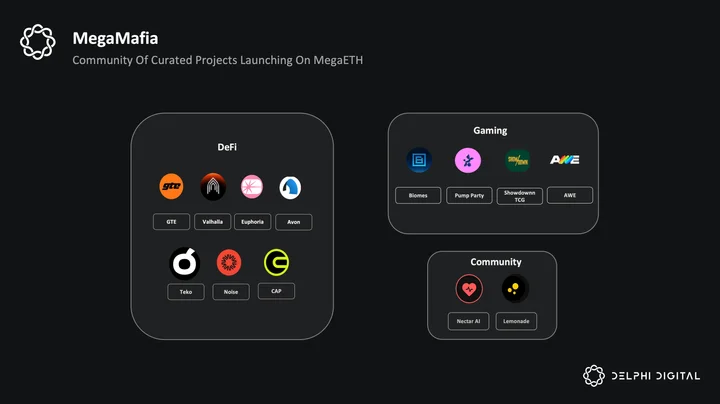
MegaMafia projects have collectively raised more capital than MegaETH itself, which is a very good signal. When applications are able to raise more capital than the platform, it shows strong market confidence in the actual use cases, not just the promise of infrastructure. Funding for both MegaETH and its applications have mixed participation from VCs as well as retail investors on Echo. The main idea behind raising capital on Echo is to shift the perspective that users and retail are exit liquidity for the insiders to sell and instead give an opportunity to to the users and retail to share the upside. This is growing trend, with more than $70M raised through Echo. We’ll briefly look at few of the projects on MegaETH.
- GTE is a DEX focused on delivering CEX like experience using MegaETH’s low latency. GTE’s mission is to have onchain price discovery for assets. They have vertically integrated full trading lifecycle by combining a launchpad, spot exchange and leverage trading. Since its on MegaETH, it allows market makers and HFTs to colocate with the sequencer, leading to much tighter spreads, faster and efficient on chain price discovery. Similar to MegaETH, the funding round for GTE had a mix of VCs as well as retail on Echo like. GTE is focused on attracting both retail as well as institutional users. Trading being one of the main usecases and revenue drivers for chains, GTE will be a crucial piece of application on MegaETH.
The world is discovering what we’ve always known
Internet capital markets are the most efficient means of capital formation in the history of the world
Like all markets, the most efficient internet capital markets will form on systems that offer the lowest latency at scale…
— Matteo (@mlunghi2000) January 30, 2025
- Euphoria is on the other end of the spectrum taking a different approach to derivatives. Instead of focusing on more sophistication, they’re going the other way. “Tap trading,” is a new primitive that they’re bringing for a mobile-first derivatives designed for the TikTok generation and broader appeal. Instead of complex interfaces, Euphoria focuses on intuitive gestures and a gamified, social trading environment, prioritizing simplicity and user engagement. Euphoria wants to deliver true “one-tap trading” – making derivatives accessible and fast directly on mobile devices. Their core thesis is based on the observation that simpler, socially driven trading experiences such as memecoins and prediction markets have seen explosive engagement. Tap trading follows the same trajectory to capture and engage a similar user base.
- AWE (Autonomous World Engine) is another interesting application for MegaETH, demonstrating chain’s potential to power interactive 3D experiences. AWE is essentially a web-based game engine designed to democratize 3D creation. Unlike traditional engines, it operates directly within web browsers, eliminating the need for downloads and specialized hardware. This accessibility is achieved through the use of WebGL and WebGPU, combined with an intuitive development environment that offers both code-based (JavaScript/TypeScript) and no-code (drag-and-drop) options. For MegaETH, AWE is significant because it directly benefits from the chain’s real-time capabilities. The engine’s focus on responsiveness and seamless web integration aligns perfectly with MegaETH’s low latency to unlock performant and accessible 3D web experiences.
Conclusion
While MegaETH’s technical innovations and growing ecosystem have potential, its important to consider the broader reality that mainstream adoption of DeFi on rollups, AltDA L2s, or high-performance L1s like Solana are still facing hurdles. For MegaETH specifically, its performance-centric design introduces questions: Will the market readily embrace AltDA security assumptions and centralized sequencing tradeoffs? Can UX overcome bridging fragmentation? The main challenges are those of trustless bridging, liquidity fragmentation. Less than 3% of total ETH has been bridged to L2s, comparable to ETF adoption. Serious DeFi users remain hesitant due to withdrawal times and bridging concerns.
Despite the growth of L2 usage within Ethereum in ’24 (10x more TX than the L1 now), there are still only 3.2 million ETH sitting on the L2s (down from a peak of 3.6m last July).
That’s 2.7% of the total supply. For reference, the ETFs now hold 3% of the total ETH supply.
This… pic.twitter.com/zWnnBkCvdQ
— Michael Nadeau | The DeFi Report (@JustDeauIt) January 24, 2025
Yet history suggests that markets often favor solutions that deliver tangible value, even when they involve calculated trade-offs. The success of Solana, despite initial centralization concerns, shows how performance and practical utility can drive substantial activity when aligned with market needs. MegaETH’s approach on serving performance-sensitive applications, combined with its curated ecosystem of ambitious builders, is pushing the boundaries of what’s possible in crypto. This is an important step in testing new models for scaling and adoption rather than obstacles.
0 Comments