
Looking back, 2021 felt like a fever dream – we witnessed a Cambrian explosion with basically anything involving crypto, but even more so with NFTs. There was narrative after narrative, mints every other day, random projects minting out and then instantly going to zero, people were grinding on discord for whitelists, a sense of false positivity took over the whole space with users exclaiming “GM” and “wagmi” as their very illiquid Fiverr-made profile pictures lost five figures in value per day, similar to today’s memecoin mania but even less liquid (Blur wasn’t even a thing back then). Amidst this chaos, Milady was born – Remilia’s first pfpNFT. A now renown collection across crypto, not only because of its cute aesthetics but also because of its community cult-like behavior and notable controversies. But before we even talk about Milady, we must understand what Remilia is and also what it isn’t.
Remilia
Remilia is behind multiple collections, most notably Milady Maker and Redacted Remilio Babies. These two collections are by far their most successful creations, becoming viral throughout Crypto Twitter and later on throughout various corners of the internet. This virality rapidly contributed to the success of the brand and further expansion through other collections (which will be covered in detail later on), hitting a total market cap of $240M and placing Remilia as the fourth largest NFT brand right after The Igloo Company (the company behind Pudgy Penguins). In the meantime, their main collection, Milady Maker, has been steadily dethroning other NFTs, surpassing Azuki’s floor price and resting at 4th place when it comes to Ethereum generative pfpNFTs, after Punks, BAYCs, and Pudgy Penguins.
Ok, but what exactly is Remilia? To be honest, the answer isn’t quite simple. To fully understand Remilia, we would have to go down a rabbit hole that might go way beyond the purpose of this report – and I’m not the only one facing this issue. In an article on Charlotte Fang’s Mirror, a guest author called Paul Tristis stated: “I was going to start by writing about Remilia, but I never wrote about Remilia, because I found writing about Remilia impossible without first writing about Miya. I then found writing about Miya impossible without first writing about the internet.” Fortunately, there’s a lot of literature on the topic in Charlotte Fang’s Mirror for those who want to understand Remilia’s ethos and dogma – but I’ll present a summarised version of what Remilia is, doing my best not to oversimplify some key concepts.
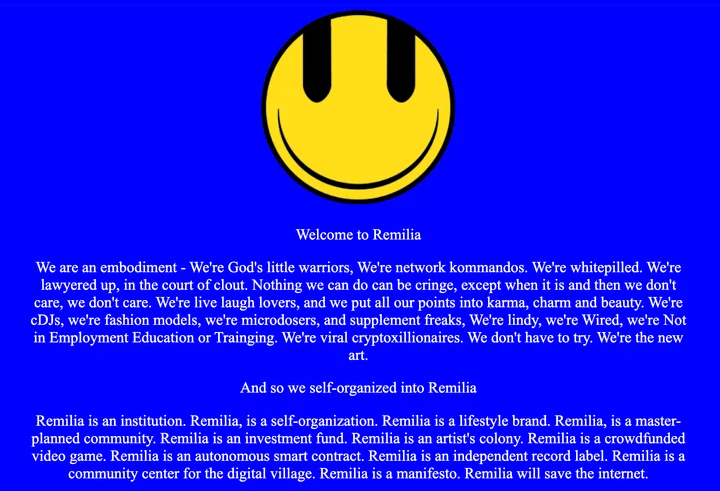
On the New Net Art Manifesto, Charlotte Fang (Remilia CEO and founder) describes the Collective as a fellowship of net art extremists founded in January 2021 with the goals of platforming the New Wave of Net Art and building the New Internet. According to CF, for the art world, net art has been dead since 2017 – killed by woke politics in art and subsequent censorship, which clashed with the internet anarchist nature. However, post-2021, the world became more connected, and the line between the Wired and the Real became more blurry, resulting in thousands of artists and creatives producing content online, with the traditional art world lagging behind, a scene ripe for a cultural shift – a New Wave of Net Art.
But Remilia isn’t only a collective with a mission; they also rally behind five central beliefs which consist of:
- Post-Authorship
- Posting is the New Art
- Abundance Mentality
- The White Pill
- Network Spirituality
Post-Authorship – this belief is one of the main reasons Remilia became so viral, and it simply makes sense in the age of the New Internet. There’s no point in enforcing authorship when this hinders the memetic/viral potential of a work of art. After all, this cycle has taught us that attention is the most valuable resource, so one should embrace virality with open arms, and it simply worked out for Remilia. Some might try to bring parallels with this concept and that trend we saw with NFTs adopting a CC0 patent, but it’s not the same. Remilia adopted a Viral Public License (VPL). This copyleft license applies to every collection they created, but instead of simply waiving rights, it also requires every project using it to waive rights, too, with no further restrictions. This resulted in a Cambrian explosion of derivative projects coming out from Remilia’s collections, but instead of suing them as Yuga Labs did, they embraced them. Some even morphed into their own ecosystems, such as Radbro Webring (the collective behind Radbro and SchizoPosters) and Retardio Cousins (a derivative in Solana made by Paradilf). This might seem dilutive in the short term. Still, in the long run, it simply brought more attention to the main collections – and we did witness a “flight-to-quality” after the first wave of derivatives came out, similar to when one large market cap memecoin comes out and then a bunch of short-lived derivatives pop up, the main collections kept on rallying while most derivatives trended to zero.
Abundance Mentality – this one is a bit more straightforward. Karma is real. You receive from the world what you give to it. Embracing a mindset of abundance, in contrast to the real-life art world, which is plagued by scarcity, having many players and few winners.

The Whitepill – before explaining the white pill, one must understand where this concept comes from. If
Read the full report
This report is part of Delphi Pro.
- 800+ Pro reports across every major sector
- Talk directly with our analysts
- Private community of funds and builders
Already a Pro member? Log in
0 Comments