Monthly Chartbook - Spring Crossroads
APR 10, 2023 • 26 Min Read





Market Musings
“I don’t like to commit myself about Heaven and Hell, you see, I have friends in both places.” – Mark Twain
From Mark Twain’s prose to Jerome Powell’s presser…
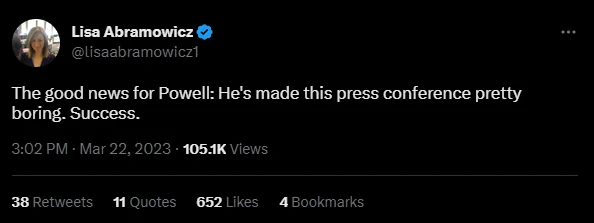
Lord Powell’s latest press conference on March 22nd was a masterclass in Central Banking 101: the art of hedging one’s bets. In all fairness, Powell was faced with an impossible task.
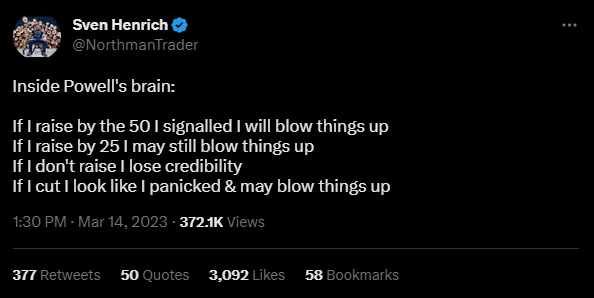
Leading up to the March 24th FOMC, the market was reeling from the largest banking crisis since 2008 and investors were understandably tweakin! People were desperate for reassurance. However, too much reassurance could easily be interpreted as the Fed going soft. This would be, uhh, bad, as inflation remains pernicious. Powell had to walk a tightrope.

“Man in a suit walking a tightrope” – Bing Creator
In doing so, Powell appeared just as conflicted as the rest of us. Let’s run through a highlight reel of Powell’s commentary and read between the lines of his exhilarating monologue.
“In the past two weeks, serious difficulties at a small number of banks have emerged. History has shown that isolated banking problems, if left unaddressed, can undermine confidence in healthy banks and threaten the ability of the banking system as a whole to play its vital role in supporting the savings and credit needs of households and businesses.”
Translation: I need to address the banking crisis head-on and reassure the market that the Fed is on top of things.
“Our banking system is sound and resilient, with strong capital and liquidity.”
Translation: Project confidence. Nip the bank runs in the bud.
“Inflation remains too high.”
Translation: Return to your usual programming: inflation, inflation, inflation. Emphasize that we can walk and chew gum at the same time.
“Despite elevated inflation, longer-term inflation expectations appear to remain well anchored.”
Translation: Qualify the hawkish messaging on inflation. The yield curve is pricing in a full-blown recession! Signal an awareness of the market’s view that LT inflation is not a concern.
“The Committee raised the target range for the federal funds rate by ¼ percentage point, bringing the target range to 4¾ to 5%.”
Translation: Stay the course. The inflation fight continues.
“We no longer state that we anticipate that ongoing rate increases will be appropriate to quell inflation.”
Translation: Qualify the hike. We only hiked 25bps. Relax, guys! A week or so ago, everyone was calling for 50bps. The market already priced this in, and regardless, this might be our last one.
“Events in the banking system over the past two weeks are likely to result in tighter credit conditions.”
Translation: Signal to the market that we’re watching credit conditions closely. Hint that the banking crisis could impact our assessment of financial conditions and future monetary policy.
Outside of Powell’s oxymoronic remarks — “the banking system is strong and liquid” but… “recent events are likely to result in tighter credit conditions” — perhaps the biggest takeaway from the FOMC was what the Fed did, or rather didn’t do, in its Summary of Economic Projections (SEP).
The creatively named SEP is a series of data that’s published quarterly and includes the Fed’s heavily scrutinized “dot plot,” which maps out policymakers’ expectations for where interest rates could be headed. The dots act as a powerful signaling mechanism to the market.
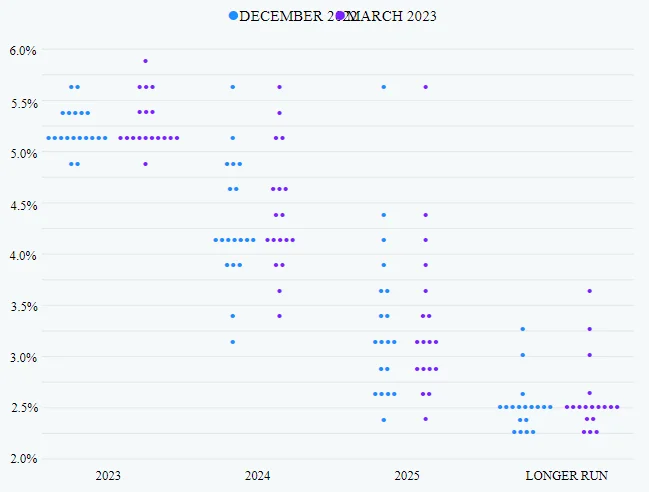
The March 2023 SEP was the first time since the Fed embarked on its hiking campaign that it kept its year-end 2023 dot unchanged. This “dot” represents the Federal Reserve’s expectations for the Fed funds rate at the end of 2023.
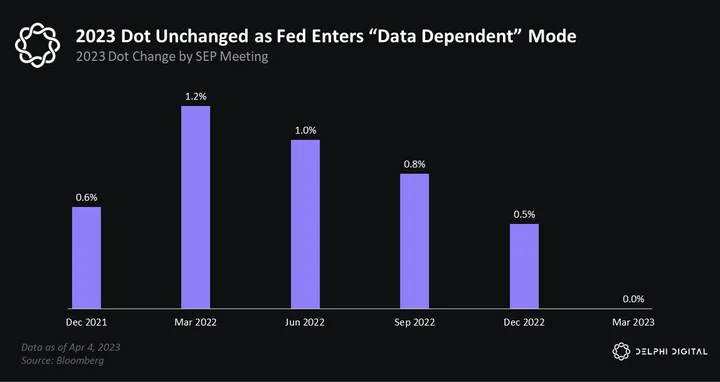
Leaving the dot unchanged is a notable departure from the Fed’s modus operandi, which saw it raise the 2023 year-end dot projection five consecutive times before the March meeting. We view the unchanged dot as implicitly dovish, especially since traders expected a 50-70bp jump prior to the banking crisis.
Along with Powell’s waffling statement, the SEP offers concrete evidence of a Fed that’s firmly in “data dependent” mode due to the banking crisis. Part of the issue here is that the Fed is now pursuing a contradictory monetary policy.
On one hand, the Fed is hiking rates and continues to let its balance sheet run off — aka quantitative tightening. On the other, it’s injecting liquidity back into the market via its BTFP program — aka quasi-quantitative easing. This sends mixed signals to the market and begs the question of whether the Fed is truly committed to fighting inflation for “as long as it takes.”
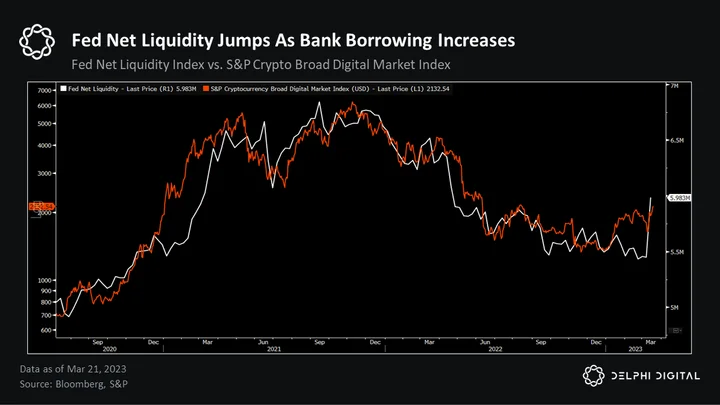
Mechanically, the Fed’s current monetary policy is also problematic. A dumb but not
Read the full report
This report is part of Delphi Pro.
- 800+ Pro reports across every major sector
- Talk directly with our analysts
- Private community of funds and builders
Already a Pro member? Log in
0 Comments