Onboarding Players through IP
Introduction
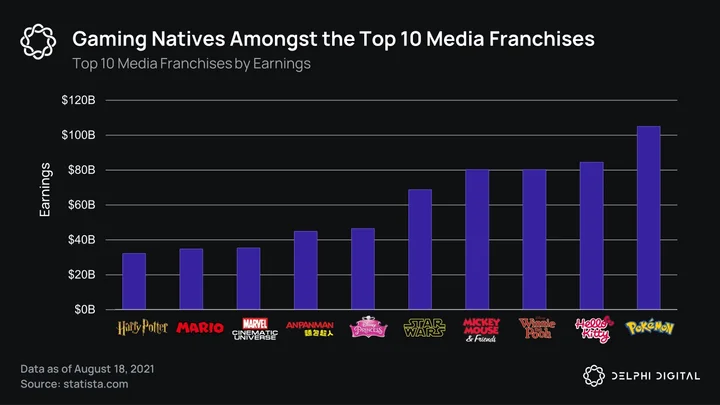
The history of IP and gaming goes way back, with many of the greatest IPs we know today originating in games. Pokémon and Mario, two of the ten highest grossing media franchises, are game-original IPs, with Pokémon claiming the number one spot in terms of brand value at around $100B in lifetime grossing.
Reciprocally, nearly all other members of that top 10 that aren’t natively gaming IPs, have expanded their IP into gaming in some form or another. Disney has built countless games over the years, the Star Wars IP is being integrated into several games per year across all a multitude of genres. Last year, Harry Potter launched a widely successful game in Hogwarts Legacy, selling 24 million copies, netting over $1B in revenue and becoming the most succesful game release in 2023.
Gaming is one of the cheapest ways to consume entertainment. Additionally, it is a readily available form of entertainment, which led many big IPs to strike deals with studios to leverage their brand with minimal effort and risk. The studio develops the game, while the IP provides access to an existing fan base, hungry to consume more franchise content.
This makes IP a very accessible tool for Web3 studios that can help overcome initial trust barriers that many Web2 players still have. Bringing an IP to the blockchain could enable games to monetize an existing userbase in an environment that allows for better UA and stronger retention.
The Power of the right IP
Most new IPs being built from scratch fail to gain traction and Web3 is no different. You need to create artwork, stories and products that resonate with a large enough community for it to be meaningful, all the while making sure to stay original along the way. Executing consistently, while having the patience, knack for timing and necessary luck to build out strong IP is extremely challenging.
BAYC is a prime example of how difficult this is in practice. They had the strongest NFT narrative of the last cycle, built a tight community, received endorsements from many public figures and traded at an all-time high floor price of over $300,000. After launching a few successful gamified experiences, they decided to lean more heavily into gaming as a brand through ventures like Otherside, their attempt at building a metaverse and a few other games like HV-MTL or Legends of Mara.
For a while, their narrative seemed unstoppable. No collection came close to their trading volume and their gamified minting experience Dookey Dash, an endless runner where players could win allowlists for Yuga’s next collection, was a big hit. The winning key rewarded to the #1 ranked player, was bought for $1,000,000. But from there, things went downhill.
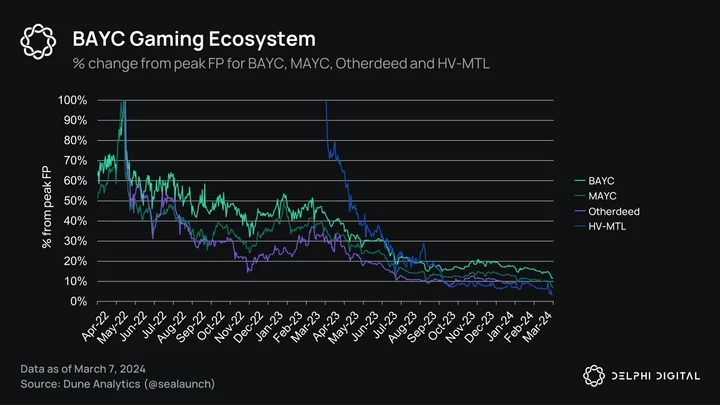
Short-term attention and speculation do not create a strong IP and 1 year of crazy euphoria is not enough to build sustainable enough of a following to cement yourself as a brand in the gaming landscape. Once you build up expectations, you will have to deal with them, especially in Web3. People were expecting a constant stream of free money and the quality of games released has so far not met expectations.
The other option for games to leverage IP is to partner with existing brands. This obviously cuts into profits and makes you less flexible, but using existing IP to target relevant audiences can be a very powerful tool for a studio. As IPs resonate with certain groups of people, you can attract new customers very efficiently if you find organic alignment with an IP and leverage it.
Monopoly is one of the most pertinent examples of the impact a licensed IP can bring to gaming. Monopoly was inspired by the Landlord’s Game, a game invented by Lizzie Magie in 1903 as an education tool, intended to illustrate the single tax-theory of Henry George. This went on to become one of the oldest and most established gaming IPs, with estimates putting the lifetime sale numbers north of 250 million copies across 103 licensed countries. The only board games that have sold more copies are ches
Read the full report
This report is part of Delphi Pro.
- 800+ Pro reports across every major sector
- Talk directly with our analysts
- Private community of funds and builders
Already a Pro member? Log in

0 Comments