
Report Summary
Key Takeaways
-
Stablecoins: The Killer App
-
Stablecoins have become the fastest-growing settlement layer, with over $245B circulating and $15T settled in 2024 (surpassing Visa).
-
Use cases now extend beyond trading → remittances, B2B payments, merchant settlement.
-
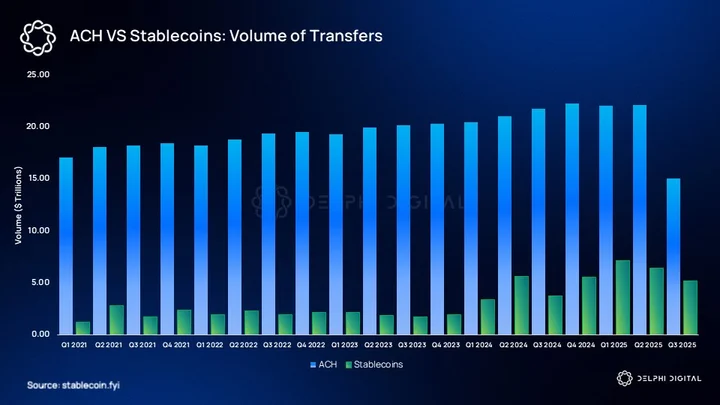
Stablecoins are on track to rival ACH (~$20T/quarter) with $7T+ already settled in Q1 2025.
-
-
Plasma’s Core Proposition
-
A Layer-1 blockchain purpose-built for stablecoin finance.
-
Optimized for high-frequency, low-margin flows where cost and finality matter most.
-
Targets the trillion-dollar cross-border payments and remittance markets.
-
-
Architecture
-
PlasmaBFT (HotStuff-based consensus) → rapid finality & high throughput (1,000 TPS → scaling to 10,000+).
-
EVM-compatible execution for easy developer onboarding.
-
Stablecoin-centric fee model:
-
USDT transfers = zero fees (Plasma’s strategic wedge).
-
Non-stablecoin txs = modified EIP-1559 with burns.
-
-
XPL staking secures the network.
-
Native Bitcoin bridge + issuer/exchange partnerships at genesis.
-
-
Zero-Fee USDT Transfers
-
Strategic move to make Plasma the default ledger for USDT flows.
-
Free transfers attract liquidity (like PayPal’s early model).
-
Monetization shifts downstream (swaps, lending, FX, merchant settlement).
-
“Split-block architecture” separates execution from transfer blocks → efficient, scalable free transfers.
-
-
Plasma One – The Neobank Layer
-
Consumer & merchant-facing app extending base-layer benefits.
-
Revenue via:
-
Card interchange/merchant fees
-
FX spreads
-
Yield capture on deposits
-
-
Designed to bring emerging markets and everyday users into stablecoin finance.
-
-
Competitive Positioning
-
Tron = main USDT chain but weak DeFi penetration → Plasma aims to be the “Tron killer.”
-
Arc, Codex, Tempo = issuer-aligned & compliance-heavy; risk siloing usage.
-
Plasma = issuer-neutral, EVM-compatible, DeFi-friendly → balances adoption with decentralization.
-
-
XPL Tokenomics
-
Gas & staking token; validators secured via staking.
-
Initial supply: 10B tokens, 5% inflation (declining to 3%).
-
Allocation: 10% public sale, 40% ecosystem, 25% team, 25% investors (1-year cliff + 2-year vest).
-
EIP-1559 burn → potential deflation under high usage.
-
Value accrues via monetary premium narrative (stablecoin hub) more than immediate fee revenue.
-
-
Adoption & Ecosystem
-
$1B committed to Binance Earn product on Plasma before launch.
-
Partnerships with Aave, Fluid, Wildcat, Maple Finance, USD.AI.
-
Aims to combine remittance/merchant flows with DeFi liquidity.
-
-
Valuation Model
-
Scenarios based on 3%, 10%, 15% USDT market share.
-
Conservative multiples applied (Tron’s 0.4× supply multiple for bear case).
-
Growth tied more to narrative traction & adoption milestones than near-term REV metrics.
-
Summary
Plasma positions itself as the stablecoin-native blockchain, designed to capture the growing role of stablecoins as the internet’s settlement layer. By offering zero-fee USDT transfers, Plasma aims to attract global flows, then monetize them through higher-value services (DeFi, FX, merchant settlement) and via Plasma One, its integrated neobank.
With strong partnerships (Binance, Aave, Maple) and issuer neutrality, Plasma differentiates itself from Tron’s limited DeFi ecosystem and issuer-aligned chains like Arc or Tempo. Its token, XPL, derives value from network adoption and monetary premium, not immediate fee capture, with deflationary dynamics possible as activity scales.
Conclusion: Plasma’s bet is that free stablecoin transfers will make it the gravitational hub for USDT flows, giving it a path to dominate the trillion-dollar opportunity in payments, remittances, and on-chain settlement.
-
The Dollar’s Fastest-Growing Settlement Layer
Stablecoins are not just another crypto primitive. They are the closest thing the world has ever seen to a globally accessible currency. Stablecoins collapse the transfer and settlement stack by wrapping the US dollar (and other fiat currencies, to a lesser extent) into a bearer digital format. Clearing and settlement happen in a single atomic transaction and can be finalized near-instantly.
This property makes them a functional equivalent to Eurodollars on-chain. Stablecoins are portable dollars that operate outside the traditional banking system with none of the friction of correspondent banking, card networks, or wire transfers.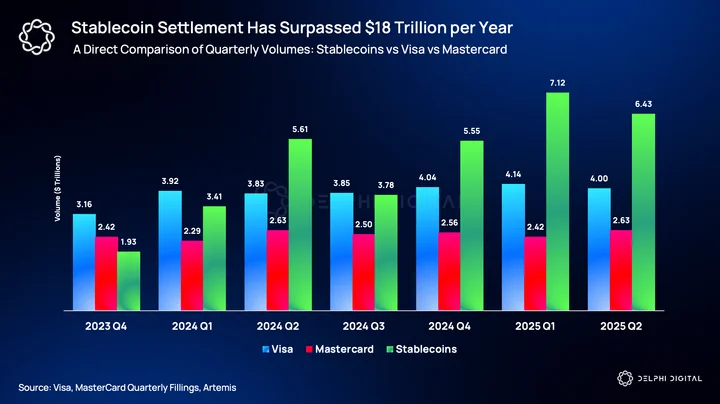
The scale of adoption is already staggering. As of mid-2025, over $245 billion in stablecoins circulate on public blockchains, of which ~62% is USDT and ~23% is USDC. On-chain settlement volumes exceeded $15 trillion in 2024, surpassing Visa’s $14.8 trillion.
One of the main uses of stablecoins today is serving as a quote asset across exchanges (centralized and decentralized), as well as facilitating leverage for investors. But stablecoins have quickly graduated from being a niche settlement layer for traders to a payments rail that now sits shoulder to shoulder with the largest card networks. In Q1 2025, stablecoins cleared more than $7 trillion, briefly surpassing the combined volumes of Visa and Mastercard. In every subsequent quarter, they have remained within striking distance of the cumulative settlement volume of the two largest payment processors.
The contrast in trajectories is striking. Card networks continue to grow steadily, but at a measured pace. Stablecoins, by comparison, have compounded at a much faster clip, with volumes that were barely visible just a few years ago now rivaling the scale of legacy rails.
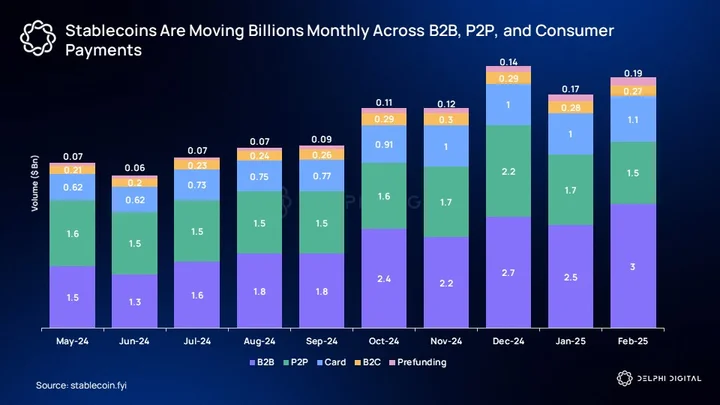
What started as collateral for crypto trading has morphed into flows that increasingly serve remittances, merchant settlement, and B2B payments. Especially in markets where local currency instability or weak banking infrastructure make dollars on-chain not just more functional, but also a relative store of value. The fact that stablecoin networks can enable vastly more kinds of financial activity than pure payment processing networks like Visa and Mastercard means we should expect stablecoin market share to continue rising in this context.
ACH, the U.S. bank-to-bank transfer system, still clears around $20 trillion in quarterly payments, but stablecoins are beginning to catch up. From barely registering in 2021, stablecoins now process over $7 trillion a quarter, steadily eating into ACH’s share of digital dollar settlement.
Plasma: Today’s Opportunity to Build the Future of Payments
Despite their importance, stablecoins remain second-class citizens on the chains that host them. Ethereum, Tron, Solana, and others were designed as general-purpose smart contract platforms, not as dedicated monetary rails. As a result, stablecoin transfers are subject to volatile gas pricing, MEV predation, and fee models denominated in speculative native tokens. This mismatch has created inefficiencies: billions in user fees paid annually for what are, at their core, simple ledger updates.
Plasma turns this model inside out. It is a Layer-1 blockchain purpose-built for stablecoin finance, with USDT and other fiat-backed tokens treated as the network’s primary workload, not just another application on top. By optimizing consensus, fee policy, and economic incentives for high-frequency and low-margin flows, Plasma positions itself as the settlement layer for the global dollar economy. In doing so, it intelligently tackles the trillion-dollar opportunity of cross-border payments, remittances, and merchant settlement markets where cost sensitivity and the speed of finality matter more than anything else.
An Overview of Plasma’s Architecture
Plasma’s design reflects lessons from a decade of L1 experimentation. At the base, it runs a HotStuff-derived BFT consensus (PlasmaBFT) that delivers rapid finality and throughput. On day one of the mainnet launch, TPS will sit at over 1,000 TPS, eventually scaling to over 10,000 TPS. Atop this, it employs a Reth-based execution layer, ensuring full EVM equivalence and compatibility with existing tooling and contracts.
Key design choices include:
- Stablecoin-centric fee model: USDT transfers are zero fees, while non-stablecoin transactions follow a modified EIP-1559 burn mechanism to funnel value back to the XPL token. This is applied to transfers only and not other types of transactions, such as swaps.
- Validator security via XPL staking: XPL functions as Plasma’s reserve collateral, ensuring economic security and aligning long-term incentives.
- Liquidity alignment with USDT: USDT is natively integrated at genesis, with issuer and exchange partners providing immediate depth to settlement pools.
- Cross-asset bridge rails: A native Bitcoin bridge positions Plasma as the venue where the two most adopted on-chain asset classes, BTC and stablecoins, intersect.
Plasma is less about adding another L1 blockchain to the pile, and more about how a chain designed around stablecoins can anchor the next phase of global dollar settlement.
Zero-Fee USDT Transfers: Plasma’s Strategic Wedge
One of Plasma’s boldest design choices is to make USDT transfers free at the base layer. At first glance, this looks counterintuitive. Blockchains are supposed to monetize on transaction fees, and stablecoins, particularly USDT, are the highest-frequency use case in crypto today. Why would a new chain choose to give away its most valuable flow?
The answer lies in how Plasma frames value capture. Stablecoins already process more than 10 trillion dollars in quarterly settlement volume. The real opportunity is not the marginal fee on a transfer. It’s becoming the default ledger for those transfers. Just as internet companies gave away email, messaging, and search to monetize the downstream activity those free services enabled, Plasma is using zero-fee USDT transfers as a customer acquisition strategy for global dollar flows.
PayPal, for instance, seeded its early network by offering free person-to-person payments, later monetizing through merchant checkout fees and FX spreads. Google took a similar path with Android, distributing the operating system for free while capturing value through search and app store revenue. Plasma is following the same playbook with stablecoins: giving away the most commoditized service in order to attract flows, applications, and developers, then monetizing the higher-value layers of settlement, liquidity, and financial services that those flows enable.
It is important to note that zero-fee transfers only apply to simple USDT sends and receives, similar to sending money on Venmo. Any other interactions involving USDT, such as swaps, lending, or contract calls, remain subject to regular fees. The exemption is deliberately narrow and designed to make the most frequent and commoditized action on-chain feel frictionless while keeping validator incentives and the broader fee model intact.
The paradox of giving away the most used feature for free is intentional. By removing friction at the base layer, Plasma aims to become the cheapest and fastest venue for USDT transfers across wallets, exchanges, and settlement rails. The appeal is strongest for high-frequency participants such as market makers, CEX off-ramps, PSPs, and remittance operators who are most sensitive to transfer costs.
The end vision: if USDT flows start to concentrate on Plasma, liquidity deepens, balances accumulate on-chain, and USDT activity migrates from a fragmented multichain footprint closer to a single gravitational hub.
Plasma is not expecting to monetize USDT transfers themselves. The free transfer layer is a wedge that draws flows into the system, while monetization occurs downstream through fee-paying DeFi transactions, FX conversions, and settlement services. The long-term bet is simple. XPL will capture value not from taxing simple transfers, but from securing the infrastructure powering those flows.
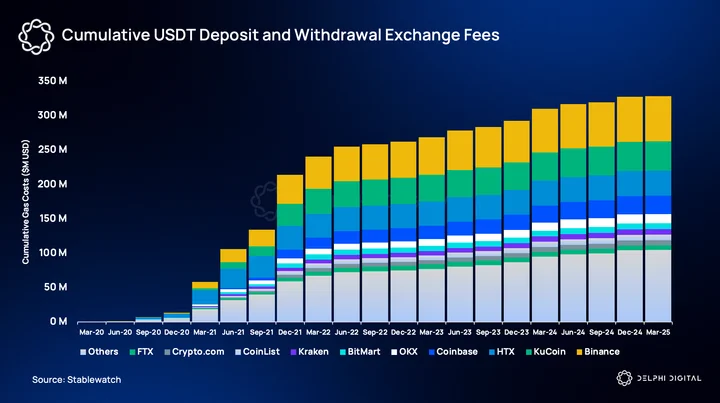
Users have spent over $300 million in the last 5 years to withdraw/deposit USDT from CEXs. This is the clearest example of how free USDT transfers offer a strong wedge for users to choose Plasma as their USDT hub over any other chain.
Monetizing Flows Through Plasma One
The next question is how those flows are captured and monetized. This is where Plasma One, the stablecoin-native neobank, comes in.
Plasma One is designed as the front door for users, merchants, and businesses. It extends the base-layer advantage of zero-fee transfers into a product that feels like everyday money. Users can save in dollars, earn yield, swipe cards at merchants, and send payments instantly for free. For merchants, Plasma One provides direct settlement in USDT, cutting out intermediaries and FX costs. Developers and institutions can all plug into Plasma’s distribution through Plasma One.
The economics shift from taxing each transfer to monetizing the layers that sit on top of those transfers. Plasma One can potentially capture value in three ways:
- Card Interchange and Merchant Settlement: Every swipe or payout generates fees, just as legacy card networks do, but with lower costs and wider reach.
- FX and Conversion Spreads: Moving between USDT, local currencies, and other stablecoins creates natural spreads that Plasma can capture through its integrated FX stack.
- Yield Capture: User deposits on Plasma One can be routed into on-chain money markets, generating yield that can be shared with users or retained in part by the ecosystem.
This value proposition only gets more powerful as Plasma targets emerging markets whose currencies have been depreciating against the Dollar and the Euro.
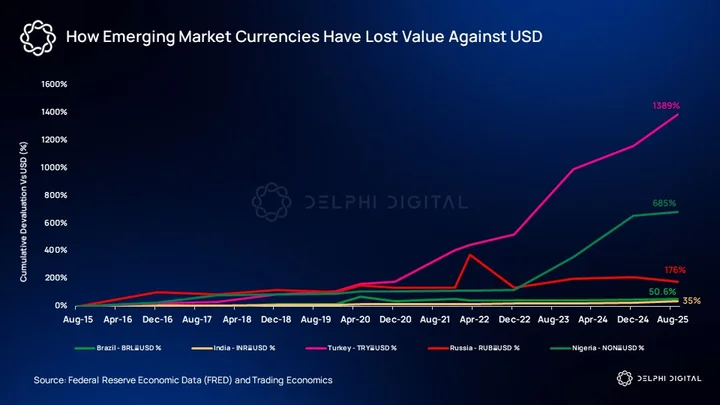
By owning both the chain and the neobank, Plasma closes the loop between infrastructure and distribution. Zero-fee transfers attract flows. Plasma One gives those flows a home and monetizes them through services people already expect from a bank, but delivered on stablecoin rails.
Where Plasma Sits in the Stablecoin L1 Race
The past year has seen the rise of stablecoin-focused chains, each built around the recognition that dollar settlement is crypto’s killer app. Some, like Arc and Codex, are tightly aligned with Circle and naturally favor USDC, although they remain open to flows from other stablecoins such as USDT. Their pitch leans heavily on regulatory clarity and institutional adoption, framing themselves as the compliant rails for capital markets. Arc’s reliance on USDC ties its growth to a stablecoin with narrower global distribution and weaker penetration in emerging markets compared to USDT.
Others, like Stable, position themselves as the home for USDT flows lacking issuer neutrality. Tempo sits somewhere in between, emphasizing regulated corridors and compliance-first integrations with enterprises and PSPs. While these issuer-centric or compliance-heavy models offer strong corporate alignment, they risk recreating silos that limit experimentation and composability.
Plasma takes a different stance. By anchoring around USDT but maintaining issuer neutrality and full EVM programmability, Plasma positions itself as a more accommodating home for DeFi and organic stablecoin usage. It is designed to absorb the messy, high-frequency flows from remittances, trading, and merchant settlement that drive real liquidity, rather than only serving curated institutional corridors. Plasma’s positioning is an extension of Tether flows from cross-border and retail payments, consolidating them alongside trading and settlement activity. The team is also putting real weight behind institutional adoption, building PSP rails and compliance hooks so Plasma can support enterprise corridors alongside retail flows from day one.
Stablecoins are already clearing trillions in value per quarter; the chains that allow liquidity to remain fluid and composable are better placed to emerge as true settlement hubs. Neutrality, rather than corporate alignment, may prove the stronger foundation for capturing the next wave of stablecoin adoption.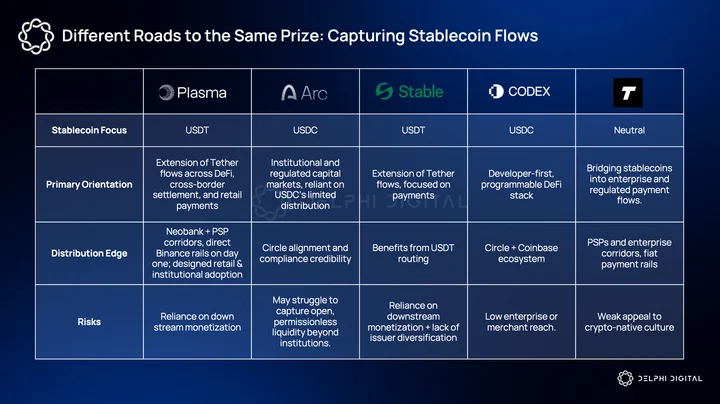
XPL Token Economics
At the core of Plasma lies XPL, the native token that powers the network.
XPL is the native token of the Plasma blockchain, analogous to ETH on Ethereum and SOL on Solana. XPL serves as the gas token for transactions & smart contract execution, the staking asset securing the network, and the reward token for validators.
As previously mentioned, Plasma’s architecture allows gasless stablecoin transfers for end-users, but any more complex interactions (deploying contracts, advanced dApp usage) require XPL for gas — or automatically convert a portion of stablecoins to XPL for fees.
XPL, like most L1s, will not have a fixed supply cap and is subject to programmatic emissions – just like ETH or SOL. The initial supply will be 10 billion XPL at mainnet beta launch, with 5% annual inflation for validator rewards. Inflation will decrease by 0.5% each year to a long-term rate of 3%.
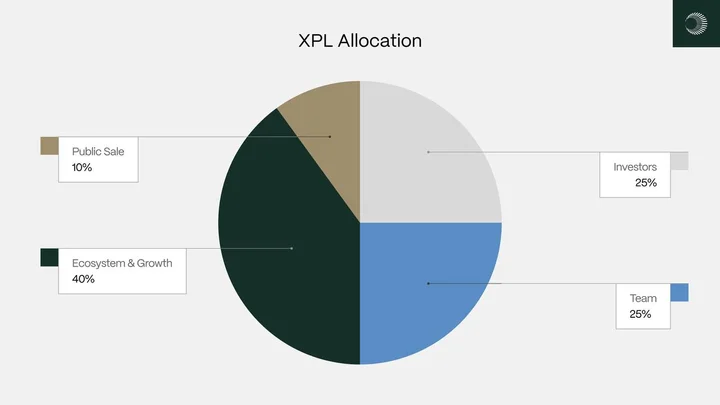
- Public sale: 10% (unlocked at TGE for non-US investors, Jul. 28, 2026, for US investors)
- Ecosystem and growth: 40%
- Team: 25% (1 year cliff + 2 year vest)
- Investors: 25% (1 year cliff + 2 year vest)
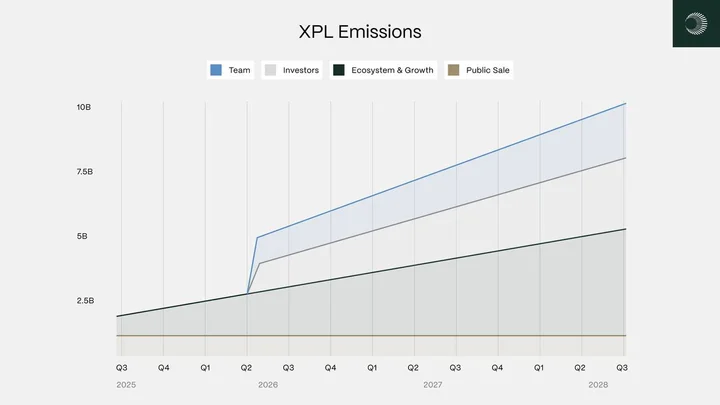
Plasma adopts Ethereum’s EIP-1559: base transaction fees are burned. Network growth will create deflationary pressure against the token emissions. In practice, heavy usage could make XPL a net deflationary token.
The initial float at mainnet launch will consist of the public sale tokens (10% minus US investor allocations), any ecosystem tokens unlocked (8% immediately), and potentially a small portion of strategic partner distributions. Team and investor tokens (a combined 50%) are all locked at genesis. Thus, the initial float is relatively limited and will likely land around ~18% of total supply at TGE.
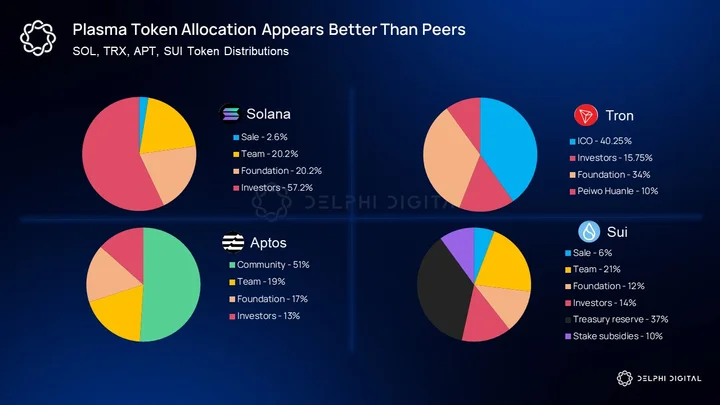
Token allocation is extremely important for L1 tokens. While it is just a talking point for governance tokens, L1s have the public good, decentralized infrastructure, and commodity angles to account for. Aggressive or extractive token allocations will linger throughout a blockchain’s ecosystem lifecycle. From this regard, XPL’s overall distribution is very healthy relative to other L1s.
At this stage it’s unclear how XPL’s token allocation will stack up to more ideal comparables like Tempo and Arc. It will be important to keep an eye on this as more details emerge.
Why XPL Has Value
Plasma’s value proposition is fundamentally tied to the idea that stablecoins are the killer application of crypto. As previously mentioned, stablecoins already processed an astounding $27.6 trillion in on-chain volume in 2024, surpassing the combined volume of Visa and Mastercard that year. Crypto innovation, particularly DeFi, has reached an impasse. Bridging legacy money with blockchain rails is a big domino that needs to fall to unlock the next era of innovation.
When evaluating L1 tokens, analysts often use two frameworks:
- Real economic value (REV) – fees + MEV. This method treats the token like a stock with a claim on cash flows.
- Monetary premium – This method views the token as a currency valued for its utility and network effects.
For a new chain like Plasma, fee capture is initially low, especially since Plasma offers zero or negligible fees to bootstrap usage. Valuing Plasma based on REV would be impractical. And other new chains like Aptos and Sui have never been held to this standard by the market.
The monetary premium aspect is more relevant for XPL at this stage. People will value XPL not because it immediately pays large staking rewards or dividends, but because they anticipate Plasma to become crucial infrastructure in a stablecoin-dominated future.
Staking rewards and deflationary pressure from burns will serve to benchmark progress here and validate the thesis. Monetary policy is crucial for L1s and serves to build a perception of being an effective store of value. However, a deflationary monetary issuance regime is unlikely to be the north star for Plasma’s valuation – especially at the beginning.
The market for new L1 tokens tends to converge closer to the potential this new chain has, rather than its core fundamentals on day 1.
For example, excitement about MoveVM and throughput that competes with Solana drove mindshare toward alternative high-throughput chains like Sui and Aptos – and this desire for faster chains fueled their valuation more than anything else.
With Plasma at the center of crypto’s most fundamentally sound use case — stablecoins — the primary source of value for XPL will be derived from its perceived monetary premium. As the chain and its ecosystem kick off and find firm footing, we expect to see REV and core economic metrics to also start ticking up.
The Present Competitive Landscape
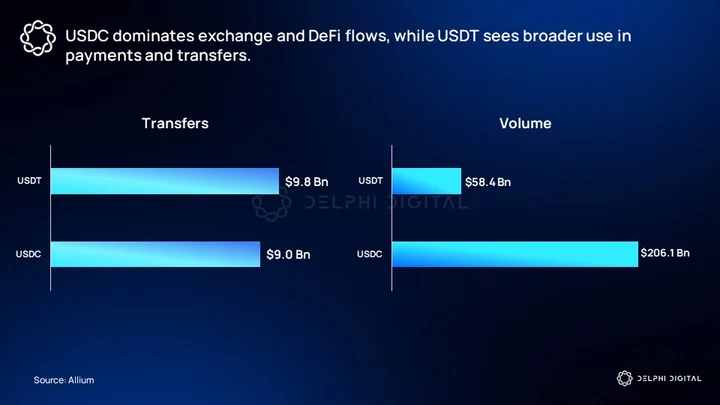
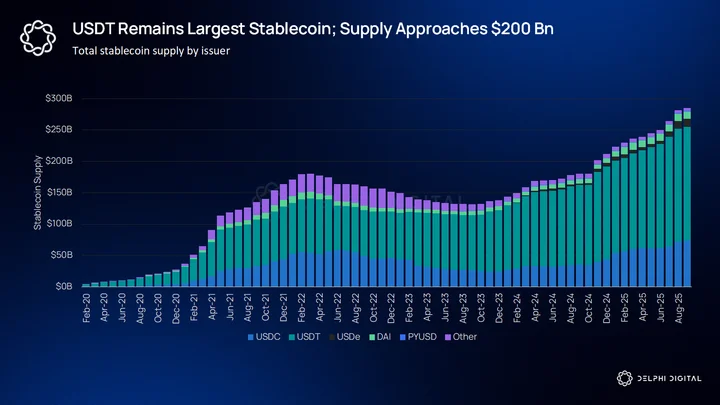
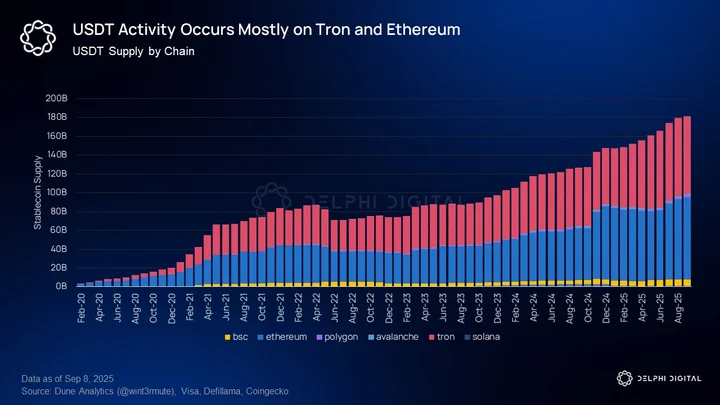
USDT is the biggest stablecoin with the most liquidity on CEXs. USDC is favored in DeFi, has a lot of integrations, is a major pair for DEX liquidity, and has strong momentum for payments. Despite the ballooning design space for stablecoins and broader interest in the sector, USDT has fortified its market share as supply approaches $200 billion.
Ethereum is the dominant liquidity hub for stablecoins due to its strong grip on DeFi innovation and activity. Despite lots of buzz around Solana, Aptos, and Sui, these chains have not yet attracted a similar mass of stablecoins as Ethereum and Tron.
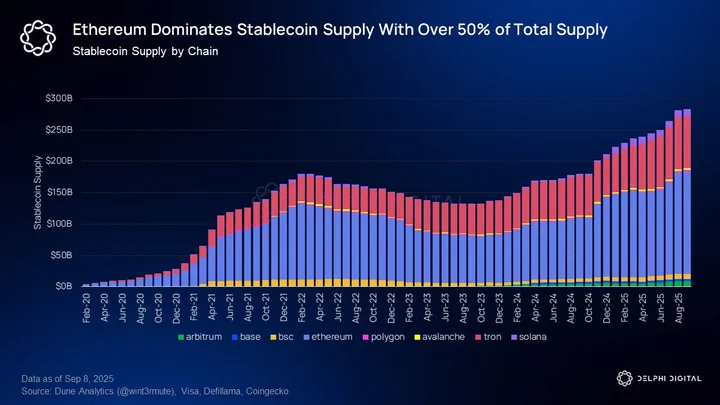
Tron is the #2 chain by stablecoin supply, having established itself as the unofficial USDT chain for transfers. Tron has limited stablecoin and DeFi activity outside of USDT, but its market share here is impressive: Tron’s $83B USDT supply is very close to Ethereum’s $87B.
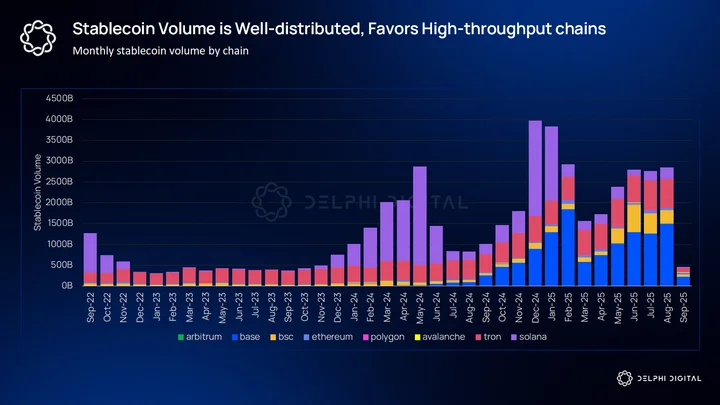
Stablecoin transaction volume is much more distributed across ecosystems. Ethereum lags far behind L2s and competing L1s. Tron, Solana, Base, and BSC all move more stablecoin volume than Ethereum. The high-throughput thesis is best expressed here, as Ethereum mainnet gas fees are prohibitive for everyday stablecoin usage. As a result, Ethereum is mainly used for complex, high-stakes DeFi instruments.
Plasma’s feeless USDT transfers unapologetically position itself as a Tron-killer. While Tron has found product market fit as the USDT chain, it has failed to build a vibrant defi ecosystem around this, at least one with the usage that $83B in USDT implies.
The goal for Plasma should be to secure partnerships with major DeFi teams to get beyond the remittance chain niche and earn both TVL and volume. And this is already well in the works.
The Binance Earn product on Plasma is a fully onchain USDT yield product with $1 billion committed before mainnet beta launch. Users can lock USDT via Binance Earn, and that USDT is deployed into infrastructure rails operated by Plasma that generate the yield. This program is analogous to native USDC yield on Base.
In addition, Plasma has announced partnerships with Aave, Fluid, Wildcat, Maple Finance, and USD.AI. These partnerships balance crypto-native usage (Aave, Fluid, USD.AI), with more institutional-facing fintech-like use cases (Maple Finance, Wildcat, USD.AI). Positioning Plasma as a chain where users can conduct business as usual, and fintech apps have a better shot at product market fit, is a solid strategy to earn sustained usage and build out a real moat.
Theoretical Valuation Model
Stable, Arc (Circle), and Tempo (Stripe) are the most logical comparisons for Plasma. But these are not yet liquid. For now, the high-throughput and DeFi-dominant chains like Tron, Solana, Ethereum, Aptos, and Sui are the best options.
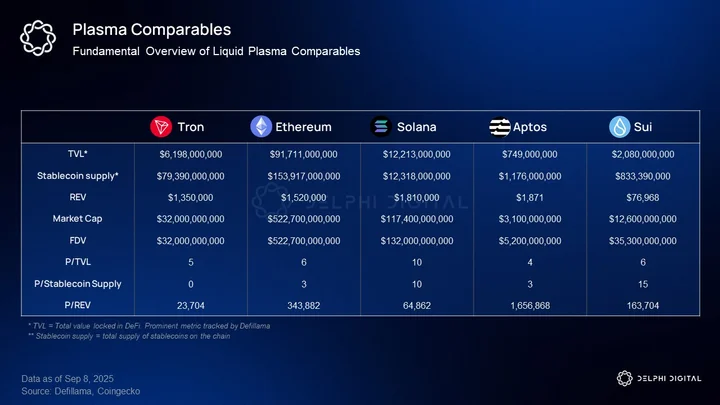
REV is an intuitive metric that makes a lot of sense as a mental model to understand L1 value capture. However, it clearly has very little correlation with market pricing and is not relevant for current-day L1 valuations. Solana’s REV numbers were attractive due to the activities its ecosystem attracted. TVL remains the most commonly referenced metric for blockchain traction, and stablecoin supply offers a nice complementary data point.
Both metrics appear reasonably consistent with valuations of the sample group, with multiples below 15 and often in the mid single digits.
Tron has a niche use case, limited growth prospects given poor DeFi penetration, and it lacks a tech-premium often associated with these next-gen blockchains. As a result, its 0.4 price-to-stablecoin supply multiple is likely an outlier.
With a reasonable expectation of how the market will react to various levels of traction, we can construct a scenario analysis for Plasma’s XPL valuation.
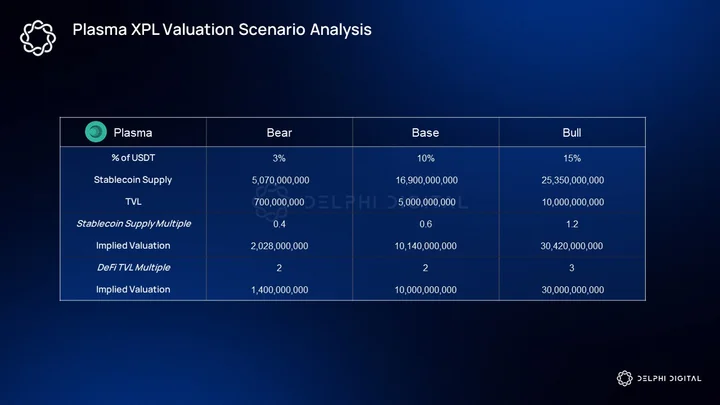
Our bear, base, and bull cases assume 3%, 10%, and 15% market share of USDT supply, respectively.
It is important to note potential flaws in assumptions:
- Downside: It is possible the corpo chain narrative becomes saturated and these chains cannibalize usage and mindshare, compressing multiples. To account for this, we went with lower multiples for stablecoin supply, using Tron’s 0.4 outlier for the bear case.
- Upside: our USDT market share assumes a fixed pie. E.g. Tether does not issue additional USDT + Plasma itself has no impact on new USDT issuance. Both of these scenarios are unlikely, so this is an extremely conservative assumption. Plasma could achieve lower market share numbers and reach the same outcome if the pie continues to grow at the current rate.
XPL’s pre-market valuation is largely in line with this approach to valuing the network. The upside here hinges mainly on fostering the narrative and signaling traction through partnerships and milestones. The biggest risk is the influx of similarly branded chains coming to the market. The vision for Plasma is attractive and the narrative it occupies is a cornerstone for the cycle.
Conclusion
The growth of Tether and Circle as issuers, the sheer amount of stablecoins in use over onchain platforms, the emergence of new-age products like Ethena and Wildcat, and widespread acceptance from traditional payments firms like PayPal and Stripe all tell us one thing: you can’t deny the opportunity in stablecoins.
At the same time, there’s a need to continue to cling to crypto’s core ethos. Permissionless usage, decentralization, and grassroots community building are still a core part of the equation. And with the onset of the stablecoin L1s, some of which may take the shape of a corporation-controlled chain, Plasma seems best positioned in this specific regard. With strong day 1 integrations but still arms length with centralized operators, Plasma bridges the best of stablecoins with the ethos of onchain capital markets.
The L1 wars have increasingly become commoditized. High throughput is table stakes. The real war is on genuine ecosystem development and user acquisition.
Plasma makes a concerted bet that stablecoin transfer costs should eventually trend to zero, and that the real value is in facilitating higher-stakes activity like lending/financing and trading. In short, the real business model for Plasma is rooted in becoming a hub for stablecoin liquidity. And one of the simplest ways to organically get there is to give users the high-frequency use case (simple payments/transfers) for free.
With Plasma One and the assortment of DeFi protocols that will deploy on the chain, it’s clear Plasma views distribution as its real source of differentiation rather than just the technology stack. As the world opens up to stablecoins, Plasma aims to establish itself as one of the leading platforms for developers and users to congregate around stablecoin products.
0 Comments