Pocket Network: The Decentralized Marketplace for Blockchain Connectivity
MAR 22, 2022 • 27 Min Read


The Emergence of Centralized Platforms
Moxie Marlinspike, the founder of popular messaging app Signal, recently wrote one of the better critiques of web3. In his article titled, “My first impressions of web3”, one of Moxie’s core criticisms is the lack of attention to the client/server interface in web3. In today’s Internet Age, the majority of online activity filters through a small cohort of centralized platforms that abstract away the complexities of publishing and consuming web-based content. Despite the decentralized ethos the Internet was built upon, we’ve witnessed a consolidation of power towards centralized platforms because, as Moxie rightfully stresses, “people do not want to run their own servers”.
In the context of today’s web3 infrastructure stack, Moxie likens users and dapps to clients, and blockchains to servers. Drawing parallels to the rise of web2 platforms, he asserts that it doesn’t matter how trustless blockchains are, users still don’t want to run their own nodes. Therefore, client-server interactions are bound to be facilitated by centralized platforms that abstract away the complexities involved with blockchain connectivity.
“This was surprising to me. So much work, energy, and time has gone into creating a trustless distributed consensus mechanism, but virtually all clients that wish to access it do so by simply trusting the outputs from these two companies without any further verification.” – Moxie
Importantly, he attributes centralized platforms’ success to their agility, noting that “a protocol moves much more slowly than a platform”. As a result, web3 is destined to be invaded by centralized platforms, just like we see in today’s web2 era.
Incentivizing a Decentralized Future
It’s hard to disregard Moxie’s criticisms given the overwhelming presence of centralized platforms in web3. While Infura, OpenSea, Coinbase, and Etherscan make it very practical for anyone to interact with blockchains, in many ways they also dampen the decentralized, censorship-resistant ethos of web3 itself.
On the other hand, a key factor overlooked in Moxie’s criticisms is the power of incentives. While their governance is slow, protocols can use crypto-economic incentives to create efficient, permissionless markets. When designed correctly, these protocols can be extremely powerful growth engines as incentives, and distributed ownership, attract more supply and demand to a given network.
The emergence of decentralized middleware protocols is living proof of this. Today, many applications use Filecoin/Arweave to store data, The Graph to index data, and Chainlink/Band to feed data. But Web3 applications also need a way to communicate and retrieve information from the blockchains they operate on. Today, most web3 apps use incumbent providers like Infura or Alchemy for their blockchain connectivity needs.
Infura is a service provider that has built a suite of APIs and developer tools for developers to access Ethereum and other networks, like IPFS. Infura provides endpoints to Ethereum’s API that developers can, for example, “point” their code to when requesting information from the Ethereum blockchain. Centralized entities like Infura aren’t inherently bad, but as history has proven, Web3 applications are more exposed to outages and censorship than decentralized alternatives.
A key protocol attacking this middleware category is the Pocket Network.
Pocket Network describes itself as a “multi-chain relay protocol that incentivizes RPC nodes to provide DApps and their users with unstoppable Web3 access”. For those less inclined for technical jargon, it can be thought of as the “TCP/IP of Web3 node infrastructure”.
“Pocket was designed to be the most reliable and redundant full node network in the world.”
– Pocket Network, Inc. CEO, Michael O’Rourke
To understand Pocket Network, we must first understand the problem it aims to solve. Pocket is a decentralized API protocol for blockchains. It addresses the very problem raised by Moxie — users’ unwillingness to run their own nodes, and applications’ growing reliance on platforms like Infura and Alchemy.
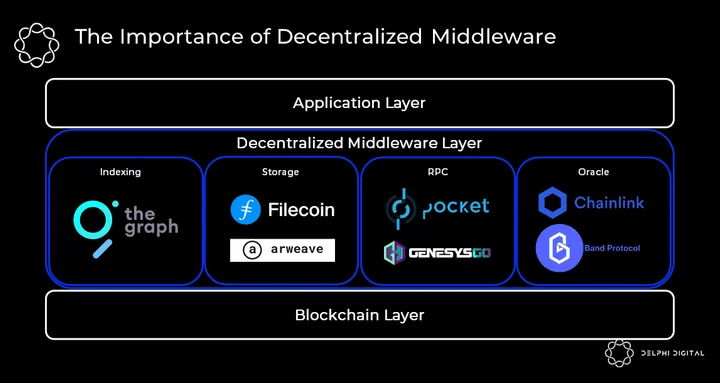
Pocket offers a decentralized alternative to Infura and Alchemy. It does so by creating an efficient, permissionless two-sided market between:
- Developers who request on-chain data for their apps in a trust minimized and reliable way.
- Relayers who want to be compensated for running blockchain nodes and relaying data from various blockchains.
All network activity is coordinated through Pocket’s proof-of-stake (Pos) blockchain, rather than through a centralized company.
Infura has been incredibly successful since its debut. By 2020, it was already facilitating around 10 billion daily requests. This figure is 36x bigger than Pocket Network’s year-to-date average of 277m daily relays. Pocket Network has a long way to go before it truly challe
Read the full report
This report is part of Delphi Pro.
- 800+ Pro reports across every major sector
- Talk directly with our analysts
- Private community of funds and builders
Already a Pro member? Log in
0 Comments