Introduction
Perpetual futures have reached escape velocity and are now the primary way traders express their views on assets. Perps are easy to understand, offer 24/7 exposure without expiry, and allow traders to access a wide range of leverage. But for all their flexibility, the exposure you get from them remains linear. A trader holding one BTC contract only gains or loses the same dollar amount for each dollar move in BTC.
This leaves no room for outsized, non-linear payoffs, like a 0DTE option 10x’ing from a 2% move, or a 5x from a short-dated binary option.
For a trader who expects BTC to go much higher, the default answer is to increase the size of the long. That raises the potential payoff but also the exposure from the moment the trade opens. The position doesn’t become more sensitive as the rally develops unless the trader actively adds to it. And adding leverage inevitably brings liquidation closer if the market moves against them first.
A better way to express this view on the market is upside convexity. With a convex long position, exposure to BTC increases as its price rises, allowing gains to accelerate as the move continues. If BTC falls, the position’s sensitivity decreases, so each additional dollar decline has a smaller effect. More upside, less downside. Anyone who has traded options will recognize the appeal of a payoff that changes as the underlying moves.
The growth of the options markets shows how much demand for convexity exists. In 2017, traders bought and sold roughly 4.2 billion U.S. options contracts. That same year, Robinhood introduced commission-free options trading, simplifying the instrument and opening the door to a much wider group of traders. By 2025, annual volume had more than tripled to over 15 billion contracts.
Retail has played a huge part in that growth. Robinhood customers alone traded 905 million options contracts in Q3 ‘26, generating $399 million in options transaction revenue. Citadel also reported that retail investors traded an average of roughly $6.8 billion in options premium per day through its platform in June 2026, 65% above its 2025 average.
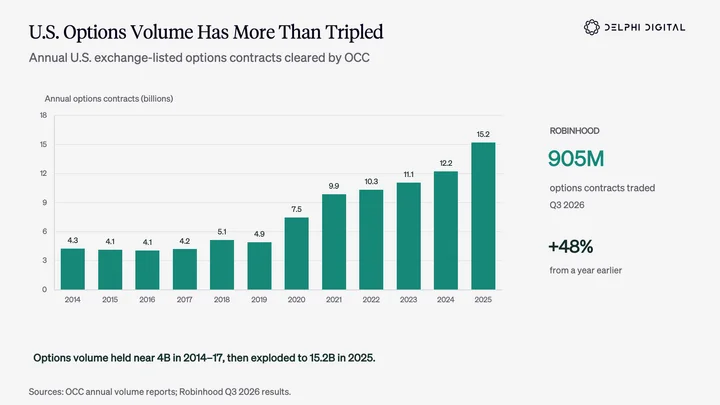
Traders use options for all sorts of reasons, from protecting existing positions to making highly speculative bets. The unwavering growth is a case in point of people wanting more control over their exposure than a linear long or short provides.
You see a similar appetite for outsized payoffs in prediction markets. In a study of resolved Polymarket markets, roughly 18% of purchases were of contracts priced below 10¢, with traders spending about $274 million on them. Buying a contract at 10¢ gives a trader a potential 10x payout if the outcome resolves in their favor, while limiting the upfront cost. People are chasing convexity.
But prediction markets are all built around a specific outcome. A trader betting that BTC will exceed a certain price by a set date receives the same payout at resolution whether BTC barely clears that level or rallies far beyond it. If the condition isn’t met, the contract expires worthless, even if BTC rose substantially along the way.
Traditional options come with their own trade-offs. A BTC call gives a trader convex exposure, but they must choose a strike and expiry, pay a premium, and find liquidity in that particular contract. If the rally takes longer than expected, the call can expire worthless even if BTC moves in the right direction.
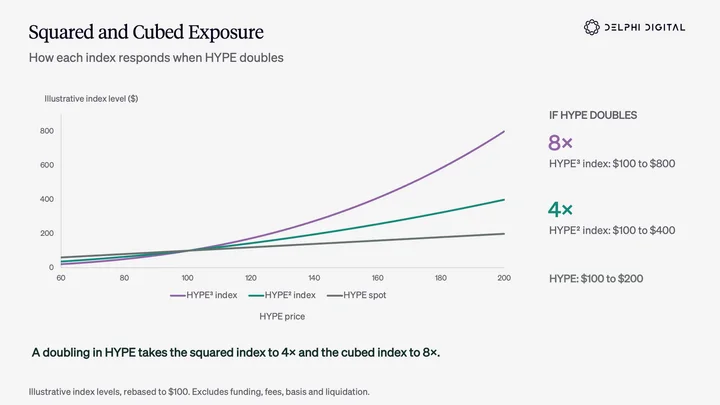
Power Perps are Paragon’s new product bringing the convexity of options right into the simplicity of a perpetual future. Instead of tracking the underlying asset’s price directly, Power Perps reference an index based on that price raised to a power, such as squared or cubed.
For the trader expecting a large rally, Power Perps let their position gain exposure as the underlying rises or shed exposure as it falls, without choosing a strike or expiry. Compared with a linear long that starts with the same exposure, that means more upside if the asset rises and a smaller price loss if it falls.
They can hold the position through a familiar perp for as long as they want, and they don’t need to add leverage to introduce convexity. Funding still affects the cost of holding the trade, but traders now have a way to access that exposure alongside the spot and perp markets they already use.
Paragon is a market deployer on Hyperliquid, offering perps tracking assets ranging from individual stocks to rates and crypto. Its Power Perps are launched via HIP-3, Hyperliquid’s framework for third-party teams to launch their own perps.
A deployer chooses what its markets track and is responsible for the contract specifications, price feeds, and settings (such as leverage limits). The markets then use Hyperliquid’s trading infrastructure, including its order books and margin system. In Paragon’s case, that same framework gives the team room to introduce a market based on squared or cubed exposure.
The First Time Around
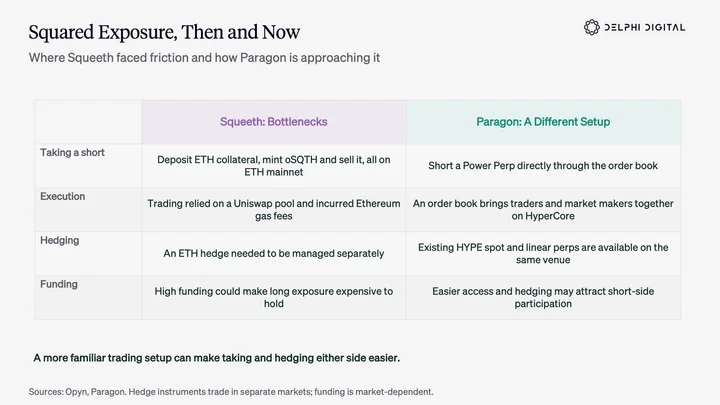
This idea of trading squared exposure through a perpetual isn’t entirely new. Many natives may remember when Opyn introduced Squeeth in 2022, giving traders ETH-squared exposure through a token called oSQTH. Users could buy the token on Uniswap to go long, while traders looking to take the other side could deposit collateral, mint oSQTH, and sell it.
Squeeth became a building block for other products. Opyn’s “Crab” strategy combined a short Squeeth position with ETH exposure and packaged it into a vault for users who wanted to take the other side of the trade without managing the position themselves. We covered both Squeeth and Crab at the time, as traders experimented with ways to bring options-like exposure and volatility strategies onchain.
Squeeth is a great history lesson. It showed what needed to change to build a sustainable market around this type of exposure. Traders looking to take the short side had to deposit collateral, mint oSQTH, and sell it through a Uniswap pool, then manage their ETH hedge separately. Trading and rebalancing on Ethereum mainnet meant paying high gas costs, while execution depended on pool liquidity.
Those costs and extra steps made taking the other side much more involved, limiting competition among short sellers. Funding rates then suffered, particularly when traders expected large moves in ETH, making Squeeth a much more expensive hold than a linear perp. The product in this iteration was not feasible.
Yet, for a product built around a relatively unfamiliar derivative, Squeeth found a real audience. By the time it shut down in November 2024, more than 18,000 unique users had traded over $1.8 billion in ETH exposure.
Paragon is bringing this idea into a different environment, one where onchain finance is now more mature. Power Perps will trade through HyperCore’s order book infra, alongside the existing spot and perp markets traders already use. A trader opens and manages the position in a familiar format, while market makers can use those surrounding markets to hedge the exposure they take on. Hyperliquid’s unified account and portfolio margin features can make it even easier to put existing capital to work here, while HyperEVM opens the door for developers to build new products and strategies around Power Perps.
For those traders willing to take the short side, that means no minting of an extra token, selling it through an AMM, or managing the trade across separate protocols. They can quote or open a Power Perp position directly and adjust their hedge using the surrounding spot and perp markets. An established base of traders and market makers gives Paragon a much stronger starting point for attracting both sides of the trade, with more participation creating the potential for tighter execution and more competitive funding.
The great thing about Power Perps is that this tool opens up far more possibilities than the simple linear directional view you’re limited to with regular perps. Users who expect a large rally could use a Power Perp alongside a regular perp to shape their exposure, adjusting how much they stand to gain or lose as the underlying price changes. Traders can take the other side of that long, using combinations of Power Perps, linear perps, options, and spot to build strategies around their views on volatility, hedge positions, or shape their exposure to different price moves. A great new tool for the house of all finance.
Paragon is bringing the first of these markets to Hyperliquid with HYPE², where traders can take either side of this exposure through a single order book. Rather than spreading that activity across contracts with different strikes and expiries, users seeking convex HYPE exposure can meet in one market.
Why Convexity Beats Simply Adding Leverage
A regular HYPE perp references the spot price of HYPE directly. HYPE² instead references an index based on the price of HYPE squared. To keep this index price easy to read, Paragon scales it down by HYPE’s price at launch.
If HYPE were $100 at launch, its squared price would be 10,000. Dividing that by the $100 launch price gives us an index that also starts at $100.
For a simple example of your possible returns trading this product, assume the HYPE² index starts at $100. If HYPE rises 20% to $120, the squared index rises 44% to $144. If HYPE instead falls 20% to $80, the index falls 36% to $64.
The result is more upside and less downside than a regular perp on 2x leverage for the same move.
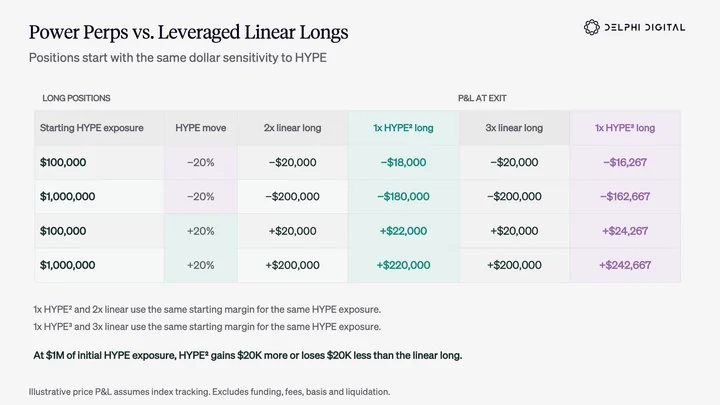
The Power Perp benefits become more obvious when we compare them to a regular leveraged perp trade. Say you want $1 million of exposure to HYPE.
You could open a 2x linear long using $500,000 of margin, or a 1x HYPE² long with the same margin. If HYPE rises 20%, the squared position shows a $220,000 price gain, compared with $200,000 for the linear long.
If HYPE falls 20%, the squared position shows a $180,000 loss, compared with $200,000 for the linear long.
The table below compares both squared and cubed exposure with a linear long starting with the same HYPE exposure. We use 2x leverage for the linear comparison with HYPE² and 3x for the comparison with HYPE³, so each pair starts with the same margin.
Options traders call this sensitivity to the underlying delta. Gamma measures how much that delta changes as the underlying moves. A fixed-size linear perp position has a constant delta. But a long HYPE² position has positive gamma.
So its delta increases as HYPE rises and decreases as HYPE falls. For a fixed number of HYPE² units, gamma stays constant. Meaning delta changes by the same amount for each $1 move in HYPE.
This can be a bit confusing. In practice, it simply means your long position picks up exposure to HYPE as the price rises. If the rally keeps going, each additional dollar of upside matters more to your position.
And the other side of the coin: when HYPE falls, the position sheds exposure, so each additional dollar of decline has a smaller effect than the last.
That’s the true appeal of convexity. With the same starting exposure, the Power Perp gives you more upside as HYPE rises and cushions your losses as it falls, compared to a linear position. The drawback is a higher funding rate.
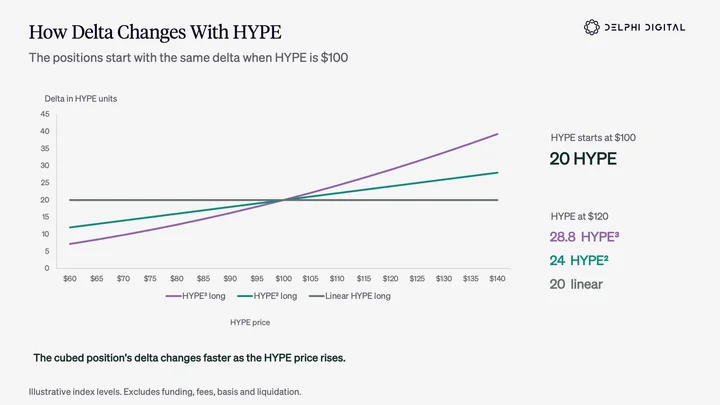
A 1x HYPE² position begins with the same dollar sensitivity as a 2x linear HYPE position of equal margin.
But if HYPE rallies, the squared position’s exposure grows. The trader captures more of each further gain as the move develops. If HYPE falls, that exposure shrinks.
A fixed-size linear long keeps the same dollar sensitivity throughout, whether the trade is working or not.
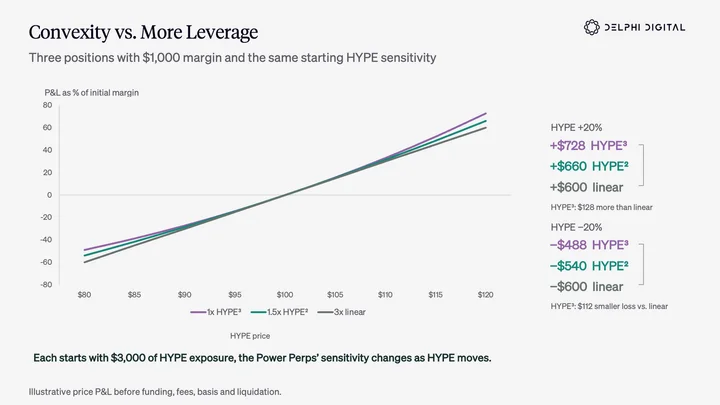
The power of the contract is separate from added leverage. A trader can hold HYPE² at 1x and still have a convex position, or use leverage to increase its size relative to their margin. However, adding leverage amplifies both gains and losses and brings liquidation closer, so a trader can lose the position before their view plays out.
It’s Not All Roses. Holding that convexity comes with a cost in the funding rate, similar to the time decay an options trader pays to hold a position. Like a regular perp, Power Perps use funding payments between longs and shorts. Longs generally pay, though the rate and direction can change.
Paragon calculates the base funding rate using HYPE’s recent volatility, funding on the underlying perp, and the power of the contract. The final rate depends on where HYPE² trades relative to its index. Hyperliquid’s existing spot and perp markets give traders a familiar place to hedge, which may help attract more participation to the other side of the trade. Funding can run higher than on a regular perp, so the real question is whether it stays reasonable enough for traders to pay up for convexity.
Where Power Perps Can Fit Between Spot, Perps, and Options
Understanding what benefits Power Perps have over other trading instruments, and how they behave, is one part of the equation. The other is where they best fit in a trader’s toolkit.
A regular perp is a straightforward way to take a directional position. A trader who wants to be long HYPE can choose their position size and leverage, then adjust or close the trade as their view changes.
Options offer more control over how a position pays out, but require precision. A trader expecting an announcement or major price move by a particular date can choose an expiry around that event and select a strike that reflects the size of the move they’re targeting. They can combine contracts to set up spreads, protect a spot position, or express a view on volatility. That flexibility comes with more decisions to manage, including the premium, time remaining, and liquidity available in each contract.
Power Perps fill a gap between those two ways of trading. They give you a position whose exposure changes with the underlying; in a perp, you can hold it without choosing a strike or rolling an expiry. That makes it easier to stay positioned for a larger move when you don’t have a precise date in mind.
You give up some of the precision of an options chain, and the position comes with funding and margin requirements. But you gain a different way to carry convex exposure alongside the spot and linear perps already in your account.
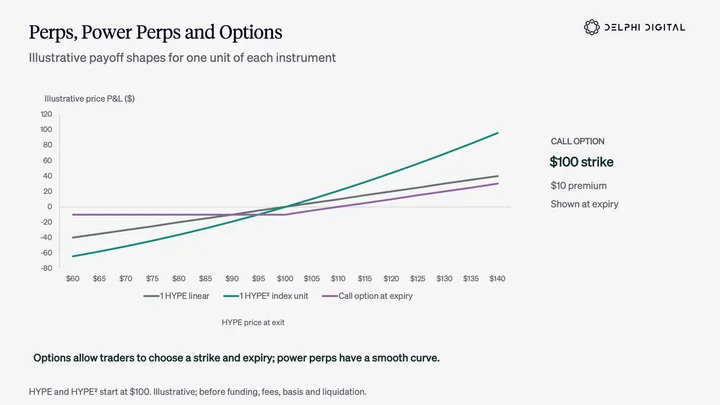
The Power Perp’s appeal becomes obvious as HYPE moves higher. In this illustrative example, its gains grow faster than both the linear perp and the call option, giving the trader more upside as the rally continues. The call option does limit the buyer’s downside to the premium paid, though, and its payoff varies with the strike and expiry.
Playing HYPE’s Next Big Move
Imagine a major announcement around changes in HYPE buybacks takes place this week. It’s not clear whether the new stance will be bearish or bullish. But whatever is announced will likely cause a strong HYPE move either way.
In this case, you don’t want to be long or short HYPE. You want exposure to a large move in HYPE without expressing a strong view on the actual direction. The best way to trade this is by going long volatility.
A great way to do this is to go long HYPE² and short enough of the linear HYPE perp to offset the position’s delta at entry.
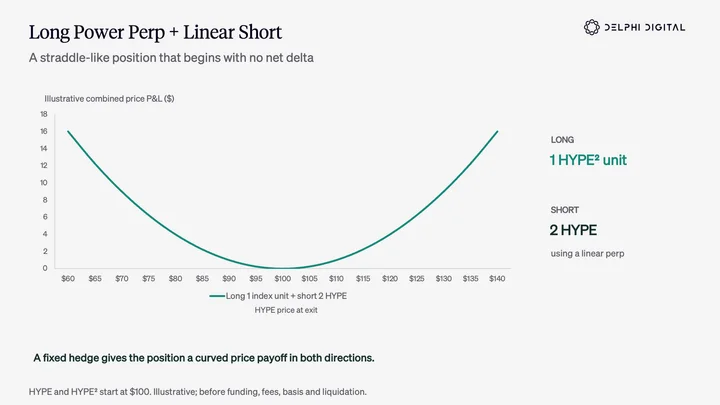
For a small move around the starting price, gains on one leg roughly offset losses on the other. But as HYPE moves further away, either up or down, the Power Perp’s delta changes while the linear hedge stays fixed.
The combined position develops a curved, straddle-like payoff that benefits from a large move in either direction. It doesn’t matter whether HYPE nukes or pumps, you make money in both scenarios.
To return to our earlier example, assume HYPE and its squared index both start at $100. A trader goes long one unit of HYPE² and shorts two HYPE through a linear perp, matching the squared position’s starting delta. If HYPE rises to $120, the squared leg gains $44 while the linear short loses $40. If HYPE falls to $80, the squared leg loses $36 while the linear short gains $40. In both cases, the combined PnL is positive.
Getting Paid While HYPE Stays Quiet
The opposite combination takes the other side of that curve, essentially selling volatility.
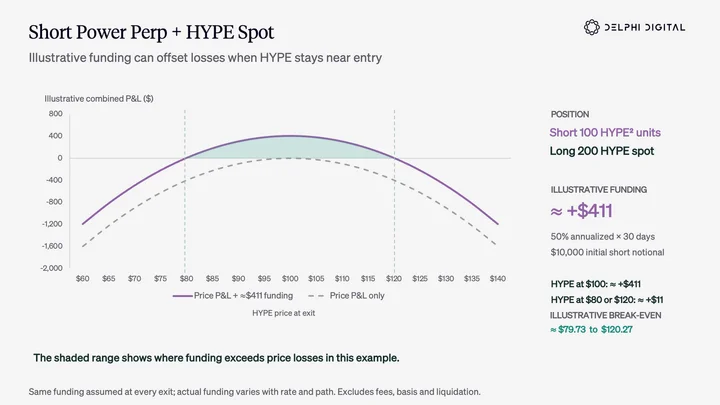
You short HYPE² and buy enough HYPE spot to offset your starting delta. If HYPE stays close to the entry price and funding remains positive, the funding received can outweigh any losses and fees. This trade has a similar appeal to selling a straddle, but collects funding over time instead of premium upfront.
Hedging Your Convexity Around Earnings
Suppose you’re bullish on NVDA over the coming months and want the increasing upside exposure of an NVDA² long, but you’re concerned about a sell-off around its upcoming earnings release. You could buy an NVDA put alongside the Power Perp to protect against some of the downside below the put’s strike until it expires.
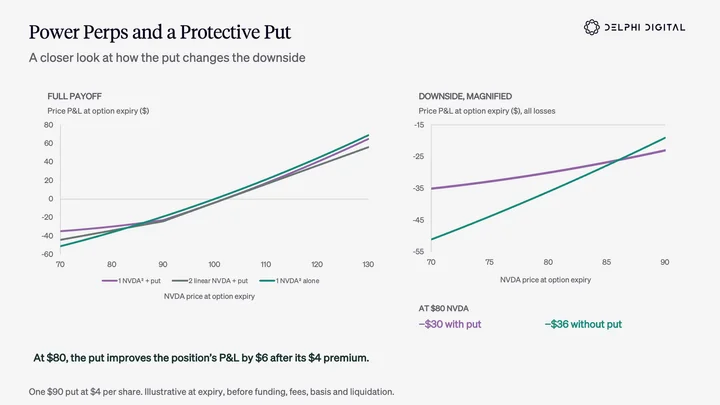
Using the same starting prices as above, assume NVDA and its squared index are both at $100. You go long one unit of NVDA² and buy a put covering one NVDA with a $90 strike, paying a $4 premium. If NVDA falls to $80 at the option’s expiry, the NVDA² position would show a $36 loss, while the put would be worth $10. After the premium, the combined price loss would be $30. If NVDA instead rises to $120, the Power Perp would gain $44 and the put would expire worthless, leaving a $40 gain after the premium.
These products trade differently in practice, but can be powerful once combined. An options chain divides activity across contracts with different strikes and expiries. A Power Perp instead brings traders interested in that convex exposure into one order book, without requiring them to roll between expiries.
This concentration into one instrument gives market makers and traders one place to meet for a particular exposure, making deep liquidity much easier to achieve. Spreads, execution size, and funding costs will always depend on how much participation the market attracts.
Why Hyperliquid Is the Best Home for Power Perps
For Power Perps to work, traders need to be willing to take the other side of that accelerating upside, and those counterparties need a way to manage the exposure they take on. Hyperliquid gives Paragon a head start on both. Directional traders already come to the venue for other perps, and market makers have direct access to spot and perp markets for hedging.
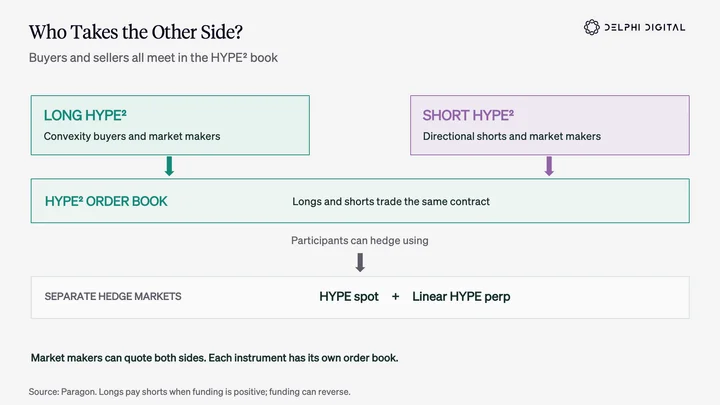
This is one reason the Hyperliquid setting is the linchpin for Power Perp’s success. Traders already use the venue for assets like HYPE spot and perps, giving Power Perp participants access to markets they can use to build and adjust positions. A trader who wants to hedge a HYPE² short doesn’t need to find a separate venue and move capital there first.
Portfolio margin can make these positions far more capital-efficient than earlier attempts. For example, if you’re short HYPE² against a spot HYPE position, you can use eligible assets as collateral while managing the trade in one account. That gives you another way to put existing holdings to work, though the benefit will depend on your account setup and the market’s final margin settings.
It also helps explain the opportunity to revisit an idea like Squeeth. The original product showed that traders were interested in both sides of squared exposure, from buying convexity outright to selling it through strategies like Crab. But trading Squeeth came with a lot of moving parts, especially on the short side, where you had to deposit collateral, mint oSQTH, sell it through a Uniswap pool, and manage your ETH hedge separately.
Paragon is abstracting its complexity and making that exposure simpler to trade on Hyperliquid. You can go long or short a Power Perp directly through an order book, then use the spot and linear perp markets on the same venue to hedge, all through a trading interface you already know.
Where Can Power Perps Go From Here?
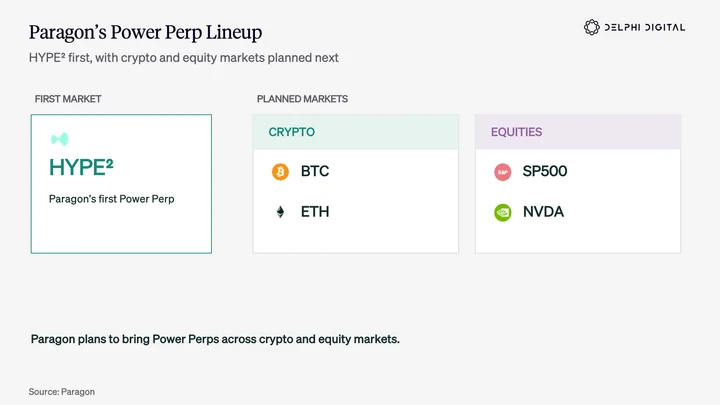
HYPE² is where Paragon is starting, but the team has a broader set of markets in mind. The next Power Perp launches include ETH, BTC, SP500, and NVDA, bringing the product to assets at the center of some of the largest derivatives markets.
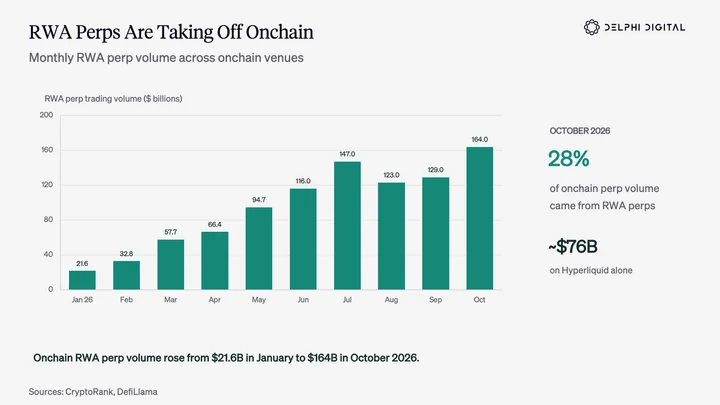
The equity markets are particularly interesting here. Trading traditional assets onchain has gone from a niche idea to a meaningful part of the perp market in a short time. Across onchain venues, monthly RWA perp volume grew from just $21.6 billion in January to $164 billion in October, accounting for roughly 28% of all onchain perp trading that month. Hyperliquid has become a major venue for this activity, with an estimated $76 billion in RWA perp volume in October alone. Traders are already coming onchain to trade these markets, and Paragon wants to give them another way to express those views.
A massive options market also surrounds the same assets. As we covered, options activity has exploded over the past few years, and a lot of that trading happens in names and indices people follow every day. Cboe’s S&P 500 index options alone traded an average of 5.5 million contracts per day in October 2026, a new monthly record. Not all of those traders will be looking for a Power Perp, but it shows how much activity already exists in these markets.
That existing activity could create room for Power Perps alongside the options traders already use. Traders move between stocks, futures, and different options contracts depending on the exposure they want. A Power Perp gives them another choice in that mix, with a position they can hold without choosing a strike or rolling an expiry.
There’s also the obvious bigger shift happening around Hyperliquid itself. Over the past year, the platform has grown beyond its roots in crypto perps, with HIP-3 deployers bringing stocks, indices, commodities, and currencies onchain. Traditional finance has been paying attention.
In March, S&P Dow Jones Indices licensed the S&P 500 to Trade[XYZ] for a perpetual contract on Hyperliquid. More recently, Intercontinental Exchange, the owner of the NYSE, announced a strategic investment in Trade[XYZ] and plans to build a regulated market and clearing structure on Hyperliquid for U.S. perpetual futures.
All of this creates an interesting backdrop for Paragon. As more traders come to Hyperliquid to trade traditional assets, Power Perps give them another way to express those views alongside the linear perps already available. There’s an opportunity to reach options traders who are used to thinking in terms of nonlinear exposure but may find a use for a position they can trade and manage through a perp.
The ICE partnership is with Trade[XYZ], not Paragon, and there’s no indication that Power Perps are part of its proposed U.S. offering. But the broader trend matters for Paragon all the same.
As Hyperliquid brings more traditional markets onchain, it’s attracting traders and liquidity that deployers can build around. Power Perps are an example of what that makes possible, introducing a new way to trade these assets alongside the spot and perp markets already on the platform. The more entrenched Hyperliquid becomes as a venue for trading assets onchain beyond crypto, the bigger the potential audience for new instruments built on top of it.
When Is Convexity Worth Paying For?
If you’re considering a Power Perp long, it comes down to the size of the move you expect and what you’ll pay to stay in the trade. A trader expecting a substantial rally may be willing to pay funding in exchange for exposure that grows as the asset rises. If you expect a smaller move, the extra price gains over a comparable linear position may not leave much room to cover the difference in costs.
The same percentage change on an asset can also look much different depending on how long it takes to play out. Two traders may enter at the same price and exit at the same target, yet have different results if one holds for a few days and the other holds for several months.
A sideways market can be a tough place to hold a directional long. HYPE might rally along the way, but if it ends up back where it started, the squared index will too. A trader who held through the round trip would see those price gains disappear and may have paid funding while waiting.
For the trader on the other side, a quieter market can give a hedged short more time to collect funding. A sharp move can be much harder to manage, as losses can build quickly and the funding collected along the way might not be enough to cover them.
Power Perps let traders stay positioned for a move as their exposure grows with it, without picking a strike or an expiry. That’s a powerful addition to a market where so much activity already happens through perps. Paragon’s bet is that putting this exposure on Hyperliquid, next to the markets traders use every day, can turn an idea that once sat at the edges of DeFi into a regular part of their toolkit. For that to happen, the market still needs tight enough execution, manageable funding, and traders on both sides of the book. If those pieces come together, the product gives Hyperliquid traders a new way to put conviction to work.

0 Comments