Ranking NFT Platforms: A Guide For Brands
MAY 11, 2021 • 20 Min Read

Introduction
After many years of development and iteration, a multi-faceted crypto ecosystem has finally started to emerge. For sectors like DeFi and NFTs in particular, the innovation shows no signs of slowing down. Rather it’s the opposite. Each new application and use case builds upon what came before. None of this would have happened without Ethereum, which settled $1.5 trillion of value in Q1 alone. Ethereum is where much of the liquidity, tooling, and users are. It’s where the action happens. For organizations interested in pursuing a NFT strategy of their own, Ethereum is arguably the best ecosystem to launch it on. There’s just one big problem at the moment holding, it and your plans, back from prime time – scalability.
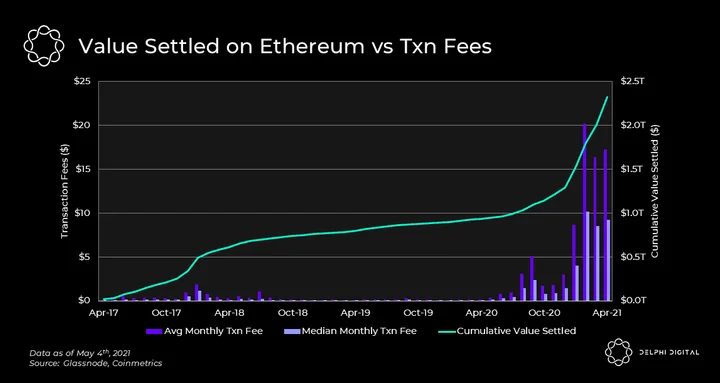
The decentralized nature of Ethereum provides the network with its primary benefits. Namely its security, immutability, and transparency. But all of that comes at a cost, as the network can only handle so many transactions at a given time. When demand exceeds capacity, transaction fees rise, pricing out less valuable applications and smaller users. As a business, the costs you pay and the burdens you place on your users matter deeply. It’s easy to understand why this could be a cause for concern. However, don’t let this deter you. There are scaling solutions for Ethereum and alternative networks that can help you accomplish your goals. The purpose of this post is to compare those options across key criteria, so that you’re better equipped to answer this question – where do you want to build the future of your digital brand?
While there is no shortage of possibilities to go with, in some form or another, our intent with this comparison is to be focused rather than exhaustive. As it stands now, there are relatively few production-ready NFT solutions on the market. In particular, we will be looking at Ethereum’s base layer, Immutable X (Starkware/Volition), Polygon (PoS Chain), Flow, and WAX (built on EOS’ L1). Generally speaking, other alternatives are still in development, have yet to gain sufficient traction, or were bespoke solutions. At the end of this post, we’ll include an honorable mentions section to shine light on some of these. Before we progress further, we’d also like to touch on environmental concerns due to some recent NFT criticism on that point. You can take comfort in knowing that all of the solutions covered in this post are either already green or moving towards it (i.e. Ethereum PoS).
At a high level, we evaluated these solutions across key criteria that all factor into the end user experience. Now, for our grading to make sense, let’s first zoom out and see how all of this looks at a network level.
Analyzing at the Network Level
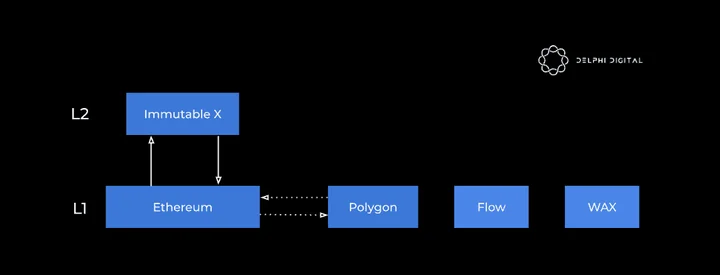
As we alluded to earlier in the post, we place a premium on the Ethereum network. The diagram above illustrates how these various solutions exist relative to it and certain attributes of each. Namely, security and compatibility. On the left hand side you’ll notice the labels L1, which refers to a “layer 1”, and L2, which refers to a “layer 2”. Simply put, a layer 1 is a standalone network with its own set of validators and security guarantees, whereas a layer 2 is a scaling solution built on top of an existing layer 1, with security guarantees very close to the underlying network it sits on top of. For those new to the crypto scene, having strong security in this context means that the validators running the decentralized network can’t easily manipulate or steal from users.
It’s important to emphasize that security varies significantly across the different L1s, with Ethe
Read the full report
This report is part of Delphi Pro.
- 800+ Pro reports across every major sector
- Talk directly with our analysts
- Private community of funds and builders
Already a Pro member? Log in
0 Comments