Introduction
Apps need users, and users seek yield. Both depend on cryptoeconomic security—at least, that’s the claim. But is cryptoeconomic security just a another buzzword or a really thing?
Generally speaking, it measures the cost required to corrupt a network: the higher the cost, the stronger the security. Achieving this level of security is difficult, especially for new applications launching from scratch.
In PoW blockchains like Bitcoin, security comes from the total hashrate, or the computational power dedicated to maintaining the network. In PoS blockchains, security relies on staked capital, meaning an attacker would need to control a significant share of tokens to compromise the network.
dApps deployed on Ethereum L1 do not require to bootstrap their own network, and instead can rely on Ethereum’s decentralized network operators for settlement.
But for projects aiming to secure their networks independently, the traditional approach requires launching a dedicated PoS network, having to incentivize validators to operate nodes and introducing a native token to encourage staking. This is where restaking pitch taps in.
Restaking offers an alternative ‘solution’: it enables projects to use already staked assets to secure additional services that demand economic security. Restakers can earn extra rewards on top of the base staked asset, though they also accept the risk of additional slashing penalties.
During the report, we won’t go too deep into restaking architecture, as it’s already well-covered. Instead, we’ll focus on practical restaking use-cases, explore some applications being built on top of restaking protocols that I find interesting, the differences between restaking in Ethereum, Solana, and Cosmos, and what are apps’ goals in those ecosystems.
Currently, there is $21.86 billion worth of assets being restaked across Ethereum, Solana, Bitcoin, and the Cosmos Hub. Ethereum is by far the largest protocol supporting restaking, with ETH and ETH LSTs capturing $17.2 billion in restaked deposits mostly through EigenLayer followed by Symbiotic and Karak. The next biggest eco is Bitcoin with $2.7B through Babylon, and finally, Solana via Jito and Solayer with $366 million worth of SOL restaked.
EigenLayer
EigenLayer (EL) pioneered the restaking market with an approach called ‘pooled security,’ enabling applications known as Actively Validated Services (AVSs) to leverage restaked assets, either natively staked ETH or Liquid Staking Tokens (LSTs), for additional yield.
They are defined better as a marketplace connecting restakers (users seeking extra yield on staked assets) with AVSs (services needing cryptoeconomic security).
In the future, they plan to support permissionless tokens, allowing AVSs to accept any ERC-20 token as restaked assets, but currently they just accept ETH, ETH LSTs, and EIGEN to be restaked. As of November 13, 2024, they attracted +$15B TVL, composed of native staked ETH ($10 billion), ETH LSTs ($3.5 billion), and EIGEN ($1.1M)
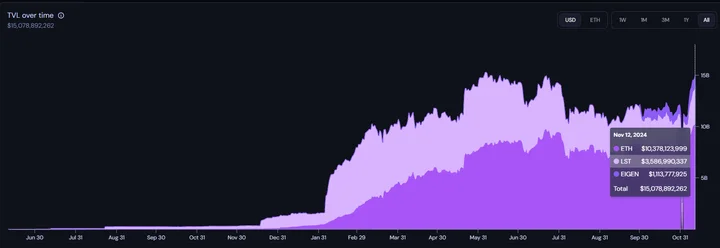
EigenLayer’s system is composed of:
- Restakers: They stake native ETH or liquid staking tokens (LSTs) to secure Actively Validated Services (AVSs), earning extra yield but facing additional slashing conditions (not yet enforced). Existing Ethereum validators restake by linking their validator’s withdrawal credentials to an EigenPod smart contract that manages restaking and withdrawals.
- Node Operators are more akin to validators on a network. They provide infrastructure services to AVSs and run the required software (and sometimes, hardware) in return for rewards. Operators are subject to AVS-specific slashing conditions if they misbehave.
- AVS: AVSs include applications that are looking for cryptoeconomic security, such as blockchains, data availability layers, oracles, bridges, etc. Each AVS has operational and slashing rules enforced through smart contracts that interact with EigenLayer.
As of Nov 4, 2024, slashing is not yet active. To prevent unjustified slashing, EigenLayer plans a reputation-based veto committee to review slashing decisions to prevent arbitrary or malicious slashing by AVSs.
But, how does EigenLayer actually work?
First, a little background. Ethereum’s Proof of Stake (PoS) mechanism operates with two layers: the consensus layer (CL) and the execution layer (EL). To become a staker, you deposit ETH from a regular Ethereum account (EOA) into the staking contract and specify a withdrawal address. Normally, this withdrawal address could be the same as your deposit address.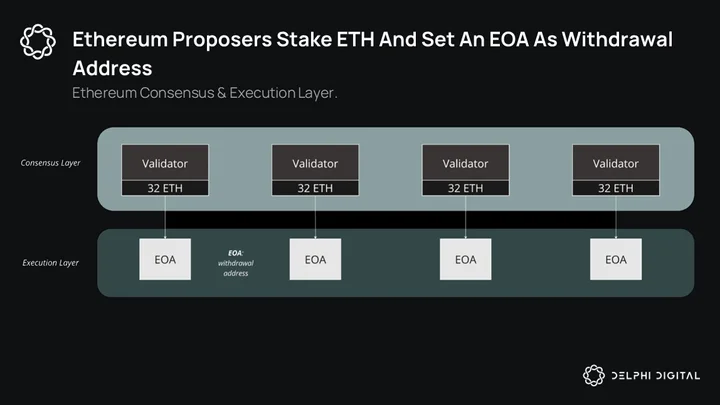 EigenLayer leverages this by allowing you to set a different contract (known as an Eigenpod) as your withdrawal address. When you eventually exit staking, your ETH is transferred to this Eigenpod, so essentially you’re delegating your withdrawal credentials to another contract.
EigenLayer enables third-party services (AVS) to manage slashing events by sending slashing notifications to the Eigenpod. If you violate a staking rule, the AVS can update the Eigenpod, signaling a reduction in the ETH you can withdraw.
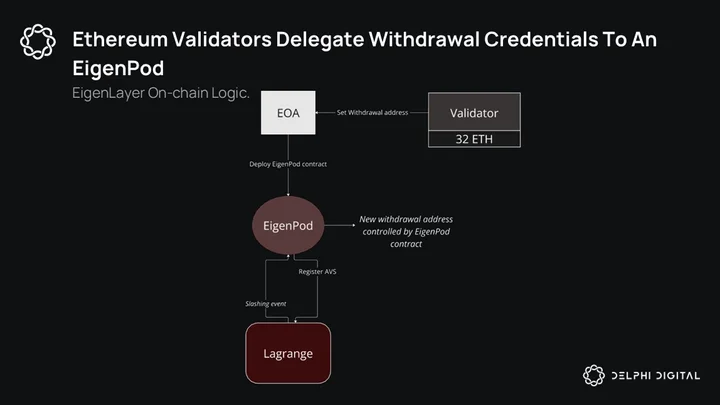
Until you exit staking, Ethereum’s main system is unaware of any slashing; it still reflects your original ETH amount. But when your ETH is sent to the Eigenpod, it enforces the adjusted balance—deducting any slashed amount—allowing you to withdraw only the remaining ETH
AVS Ecosystem
The ecosystem of Application Validated Services (AVSs) can be organized into two main categories: horizontal and vertical AVSs.
Horizontal AVSs provide foundational services applicable across different layers and applications, offering tools and infrastructure that serve various roles, from developer frameworks to operator management.
- Developer Services: frameworks and tools that assist developers in building and deploying PoS networks that require shared security infrastructure (e.g. Blockless, Ethos)
- Operator Services: help AVS operators manage operational tasks, such as node infrastructure, validator tasks, and staking operations. (e.g. Supermeta)
- Payment Services: handle payment distribution to both restakers and operators, such as the distribution of AVS rewards. (e.g. Anzen)
Vertical AVSs are services designed for more targeted, purpose-built applications that scale Ethereum or add layers of functionality.
Rollup Services: enable foundational services that scale Ethereum by adding rollups or scaling solutions, while inheriting Ethereum’s security, including:
- Data Availability (e.g. EigenDA, NearDA): Ensures data integrity and availability.
- Shared Sequencing (e.g. Espresso, Radius): manages transaction ordering across rollups.
- Rollup-as-a-Service (e.g. Caldera, AltLayer): simplifies the creation of custom rollups.
- Interoperability (e.g. Omni, Polymer, Hyperlane, Polyhedra): facilitates cross-chain interactions.
Decentralized Networks: These services require distributed validator mechanisms to operate. Applications including Oracles (e.g. eOracle), Proof Verification (e.g. Aligned Layer), DePIN (e.g. WitnessChain, OpenLayer), Security Monitoring (e.g., Drosera)
Applied Cryptography: These services create robust cryptographic systems to enhance security and privacy, such as FHE (e.g. Fhenix), MPC (e.g. Silence Laboratories), Threshold Cryptography (e.g. Mishti Network).
MEV Management: allow block proposers to establish credible commitments on block inclusion and ordering, helping to manage Maximal Extractable Value (MEV) in a fair and transparent way.
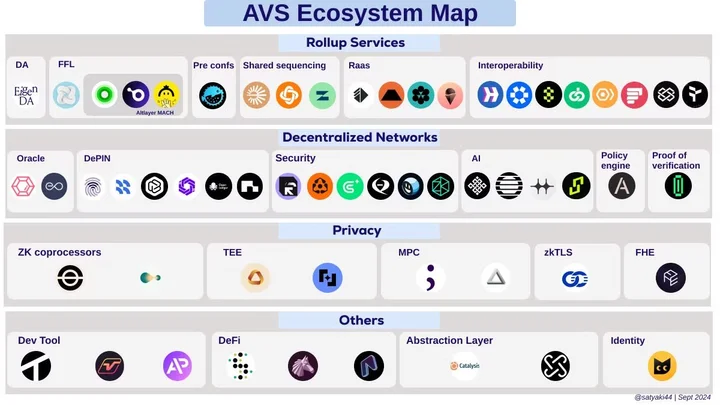
Source: satyaki44
Restaking Use-Cases
When talking about theoretical restaking use-cases, I see three main components that restaking can offer: pooled security, bootstraping a decentralized validator set, and social alignment with the base layer.
Economic security – Economic security is measured in dollar terms but provided in native digital assets (e.g., an AVS secured by $100 million in ETH). Fluctuations in asset values can impact the economic security of AVSs. Using higher-quality, more liquid & higher market cap assets to secure AVSs is key for reducing volatility in their economic security.
While Eigen has been about “accruing value to ETH”, other restaking protocols are enabling permissionless assets—not just ETH—to be staked as more protocols adopt this approach to not get behind the competition. To me, this highlights that the “pooled security” thing in restaking isn’t primarily about leveraging the value of the asset with the most economic value; by allowing any asset to be “restaked”, you simply turn restaking into traditional staking, so we’re back where we started.
It’s just a matter of time until we start seeing restaking protocols allowing LRTs to be restaked, creating a never ending circle of restaking and a potential catastrophic death spiral. Of all the money lost due to exploits in crypto, the main reasons result from private keys being compromised, smart contract vulnerabilities, or poor protocol design. These losses are entirely unrelated to a lack of ‘economic security’.
Restaking by itself isn’t magical; it’s not like restaking makes all those protocols exist out of thin air. All the AVSs out there today could launch independently of restaking and function in the same way. That said, I’m sure they wouldn’t attract as much value at stake to secure their networks. What they’re doing now is simply leveraging Ethereum’s social alignment to draw in users and capital, but let me doubt about the added value of shared security.
Restaking is valuable when your app’s goal is to bootstrap a validator set—especially if the base layer itself is decentralized enough, where Ethereum stands out as the most credible neutral base layer, making it an ideal choice for those apps seeking such decentralization from scratch.
Proposer commitments – restaking is also valuable as a temporary solution when you lack an in-protocol enforced proposer-commitment. For example, to get rid of relays by letting restakers commit to a partial block-auction, enforcing transaction ordering, or to perform top-of-block auctions.
The Cosmos ecosystem (as typical) offers a p
Read the full report
This report is part of Delphi Pro.
- 800+ Pro reports across every major sector
- Talk directly with our analysts
- Private community of funds and builders
Already a Pro member? Log in
0 Comments