
Report Summary
Market Context
-
RWAs are one of the fastest-growing narratives in crypto, bridging traditional finance (TradFi) with blockchain rails.
-
Total RWA value onchain (excl. stablecoins) > $30B, doubling in the past 9 months.
-
Adoption is strongest in fixed income and private credit, but expanding into equities, real estate, and insurance.
Avalanche’s RWA Positioning
-
Holds $740M in tokenized RWAs across 41 assets & 7,700 wallets → now a top 5 RWA network.
-
Recent inflows:
-
$250M credit products onboarded via Grove + Janus Henderson.
-
$300M in assets tokenized by Skybridge.
-
-
Strong stablecoin base ($1.8B, top 10 chain) provides settlement and distribution rails.
-
Dual architecture:
-
C-Chain → liquidity & composability.
-
Appchains → compliance, sovereignty, and bespoke institutional design.
-
Institutional Issuers on Avalanche
-
Dinari: launching an appchain for compliant tokenized equities (dShares). Targeting cross-chain interoperability; validators include Gemini, BitGo, VanEck. Long-term vision: DTCC-like clearinghouse for securities.
-
Wyoming’s FRNT stablecoin: first U.S. state-backed stablecoin, piloted on Avalanche for government payments (cutting settlement from 45 days → seconds). Integrated with Visa via Rain card.
-
Hashfire: automates legal/financial agreements into tokenized contracts. Used in the Wyoming pilot; expanding into B2B receivables, insurance claims, project financing.
-
Re (Reinsurance): offers tokenized insurance yield products (reUSD, reUSDe) with transparent onchain reporting. Grew from $80M premiums (2024) → $168M (2025), with 90%+ renewal rates.
-
Grove Finance: partnered with Centrifuge + Janus Henderson, deploying $250M CLO & Treasury funds. Positions Avalanche RWAs as DeFi collateral.
-
Inversion: PE-inspired strategy, acquiring real-world businesses and moving them onchain via an Avalanche L1. Raised $26.5M seed (Dragonfly, VanEck, ParaFi).
Global Distribution Layer
-
OpenTrade: provides yield vaults (Treasuries, MMFs, European bonds) powering fintech apps. $58M TVL, 97% on Avalanche.
-
Key integrations:
-
Buenbit (Argentina, 800k users) → 4–7% yield via tokenized MMFs.
-
Littio (Colombia, 80k users) → USD/EUR savings, 6% APY; $100M txns processed in 4 months.
-
Belo (3M users, 18 countries) → 4% APY stablecoin savings, fully liquid.
-
Criptan (Spain, 85k users) → up to 8.35% APY on USDC, 5.5% on EURC; €500k+ interest already paid.
-
Strategic Advantage
-
Avalanche’s appchain + C-Chain model uniquely solves both sides of the RWA equation:
-
Supply → issuers like SkyBridge, Franklin Templeton, Dinari.
-
Demand → consumer platforms embedding RWA yields for millions of users.
-
-
Differentiator: compliance + global distribution at scale.
-
RWAs are no longer just pilots → Avalanche is proving production-level adoption across multiple asset classes.
Conclusion
Avalanche has evolved into one of the most diverse and mature RWA ecosystems, spanning:
-
Securities (Dinari)
-
State stablecoins (Wyoming FRNT)
-
Insurance & credit (Re, Grove)
-
Consumer fintech integrations (OpenTrade, Buenbit, Belo, Criptan, Littio)
This positions Avalanche not only as a hub for tokenization but as a foundational digital finance stack, bridging TradFi-grade issuance with real-world user adoption.
-
Introduction
Real-world assets (RWAs) have surfaced as one of the most compelling narratives for crypto adoption, enabling the onboarding of traditional finance products onto blockchain rails. For institutions, however, deploying on general-purpose chains presents challenges. The absence of KYC and AML, combined with reliance on unknown validators, makes it difficult for firms to operate in a compliant environment.
Avalanche has positioned itself to meet this need by leveraging customizable, compliance-ready appchains to power institutional integrations. Over the past year, this approach has driven accelerated growth across all RWA verticals. From traditional funds and tokenized equities to reinsurance products, public finance pilots, and property deed tokenization. What began as early advocacy for RWAs has now matured into a full-fledged ecosystem, with Avalanche emerging as a hub for asset tokenization and TradFi deployments.
Crucially, Avalanche’s ecosystem of RWAs extends beyond issuance. The network can bridge institutional supply with real user demand across the globe. Platforms like Belo now offer U.S Treasury yield directly to millions of users in Latin America through Avalanche RWAs. To better understand how Avalanche stacks up in this sector, let’s first map out the broader RWA market.
The RWA Opportunity
The onchain RWA market is still nascent compared to traditional finance, though adoption is accelerating. Treasuries, equities, credit products, and real estate are being onboarded at a rapid pace. Today, the total RWA value onchain (excluding stablecoins) exceeds $30 billion, double what it was nine months ago. Much of this value continues to cluster in fixed income and private credit, but other sectors are catching up.
The Avalanche ecosystem currently holds over $740 million in tokenized RWAs, spanning across 41 assets held by 7,700 unique wallets. Grove just onboarded $250 million in credit products with Janus Henderson, and hedge fund Skybridge recently tokenized another $300 million in assets. With these new deployments, Avalanche has more than doubled its tokenized value over the past few months and now ranks among the top five networks by RWA value.
Stablecoins are critical to Avalanche’s RWA stack. They act as the primary rails for settlement, payment flows, and yield distribution. The network currently holds over $1.8 billion in stablecoins and is among the top 10 chains by total stablecoin marketcap. This liquidity is foundational for both institutional issuance and distribution to everyday users across the globe. USDC and USDT continue to make up the largest share of supply, but new alternatives are starting to grow in relevance. Avant’s avUSD has gained traction as a top yield-earning stable, while Agora’s AUSD is an institutional-grade stable focused on enterprise deployments.
Beyond the headline figures, Avalanche’s positioning rests on infrastructure and design choices that align with institutional requirements. The Avalanche C-Chain provides liquidity and composability for all applications across the ecosystem. Appchains build on this by powering bespoke L1s with compliance features, tailored tokenomics models, and sovereignty over network design.
As a result, Avalanche intelligently solves both sides of the RWA equation. On the supply side, issuers like SkyBridge, Janus Henderson, Franklin Templeton, and Dinari are deploying on the network. And on the demand side, platforms like OpenTrade and Grove are channeling yield opportunities to users worldwide. Together, they provide the supply and distribution infrastructure needed for RWAs to scale across asset classes and user segments.
Exploring RWA Issuers on Avalanche
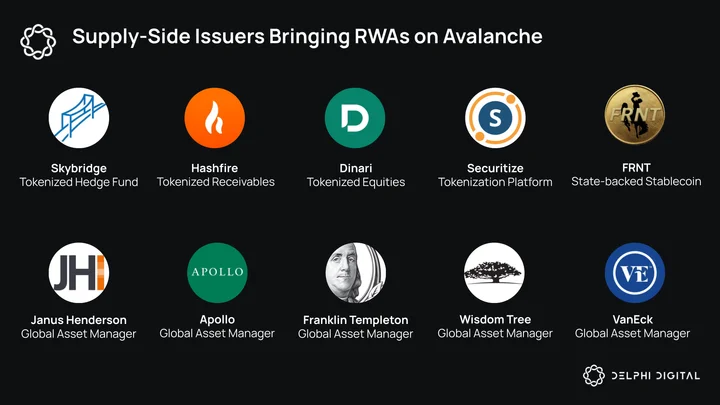
Avalanche has become a key venue for institutional deployment and a leading launchpad for RWA issuers. Firms are bringing a wide range of assets onchain, from tokenized hedge funds and U.S. equities to reinsurance contracts and state-backed stablecoins.
Dinari Financial Network
Dinari is arriving as one of the most significant RWA issuers on Avalanche. To support its flagship product, dShares (tokenized U.S equities), the team is launching a dedicated appchain focused on compliant issuance, settlement, and cross-chain transfers of securities. The new Dinari Financial Network will serve as a coordination layer for these assets, underpinning cross-chain liquidity while preserving compliance.
Today, Dinari’s dShares account for $3.6 million of the $400 million in tokenized stocks outstanding, with nearly all holdings concentrated on Arbitrum. Despite its small share, Dinari already supports more than 150 equities like NVDA, SPY, and TSLA. This concentration is set to shift as expansion accelerates, with the upcoming Avalanche L1 enabling interoperability with other chains. Solana will be among the first, with dShares becoming fully compatible across Avalanche and other networks through the appchain.
Dinari enforces a strict issuance and redemption model for its RWAs. Each dShare is minted or burned only when a corresponding brokerage transaction is executed. For issuance, users escrow funds onchain and trigger a forward order to a partnered broker-dealer. Only once that order is filled and Dinari receives confirmation, dShares are minted.
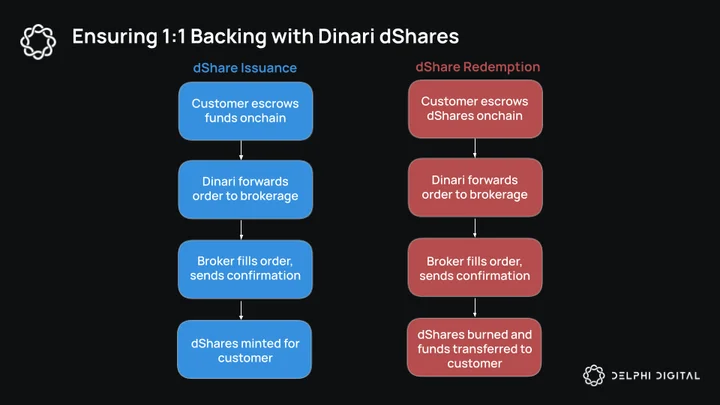 Redemptions follow the inverse: dShares are held onchain and burned after the sell order from the broker-dealer has been confirmed. This ensures strict 1:1 backing and minimal trust settlement via smart contracts.
CEO Gabriel Otte said Dinari’s decision to launch its own Avalanche appchain was driven by necessity. Most public chains lack the compliance granularity required for securities issuance, and fragmentation across multiple ecosystems would undercut global liquidity. By building on Avalanche, Dinari gains full control over execution logic and network governance. Validators will initially be drawn from a consortium of institutions, including Gemini, BitGo, and VanEck, who will also serve as custodians.
The long-term vision mimics that of the DTCC, positioning Dinari as a modern clearinghouse for tokenized securities.
FRNT: The Wyoming Stablecoin
On August 19th, Wyoming became the first U.S. state to issue its own fully reserved stablecoin, FRNT. This digital dollar is issued by the Wyoming Stable Token Commission, a public entity governed by five state-appointed commissioners who oversee supply, reserves, and deployments.
In July, Wyoming piloted FRNT for government contractor payments with Avalanche-based Hashfire. The test showed that invoices, normally subject to 45-day settlement periods, could be authenticated and paid in seconds. State officials pointed out the system could also deliver disaster relief instantly, bypassing weeks of delays. More broadly, FRNT and other state-backed stablecoins could completely modernize government operations and add greater transparency to their financial flows.
FRNT is fully backed by cash and U.S. Treasuries, with a 2% overcollateralization buffer bringing reserves to 102%. While not yet available for public purchase, FRNT has already been deployed on several networks, including Avalanche. It has also been integrated with Rain’s Visa card platform, setting the stage for everyday spending. The Rain card will allow FRNT to be used at any merchant that accepts Visa, making it the first U.S. state-issued stablecoin with real consumer use.
Hashfire
Hashfire is a financial infrastructure startup with its own Avalanche L1 to transform legal and financial agreements into programmable, tokenized assets. These tokenized contracts execute and settle automatically, removing manual approval delays and enforcing logic directly onchain.
The platform recently drew attention through its role in the Wyoming FRNT pilot. During the test, Hashfire processed government vendor agreements and disbursed stablecoin payments within minutes, eliminating the typical, lengthy 45-day processing time.
Hashfire’s workflow mirrors how organizations already manage contract processes, but adds automation and auditability at each stage. Contracts are uploaded and routed through internal approval flows, where roles and responsibilities are assigned within the organization. Once internally approved, agreements are signed by vendors and become a tamper-proof onchain record. Each transaction generates a real-time audit trail, and all payments settle near-instantly via smart contracts. By abstracting away wallets and gas, users enjoy the same familiar workflows while gaining the speed and certainty of onchain settlement.
And it’s easily replicated. The same framework reducing Wyoming’s payment cycle from weeks to seconds could axe settlement times across other industries. Looking ahead, Hashfire is expanding beyond public finance pilots into use cases such as B2B receivables, insurance claims, and project financing. Approved contracts and orders on the platform can already function as composable assets, giving vendors access to instant financing and turning agreements into liquidity.
Worldwide Demand
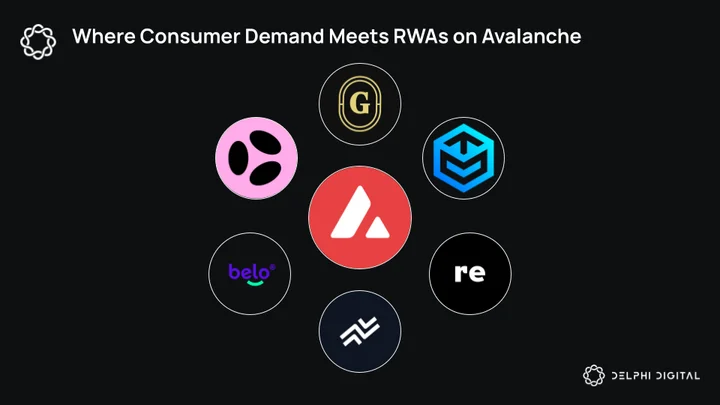
On the consumer demand side, a growing set of institutions and fintech platforms are adding Avalanche RWAs to their offerings. While protocols like Hashfire and Dinari showcase the infrastructure for programmable settlement, projects like OpenTrade and Grove demonstrate how tokenized assets are being deployed to end users across global markets.
Re.xyz
Re is a decentralized reinsurance platform bringing institutional-grade insurance yield to users on Avalanche. It offers two permissioned products: reUSD (Basis-Plus) & reUSDe (Insurance Alpha). Both tokens are KYC/AML-gated and restricted to non-U.S. users.
reUSD serves as a low-volatility vault that generates yield from T-bills and delta-neutral ETH basis strategies. It carries comparatively little underwriting risk and targets returns in the 6–12% APY range.
reUSDe is different. Unlike reUSD, it carries underwriting exposure through U.S. insurance programs such as homeowners, auto, and workers’ compensation. These non-catastrophic lines are historically profitable and generate 15–23% annual yields, though they are not risk-free.
Re sources this insurance exposure through partnerships with licensed insurers and reinsurers. Deposited capital for reUSDe is deployed into fully collateralized quota-share treaties, where investors take on a fixed share of premiums and claims. It also uses surplus notes, a form of debt that provides capital to insurers but can only be repaid once policyholder claims are satisfied. Drawdowns, repayments, and trust balances are published onchain through Chainlink oracles, creating a transparent audit trail.
Re has also introduced a Points Program to incentivize early participation. Users earn multipliers for holding reUSD or reUSDe directly (5x daily points) and higher rewards by deploying them in DeFi protocols. Providing liquidity on Blackhole, Curve, or Pendle can boost earnings up to 20x. The points are expected to convert into future token rewards as a way to give early allocators an additional upside beyond stable income.
The platform has already shown significant growth. In 2024, it supported just over $80 million in underwritten premiums. That figure surpassed $130 million across 330,000 policies by early 2025 and now sits at $168 million.
More than 90% of the 2024 business was renewed, underscoring both durability and partner confidence. And while reUSD is deployed across several networks, Avalanche remains the primary hub with the largest share of holders. Re’s strong renewal rates and expanding premiums prove that institutional yield can scale onchain, with Avalanche providing the infrastructure to support it.
Grove Finance
Grove is an institutional credit platform incubated under Sky (formerly MakerDAO) and backed by Steakhouse Financial. Rather than issuing its own products, Grove functions as an allocator, connecting tokenized assets to onchain capital. The platform recently announced its expansion to Avalanche, with a target deployment of over $250 million in tokenized RWAs.
To achieve this, Grove has partnered with tokenization platform Centrifuge and Janus Henderson, a $373 billion global asset manager. Their collaboration brings the Anemoy AAA CLO Fund (JAAA) and the Anemoy Treasury Fund (JTRSY) onchain, both tokenized through Centrifuge. $250 million of JAAA is already live on Avalanche, making it the largest institutional credit product deployed on the network.
Regulatory alignment and support for institutional execution made Avalanche a natural fit for Grove. “It necessitates infrastructure capable of supporting institutional execution, composability, and scalable operations,” the team stated. For Avalanche, Grove’s arrival signals that institutions are ready to move from issuance into practical onchain utility.
As allocations into these funds scale, they can serve as foundational collateral within DeFi. DAOs could use them for safer treasury management, while protocols could launch lending markets around RWAs. In this way, Grove can extend access to products that were previously restricted to traditional financial channels and plant them in the core of Avalanche’s RWA ecosystem.
Inversion
Inversion is building an Avalanche L1 with a simple, yet compelling premise. Instead of waiting for crypto-native apps to scale, the team plans on acquiring existing businesses and making them more efficient with blockchain infrastructure. This way, they can bring the real world onchain by supplanting traditional workflows with crypto rails in companies that already have distribution.
The approach applies the private equity playbook to crypto, upgrading businesses that already serve large user bases. Inversion recently raised a $26.5 million seed round on this vision, led by Dragonfly, with participation from VanEck, Parafi, and more. Founder Santiago Santos has emphasized that building distribution is slow and costly, and Inversion’s strategy is to accelerate adoption by acquiring it directly.
Although still pre-launch, Inversion seeks to introduce a new layer of demand within Avalanche’s RWA stack. By anchoring their approach to an Avalanche L1, Inversion adds a different path to growing the onchain pie, channeling activity into the network through established companies rather than new projects.
OpenTrade: The Global RWA Distribution Layer
OpenTrade is a stablecoin vault and yield platform that allows fintechs, neobanks, and exchanges to embed RWA yield into their products. Rather than targeting end users directly, OpenTrade provides the infrastructure and bank-grade legal framework for third-party platforms to offer compliant, integrated access to tokenized yield. The platform currently runs on Avalanche and Ethereum, built on a modified version of Circle’s open-source Perimeter Protocol.
OpenTrade supports a growing suite of stablecoin vaults backed by tokenized strategies. These include fixed and flexible term products across U.S. Treasuries, European bonds, money markets, and rates-based products. As of September 2025, OpenTrade manages $58 million in total value across five tokenized RWAs, with Avalanche accounting for over 97% of usage. The most popular vault is the Flexible Term USD Vault (XTBT), holding over $42 million across both networks.
This infrastructure has become a key distribution layer for bringing RWA yield to users. Regional fintechs across Latin America and Europe are now integrating these vaults directly into user-facing apps. This is especially powerful in high-inflation economies, where access to stable, dollar-denominated yield is critical.
Buenbit
Founded in 2018, Buenbit is one of Latin America’s leading crypto-fintech platforms with over 800,000 users across Argentina and the broader region. The platform offers access to digital dollars and crypto, helping users protect their savings in areas where annual inflation can exceed 140%. More recently, it introduced in-app USDC and USDT savings features where users earn daily interest with no lock-ups or hidden fees.
To power this yield product, Buenbit integrated directly with OpenTrade, embedding RWA returns via tokenized institutional strategies like the Franklin Templeton Money Market Fund. Users gain access to low-risk, dollar-denominated yields with an APR between 4 and 7%, while OpenTrade’s infrastructure ensures daily compounding and instant liquidity. The integration also seamlessly manages its positions without adding operational overhead for Buenbit.
Littio
Littio is a Y Combinator and Circle-backed neobank offering USD and EUR accounts to more than 80,000 users across Colombia. The platform simplifies conversion from pesos to stablecoins, allowing users to save, spend, and earn yield through a mobile app and Littio debit card.

For most Colombians, access to dollars and euros remains limited, despite growing demand to preserve savings. Littio bridges this gap by combining stablecoins and modern UX to offer fully digital bank accounts starting from as little as $1.
Through its partnership with OpenTrade, Littio is now turning idle user balances into RWA returns. This integration earns users up to 6% APY on their stablecoin balances, without leaving the app, interacting with traditional finance, or facing lockups. Returns accrue daily and can be withdrawn at any time, providing users with both stability and liquidity.
Based on the latest figures shared by the team, Littio users earned over $250,000 in interest just four months after launch, with more than $100 million in transactions processed. These early results signal how stablecoin savings products can extend beyond crypto niches to meet real financial needs in underserved markets like Colombia. Such early results showcase how onchain RWA products can extend beyond crypto niches to meet real financial needs in underserved markets like Colombia.
Belo
Belo is a top Latin American crypto-fintech platform used by over 3 million people across 18 countries to send, receive, and hold dollars via stablecoins. As high inflation erodes local currencies, Belo offers an accessible alternative for income preservation and cross-border payments.
To enhance its savings products for users, Belo recently integrated with OpenTrade to turn idle stable balances into real-world yield. Through OpenTrade’s Money Market Fund Vault, Belo depositors are earning stable, transparent returns without giving up liquidity or introducing operational friction. Users can now earn an APY of up to 4% directly within the Belo app, no minimums, lockups, or hidden fees. Interest accrues daily, and balances remain fully liquid in USDC or USDT.
Powered by OpenTrade and made possible through Avalanche’s RWA infra, Belo is showing how compliant, onchain savings products can scale.
Criptan
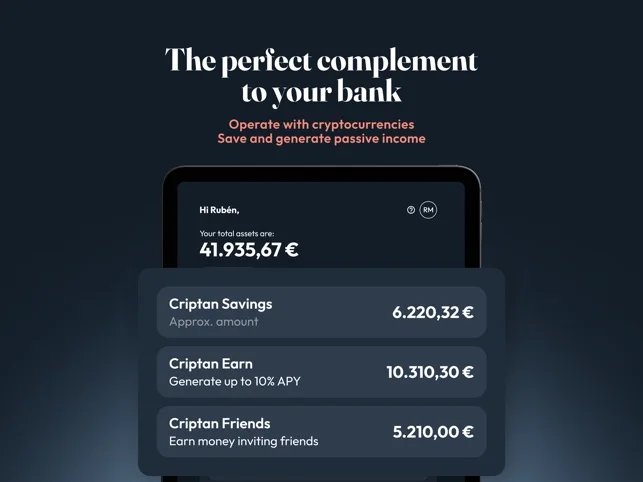
Criptan is a fintech platform registered with the Bank of Spain that offers secure access to crypto and stablecoin accounts for over 85,000 individual and business users. Local banks rarely offer more than 2% on Euro savings and provide no access to dollar-based yield. Criptan fills that gap with a simple, higher-return alternative through RWA-backed yield on both EURC and USDC.
To power this, Criptan partnered with OpenTrade for its Criptan Earn product, which taps into the USD Money Market USDC Yield and E.U. Gov Bond EURC Yield vaults. This allows users to earn an APY of up to 8.35% on USDC and up to 5.50% on EURC balances. Similar to other apps, interest accrues daily, balances remain liquid, and there are no lockups or hidden fees. The platform has paid out over €500,000 in earnings to date, with total platform AUM now exceeding $75 million.
From Pilots to Scale
Avalanche has quietly assembled one of the most diverse RWA stacks at a time when the sector is becoming a defining vertical for onchain adoption. Tokenized securities, state-backed stablecoins, reinsurance products, and fintech savings apps are all live today, underscoring the breadth of deployments on the network.
What sets Avalanche apart is its ability to bridge institutional-grade infrastructure with real consumer distribution. Appchains give issuers sovereignty and compliance features, while the Avalanche C-Chain anchors liquidity and composability. This dual architecture allows institutions to meet regulatory requirements without losing access to the broader DeFi toolkit. At the same time, consumer platforms across Latin America and Europe are embedding Avalanche RWAs directly into user apps, pairing institutional supply with everyday demand.
The path from pilot programs to scaled adoption is no longer an experiment. Avalanche is already proving the model across multiple asset classes. Wyoming is issuing a state stablecoin, Dinari is building an onchain clearinghouse for tokenized equities, and fintechs like Belo and Criptan are offering high-yield RWA savings accounts to hundreds of thousands of users. As RWAs continue to expand, Avalanche is positioned not only as a leading hub for tokenization but as a foundational ecosystem for digital finance.
0 Comments