Shuffle: Stacking USDC from Casino Profits While Awaiting Rerating
JUL 07, 2025 • 19 Min Read
Report Summary
This report breaks down how Shuffle ($SHFL) — a rising crypto casino — is addressing the pitfalls of past casino tokens (like Rollbit) by paying real, transparent USDC dividends directly to stakers. Unlike opaque buybacks, Shuffle’s model distributes ~48% APR in cash yield, funded by verified gaming revenue. Its unique tokenomics, robust growth, and disciplined supply schedule position it as a potential leader in the next evolution of “gamble-fi” — one that’s more credible and yield-focused.
Key Takeaways
1. Huge Market, Strong Revenue
-
Crypto casinos generate billions annually — Stake.com alone made ~$5B in 2024.
-
Shuffle has climbed to #3 by deposit volume ($1.8B), gaining share fast and adding new users 3× faster than Roobet (#2).
-
Monthly run rate: ~$9M in net gaming revenue (NGR) → $108M annualized.
2. Real Yield, Not Vapor
-
Shuffle replaced buy-and-burn mechanics with a “lottery” dividend: 15% of NGR paid weekly in USDC.
-
Stakers get ~48% annualized yield, funded by real casino profits — not token inflation.
-
Current market cap is 4.5× earnings, much cheaper than DeFi peers (~39× average).
3. Learning from Rollbit’s Mistakes
-
Rollbit ($RLB) lost steam due to:
-
Fully airdropped supply → constant sell pressure.
-
Undoxxed team → trust gap.
-
“Invisible” burns → unclear value to holders.
-
-
SHFL fixes this with:
-
A fully doxxed team.
-
Only 28% of supply airdropped so far → room to tune incentives.
-
Transparent USDC payments, not hidden burns.
-
4. Staking Mechanism
-
The “lottery” acts like a perpetual dividend, not pure chance:
-
95% of prize pool pays stakers weekly.
-
Only ~50% of circulating SHFL is staked → more upside if staking grows.
-
-
Onchain version is planned to remove KYC/off-chain friction → expands access.
5. Undervalued vs Peers
-
Rollbit trades cheaper but has trust issues.
-
SHFL’s real cash flows and growth story are stronger.
-
If it re-rates to half the DeFi peer average multiple, upside is ~43%.
-
If it re-rates to full peer average, upside is 140%+.
6. Key Risks
-
Unlock risk: Team & investor tokens vest through 2028 → potential sell pressure.
-
Off-chain staking limits bigger capital (DAOs, funds) from capturing yield.
-
Trust gap: Users must trust that 15% NGR really goes to stakers; no third-party audits yet.
-
Directional token risk: If SHFL price drops, yield alone may not offset losses.
Conclusion
Shuffle is the next iteration of the casino token playbook — delivering transparent, real USDC cash flow rather than speculative burns. It combines the growth engine of crypto gambling with an income stream more typical of DeFi “real yield” projects, all while riding the huge, sticky casino revenue wave.
-
Shuffle ($SHFL): Stacking USDC from Casino Profits While Awaiting Rerating
Crypto casinos operate at revenue scales that outstrip most trading venues. Stake generated an estimated $5 billion in 2024, compared to $750 million for Hyperliquid and $6.6 billion for Coinbase. Hyperliquid demonstrated how disciplined, transparent buyback programs can translate cash flow into token performance, evidence that markets reward mechanisms feeding value directly back to holders. This “revenue meta”, where markets value projects generating revenue from strong underlying businesses while enabling token holder participation, shows no signs of abating.
The previous casino-token cycle, led by Rollbit ($RLB) in mid-2023, lost momentum. An undoxxed team, questions around whale-driven volume, a contentious token migration, and recurring withdrawal concerns have left the narrative stale, dragging broader “gamble-fi” sentiment with it. Despite aggressive buyback and burn mechanics – with nearly 60% of RLB’s original supply already retired – the token continues grinding lower, suggesting markets have grown skeptical of “invisible” burns without transparent value delivery.
Shuffle.com ($SHFL) presents a cleaner opportunity. Having climbed to the #3 spot by deposit volume, the token launched in March 2024, and while utility remained limited initially, several catalysts are converging: second airdrop emissions have wound down, the underlying business generates $108 million in annualized revenue, and the project’s transparent distribution – backed by a fully doxxed team – contrasts sharply with Rollbit’s opacity.
Most importantly, rather than relying on buybacks, a newly introduced lottery mechanism delivers approximately 48% APR in USDC directly to stakers’ wallets, funded from platform gaming revenue. This transparent, cash-yield approach addresses the trust gap that has plagued other casino tokens. At current valuations, SHFL trades at just 14x earnings versus 39x for comparable DeFi protocols, creating a compelling asymmetric opportunity. Continued emphasis on directing casino profits toward token-holder economics positions $SHFL as a protocol capable of generating substantial revenue while driving meaningful value back to holders.
$SHFL exhibits defensive trading characteristics – relative strength during market downturns, muted performance on green days. This flight-to-safety behavior, combined with genuine USDC yields, presents an attractive risk-adjusted opportunity should the market continue its extended consolidation or enter bearish conditions. However, the combination of strong fundamentals and proven revenue generation also positions SHFL as a candidate for significant rerating as markets increasingly reward sustainable cash flow over speculation.
Stacking the Deck: Mapping Shuffle’s Rise in Crypto Revenue Rankings
Crypto casinos remain one of the highest-margin business models in crypto. While most operators don’t report revenue directly, Tanzanite has begun surfacing deposit volume, user counts, and market share data across the category. It’s not a complete picture – notably excluding BTC and LTC deposits – but it’s enough to get directional signals on who’s growing, who’s stalling, and where the attention is starting to flow.
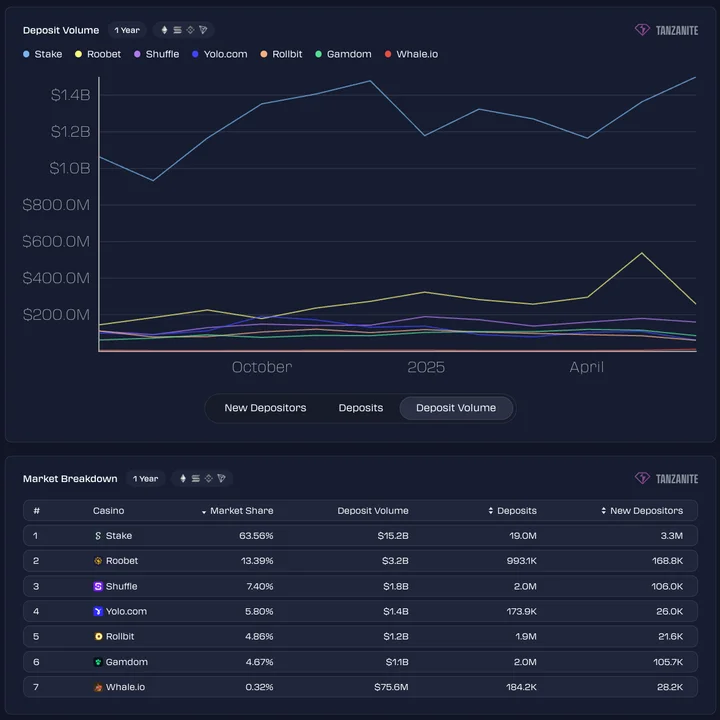
Stake continues to dominate the space by a wide margin, with $15.2 billion in deposits over the past year and 63.56% market share, but has no plans for token integration. Roobet, the next largest platform, sits at $3.2 billion (13.39%) and similarly has yet to integrate a token with no reported plans to do so. Shuffle has now climbed to the #3 spot with $1.8 billion in deposits (7.40% market share), leapfrogging both Yolo.com and Rollbit.
This represents meaningful momentum; Shuffle now commands higher deposit volumes than Rollbit ($1.2 billion, 4.86%), which despite far greater early mindshare on CT, appears to have plateaued.
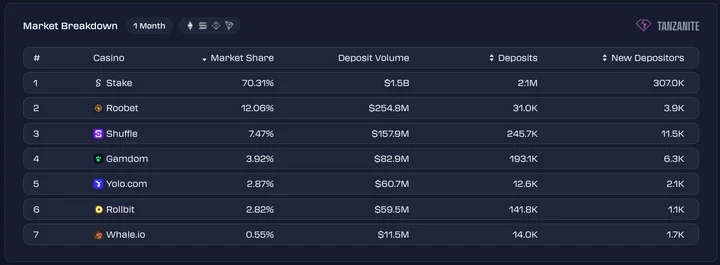
The monthly data reveals Shuffle’s trajectory is even more impressive. Over the past month, Shuffle captured $157.9M in deposits (7.47% market share) versus Roobet’s $254.8M (12.06%). While Roobet still holds the #2 position, the gap is narrowing rapidly; Shuffle is now running at roughly 62% of Roobet’s monthly volume, compared to just 56% on an annual basis.
More tellingly, Shuffle added 11.5K new depositors in the past month compared to Roobet’s 3.9K, suggesting Shuffle is not only growing faster but also expanding its user base at nearly 3x the rate. If current trends persist, Shuffle could challenge Roobet for the #2 spot within the next 6-12 months.
Actual on-chain flows give us a clean read on Shuffle’s earnings power and growth trajectory. In the June 20th lottery drawing, the protocol transferred $312,001 to its lottery contract. Because that pool receives a fixed 15% of net gaming revenue (NGR), the payment backs out to ≈ $2.08 million in weekly NGR-or about $9.0 million a month, $108 million annualized.
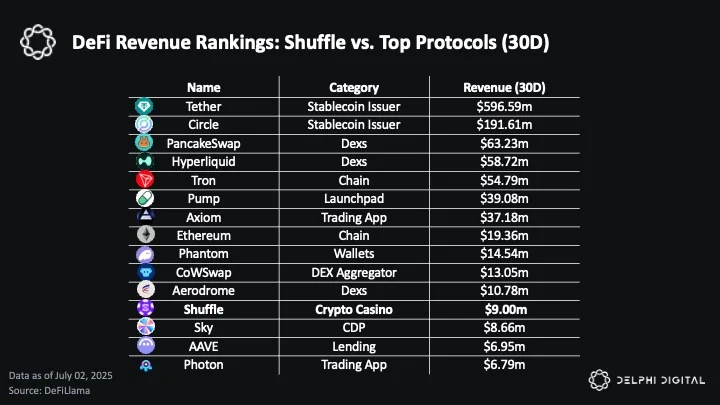
At that run-rate, Shuffle would rank approximately 12th on the 30-day revenue leaderboard per DefiLlama, sitting between Aerodrome ($10.78m) and Sky ($8.66m). For additional context, Hyperliquid sits at #4 with ~$58.72m over the same period, while Pump holds #6 at $39.08m. Notably, Shuffle’s $9.0m monthly revenue run-rate would place it ahead of established protocols like Sky ($8.66m, formerly MakerDAO) and AAVE ($6.95m).
The growth in lottery payments since the mechanism launched in October also tells a compelling story. The initial average across the first 10 draws was $189,656, compared to a recent average of $290,001 over the last 5 draws, representing 64.5% growth in underlying gaming revenue. The June 20th payment of $312,001 marked a 7.6% increase even over that recent average, suggesting the business continues to accelerate.
Righting Rollbit’s Wrongs: Why Shuffle Could Succeed Where $RLB Stalled
What makes Shuffle interesting isn’t just that it’s growing – it’s that the $SHFL token may now have a chance to pick up where $RLB left off, while improving on some of the core design flaws that have stalled Rollbit’s momentum despite seemingly strong fundamentals and aggressive buybacks which Delphi covered in depth at the time of its initial success here: Rolling the Dice on Rollbit Fundamentals.
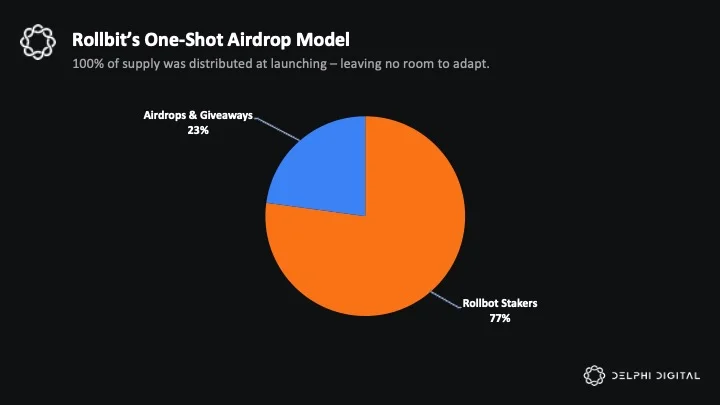
When Rollbit launched, it went fully community-owned, airdropping 100% of its supply to Rollbot stakers (many of which likely belonged to the team) and its early users. In theory, it was a noble distribution. In practice, it became a structural headwind.
First, the airdrops began near the bottom of the bear market in late 2021, meaning many recipients were quickly deep in profit as the token climbed from near-zero to a peak market cap of over $800 million in under a year. And a large portion of those users weren’t crypto-native holders – they were gamblers.
The result was predictable: sustained sell pressure from users who had no long-term alignment with the token. Compounding the issue, with the entire supply distributed, the Rollbit team had no flexibility left to adjust incentives, allocate toward growth, or refine the token model over time.
SHFL, by contrast, has taken a more measured and strategic approach. The team has allocated 28% of supply across three separate airdrops, designed to reward early users while simultaneously incentivizing further gameplay and growth. The first drop was tied to Shuffle’s TGE in March 2024. By the time the second airdrop took place in December, Shuffle had grown its user base more than 10x. This structure converted users into stakeholders, creating a self-reinforcing loop of engagement, volume, and loyalty.
The second airdrop’s six-month vesting period concluded on June 14, 2025, marking a significant unlock event that has now been absorbed by the market. While there is still 9% of supply reserved for a third airdrop, this structure has created a far more gradual and scalable token distribution model than what Rollbit rolled out.
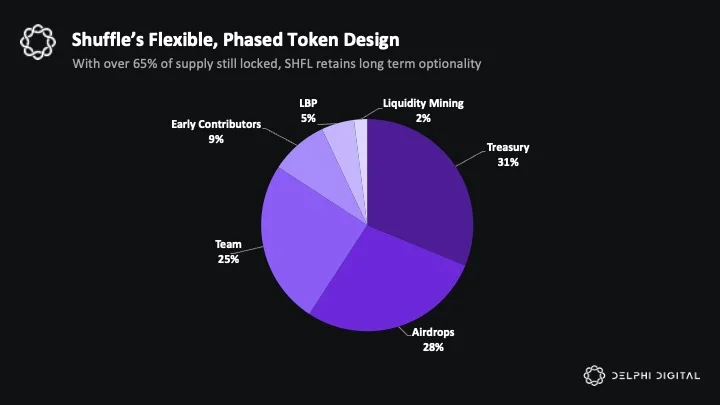
Looking at the full token breakdown, SHFL’s design leans toward optionality. Airdrops account for 28% of supply, while 25% was allocated to the team and 8.8% to early contributors – including angel investors and strategic private investors who were key to Shuffle’s early development. Both team and early contributor allocations are on a six-month cliff followed by 36-month linear vesting, meaning these investors are still in the process of unlocking tokens, which could create ongoing sell pressure. The liquidity bootstrapping pool accounted for 5% and was immediately liquid. Liquidity mining covers 2%, vesting over three years. And the largest single category, 31.2%, sits in the treasury, which vested at TGE but remains non-circulating. That means over 65% of SHFL’s total supply is still locked or team-controlled, giving the project far more levers to pull going forward.
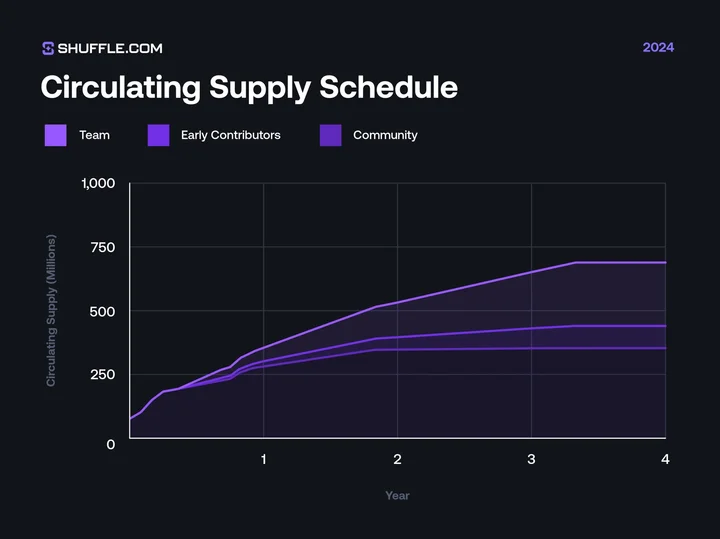
The flip side, of course, is that a more concentrated supply carries the risk of insider sell pressure, particularly as early contributor tokens continue vesting over the next three years. But so far, there’s been no sign of significant dumping, and the team has shown signs of continuing to align token incentives with real platform revenue. If that trend holds, SHFL may end up with a cleaner and more scalable token economy – one that still has room to evolve and improve, rather than being locked into a one-shot airdrop model like RLB.
The Buyback Paradox: When Revenue Doesn’t Drive Returns
Rollbit’s experience also shows that aggressive buy-and-burn mechanics aren’t a silver bullet. The dashboard flashes impressive numbers-30-day casino revenue of $12.7 million, crypto futures revenue of $2.2 million, and sports revenue of $1.4 million, totaling roughly $16.3 million in monthly revenue. With 59.22% of the original five-billion RLB supply already retired through burns, the fundamentals appear strong on paper.
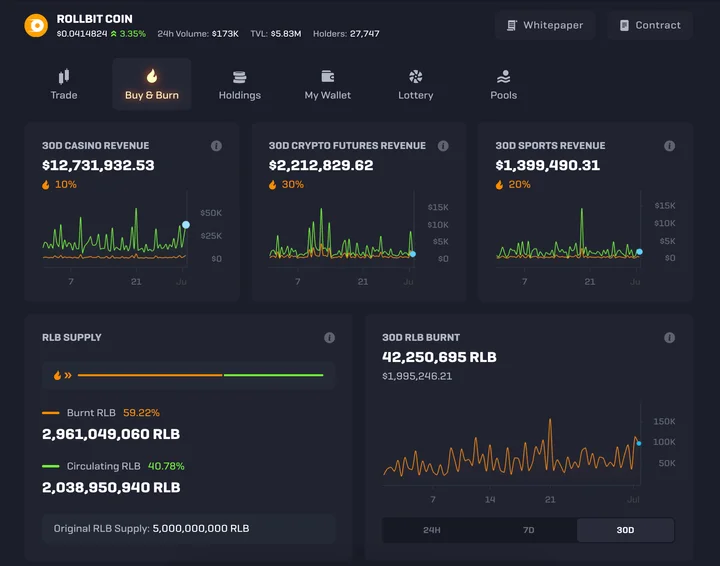
Yet the token continues to grind lower. Part of the drag is likely structural: early airdrop recipients are still selling, and the market’s lingering doubts about an undoxxed team and opaque treasury flows make every rally fade. Adding to these concerns, rumors have emerged that the team is launching a new crypto casino venture, luck.io, raising questions about divided focus and resource allocation.
The revenue figures themselves also warrant scrutiny. Rollbit’s reported $16.3 million in monthly revenue would significantly exceed Shuffle’s ~$9.0 million run-rate, yet this creates a puzzling disconnect: while Shuffle’s deposit volumes continue growing rapidly, Rollbit’s have stagnated. Either Rollbit’s revenue reporting lacks transparency, or the platform isn’t successfully converting revenue into sustainable user growth, both concerning signals for long-term token value.
Whatever the precise mix of factors, the takeaway is clear: large headline burns and a shrinking float haven’t been enough to overcome mounting credibility concerns.

Shuffle appears to be learning from that misfire. Their original plan earmarked 30% of NGR for SHFL buy-backs and burns; the team has since halved that allocation and redirected the 15% NGR figure into a lottery that pays SHFL stakers directly in USDC. The shift trades headline supply reduction for a transparent, cash-yield mechanism that users can verify in real time, addressing the very trust gap Rollbit hasn’t shaken.
If Rollbit’s stalled price action reflects market skepticism toward “invisible” burns, Shuffle’s pivot toward visible, platform-level payouts could prove the more convincing path to long-term value accrual.
From House Edge to Holder Yield: Deconstructing the SHFL Lottery
It should be noted that despite the “lottery” branding, Shuffle’s new mechanic functions more like a perpetual dividend. Each week the protocol funnels 15% of net gaming revenue directly into a USDC prize pool and distributes tickets to everyone staking SHFL (50 SHFL = 1 ticket).
Because the pool is funded with hard-cash (USDC) revenue – not token emissions – every staker receives the same pro-rata expected return, making the draw function more like a revenue share than a pure gamble for the jackpot.
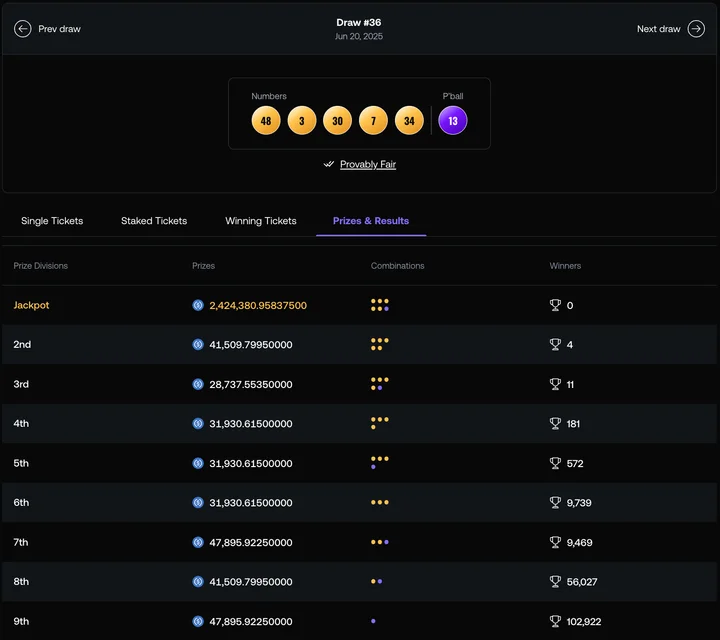
For example, in draw #36 (June 20), $345,796 was added to the prize pool, $312,001 from net gaming revenue and $33,795 from additional “single” lottery ticket sales. Of that total, 5% (~$17,290) was allocated to the jackpot, which once again went unclaimed, bringing its total to over $2.4 million.
The remaining 95% was distributed across eight lower-tier brackets using fixed percentage splits. With roughly $32.3M in SHFL staked, about half of the circulating supply, this translates to a weekly yield of 0.92%, or ~48% annualized, derived from Shuffle’s gaming revenue and lottery participation.
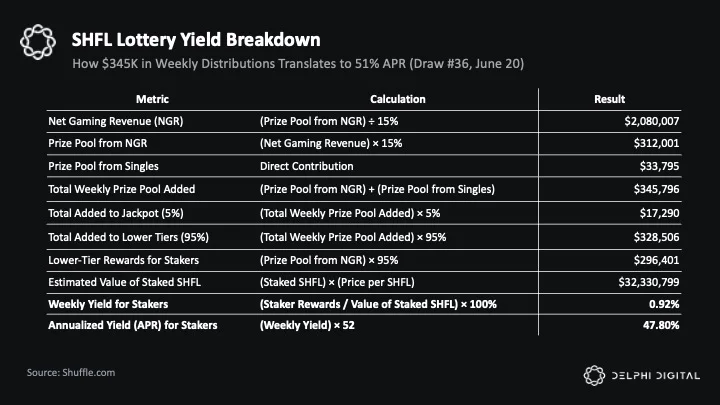
Unlike a traditional lottery, this structure ensures recurring USDC payouts to stakers across multiple tiers regardless of jackpot outcomes. The result is a quietly powerful, albeit under-marketed, onchain dividend system-with the added kicker of a $2.3M jackpot “call option” that continues to grow and has yet to be hit…
One reason Shuffle’s USDC APR has remained so high is that the opportunity hasn’t yet been fully arbed out. Despite weekly yields reaching ~48%, only about half of SHFL’s circulating supply is currently staked. Even if 100% of supply were staked, the effective APR-driven purely by protocol revenue-would still hover around 24–25%, far above most dollar denominated DeFi benchmarks (Aave’s USDC supply APY currently sits around 4.5%). But the real bottleneck isn’t yield awareness, it’s access.
Shuffle staking happens offchain, on their platform, making it difficult or even impossible for most funds – including their own investors – to stake SHFL. LP agreements often prohibit depositing into opaque, custodial venues like crypto casinos, even when the yield is real.
This creates an unusual dynamic: the staking pool offers unusually high, sustainable yield – but can’t be arbed by more cautious whales or funds, leaving more room for individual users and early adopters to capture upside.
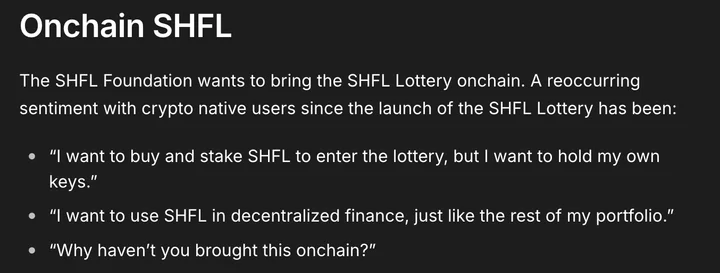
Because the lottery is still not fully onchain and takes place within the gated Shuffle platform, it’s been bottlenecked-unable to reach a broader, permissionless audience. But that friction also creates room for growth. The team plans to launch an onchain version of the SHFL Lottery, removing the KYC barrier and making ticket entry as simple as a wallet transaction. According to their docs, this would take the form of a standalone, fully onchain “main lottery” open to anyone, alongside the existing staking lottery hosted on Shuffle.com.
Crucially, a portion of revenue from main lottery ticket sales could be redirected back to the staking pool-tying together both systems and amplifying the network effects. The result could be a dual-track model: a mass-market, onchain Powerball feeding yield to the staker base – built not just to replicate what exists today, but to scale it far beyond.
Valuation: The Dividend Discount Dilemma
Shuffle’s USDC dividends create a unique valuation challenge. Unlike tokens delivering value through buybacks or typical DeFi “yields” from inflationary emissions, SHFL distributes hard cash from real business operations. While a small sector of protocols have experimented with ETH distributions to stakers, direct cash dividends remain extremely rare in crypto, making traditional comps less meaningful.
Still, the numbers tell a compelling story. Based on last week’s NGR added to lottery, SHFL token holders are capturing $16.2 million annually in USDC distributions (15% of the $108 million NGR run-rate). At a $73 million market cap, this translates to a 22.2% dividend yield, or just 4.5x annual distributions, extraordinarily cheap by any standard. On an FDV basis of $227 million, the yield drops to 7.1% with a 14x earnings multiple, which appears more reasonable but still attractive.
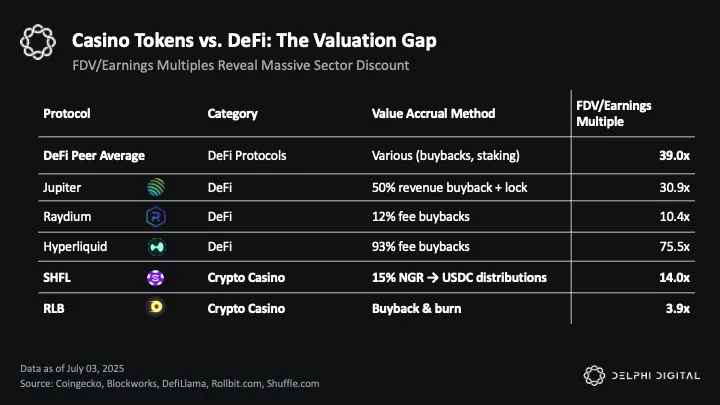
Compared to established DeFi protocols with token value accrual mechanisms, SHFL’s valuation discount becomes stark. Jupiter trades at 30.9x FDV/earnings returning 50% of revenue through buybacks and locks. Raydium commands 10.4x with 12% of its fees going to buybacks. Hyperliquid trades at a 75.5x multiple with 93% fee buybacks to $HYPE holders. The average across these three protocols is approximately 39x FDV/earnings.
Even more striking is Rollbit’s valuation discount despite higher absolute burn rates. RLB trades at an $88.2 million market cap with approximately $1.9 million in monthly buybacks and burns, based on its reported June numbers, translating to $22.8 million annualized. This creates an FDV/earnings multiple of just 3.87x-even cheaper than SHFL’s 4.5x market cap multiple and dramatically below its 14x FDV multiple.
With over 60% of RLB’s original supply already burned and the current burn rate continuing, RLB could eventually experience a supply shock where the increasingly scarce float drives significant price appreciation. However, as mentioned earlier, this warrants skepticism given the team’s opacity and potential divided focus with new ventures.
This comparison shows an interesting dynamic: both casino tokens trade at massive discounts to DeFi protocols. While Jupiter, Raydium, and Hyperliquid average 39x FDV/earnings, the casino tokens sit at 3.87x (RLB) and 14x (SHFL). The difference is that RLB’s “invisible” burns haven’t translated to price appreciation despite aggressive rates, while SHFL’s transparent USDC distributions create verifiable value for holders. Additionally, based on our earlier findings, Rollbit appears to be stagnating while Shuffle continues growing rapidly, justifying SHFL’s valuation premium through superior growth prospects and transparent value delivery mechanisms.
SHFL’s 14x FDV multiple sits well below the DeFi peer group average, despite offering direct USDC distributions rather than token buybacks that may or may not translate to price appreciation. If SHFL traded at even half the average multiple of its DeFi peers-around 20x earnings-it would reach a $324 million FDV, representing 43% upside from current levels. At the full peer average of 39x, the upside would exceed 140%.
The wide valuation gap suggests the market either doesn’t understand SHFL’s cash distribution model or significantly discounts casino revenue versus DeFi protocol fees. As the revenue meta continues gaining traction and investors recognize the sustainability of direct cash yields, this disconnect appears increasingly unsustainable.
Risk Assessment: What Could Go Wrong
The bear case is straightforward. SHFL stakers face significant directional token risk alongside their USDC yield. With insiders and early investors unlocking tokens through 2028 on a 36-month linear schedule, persistent sell pressure represents a structural headwind that could overwhelm any yield benefits. For example, a 20% token decline would wipe out roughly five months of USDC distributions, while a 48% drop would completely offset an entire year of yield at its current APY. If SHFL were to continue to trade flat, the yield is compelling but significant downside can erode initial capital despite collecting weekly cash rewards.
Token mechanics also create exploitable inefficiencies. Outside of liquidity constraints, nothing prevents mercenary capital from buying before Friday draws and dumping after claiming rewards. This gaming behavior could create recurring sell pressure around distribution dates, undermining price stability for longer-term stakers.
Transparency gaps compound the risk. While USDC flows into the lottery pool are visible onchain, Shuffle provides no independent verification that the full 15% of NGR is consistently allocated as promised. Total revenue figures remain opaque, understandable for casino operators who guard this data closely, but problematic for investors seeking accountability. Without auditable smart contracts or onchain oracles confirming revenue splits, stakers must trust team claims about allocation percentages and whether they’re fully realizing their share of business growth.
The Bottom Line: Why SHFL’s Risks May Be Worth Taking
Despite these concerns, the opportunity feels uncrowded and underexploited. The 48% USDC yield remains largely unmarketed across crypto social channels, with most of the market unaware this mechanism exists. This creates room for discovery-driven upside as awareness spreads.
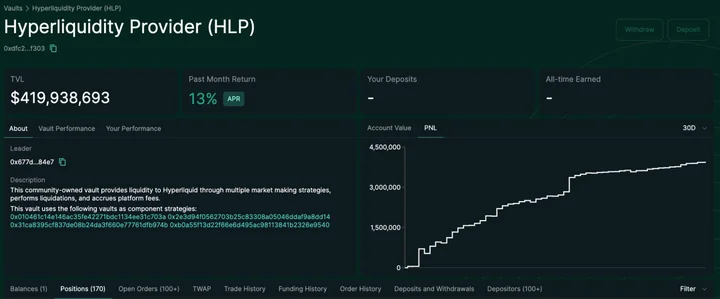
The structural parallels to Hyperliquid’s HLP are also compelling: both let users capture protocol revenue generation, both create aligned holder communities, and both turn participants into product evangelists. HLP holders benefit from trading fees and liquidations; SHFL stakers collect casino profits.
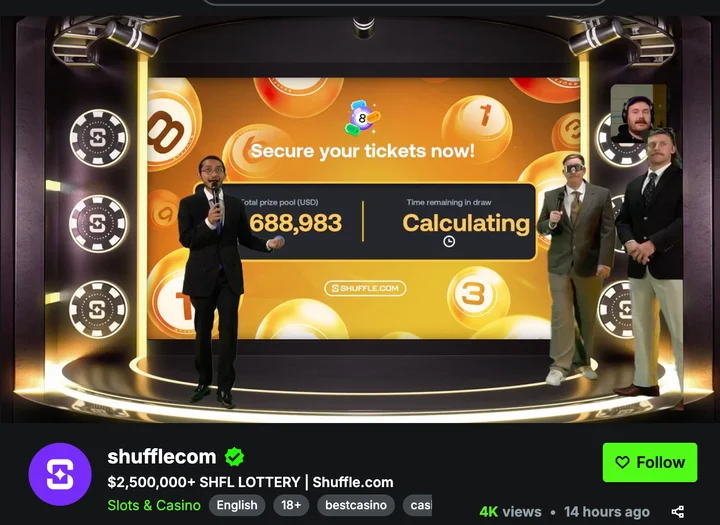
The weekly live-streamed lottery drawings also add genuine community engagement: stakers look forward to Friday draws hoping to hit the jackpot but happy to collect their weekly USDC dividends, wanting to tell friends about the opportunity, and developing emotional attachment beyond pure yield farming.
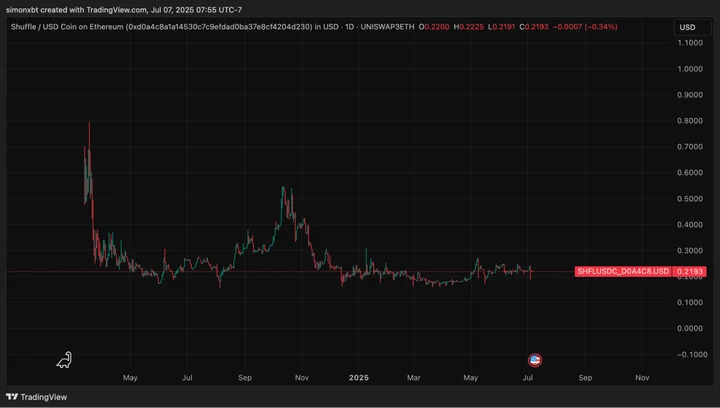
SHFL has traded sideways around a $70 million market cap for months, behaving more like a defensive bond than a growth play. This defensive characteristic could prove valuable during bear markets or extended chop, where consistent USDC distributions matter most. However, in a full-blown alt season, fundamental yielding opportunities like this typically aren’t the fastest runners-momentum and speculation dominate over cash flow generation.
That said, several catalysts could drive meaningful rerating beyond steady yields. If Shuffle continues directing larger portions of NGR toward stakers, the value proposition becomes increasingly compelling. Potential cross-chain migration to Solana could improve accessibility and reduce friction; ironically, the same way RLB initially took off after migrating from Solana to Ethereum. Additional exchange listings could deepen liquidity and broaden the holder base. Most importantly, if the revenue meta continues gaining momentum and markets recognize sustainable cash yields as valuable, SHFL’s relative undervaluation becomes harder to justify.
The setup, in my opinion, is simple: get paid 48% USDC yields while waiting for market recognition and rerating of a profitable, growing business. It’s acted like a bit of a flight to safety during recent BTC dumps, showing notable relative strength in a market where most alts have been bleeding, making it a defensive play better suited for chop or bear markets than full-blown alt season momentum.
Conclusion: Stacking Yield While Waiting for Recognition
SHFL operates more like a crypto exchange than a traditional casino token, generating substantial revenue while transparently sharing profits with holders. In a market increasingly focused on sustainable business models over speculation, casino protocols represent one of the few sectors with proven revenue generation at scale. While speculative, it’s reasonable to expect that eventually a crypto casino token could break into the top 20 coins by market cap, one day. The winner will be the platform with exceptional product execution, transparent operations, and genuine value delivery to token holders – qualities where Shuffle appears well-positioned.
The casino token narrative may be out of favor post-Rollbit, but SHFL’s model addresses the core issues that derailed its predecessor. While RLB relied on opaque burns from an undoxxed team, SHFL offers transparent USDC distributions from a doxxed, ambitious team focused on sustainable growth. This defensive, yield-generating profile makes SHFL particularly compelling during market uncertainty, where USDC-denominated returns provide stability amid volatility.
As markets continue hunting for tokens producing real revenue, SHFL’s combination of attractive relative valuation, genuine cash yields, and growth potential in an underexplored sector seems unlikely to remain unnoticed, especially if the team/investors remain aligned and continue executing on expansion plans. Key catalysts include bringing the lottery mechanism fully onchain, increased marketing focus on the token’s yield characteristics, and potential cross-chain expansion for broader accessibility.
The setup is straightforward: patient capital gets immediate access to 48% USDC yields while positioning for potential rerating as the revenue meta gains momentum. Whether stacking cash during market chop or betting on eventual recognition of sustainable casino economics, SHFL offers a rare combination of defensive yield and asymmetric upside that becomes increasingly valuable in a market searching for substance beyond speculation.
The casino token cycle isn’t dead, it’s evolving. And SHFL appears positioned to lead that evolution.
0 Comments