Solana’s Success and Bottlenecks
Solana has unequivocally carved out its niche as a titan of speed and throughput. It has evolved from a promising but embattled L1 to a vibrant hub for trading, DeFi, and is now home to many of the most profitable businesses in crypto.
However, this very success has highlighted the network’s growing pains and the inherent limitations of its architecture for a specific, yet crucial, user base: professional and high-frequency traders. The Solana thesis has always been about bringing the Nasdaq onchain, but speed within a general-purpose environment is not the same as the specialized, low-latency performance required for a professional-grade derivatives exchange.
While the Solana Virtual Machine (SVM) is a marvel of parallel processing, it is still a shared resource. During periods of high volatility and meme trading, the network becomes congested, fee markets can become unpredictable (albeit much better than 12-18 months ago), and transaction inclusion is never guaranteed for professional traders. Transaction inclusion not always being guaranteed and where in the block you get placed, is what plagues Solana L1 perp DEXs. For a market maker quoting tight spreads or a trader needing to exit a position quickly, this unreliability is a deal breaker.
Kyle Samani, Cofounder of Multicoin Capital, has emphasized that the core function of blockchains boils down to facilitating transactions, particularly in the context of transferring or trading value while keeping it stored on a public ledger.
If the endgame vision of DeFi is creating global financial markets that are open, transparent, and censorship resistant, this cannot be fully realized if its infrastructure doesn’t allow for consistent and reliable transferring of value for professionals. This has been the plague for teams like Drift. The Drift team is great, and they have done the best with what they had on the infrastructure side, but I think it is clear, with the rise of Hyperliquid, that there are better ways to build a place to house all of finance.
Demand on Solana That Won’t Leave
Drift and Jupiter still have many users and do quite a bit of volume even though we have seen a meteoric rise in purpose-built appchains and L2s focused on building decentralized exchanges.
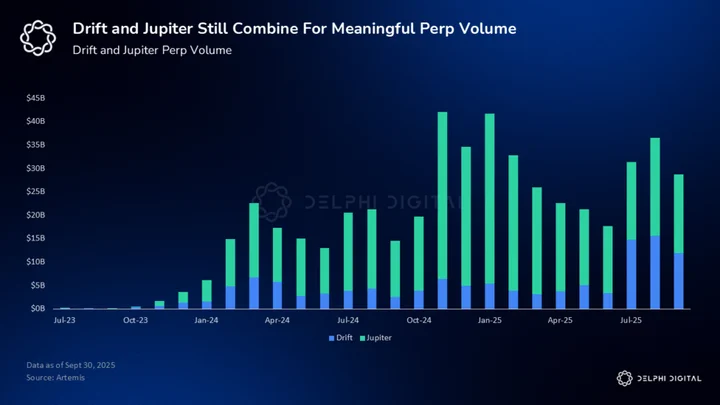
This makes me believe that the users of Drift and Jupiter are largely Solana maxis and therefore will not leave the chain/ecosystem. Because why wouldn’t you leave for a better product?
If this is the case, there is a fair number of users and volume to be had by being on/near Solana. Why am I bringing this up? Because even if Solana’s next generation perp DEXs, Bullet and Bulk, don’t compete with the likes of Hyperliquid and Binance, which they would say they will, they still have a clear path towards profitability and building a great business. They are the next generation of perpetual exchanges on Solana, purpose-built for trading.
I like using Jupiter and Drift volumes as a good proxy for potential upside for Bulk and Bullet. Obviously, if you had a conversation with either of these teams they would say their goal is not to just dominate Solana but compete with Hyperliquid. For now, I will just use the two main Solana perp exchanges as proxies. I am happy to reevaluate later. And for simplicity, I will use Drift as the main proxy given they have more than just three assets listed.
Architectural Designs
As I was digging into Bullet and Bulk, it became clear the tech is fundamentally different because it is built for trading which leads to a more superior trading experience than what’s out there on Solana right now. Bullet leans on a ZK sequencer for speed and flexibility in microstructures, Bulk embeds itself into validators for decentralization and composability. Both promise lower latency, no mempool wars
Read the full report
This report is part of Delphi Pro.
- 800+ Pro reports across every major sector
- Talk directly with our analysts
- Private community of funds and builders
Already a Pro member? Log in
0 Comments