
Report Summary
New Prediction-Based Fantasy Category – Sport.Fun blends fantasy sports with market-driven trading, allowing fractional athlete share ownership and flexible long/short-term strategies. Unlike DFS, assets don’t expire and can be held across seasons.
Large TAM with Clear Market Opportunity – Targets global fantasy sports market (320M players, $23–37B) across North America, Europe, and Asia—three of the biggest growth regions for fantasy and betting.
Strong Early Product-Market Fit – Since Aug 2025, generated ~$10M revenue: $4.3M trading fees, $226k contract renewals, $5M+ Special Packs. Launched Football.Fun early 2025, NFL Nov 2025, NBA coming 2026.
Sustainable Economic Design – Two modes (Free-to-Play/Pro) with rewards from share appreciation and Tournament Points. Contract mechanics prevent hoarding, Player Packs are sole emission source, stabilizing the in-game economy.
FUN Token with Real Value Accrual – Launching Jan 2026 with 80% of platform revenue split: 40% FUN buybacks, 40% USDC liquidity injection, 20% growth. Creates direct alignment between platform traction and token value.
Expansion Roadmap – Near-term: NBA integration, scouting features, token launch. Mid-term: Web2 marketing push. Long-term: social graph + prediction economy across all sports.
Web2 Scaling is Critical – Success depends on breaking beyond crypto-native users to mainstream fantasy/sports betting audiences while maintaining sustainable price expectations as liquidity grows.
Revenue Mix Must Evolve – Currently relies heavily on Special Packs sales. Long-term sustainability requires shifting toward organic trading fees as primary revenue driver as the platform matures.
Introduction
Sport.Fun, the company behind Football.Fun, is a skill-based sports experience that blends the strategic elements of fantasy sports with the predictive nature of information markets. The platform blends together the massive fan-driven fantasy sports market with one of the hottest new financial primitives in prediction markets.
Sport.Fun leverages proven mechanics for primary user monetization while also offering a robust blockchain-based player-driven economy centered around asset ownership and player agency. The result is a unique entertainment experience that has grossed over $10mn in revenue since launch by appealing to casual sports fans, hardcore fandoms, and market traders who can all engage with the platform in different ways.
The simplest way to understand Sport.Fun is as a prediction economy centered around sports, where your edge lies in your ability to accurately predict the best performing athletes relative to other players.
The first IP launched under the Sport.Fun banner was Football.Fun, which is the European football (soccer) flavor of the game. Football.Fun quietly launched its MVP in Feb. 2025 but gained broader appeal amongst crypto-natives when the Pro version of the game went live in Aug. 2025. The brand launched its second game focused on the NFL (American football) in early Nov. 2025, and an NBA/basketball integration is expected in Q1 2026 with more sports to follow.
In the game, players buy fractional shares of athletes with the goal of building up a squad that outperforms other players in weekly, real-world-data tournaments. Sport.Fun delivers an equally rewarding experience for players who want to make predictions over longer time frames. You can rebalance and rebuild your squad every match week, or you can set and forget your team for weeks at a time. Each entails a different strategy in athlete selection.
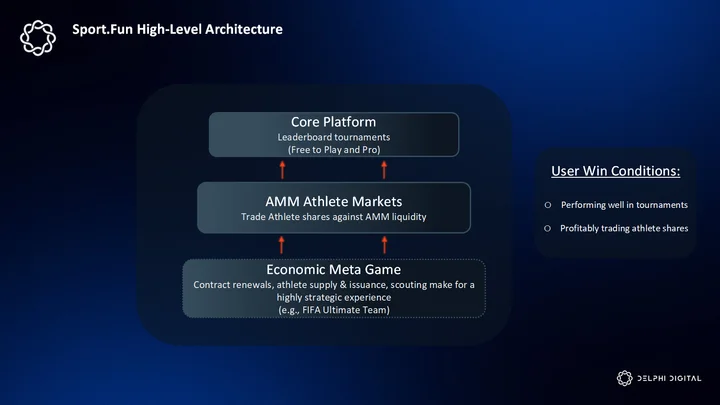
Players can build their own frameworks for valuing athletes. Maybe a specific striker looks undervalued based on the ratio of expected goals to price, or maybe a goalkeeper seems overvalued based on the ratio of clean sheets to price. Athlete share prices are decided by market demand. There are always mispriced (undervalued/overvalued) assets, and this presents an opportunity for enterprising players to scoop undervalued athletes.
As a player, you benefit from making accurate predictions in two ways:
- Demand for your athlete’s shares goes up relative to supply, causing price to increase. Shares can be traded for the main platform currency, Gold (which can be redeemed for USDC).
- Earn Tournament Points (TP) based on the matchweek performance of each athlete in your squad. Use earned TP to open “Player Packs” and receive new athlete shares that you can either add to your squad or sell for Gold.
From a product and growth perspective, the closest parallels to Sport.Fun are the daily fantasy sports (DFS) providers like FanDuel and DraftKings. However, there are several new mechanics and reward functions that make the Sport.Fun offering really stand out.
For instance, squads on Football.Fun (a player’s portfolio of active athlete shares) feel more like a spot market portfolio. Athlete shares don’t expire and leave your squad at the end of a day/week. As mentioned earlier, players can choose to play a short-term or long-term game. Build a squad optimized for the next match week, or one that capitalizes on the next few months’ worth of fixtures.
DFS, on the other hand, is like a portfolio of derivatives that expire at the end of the day or week. Your ability to make money with these platforms boils down to making predictions on a much shorter, predetermined timeline. The experience on Sport.Fun lasts for as long as the player wants, and can extend across multiple seasons. And, much like a spot portfolio, you can always sell some athlete shares to free up liquidity and adjust your strategy.
Put together, Sport Fun offers a novel and compelling player experience that appeals to different categories of sports enthusiasts – financially motivated sports speculators, fantasy hardcores, and casual fans.
The Opportunity: Sports Fantasy Meets the Prediction Economy
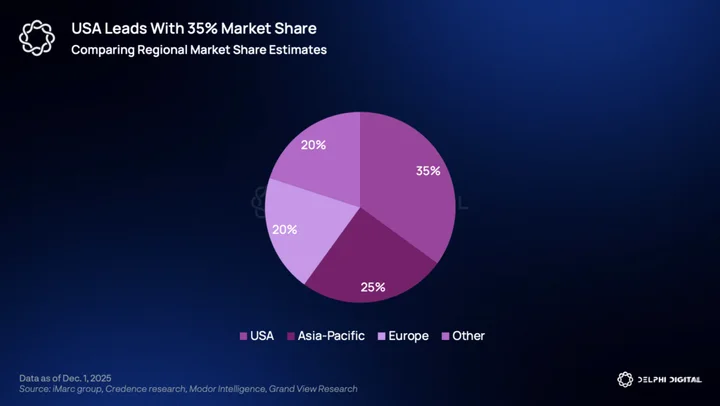
It is important to take a step back and understand the size of the total addressable market (TAM) Sport.Fun is going after. In 2023, there were an estimated 320mn global fantasy players, and the industry is worth roughly $23bn to $37bn as of the 2024-2025 season. The fantasy and sports betting markets are both dominated by North America (NA) in terms of users, revenue, and global market share.
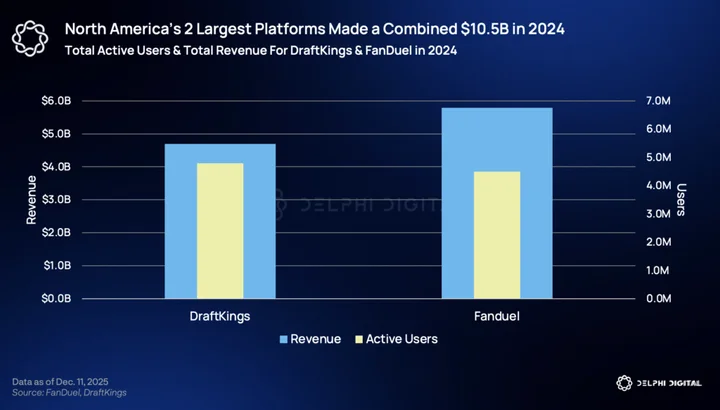 NA has been identified as a key target market for Sport.Fun. This targeting drove the recent expansion into the NFL, and the near-term focus on adding the NBA next.
Europe is the second-largest market and has a long history of fantasy and sports betting, particularly in the UK and Germany. Europe accounts for an estimated 20%-27.6% of the global market, with the UK being the largest market in that region, accounting for 6.3%, followed by Germany and France. These markets are dominated by football (soccer) and are thus crucial to Sport.Fun’s long-term success.
Other notable markets include Asia-Pacific, which accounts for roughly 25% to 30% of the global market and is growing fast at a reported 17% to 21.9% CAGR from 2025 to 2030, and Brazil, which is valued at roughly $400mn to $600mn. Notably, Sport.Fun also sees Asia as a large target market for user acquisition.
Where Sport Fun Sits in the Market
Sport.Fun has been designed with the intention of disrupting the current competitive landscape via a number of key guiding principles:
- Provide users with a low barrier to entry, but more strategic depth.
- Maximize agency over player-owned assets that don’t reset each season.
- Leverage an economic framework that better distributes value across the ecosystem, resulting in a much higher ceiling for player rewards.
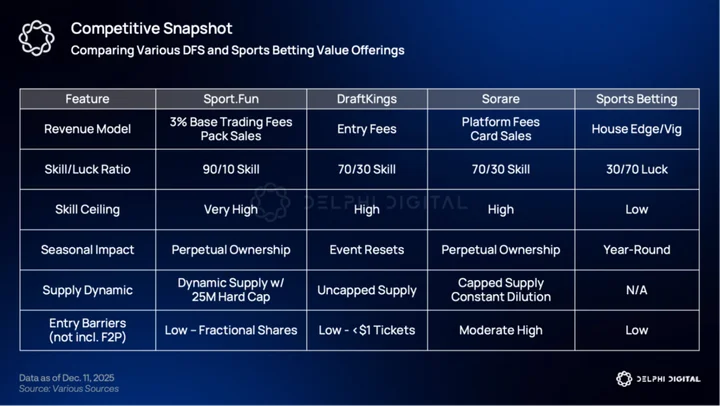
Succinctly, Sport.Fun aims to provide fantasy sports players with a comparatively better experience while introducing new systems that attract a variety of different sports enthusiasts in the same shared ecosystem. The end state is a multifaceted, highly social blockchain-based sports entertainment platform that offers users multiple ways to play and be rewarded based on their skill and engagement.
How it Works: Gameplay and Platform Design
Sport.Fun features two core game modes: the Free-to-Play version of Sport.Fun’s games, and the Pro (paid) version. We’ll use the example of Football.Fun to dissect the mechanics.
In the Pro version of Football.Fun, the core user journey is as described in the graphic below.
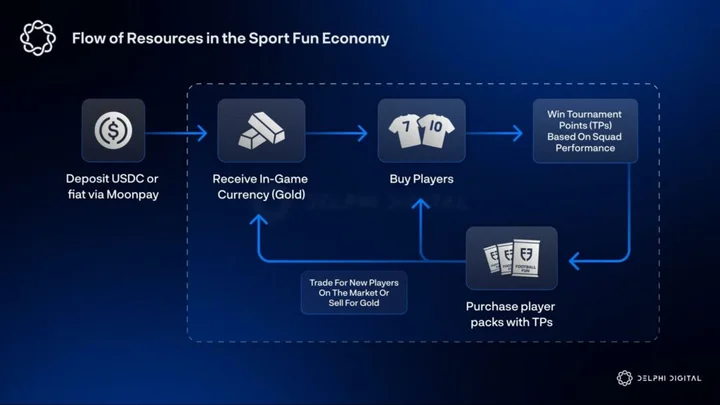
The main objective is to build a squad that players believe is relatively undervalued and performs well in tournaments, thereby earning TP and growing one’s squad value. Players spend their TP to open Player Packs, which contain shares of athletes that are already in the game. These packs are different from Founder Packs (or Special Packs) which are used to introduce new athletes into the game. Player Packs act as a key economic lever that helps balance the in-game economy as the sole source of share emissions.
When players open packs, the athletes they earn move to the “development” section of their squad. Players have to promote or cut these players depending on whether they plan to use them or not. A maximum of three athletes can be promoted a day and an active squad for each weekly tournament has a max cap of 75 athletes. If a player has more than 75 active athletes, they must pick which shares to keep active and which to deactivate.
All athletes start with four contracts. Every time they participate in a tournament from an active squad, a contract is consumed. Contracts can be renewed by directly paying Gold for more contracts, or buying more shares in the same athlete. The contract mechanism enables persistent asset holding across seasons, while mitigating against negative hoarding behavior.
A Pro Football.Fun squad can be built out with as little as $10 with no real cost ceiling. Although players can directly spend more to acquire the best performing athlete shares, TP allocation mechanisms and athlete share market dynamics mean that the greatest in-game advantage is given to players who have an edge. This is especially true for the free-to-play (F2P) player experience.
The F2P version of the game has much of the same gameplay described above. Currently, new players receive 375 TP upon sign-up, which allows them to purchase three of the most basic Player Packs. Players in the active squad can be sold for Gold to buy other athlete shares. In F2P, Gold is purely an in-game resource that cannot be exchanged for USDC.
Just like the Pro version, F2P players are rewarded for acquiring relatively undervalued athlete shares and outperforming other players in tournaments. The introduction of shared leaderboards across Pro and F2P will highlight who has the most skill, driving F2P → Pro conversions and scaling the in-game economy.
Platform Economics and Business Model
Sport.Fun monetizes in three primary ways:
- Athlete share trading fees
- Athlete contract renewals
- Special Pack sales (for new athletes added to the platform)
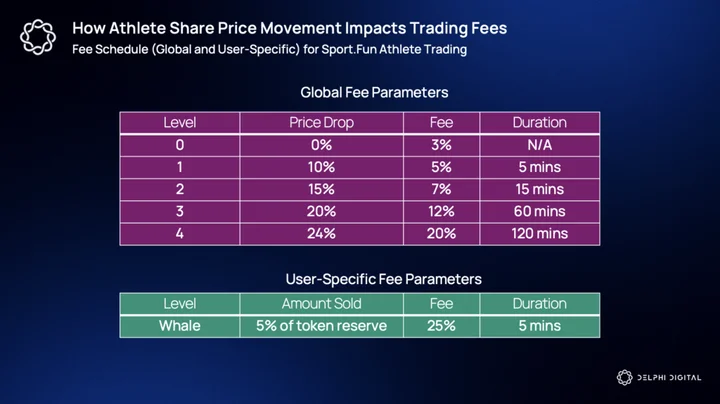
Every time an athlete is traded, a base fee of 3% is levied on the trade (down from an initial 5%), which scales to 20-25% depending on the size and timing of the trade. Higher fee parameters apply across the pool for a limited amount of time, but only come into play when a trade with a large price impact is executed. The surge fee exists to prevent large swings in share prices and to support liquidity when whales enter/exit.
Special Pack sales drip new athlete shares (previously unreleased athletes) into the market. Right now, the football (soccer) game has integrated a total of 140 athletes, with an average circulating supply of 4.1-4.6mn shares each (out of a max 25mn shares per athlete). This supply control, combined with share buyback mechanics, allows for dynamic economic balancing around in-game activity.
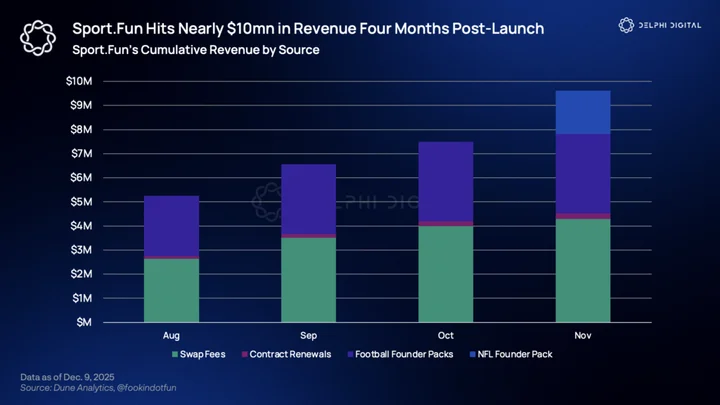
After the platform’s meteoric go-to-market in Aug. 2025, it has grossed over $4.3mn in athlete trading fees in its first four months. Additionally, Sport Fun has earned $226k from contract renewal fees paid, and made over $5mn in Special Pack sales, bringing total revenue since Aug. 2025 to just under $10mn.
Liquidity is the real north star and this is reflected in the platform’s business model. A portion of total revenue is used to buy back athlete shares based on their pro rata volume. As liquidity grows, athlete markets become more reflective of real-world sentiment and performance. As these markets become more liquid and efficient, their predictive capabilities grow in-tandem.
Overall user retention of Sport.Fun’s existing IPs has been relatively strong. Core retention metrics, as of Dec. 2025, came in at:
- Week 1: 71% retention
- Week 2: 51% retention
- Month 1: 35% retention
All in all, Sport.Fun’s numbers tell the story of an engaging platform in the early stages of its growth story. Over $90mn in volume, 20,000 lifetime users, and an ARPU over the last four months of $232 ($928 annualized) from just the trading fee portion of platform revenue. Per user monetization metrics are healthy. If Sport.Fun can execute on its Web2 user acquisition strategies over 2026 to grow the overall user base, the platform’s economics and business model are conducive to solid long-term value generation.
The Sport.Fun business model merges the activity-derived fee model from AMMs or any volume dependent business alongside other, more direct methods of monetizing in-game progression. Traction thus far has been very healthy with the team focusing purely on a crypto-native audience in recent months. Over the course of 2026, Sport.Fun will take aim at the incumbent DFS behemoths with targeted user acquisition strategies. The platform has also partnered with Moonpay to ease non-crypto native onboarding by enabling users to deposit with fiat.
Value Accrual
The FUN token will launch in January 2026. The token will go live with clear value accrual on day one, and revenue utilization focused on platform growth.
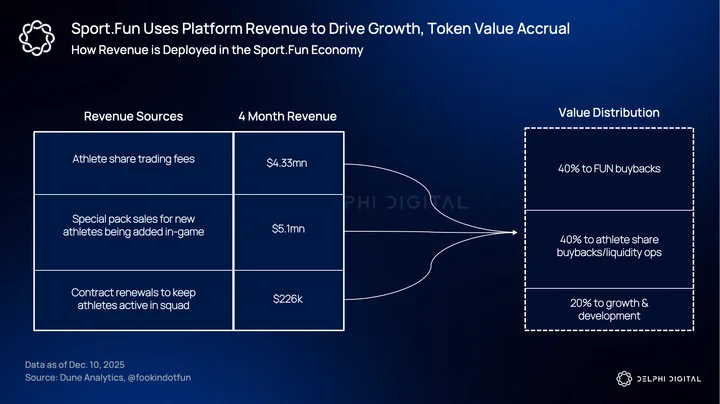
All revenue from the Sport.Fun platform will be used to productively grow the in-game economy, improve user acquisition, and pass on value creation to FUN token holders. Revenue will be split in a 40-40-20 model:
- 40% of revenue will be used to programmatically buy back FUN on the open market, thereby establishing market-derived value accretion to the token.
- 40% of revenue will be used to programmatically inject USDC liquidity into athlete markets by buying back athlete shares based on their pro-rata volume. This increases paired USDC liquidity against athlete shares. The shares bought back will go back into the pool of uncirculated shares and will be reintroduced via packs.
- 20% of revenue will be used to fund further development of the platform, user acquisition strategies, and other growth initiatives.
In short, 80% of total revenue will be used across in-game liquidity and token value accrual.
Below is a basic scenario analysis of Sport.Fun’s potential ARR based on current ARPU of $928 per annum. Note that ARPU is based on trading fee derived revenue alone, and not special pack sales. Sport Fun’s potential ARR is indexed against the P/S ratio of its largest competitors, DraftKings and FanDuel.
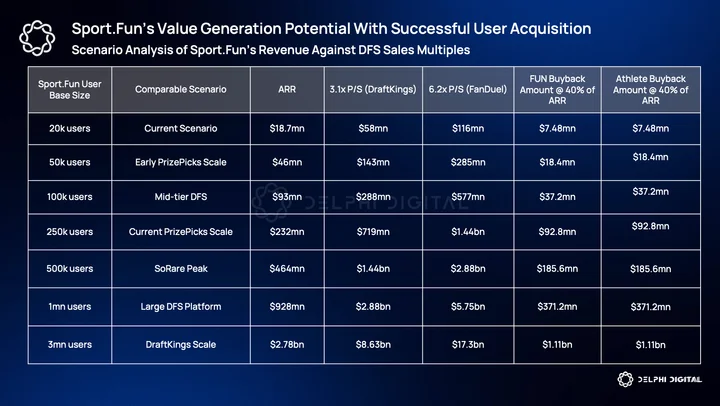
As a sports centric onchain app, Sport.Fun has the potential to appeal to more than just a crypto native audience. If the platform successfully breaks out of the crypto chasm, it will have direct implications for revenue generation and token value accrual.
FUN Token Economics
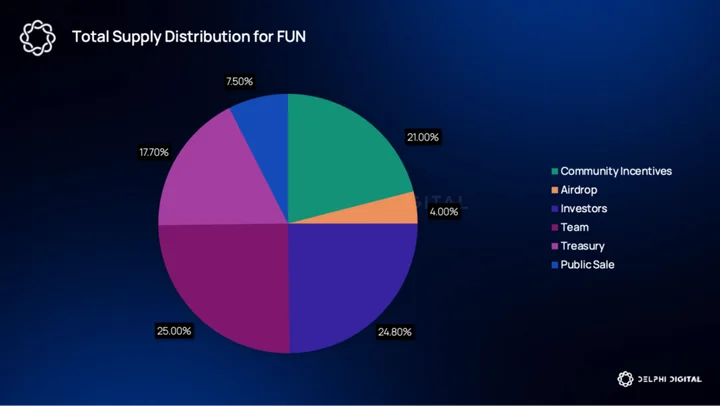
The total distribution of FUN is as follows:
- 21% Community Incentives
- 4% Genesis Airdrop
- 25% Team
- 24.8% Investors
- 17.7% Treasury
- 5%-7.5% Public Sale
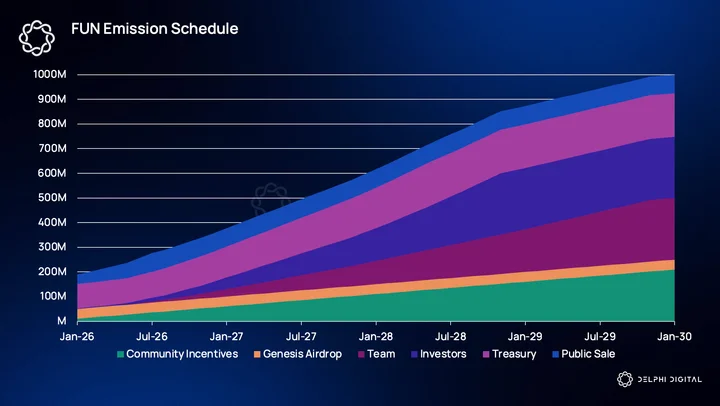
Full details on FUN vesting/emissions can be found in the project’s whitepaper.
Roadmap
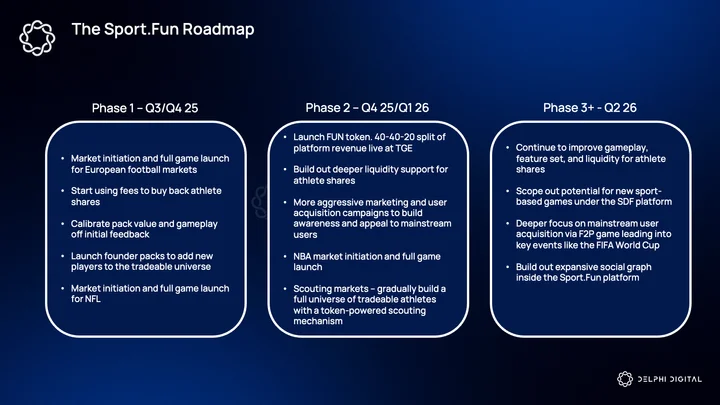
The core product direction going forward is centered around a few goals:
- Ramping up the total liquidity base to support new user acquisition and a more stable experience for all players
- Iterating the in-platform gameplay/features to offer the most engaging sports experience possible
- Adding new sports
- Growing product awareness and distribution outside of crypto circles
Phase 1 of the roadmap is complete with the recent launch of NFL markets. This marked the initiation phase of Sport.Fun where the platform established early signs of product market fit while continuing to iterate the user experience and expand across multiple different sports.
Phase 2 is focused on the FUN token launch, new franchises like the NBA, and adding more richness to gameplay with features like scouting.
Phase 3 will put user acquisition around key events (like the FIFA World Cup) and focus on further feature expansion. The long-term vision of Sport.Fun is to be a social graph and prediction economy for all kinds of sport enthusiasts.
Conclusion
Sport.Fun has quickly become one of the hottest consumer apps in crypto. It combines new-age market primitives with strategic gameplay, creating an engaging user experience.
Fantasy games like FPL are skill-based, but deeply rooted in F2P with no lever for financial rewards. Sports betting skews much further toward being a game of luck rather than skill. And DFS is rooted in short-term predictions with poor reward mechanisms for players.
The Sport.Fun vision seeks to capitalize on all of these shortcomings. Take the skill-based dynamics and player agency of fantasy and blend it into an asset economy where users can make predictions on athlete price/performance over various time horizons. In essence, give players rewards across a spectrum of how right they are, rather than their 1D or 1W performance.
However, as an early-stage venture, there are several types of execution risk to be aware of. There are some specific elements, which if derisked, raise the probability of success meaningfully. The main problems Sport.Fun needs to overcome in the path to becoming the perfect hybrid between sports fantasy and sports betting are:
- Sport.Fun requires Web2-level scale in order to achieve long-term success. The gameplay is engaging and differentiated from what exists in the market today. However, the game has to become more than a crypto-native hit. The platform must profitably acquire users from the global sports fantasy and betting markets in order to scale. Focusing on the TRM (total relevant market) rather than TAM has been the strategy so far, but going forward, Web2 user acquisition will be key. The F2P version is a crucial component of this strategy.
- To aid in wider adoption, the economy needs to transition away from the initial reliance on stark price appreciation toward expectations centered on sustainable appreciation at smaller unit amounts. It will be important to calibrate expectations around ROI as more players flock in. Maintaining efficiency between athlete performance and price will be key, and ensuring market cap does not swing wildly will also be important.
- The revenue mix is currently dominated by founder pack sales (52%). Trading fees are a significant mass (43%), but need to become a much larger portion of revenue to show the market that core platform activity can sustain the value accrual flywheel. However, special packs that introduce new athletes to the game play a key role in growing the game economy and should not be discounted as a source of overall revenue.
All in all, Sport.Fun is a differentiated skill and speculation game built on crypto rails. If executed well, the platform stands a chance of being a breakout crypto app that is able to meaningfully claw away market share from the leading incumbents and bring new users to crypto. With an existing track record of revenue generation and the promise of token value accrual from day one, the FUN token is positioned to capture upside from platform growth.
0 Comments