Introduction
Sports has been one of the most important industries for thousands of years. From the Romans spending almost a decade on building the Coliseum to our modern stadiums costing hundreds of millions, if not billions of dollars, to serve as social hotspots for large parts of society, sport is an omnipresent form of entertainment. Wherever you go, you’ll find people drawn to the competitive nature of sports.
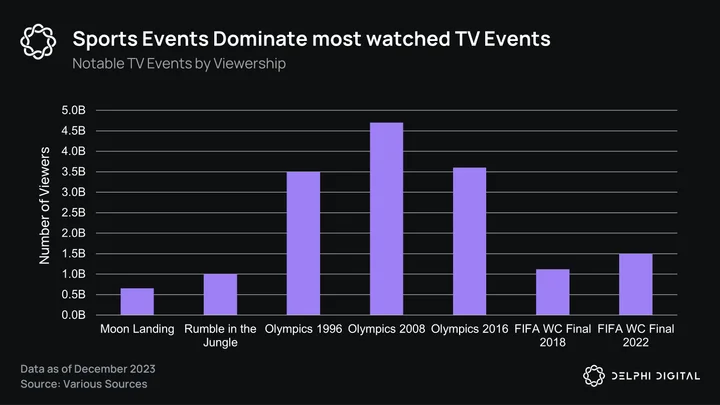
The 2018 football World Cup final in Russia was watched by approximately 1.12B viewers, while the 2022 World Cup final in Qatar drew the eyes of over 1.5B spectators. Furthermore, the Olympic games of Tokyo (2020), Rio (2016), and London (2012) all were watched by more than 3B people. Regarding the Olympic Games of Beijing (2008), Nielsen reported viewership numbers of 4.7B viewers, or around 70% of the world population, while estimates put the costs for the Beijing Olympics at around $40B if you account for built infrastructure.
Significant events with extensive viewership and unpredictable outcomes naturally attract betting markets. While the sports betting industry is vast, it is still very inefficient and predatory, lacking regulated access in many parts of the world. While estimates are tough to make, it has been reported that at least $350B is being bet illegally each year, offering users no protection while creating a perfect environment for money laundering. Blockchain technology could help regulate that market, offering the same services in a more transparent, efficient, and accessible way to users all around the world.
While the sports betting market is very old, collecting sports memorabilia is a market on the rise. Estimates state that the sports memorabilia market was worth $26B in 2022, and by 2032, this figure is expected to reach approximately $227B. NFTs and blockchain rails have the potential to revolutionize this market, making trading collectibles easier and more transparent than ever.
The Value of Sports
Sports are of incredible value to local communities. With its many stadiums, pitches, courts, and training facilities, it is one of the most essential adhesives in our society. There are over 2,292 stadiums with a capacity of over 10,000 spectators scattered throughout most global cities, some costing more than a billion dollars to build. This cultural dominance is reflected in the valuation of the world’s largest sports franchises, many of which are north of a billion dollars.
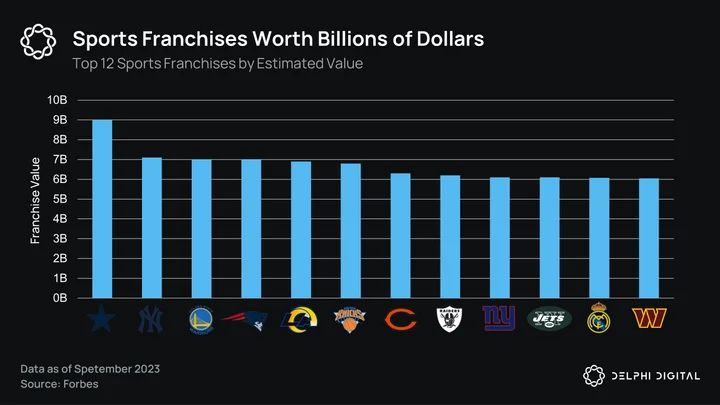
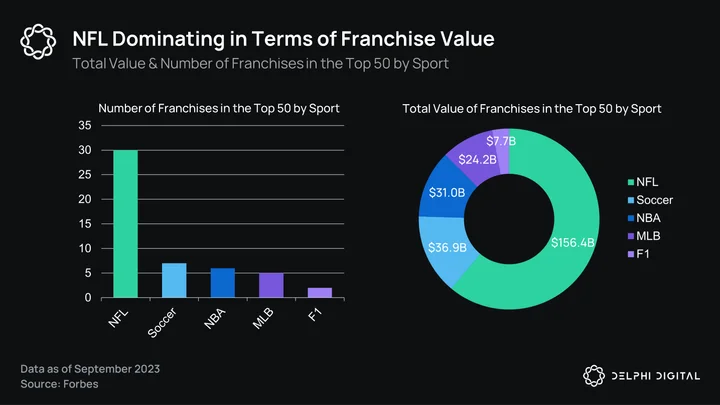
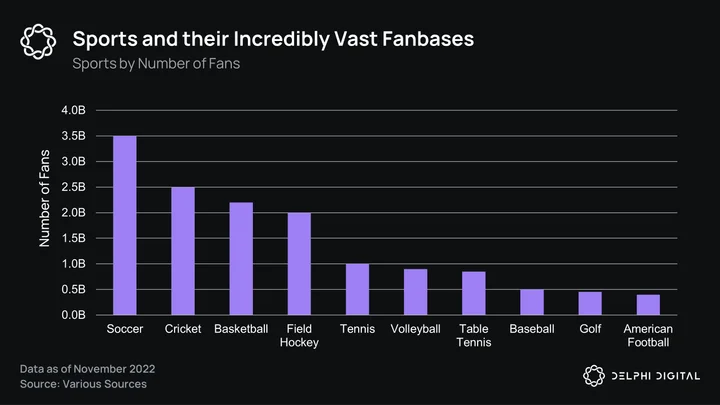
Their market, owners, roster, current performance, and history are essential to their overall market value. The amount of NFL franchises in the top 12 is of particular note. Furthermore, it is remarkable that while American football has only 10% of the worldwide fans compared to soccer, all 30 NFL franchises are represented amongst the 50 most valuable sports franchises. This fact speaks to how monetizable the NFL IP is.
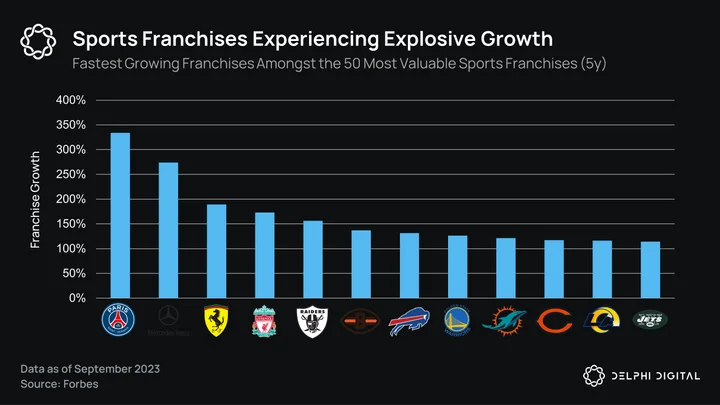
Growth for top sports franchises has been nothing short of explosive, with many franchises gaining over 100% in value over the last five years. Two soccer teams and two Formula 1 teams make up the top four. They are followed by a mix of NFL teams and the Golden State Warriors, the highest-ranking franchise in the NBA.
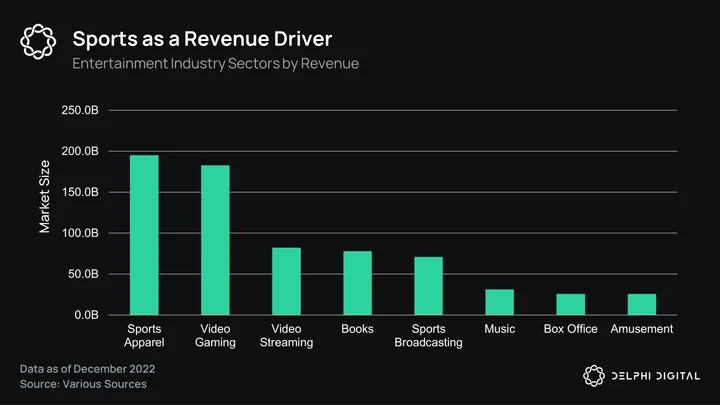
Therefore, it is not surprising that this rapidly growing market has led to sports broadcasting becoming one of the most prominent digital entertainment markets worldwide. Broadcasting is not alone; a lot of money flows through the sports industry each year. You can see the revenue of various entertainment industry sectors below.
Sports in Gaming
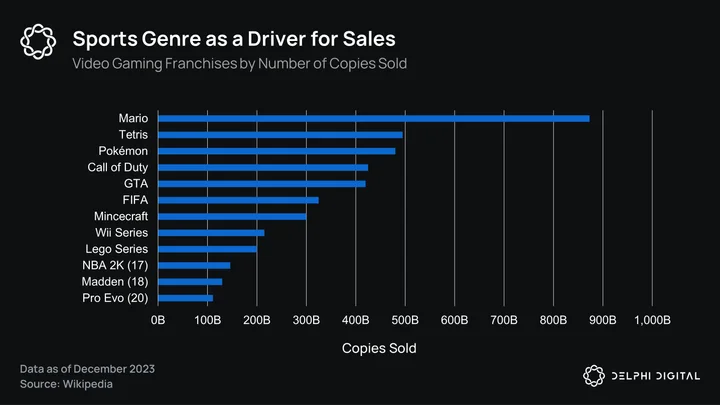
The sports industry has been one of the first big industries to enter gaming at scale. NBA Jam 93 made over $1B in revenue in its first 12 months, while the EA FC series by EA (previously EA FIFA)—which launched its first title in 1993—has sold over 325M copies and made over $20B in lifetime revenue. They have since established themselves as one of the highest-grossing video game series and the most successful sports video game franchise.
For the individual consumer, gaming represents an easily digestible, widely accessible, and cheap way to consume sports entertainment. Going to a live sports event can cost between $10 and $1000+ for a few hours of entertainment, and buying a monthly sports broadcasting subscription usually costs $10-$50 per month.
On the other hand, a typical sports game will require a single purchase of around $70 at launch (not including discounts). It can then be played for hundreds if
Read the full report
This report is part of Delphi Pro.
- 800+ Pro reports across every major sector
- Talk directly with our analysts
- Private community of funds and builders
Already a Pro member? Log in

0 Comments