
Stable coins come in many different forms, but fiat-backed absolutely dominate market share. The fiat-backed stable coin subset is further dominated by tether (USDT), typically making up over 80% of the fiat-backed stable coin supply. USDT was initially solely issued on Bitcoin’s blockchain through the Omni layer, but recent issuance has primarily taken place in ERC20 form on Ethereum’s blockchain, with a non-negligible 750m coins that also exist on Tron’s network.
Aside from a 300 million coin shift (burn and mint) from Tron’s chain to Ethereum’s that didn’t alter total supply, total supply of stable coins remained level through the first two months of the year. March kicked off the growth in stable coin supply and it has yet to slow down. Supply has increased 55% since March 1st, from 5.6B to 8.7B tokens. That comes out to nearly $65 million in new coins issued on a daily basis. For context, there’s only about $12.6 million worth of bitcoin issued daily with the price at $7,000. A majority of the issuance came from Eth based USDT, but Coinbase’s (USDC) and Binance’s (BUSD) stable coins also saw sizable growth relative to their existing supply during that period.

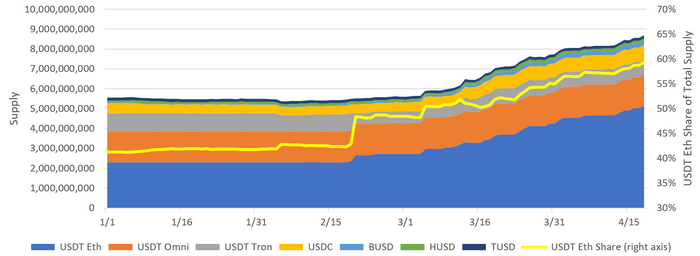
There’s often confusion surrounding the validity of new tether issuance, particularly whether new issuance is created in anticipation of, or in response to, new demand. The team have confirmed that it’s the latter. Tokens are initially created before they’ve been spoken for, however, those sit as internal inventory. They don’t become part of circulating supply until a customer has purchased the tether.
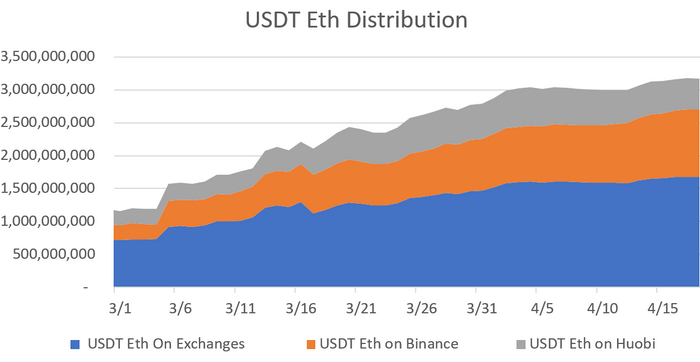
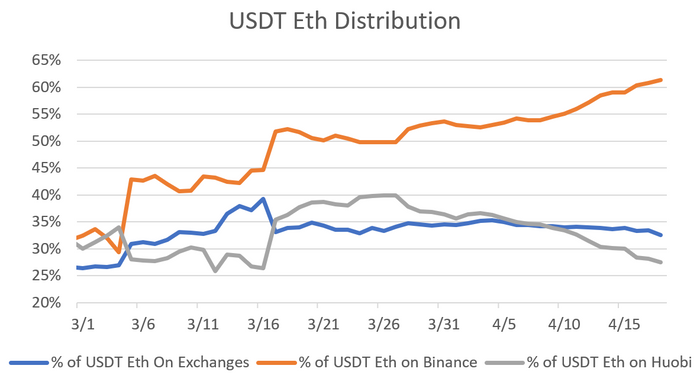
So where are all these tokens going? We focused on USDT Eth specifically, since it represents the lion’s share of new supply. Since March 1st, USDT on exchanges has grown considerably from $715 mil to $1.67 bil, with the percent of total supply on exchanges also gradually increasing from 26% to 33%. Binance has been the largest recipient of these flows, with USDT on exchange growing from $230 mil to $1.03 bil. This trend definitely appears bullish since these inflows represent some level of demand, however, prices aren’t really corroborating that narrative (thanks COVID). This is something we’ll continue monitoring as it develops.
0 Comments