
Why Story Protocol?
Intellectual property (IP) management has historically been burdened by complexity, high costs, and reliance on centralized intermediaries. With the explosive growth of AI-generated content, these traditional inefficiencies now risk spiraling out of control, creating major challenges around attribution (crediting creators and tracing ownership), originality verification, and scalable, fair licensing.
Story Protocol attempts a new approach designed specifically for the digital and AI-driven creative economy. It introduces programmable IP licensing, embeds on-chain attribution directly into the content workflow, and builds flexible licensing modules that make reuse and monetization easier and more accessible. Rather than launching as an app on an existing blockchain like Ethereum or Solana, Story has chosen the more ambitious path of building its own specialized chain. Although this decision comes with tradeoffs, including greater infrastructure overhead and adoption challenges, it also provides essential architectural control.
Core protocol features, such as tracking how value flows through reused creative work, splitting royalties across multiple contributors, and embedding legal terms into licensing, require design choices that general-purpose blockchains aren’t built to natively support. General-purpose L1’s tend to prioritize broad use cases and standardized economic mechanisms, making it difficult to optimize for IP-specific workflows that involve tracing creative ownership across layers, managing complex royalty splits, or embedding licensing terms into assets at the protocol level. These workflows often demand specialized data structures, repeated computations, and native legal logic. General-purpose chains typically can’t support these requirements, as they rely on generalized computation, lack data models optimized for complex asset relationships, and don’t have legal enforcement tools at the base layer.
Rather than over-indexing on the crypto ethos of “Code is Law”, Story strikes a thoughtful balance by recognizing that law carries greater real-world implications and enforceability—and by integrating that reality directly into the design of the system.
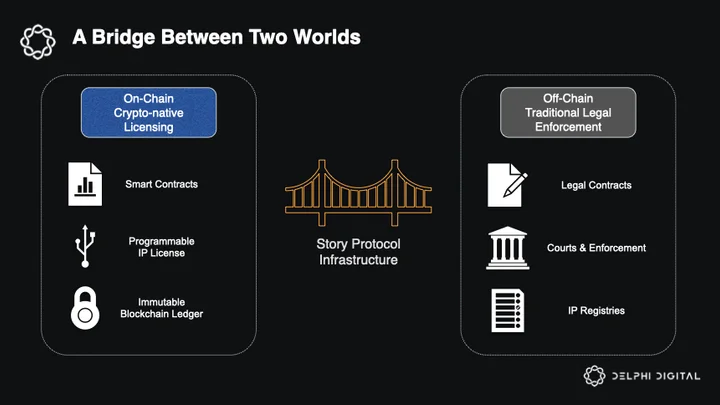
This positions Story as a crucial bridge that implements real-world legal standards into crypto-native infrastructure, making it significantly easier for creatives and owners of proprietary IP to comfortably transition into blockchain-based systems.
This report takes a closer look at whether Story’s architecture can deliver real, lasting advantages, and whether those advantages justify the complexity and ambition of building a layer-1 from the ground up. Along the way, we’ll evaluate Story’s positioning in the market, technical design, real-world use cases, AI integration strategy, and key risks that could limit its impact.
Positioning for the AI-Driven IP Economy
The proliferation of AI is beginning to overwhelm traditional IP systems. Largely shaped by slower, enforcement-heavy models, today’s frameworks often cannot keep pace with the machine-speed invention across both creative and proprietary domains. The core challenge is no longer just ownership, but how to trace contributions and distribute value at scale. Story Protocol positions itself as infrastructure for this shift, aiming to enable transparent attribution and automated compensation in an AI-native economy.
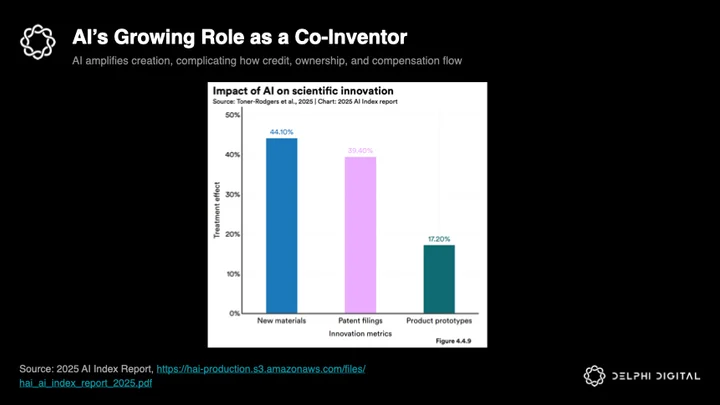
A study of 1,018 scientists concluded that the researchers who leveraged AI produced 44% more breakthroughs in materials science and 39% more new patent filings, demonstrating this emerging technology’s growing role as a co-inventor of intellectual property. Undeniably, it’s positive for society that scientific breakthroughs are accelerating.
But as AI becomes a co-author of research a difficult question arises: when new intellectual property is created in part (or entirely) by non-human entities, how do we decide which humans deserve credit and compensation? Story’s tooling is designed to help answer this question by enabling precise attribution across human and machine contributions alike. In a world where AI can independently invent or build on prior work, ensuring that foundational creators (whether they’re human or not) receive appropriate recognition and reward is more important than ever.
Many argue that intellectual property and copyright will be driven into irrelevance by the unparalleled abundance that AI makes possible. In theory, if infinite variations of knowledge work can be created at near-zero cost, the idea of owning and enforcing IP rights (under the existing frameworks) begins to collapse. Although nobody really knows exactly how things will play out, what’s becoming clear is that we need new ownership models for this new age.
Story Protocol enters a landscape dominated by three main categories of IP management systems. Despite their advantages, none can fulfill the demands of an AI-native economy in which composability is highly valuable.
- Traditional IP frameworks depend on centralized registries and m
Read the full report
This report is part of Delphi Pro.
- 800+ Pro reports across every major sector
- Talk directly with our analysts
- Private community of funds and builders
Already a Pro member? Log in
0 Comments