Sui’s Q2: On-Chain UX Primitives, BTCFi Expansion, Scaling Production
AUG 08, 2025 • 12 Min Read

Report Summary
Summary
Sui’s Q2 2025 was marked by the transition from core infrastructure builds to user-facing applications, with a focus on on-chain UX primitives, Bitcoin DeFi (BTCFi) expansion, and validator-level scalability. This quarter introduced critical frameworks like SEAL (decentralized secrets management), Passkeys (biometric auth), and Remora (horizontal validator scaling), moving Sui closer to production-grade Web3 usability.
Ecosystem-wise, Sui saw rapid BTCFi growth, breakout DeFi traction from Momentum DEX and Suilend, and a major gaming NFT campaign (Claynosaurz) that demonstrated its unique transaction primitives at scale.
Key Takeaways
1. Developer Infrastructure & UX Primitives
-
SEAL: Off-chain data encryption governed by on-chain logic. Enables gated content, private voting, encrypted chat, and secure AI model delivery.
-
Nautilus: Allows trusted computation inside TEEs (e.g., AI inference or KYC) with cryptographic attestations verified on-chain.
-
Passkeys: Biometric login replaces seed phrases using WebAuthn. Enables non-custodial wallets with Face ID/YubiKey, syncing across devices.
-
Slush Wallet: Combines zkLogin, zkSend, and account abstraction into a seamless wallet UX—send crypto with a link, no address or install needed.
-
SCION: Resilient, path-aware networking for validators, protecting against BGP hijacks and network outages.
-
Remora: Horizontally scales validator execution, enabling parallel processing of transactions without breaking consensus.
2. BTCFi Ecosystem Momentum
-
Multiple BTC assets integrated (sBTC, tBTC, xBTC, LBTC).
-
Over 2,027 BTC bridged (up 1,440 BTC from Q1).
-
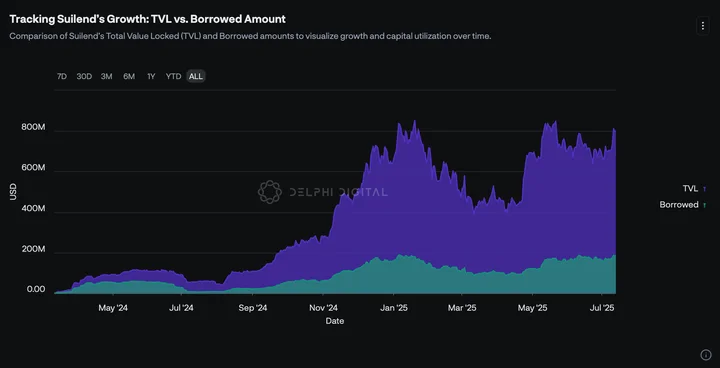
Suilend TVL reached $569M, with 0% borrow fees and increased LTV to support BTC assets.
-
STEAM AMM + Token Launcher enables fair, automated on-chain token launches.
3. DeFi and Liquidity Growth
-
Momentum DEX hit $5.5B cumulative volume, $130M TVL, and became the #1 app by user count.
-
ve(3,3) model, concentrated liquidity, and fast block finality are driving adoption.
-
Backed by OKX Ventures, Coinbase Ventures, and others.
4. NFTs and Gaming: Claynosaurz Popkins
-
Popkins launched 25K mystery boxes; 2K were winners.
-
97,347 NFTs minted, $17.6M in sales, 17.7K unique buyers.
-
Complex execution (randomness, refunds, royalties) completed on-chain using Sui’s programmable primitives.
-
Gas cost: Just 770 SUI for the full campaign.
Conclusion
Sui’s Q2 reflects a mature evolution from protocol development to real-world usability. By delivering native frameworks for privacy, authentication, and horizontal scaling, Sui is laying the groundwork for EVM-independent dApp experiences.
On the ecosystem front, BTCFi traction and DeFi participation are growing fast, driven by differentiated primitives and low-friction onboarding. If Sui can continue converging these tools into smooth user experiences — not just tech demos — it could establish itself as the UX-first L1 for the next wave of crypto applications.
-
Introduction
Since our last report, Sui has moved beyond raw infrastructure upgrades to actively translating those gains into developer-facing primitives and ecosystem traction. The architectural bets made in Q1, such as fast-path consensus in Mysticeti v2, Pilotfish, and Move VM 2.0, are in the process of giving way to production-grade frameworks. These include SEAL for decentralized secrets management, Sui Passkey for native biometric authentication, and Remora for validator-level horizontal scaling.
In Q2, Sui continued to improve its integrations addressing traditional infrastructure gaps in crypto, including privacy, verifiability, and networking. SCION will fortify validator communication against network-layer attacks. Nautilus will bridge confidential compute via TEEs with on-chain attestations. And Slush will upgrade wallet UX by merging account abstraction, zkLogin, and passkey-native flows into a unified interface.
On the ecosystem side, BTCfi on Sui continues to scale with over 3.76K worth of BTC assets now active across Sui-native protocols, and Momentum DEX is establishing itself as a liquidity and trading hub with over $5.5 billion in cumulative volume. NFT and gaming verticals also gained traction with Claynosaurz’s Popkins launch, which was a complex, fully on-chain NFT campaign.
Technical Developments
SEAL – Decentralized Secrets Management
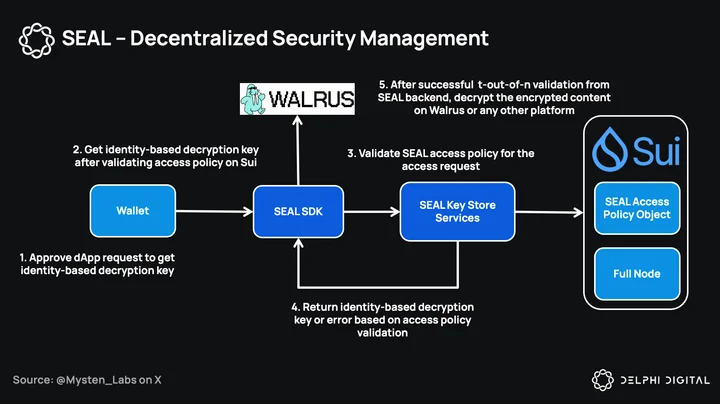
Builders need a way to keep user data, API keys, private messages, and AI model weights off-chain while ensuring access is provably governed by on-chain rules. Today, most rely on Web2 KMS (Key Management Solutions) like AWS KMS or GCP KMS workflows. These approaches break the trust model and fragment the user experience. SEAL bridges this gap by keeping data off-chain while access is transparently and securely controlled through on-chain logic.
SEAL lets you encrypt data off-chain and control decryption rights directly on-chain using smart contract–based policies. These policies define who can decrypt, when, and under what conditions, like time delays, payments, or token ownership. When someone wants to decrypt, they query a decentralized set of key servers that verify the on-chain policy before releasing keys. The actual decryption happens locally, so the servers never see the raw data, preserving privacy and decentralization.
Potential Use-cases
- Gated content marketplaces – time-locked drops where buyers pay, policy updates, and content self-unlocks.
- Private voting modules – ballots are encrypted, policies release keys post-tally.
- End-to-end encrypted chat – each message CID + per-recipient policy; no custom cryptography needed.
- Secure AI model delivery – weights stored on Walrus, decryptable only by runtime attestations.
Mysten Labs provides two public key-server endpoints today (choose 1-of-1, 1-of-2, 2-of-2), community-run servers are coming, and MPC committees are on the roadmap.
Nautilus
Crypto apps often face a privacy and performance tradeoff. Off-chain computation is fast but untrusted, while on-chain execution is verifiable but public and expensive. Nautilus solves this disconnect by allowing developers to run sensitive logic. Such as pricing, identity checks, or AI inference inside Trusted Execution Environments (TEEs) like AWS Nitro Enclaves. With Nautilus, correctness is also be proven through attestations that can be verified on Sui.
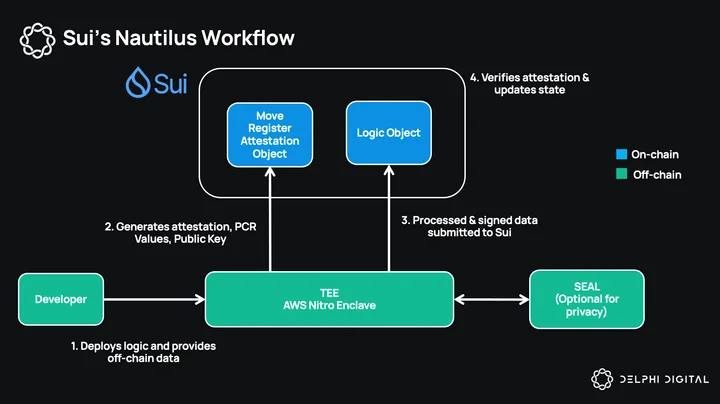
These apps generate cryptographic attestations inside TEEs that confirm a specific computation was executed as intended. The attestations are submitted to Sui and verified by Move smart contracts before any state changes happen. This setup preserves decentralization while enabling private, high-throughput execution. The initial release provides reproducible templates and native Move support for validating these enclave attestations.
When used with SEAL, Nautilus forms a full confidential compute stack. Nautilus handles private execution and SEAL controls who can access the output. For example, an enclave can run a private Machine Learning model, encrypt the result with a SEAL-governed key, and store the ciphertext on-chain. Only users who meet the SEAL policy conditions, such as token ownership or time constraints, can decrypt. This architecture unlocks new classes of crypto apps including private AI agents, KYC oracles, and sealed-bid auctions without sacrificing composability or trust.
Sui Passkey
Seed phrases are a UX dead-end. They’re unmemorable, insecure, and fundamentally incompatible with how people use devices today. Most users either store them poorly or delegate custody to centralized wallets trading off decentralization for usability. Passkey closes this gap by letting users sign transactions with device-native biometric authentication while keeping full non-custodial control.
Built on the WebAuthn standard, Passkey replaces seed phrases with hardware-backed keypairs stored in secure enclaves (like Face ID or YubiKey). When a user initiates a transaction, the authenticator signs a challenge locally so no private key ever leaves the device. Sui verifies the signature on-chain via SIP-9, binding it to a specific origin to prevent phishing. Passkey also syncs securely across devices via cloud providers (e.g., iCloud, Google Password Manager), letting users access their wallets anywhere without key imports or extensions.
How can Passkey improve UX on Sui?
- Walletless app onboarding – users sign in with Face ID or fingerprint, no installs or recovery phrases.
- Passkey-based multisig – different passkeys per device, enforcing quorum or role-based access.
- Institutional dashboards – phishing-resistant, no-password sign-ins for fund managers and ops teams.
- Consumer airdrops – one-passkey-per-device gating to prevent sybil or bot farming.
Sui Passkey is live on Testnet with browser and mobile support, and already integrated in wallets like Nimora. With SIP-9 intent signing and passkey-aware keypairs in the SDK, developers can now build secure, passwordless flows natively into their apps without any extensions or friction.
Remora
Blockchains can optimize single-node performance for only so long. Eventually, hardware bottlenecks CPU, memory, and I/O cap how many transactions a validator can process. Most chains either accept this ceiling or try to “go modular” by offloading execution. Remora takes a different path: it turns the validator into a horizontally scalable cluster, allowing Sui to scale compute capacity linearly with load, without fragmenting state or sacrificing finality.
Remora is not a single feature but a family of techniques that parallelize execution inside the validator itself. Instead of one massive process handling consensus, execution, and storage, Remora decouples these into specialized worker roles distributed across machines. Consensus remains DAG-based and low-latency via Mysticeti. But execution workloads can now be sharded and assigned dynamically, ensuring TPS scales with hardware, instead of being bottlenecked by it. Early testnet deployments have shown hundreds of thousands of TPS using commodity clusters, not supercomputers.
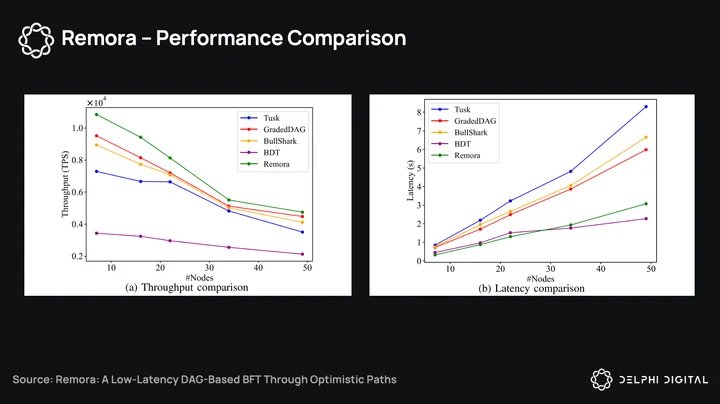
This decoupling builds directly on insights from Pilotfish, an earlier research initiative by Mysten Labs that demonstrated near-linear throughput gains by splitting execution across machines. Remora operationalizes that research: finalized transactions are streamed from Mysticeti to a pool of parallel execution workers, each responsible for processing non-overlapping state updates based on Sui’s object-centric model. Because execution is now asynchronous and horizontally scalable, validators can elastically absorb demand spikes, adding compute without architectural rewrites or consensus slowdowns.
SCION
Blockchains rely on validator-to-validator messaging for consensus, but most use standard internet protocols like IP and BGP that were never built with security, reliability, or route control in mind. These networks are vulnerable to routing attacks, ISP outages, and unpredictable latency, all of which compromise liveness and degrade performance under stress. SCION closes this gap by giving validators path-aware, attack-resistant networking that’s programmable, verifiable, and failsafe by design.
Built as a next-gen internet architecture, SCION lets nodes choose how their packets are routed, which intermediaries they trust, and what fallback paths to use if a failure occurs. Validators send consensus messages over explicitly verified paths, reducing exposure to BGP hijacks and packet loss. If one route fails, SCION auto-fails over to a preselected backup without waiting for the public internet to self-heal. Unlike VPNs or overlays, SCION enforces route-level trust at the protocol layer.
What does SCION unlock for Sui?
- Stronger consensus liveness – validators keep communicating even during ISP outages or routing attacks.
- Geopolitical resilience – regions under censorship can circumvent hostile networks using trusted paths.
- Low-latency finality – explicit path selection avoids congested routes, reducing consensus round-trip times.
- Multi-path routing – fallback links ensure consensus doesn’t halt when a primary route fails.
SCION will be used in addition to standard internet protocols as a fall back rather than as a main communication channel.
Slush – Sui Wallet + Stashed
Sending crypto usually starts with an address and ends with user friction: copy-paste errors, no wallet installed, and a confused recipient. Slush eliminates all of that. It lets users send tokens with a simple link or QR code with no address required. Behind the scenes, it combines the best of Sui’s zkLogin, zkSend, and smart account primitives to deliver a wallet UX that’s smooth, self-custodial, and app-native from the first interaction.
Slush is the merged successor to both Stashed and the original Sui Wallet, unifying them into a single cross-platform product that works on mobile, browser, and desktop. It supports zkLogin-based onboarding (no seed phrase), link-based payments via zkSend, full NFT and token management, native staking, and sync across devices. Users can send crypto through any channel, across email, messaging, QR, or NFC, without needing the recipient’s address. Wallet creation is as seamless as signing in with Google and verifying with Face ID. Once signed in, users can access the same key across devices, interact with dApps, and manage assets with a unified interface. Security features like scam detection, passkey integration, and multi-device key sync enhance the experience without compromising control.
Slush is live across platforms and will soon support EdDSA and ECDSA keys, enabling interoperability with Bitcoin, Ethereum, and Solana.
Ecosystem Updates
BTCfi
BTCfi on Sui continued to expand in Q2 with new Bitcoin assets and integrations deepening the category. sBTC from Stacks launched on Sui in May, with integrations across Suilend and Cetus for lending and yield strategies. tBTC from Threshold went live on July 8 and crossed $1M in TVL within 24 hours, anchored by deployments on Bluefin and AlphaLendSui. OKX’s xBTC also bridged to Sui in May and integrated with Cetus and Navi to enable lending, rewards programs, and BTC-denominated yields.
On the protocol side, Lombard’s LBTC expanded its integrations to Suilend, Navi, Cetus, Aftermath, Bluefin, and Turbos. Lorenzo’s stBTC and SatLayer’s restaking platform introduced new yield and restaking options for BTC holders. There are several variants of BTC assets on Sui that have different origins and custody models.
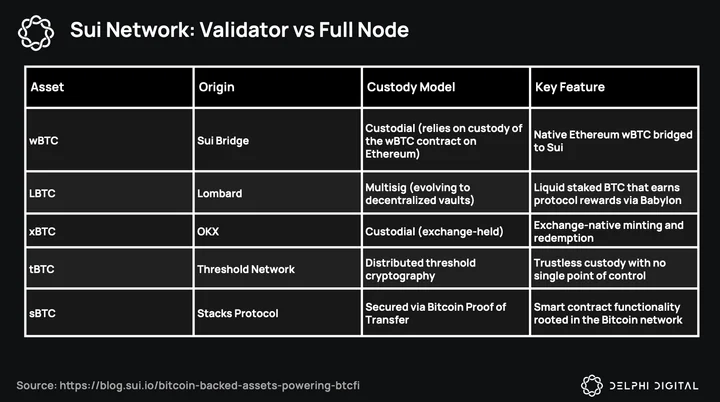
In the last 6 months, WBTC and LBTC bridge vault balances have accumulated over 2027 BTC. Up by 1440 BTC since we last covered it in our Sui Q1 report.
Suilend
Over the last 3-4 months Suilend’s TVL climbed upwards and hit $569m in July 2025, ranking second on Sui. Borrow fees on Suilend are now at 0% and the LTV has been raised to 50% for BTC assets in June to support BTCfi. Rewards programs launched in July for sSUI, DEEP, WAL, and HAEDAL assets.
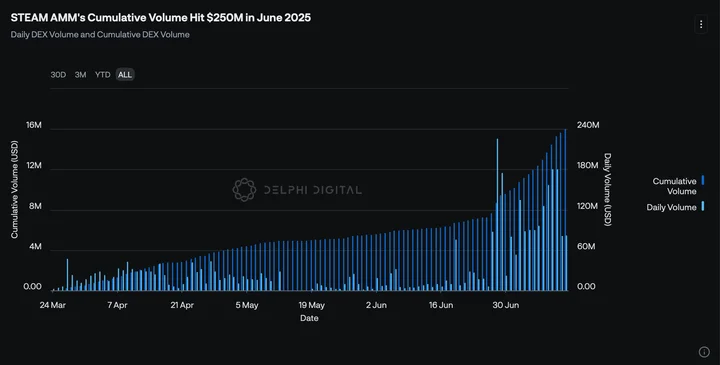
Suilend’s STEAM AMM reached a cumulative volume of $250M in June 2025 after going live in March 2025. STEAMM came up with a Token Launcher in the same month. It enables fully on-chain token launches on Sui with automated, rules-based price discovery and liquidity provisioning. It uses a stream auction mechanism where tokens are streamed over time to bidders, and participants bid by streaming SUI tokens into the auction. The auction dynamically adjusts token prices based on real-time demand, ensuring a fair, transparent, and continuous price formation process without relying on fixed prices or pre-set allocations.
This mechanism also directly integrates liquidity provisioning. A portion of the SUI collected from the auction is paired with the newly minted tokens to seed a liquidity pool on a DEX, creating immediate and deep liquidity post-launch.
Momentum DEX
Since launching in March 2025, Momentum DEX has accumulated over $5.58 billion in total trading volume on Sui.
Momentum DEX runs a ve(3,3) model on Sui. It uses vote-escrowed tokens alongside concentrated liquidity to handle capital use, spreads, and LP rewards, dealing with issues like impermanent loss and yield rates. On Sui, it taps into quick transactions and security scaling to act as a liquidity hub for Move chains, including BTCfi pools like xBTC for Bitcoin yields.
Funding came from a $10M round by Varys Capital in March 2025, followed by a strategic round in June 2025 from OKX Ventures, Coinbase Ventures, Protagonist, and DNA Fund.
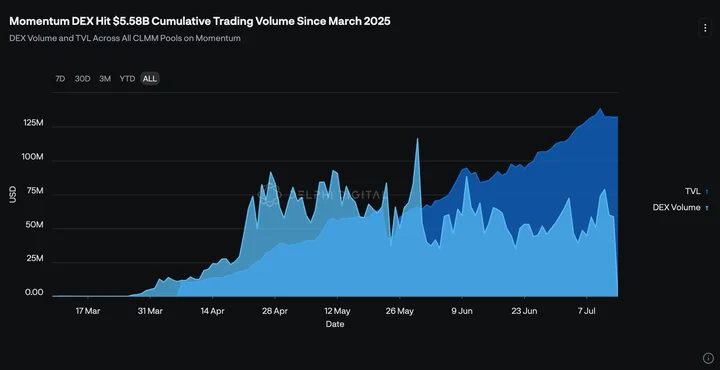
Post-launch, TVL went from $8.1M to over $130M in July 2025, volume hit $3B with $500M in swaps over a month, and about 400,000 wallets connected. It ranks first in active users on Sui DeFi, pulling 289,000 unique wallets in two weeks, and shows higher volume-to-TVL on pairs like SUI-USDC.
Claynosaurz NFT Launch
Claynosaurz launched the Popkins NFT campaign on Sui with 25,000 mystery packs priced at 200 USDC each, of which 2,000 contained a Popkin NFT. Buyers who didn’t win received a full USDC refund and additional rewards. In total, the campaign minted 97,347 NFT tickets, attracted 17,760 unique participants, generated $17.6M in ticket sales. $13.9M were refunded to non-winners in under an hour. The entire operation consumed just 770 SUI in gas fees.
The launch utilized Sui’s core primitives: shared objects to handle concurrency, dynamic collections for scalable registries, and Sui’s native randomness module for on-chain, tamper-proof winner selection. Sponsored transactions via Enoki removed gas costs for users, Walrus hosted 3D assets, and Sui Kiosks enforced royalty logic and trading rules. Programmable Transaction Blocks (PTBs) enabled atomic execution of complex operations like batch minting, refunds, and burns.
The Popkins launch shows how Sui’s primitives can be combined to handle complex, high‑volume drops efficiently. Shared objects, on‑chain randomness, sponsored transactions, and PTBs enabled fair selection, instant refunds, and smooth asset handling. It’s a practical example of Sui’s design supporting novel on‑chain user experiences.
Closing Thoughts
Sui’s Q2 was defined less by raw infrastructure lifts and more by packaging prior improvements into developer-ready capabilities. Frameworks like SEAL, Sui Passkey, and Remora weren’t just theoretical demos; they pushed Sui closer to delivering on-chain workflows that don’t require off-chain hacks. Laying out the path from Pilotfish to Remora, coupled with SCION’s networking upgrades, addresses core scaling and reliability constraints.
On the ecosystem side, BTCfi continues to entrench itself as a durable wedge for liquidity and institutional interest. We’ve had sBTC, tBTC, and xBTC diversify BTC on-ramps. While Momentum DEX and STEAMM set a firm foot in their first few months of operations.
The next frontier lies in how these technical capabilities translate into differentiated applications. With features like programmable privacy, biometric-native authentication, and native secrets management already live, Sui has an opportunity to define new UX baselines for DeFi, gaming, and on-chain services. The real test for the network will be whether these primitives converge into user experiences that feel meaningfully distinct from the EVM mold rather than incremental extensions of it.
0 Comments