
Report Summary
Report Summary
Q3 marked a major transition for Sui—from proving its raw performance to demonstrating real-world usage. Sui’s core components (Seal, Walrus, Nautilus, SuiNS, zkLogin, Passkeys) are now actively integrated and functioning together as a full-stack decentralized coordination layer.
On the network side, Sui continues to scale through parallel execution, PTBs (Programmable Transaction Blocks), and CPS (Commands per Second)—a more accurate measure of real throughput than traditional TPS.
On the ecosystem side, major traction came from:
-
Expanding Stablecoin liquidity
-
Growing BTCFi and RWA markets
-
Record usage on Suilend, Cetus, and Momentum DEX
-
Significant progress in payments, interoperability, and agent-based settlements
The quarter reflects real usage + liquidity + infrastructure maturation, not just tech demos.
Key Takeaways
1. Sui Stack is Now Fully Functional
-
Components like Seal (privacy), Walrus (storage), Nautilus (compute), SuiNS (identity), zkLogin & Passkeys now operate as a unified framework.
-
Enables apps with built-in privacy, programmable access, and composability.
2. Interoperability Gains
-
LayerZero brings omnichain fungible tokens to 140+ chains
-
NEAR Intents lets users move assets to Sui in one step
-
Ika Network enables Sui smart contracts to control external chain accounts
3. Real Throughput Measurement: CPS > TPS
-
PTBs bundle multiple operations inside one transaction.
-
CPS shows actual computational work done → a more meaningful metric than TPS.
4. Stablecoin Market Growth
-
$46.4B avg daily stablecoin volume, peak $139.7B
-
Arrival of suiUSDe (delta-neutral stablecoin) and upcoming USDi (yield-bearing stablecoin)
-
Expanded merchant infrastructure via xMoney and T’order
5. Agentic Payments Milestone
-
Mysten Labs x Google test: 6 autonomous stablecoin purchases in 1 atomic transaction
-
Shows path toward AI-driven programmable payments
6. BTCFi Expanding Rapidly
-
$3.2B cumulative BTCFi trading volume
-
Multiple BTC representations: xBTC, tBTC, LBTC, Lorenzo stBTC, etc.
-
Bitcoin used for lending, restaking, rehypothecation—not idle wrapped assets
7. Real-World Asset (RWA) Activity Rising
-
Franklin Templeton, Libre, VanEck, Canary Capital deploying live tokenized products
-
XAUm (tokenized gold on Sui) now part of Sui Foundation treasury
-
Ant Digital building ESG-linked tokenization frameworks
8. Protocol Highlights
Suilend
-
First Sui protocol to pass $1B deposits
-
Structured strategies > $90M
-
$3M SEND buybacks, 3.5% supply retired
Cetus DEX
-
$80B cumulative volume
-
DLMM launched for programmable liquidity
-
Liquidity restored to 85%+ post exploit
Momentum DEX
-
$22B cumulative volume, ~$95k daily fees
-
ve(3,3) model → fees & emissions go to lockers, not inflation
-
Momentum Vaults passed $18M in first week
9. Strategic Positioning
-
Q3 marks “Sui working as intended”
-
Focus shifts from raw TPS → privacy, control, data ownership
-
Ecosystem now has:
-
Native payments
-
Enclave compute
-
On-chain identity
-
Tokenized RWAs
-
Cross-chain liquidity
-
-
The Sui Stack: A Full-Stack Platform for Decentralized Coordination
Sui’s third quarter felt like the network finally settling into its design. The first year was about proving raw performance. Mysticeti, Pilotfish, and Move VM 2.0 showed that parallel execution works and that throughput can scale without breaking consistency. Now that the base layer is well established, the focus has shifted from how fast the system runs to what it’s being used for.
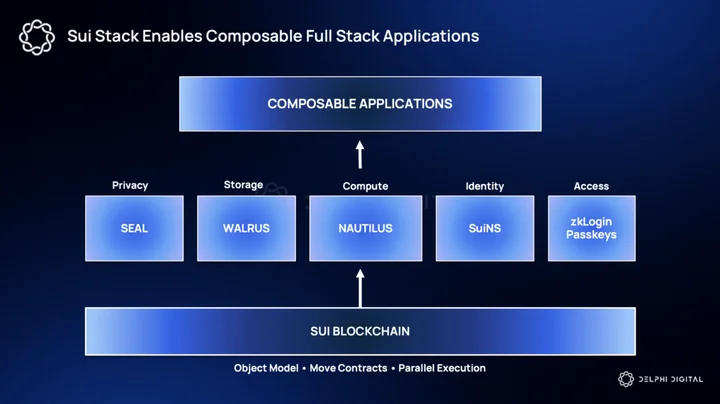
That shift is visible across the stack. Pieces like Seal for privacy, Walrus for storage, Nautilus for compute, SuiNS for identity, and zkLogin and Passkeys for access are starting to work together as a single framework. Privacy, data ownership, and identity are no longer optional features for power users. They are built into the default developer toolkit.
The same pattern shows up in the market. Suilend passed one billion dollars in deposits. Cetus and Momentum pushed trading volumes to new highs. Stablecoin liquidity deepened around suiUSDe and USDC, while XAUm from Matrixdock brought tokenized gold and RWAs on Sui. This is the foundation of a more complete economy forming on Sui. Here’s how it’s taking shape.
Technical Developments
The Sui Stack
Sui starts from objects, not accounts. That small design choice shapes everything above it. It allows parallelism to come naturally, fee markets to localize, and higher layers to treat identity, storage, and policy as addressable components instead of scattered primitives. On that foundation, Mysten Labs has been filling in the missing layers that most ecosystems only add later:
- Seal for encrypted data control
- Walrus for verifiable storage
- Nautilus for confidential compute
- SuiNS for readable on-chain identity
- zkLogin and Passkeys for seamless access
Each piece is useful on its own, but the value compounds when they are used together.
You can see this in live products. Slush uses zkLogin and link-based transfers to make onboarding one tap. Momentum, the leading DEX, benefits from Sui’s object model and fast-path consensus, so orders fill instantly without global lock contention. Suilend can move idle liquidity into an AMM and still preserve safety because balances and positions are explicit objects with traceable ownership. Even Claynosaurz’s game drops now handle randomness, refunds, and royalties entirely on-chain with low gas because Sui’s execution layer is optimized for independent state transitions.
Add privacy and access control to those same flows and new design spaces open up. With the Sui Stack Messaging SDK, a support inbox or marketplace chat does not need to live on a Web2 server. Messaging can link a wallet to a private thread, encrypt the stream with Seal, store attachments on Walrus, and bring the entire conversation under a Move policy that defines who can read and when. A research platform could publish encrypted content to Walrus and set a policy that unlocks it only for token holders after a delay or automatically refunds if access conditions are not met. Because both the policy and the pointers live on-chain, composability stays intact.
Nautilus extends this logic to computation. Some applications need to run code they cannot reveal, like pricing models, fraud filters, or ML inference. Nautilus runs this code inside a trusted enclave, returns an attestation, and lets Move verify it before updating state or releasing a key. This setup enables sealed-bid auctions, private credit checks, or agents that compute routes and encrypt results while leaving a verifiable trail. The chain enforces the policy, the enclave hides the data, and Walrus stores the output for others to reference later.
Identity ties it all together. SuiNS binds readable names to objects and services so users aren’t dealing with long addresses. zkLogin and Passkeys replace complex wallet setups with device-based credentials while keeping keys local and recoverable. This makes multi-device and multi-role access far more practical and cuts down on phishing risk. Even small teams can run shared treasuries with Passkeys on separate devices and a Seal policy that requires a quorum to decrypt spend keys or rotate roles.
Taken together, these primitives change what builders can responsibly ship. A consumer app can now offer in-app chat, token-gated content, and walletless onboarding without relying on centralized infrastructure. A DeFi protocol can keep matching public while moving risk logic into enclaves with attestations that governance can audit. A data business can license models by posting encrypted assets to Walrus and letting customers prove rights on-chain instead of sharing API keys. For institutions, every permission and proof lives transparently on-chain with recovery logic defined in code rather than hidden in a vendor console.
Sui’s early story was about throughput. Now it’s about control: who can access what, how it’s proven, and where it persists. Seal, Walrus, Nautilus, SuiNS, and zkLogin together give Sui tangible substance most chains still lack.
Interoperability – LayerZero OFTs, NEAR Intents & IKA
Sui has been expanding its ability to connect with other ecosystems. The work this quarter focused on making the movement of assets and actions across chains simpler and more reliable. Three integrations lead that effort: LayerZero (OFTs), NEAR Intents, and Ika Network.
LayerZero (OFTs).
LayerZero connects Sui to a network of over 140 blockchains through its Omnichain Fungible Token standard. The model lets a single token exist across multiple chains while keeping one shared supply. Tokens issued on Sui can move into other ecosystems, such as Solana or Base, and return without using wrapped versions. This creates direct routes for liquidity between Sui and other networks.
NEAR Intents.
NEAR’s Intents system allows users to describe an outcome instead of executing each step of a swap or bridge. Solver networks then complete the process automatically. With Sui added as a supported chain, assets from more than 20 networks can move into Sui in one action. It reduces the friction of onboarding and makes it easier for users to enter Sui’s DeFi and application layer.
Ika Network.
Ika extends Sui’s reach beyond its own runtime. It uses multiparty computation to create distributed wallets that can control accounts on external chains. Through its DWalletCap object, a Move contract on Sui can initiate or verify transactions elsewhere while keeping policy logic anchored on Sui. This allows Sui to coordinate with networks such as Bitcoin or Ethereum without relying on centralized custody.
These integrations make the network more open to external liquidity and applications. LayerZero supports token movement, NEAR Intents simplifies user entry, and Ika introduces controlled interaction with other chains. They allow value and activity to flow more freely between Sui and the rest of the ecosystem while keeping the network’s design principles intact.
Measuring Real Throughput: PTBs and CPS
TPS is the most common way to describe blockchain performance, but it only measures how many transactions are finalized, not how much computation they include. On Sui, most transactions utilize Programmable Transaction Blocks (PTBs), where a single transaction can contain hundreds of individual operations. Looking only at TPS understates the amount of real work being done.
Commands Per Second (CPS) measures that work directly. It counts each operation executed on-chain, not just the outer transaction. A network with lower TPS can still record higher CPS if its transactions bundle multiple steps. On Sui, this captures the full effect of PTBs, which handle transfers, swaps, and contract calls together in one atomic execution.
PTBs and CPS are built to compress complex activity into fewer transactions. Applications can execute larger workflows in parallel without increasing congestion or gas costs, giving developers more headroom to scale interactive workloads like DeFi routing or in-game actions.
Ecosystem Developments
Stablecoins and Payments
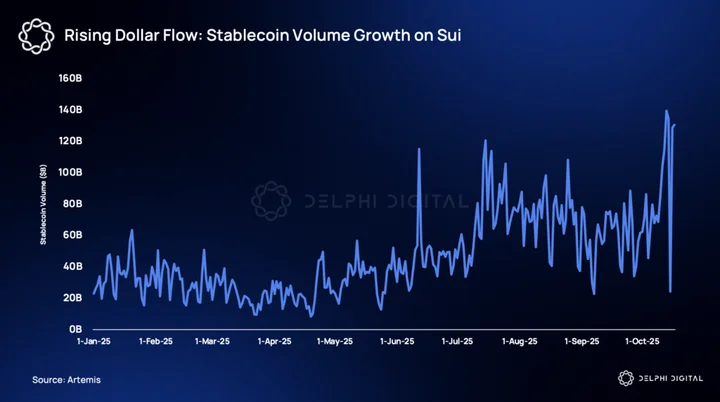
Stablecoins continue to anchor most on-chain activity on Sui. The past quarter added new forms of dollar liquidity through Ethena’s suiUSDe, the upcoming USDi, and early payments infrastructure that uses Sui’s transaction model to coordinate multi-party settlement. Average daily stablecoin volume reached $46.4 billion, peaking at $139.7 billion during the quarter.
suiUSDe and USDi
Ethena’s suiUSDe entered Sui as a delta-neutral stablecoin backed by hedged ETH collateral. It is already being used across Suilend and Cetus for lending, collateral, and liquidity provision. suiUSDe diversifies the network’s dollar base beyond custodial assets like USDC and reduces reliance on bridges for stablecoin inflows. Work is also underway on USDi, a native yield-bearing dollar unit intended for direct use in DeFi and payments. The addition of these instruments gives builders more predictable liquidity within Sui’s own environment.
Payments infrastructure.
T’order, a payments SDK, uses Programmable Transaction Blocks (PTBs) to batch multiple transfers into a single atomic action. The design fits recurring or multi-recipient payments where confirmation speed and determinism are essential. xMoney, formerly Utrust, expanded its global payments network to Sui, allowing merchants to accept and settle in stablecoins such as USDC and suiUSDe through API connections to existing checkout systems. Both efforts make use of Sui’s low-latency execution rather than relying on custodial processors.
Agentic payments.
Mysten Labs and Google recently ran a live test of the Agentic Payments Standard, an extension of Google’s A2A protocol, to see what autonomous payments might actually look like in motion. The setup had six stablecoin purchases from three merchant agents executed as one atomic transaction on Sui. It was a coordination test for programmable money, where agents could negotiate, execute, and settle value directly through verifiable on-chain logic rather than external intermediaries or API calls.
The experiment matters because it reframes what a payment is. Using Sui’s programmable transaction blocks, multiple actors can interact within a single composable flow, turning stablecoins into programmable primitives for agents. Payments stop being static endpoints and start behaving like dynamic state changes that agents can reason about, simulate, and verify in real time.
BTCFi
Bitcoin-based DeFi on Sui kept expanding through the quarter. Cumulative BTCFi trading volume crossed $3.2 billion, with daily peaks above $22 million. Activity was led by BTC, xBTC, and LBTC, which together accounted for nearly three-quarters of total volume. The steady increase in liquidity and turnover reflects how Bitcoin capital is being redeployed into Sui’s on-chain markets.
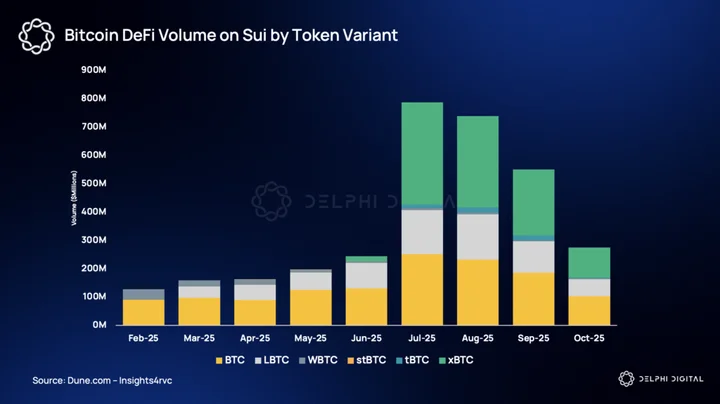
Several BTC variants are now active on Sui, including sBTC from Stacks, tBTC from Threshold, xBTC from OKX, and LBTC from Lombard. Each uses a distinct model for custody and issuance, from threshold signatures to liquid staking and institutional bridging. Lorenzo’s stBTC and SatLayer’s restaking BTC have added yield-bearing and validator-linked options, broadening the use of Bitcoin as productive collateral. These assets now move through lending, restaking, and yield strategies rather than sitting idle as wrapped tokens.
Real-World Assets
RWA activity on Sui picked up this quarter as well. Franklin Templeton and Libre rolled out live tokenized products using Sui’s infrastructure. Libre’s Gateway went live for accredited investors with Nomura Laser Digital’s carry fund. VanEck listed a collateralized SUI ETN in Europe, and Canary Capital filed for a Sui ETF in the US.
Matrixdock launched XAUm, a token backed by 99.99% gold held in audited vaults. It’s the first time tokenized gold has been issued on a non-EVM chain. The Sui Foundation added XAUm to its treasury, and Pyth now provides live pricing. Integrations with DeFi protocols are in progress as XAUm starts circulating as on-chain collateral.
Ant Digital, through its ZAN initiative, is developing ESG-linked asset tokenization frameworks on Sui, aligning sustainability reporting with on-chain verification. Libre is also expanding Gateway to include additional fund strategies from traditional managers, while Franklin Templeton continues testing Sui’s infrastructure for tokenized money-market instruments. These deployments mark a shift from test environments to production-grade issuance, with regulated products now settling directly on-chain.
Suilend
Deposits on Suilend crossed $1 billion this quarter, the first protocol on Sui to reach that scale. The growth came from new structured products rather than raw lending. Suilend Strategies went live with automated yield loops and leveraged positions across SUI, BTC, and USDC. Within weeks, deposits in these vaults climbed past $90 million as users shifted from manual lending to pre-built positions. The pattern mirrors how liquidity organizes in mature DeFi markets, where structured strategies begin to outpace base pools.
Bitcoin liquidity continued to build. Over 1,300 BTC, worth more than $170 million, now sits in Suilend markets. Most of it comes through xBTC, integrated directly with OKX. BTC is no longer passive collateral on Sui. It’s being lent, borrowed, and rehypothecated across the stack. Incentive programs added another $300k in SUI and SEND to deepen these pools, but the more durable driver is growing utility for BTCFi assets within Sui’s credit layer.
The protocol also executed $3 million in SEND buybacks, retiring roughly 3.5 percent of supply from revenue generated by Suilend, SpringSui, and STEAMM. A new SEND dashboard now tracks treasury activity, buybacks, and revenue in real time.
Cetus
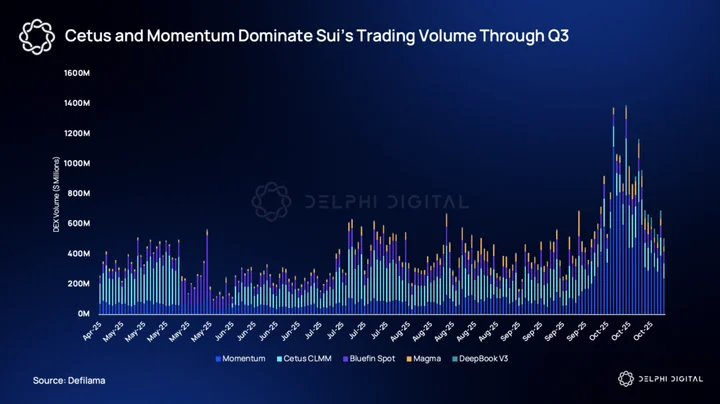
Cetus crossed $80 billion in cumulative trading volume by early October and continues to account for most on-chain trading on Sui. Daily volumes sit around $300 million, and throughput has stayed stable through network volatility. Its pools remain embedded in routing layers across Sui’s major DeFi venues.
The main technical update this quarter was the beta launch of DLMM, the Dynamic Liquidity Market Maker. DLMM lets LPs allocate liquidity across programmable price bins that rebalance automatically as prices move. Strategies such as Bid-Ask allow range management to run on code rather than manual upkeep, giving LPs tighter control over exposure. DLMM routes were added to the Cetus Aggregator, which now sources from both CLMM and DLMM pools to improve routing depth.
Liquidity recovery after the mid-year exploit remains above 85 percent, with protocol fees directed toward CETUS buybacks drawn from trading revenue.
Momentum DEX
Momentum cleared $22 billion in cumulative trading volume by the end of Q3, with total value locked holding around $465 million. Daily volumes averaged $260–270 million, generating roughly $95,000 in fees per day. The ve(3,3) model directs all trading fees and emissions to lockers and stakers, allowing liquidity to compound without unchecked additional token inflation.
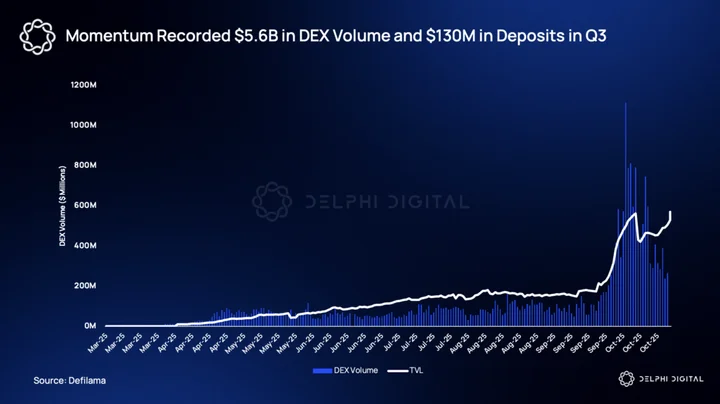
The main technical release was Momentum Vaults, launched in August with strategies. The vaults automate range management for pairs such as SUI–USDC and WAL–SUI, adjusting positions as volatility shifts. Deposits reached $18 million in the first week. New routing through Wormhole, customizable slippage settings, and native stablecoin markets for AUSD, FDUSD, and USDY reduced swap friction and improved capital efficiency across Sui’s DEX stack.
Governance and rewards remain centered on veMMT. All protocol revenue cycles back to lockers, with buybacks exceeding $1 million during the quarter. The Buidlpad community sale added $4.5 million in capital from over 420,000 participants. Partnerships with Wormhole, OKX Wallet, and DeAgentAI expanded access and tooling but left the core design intact: a liquidity system that grows through usage rather than incentives.
Conclusion
Sui’s Q3 was when the system began working as intended. The core stack with Seal, Walrus, Nautilus, SuiNS, and zkLogin moved from demos to real tools that developers are actively building with. The focus shifted from chasing benchmarks to wiring privacy, control, and storage into one runtime. Interop efforts through LayerZero, NEAR Intents, and Ika connected Sui to external liquidity, while metrics such as Commands per Second began reflecting real on-chain computation rather than lab tests.
On the ecosystem side, liquidity remained centered in DeFi. Stablecoins, BTCFi assets, and a few core protocols such as Suilend, Cetus, and Momentum carried most of the flow.
The next step is about helping builders use the stack in ways that bring out what makes Sui different. The products are here, but they require developers to think differently about coordination, data, and user experience. The frontier now lies in enabling applications that could not exist without this architecture.
0 Comments