
Note: Some Dune Analytics queries used for Synthetix had bugs and time-limited data, the numbers may be slightly off.
Introduction
A protocol’s lifeline is determined by its emissions, acting as a deadline that determines its success or failure. For a protocol to become sustainable long-term, it needs to rely on fees from organic usage. Synthetix is a rare glimpse into a protocol nearing its emission schedule and beginning to gain sustainable fees from user adoption. Synthetix has come a long way since the 2019/20 DeFi bull run – but has it done enough to guarantee its success?
To answer that, we need a holistic understanding of how Synthetix has evolved.
This post will look at the state of Synthetix liquidity, what’s driving usage, how the shift to Optimism has affected Synthetix, and other important considerations. For reference, we assume you have some familiarity with the mechanics of Synthetix. If you’re not familiar with this, don’t worry, we’ve got you covered.
The State of Synthetix
Staking Yield Breakdown
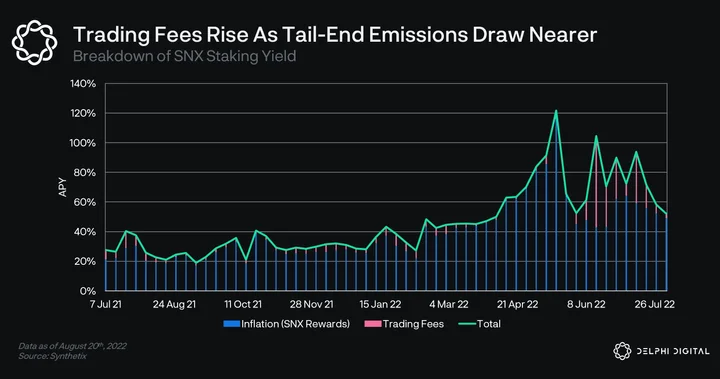
Synthetix initially had a total supply of 100M SNX tokens and aggressively inflated the token’s supply with 70% emissions in the protocol’s first year. The plan was to bootstrap synth liquidity with SNX rewards. And when emissions neared their end, trading fees would sufficiently replace them as incentives. This plan condenses a lot of the early thinking in crypto – including market leader Bitcoin. Use emissions to grow the network to a level where organic revenue can sustain operations.
However, Synthetix vastly underestimated the duration in which its product would be successfully adopted, leading the project to urgently change the monetary policy. This was proven to be true as much as two years later, as trading fees made up only 9.5% of the total SNX staking yield over the last six months.
Through a series of Synthetix Improvement Proposals (SIPs), the monetary policy was changed to a cap of 250M SNX tokens over 5 years. SNX rewards declined by 1.25% weekly since Dec. 2019, and a 2.5% annual terminal inflation rate would take hold in Sep. 2023.
The terminal inflation rate acts as a temporary safety net to continue incentivizing SNX staking and synth liquidity on DEXs. But synthetic liquidity is now fragmented among multiple protocols, meaning incentives are thinly dispersed and depleted at a faster rate. It is unlikely for the terminal inflation rate to sufficiently cover every pool and protocol which requires SNX rewards.
Furthermore, it cannot withstand prolonged market downturns, as staking yields diminish alongside SNX prices. As tail-end emissions draw nearer, Synthetix must generate revenue to sustain current incentives and retain stakers before the incentives wane. The first glimpse of meaningful and sustainable revenue was the launch of atomic swaps in Jun. 2022, where the composition of fees generated towards stakers was significantly altered. On Jun. 15, 2022, trading fees accounted for 59% of the total APY – a 45X increase from the annual low.
Global Debt Pool
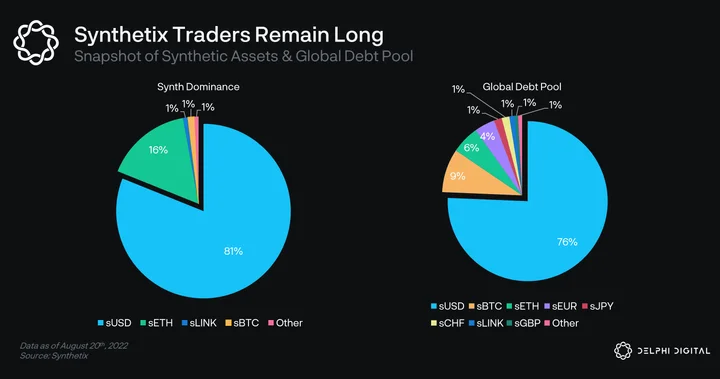
Synthetix’s synth composition has remained sUSD-dominant despite the existence of several synths and the introduction of wrapped assets. Wrapped assets ease user accessibility to the Synthetix ecosystem by circumventing SNX staking
Read the full report
This report is part of Delphi Pro.
- 800+ Pro reports across every major sector
- Talk directly with our analysts
- Private community of funds and builders
Already a Pro member? Log in
0 Comments