The race for electricity, and the companies positioned to profit.
Energy is the only universal currency.
— Vaclav Smil
In 1900, the historian Henry Adams wandered into the Gallery of Machines at the Paris Exposition and found himself standing before a forty-foot dynamo. He later recalled that he “began to feel the forty-foot dynamos as a moral force, much as the early Christians felt the Cross.” Adams grasped something his contemporaries were only beginning to see: humanity had discovered a new object of reverence, a seemingly limitless source of power around which it would reorganize society and direct its collective ambitions.
Over the next half-century, the United States acted on that insight. It strung wire across the continent, built Hoover Dam in about five years, sent the Tennessee Valley Authority into places that had never seen a light bulb, and split the atom to boil water for the grid. The conviction behind all of it was that abundant energy would pay for itself many times over, in ways no one could yet imagine.
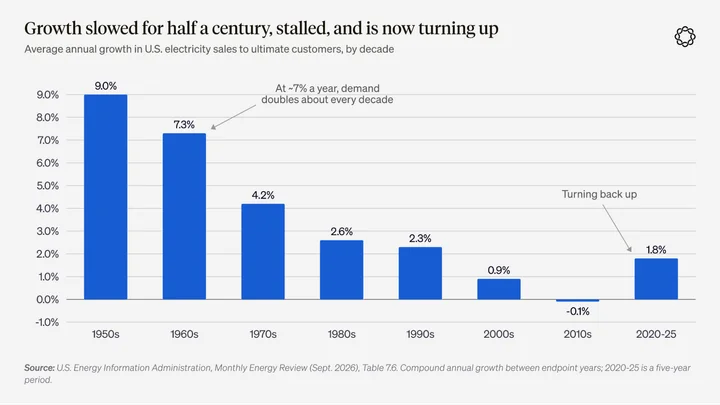
Then the ambition faded. American electricity demand, which roughly doubled every decade after the war, slowed through the 1970s and 1980s, and from the mid-2000s to the early 2020s it barely moved at all. Efficiency gains and offshored industry kept demand flat, which hid the decay, and a nation that once measured its ambition in gigawatts learned to treat flat consumption as a virtue. Institutions that had raised dams in five years began taking ten to approve a transmission line. Permitting became a sport of attrition. By the early 2020s, more generating capacity was waiting in interconnection queues for permission to plug in than existed on the entire grid.
That complacency is now colliding with the largest new source of demand in generations. AI offers the chance to bring skilled physicians, patient tutors, capable lawyers and first-rate scientists to everyone who needs them, rather than rationing that expertise by geography and fortune. If the dynamo was the moral force of Adams’ century, diffused intelligence is the moral force of ours.
But intelligence runs on electricity. Wherever power is scarce, intelligence will be too.
The Size of the Problem
The amount of AI compute that can be deployed is limited by two physical inputs: the chips available, and powered, cooled, grid-connected space in which to put them. Whichever is scarcer sets the limit:
Deployed Compute = min(chips available, powered capacity)
Both are constrained today, but power is harder to fix, for two reasons. The first is speed: chip production can expand in a matter of quarters, while new generation and transmission take years. The second is how each is allocated. Chips are sold in a market, so a buyer can pay more for earlier access, and higher prices draw more supply. Grid access is allocated through planning processes, interconnection queues and, ultimately, politics. Paying more does not move a project to the front of the line, though agreeing to be cut off when the grid is tight increasingly can. When price can’t clear a market, the rents go to whoever controls the allocation (queue positions, permitted sites) and whoever sells a substitute that is priced in a market (on-site generation). That is where this report looks for returns: turbine slots, castings, engines, fuel cells, transformers, crews, and guaranteed, uninterrupted electricity supply, or “firm power”. Inputs in global oversupply, such as battery cells, are not where the money is.
The strain is already visible. PJM’s capacity auctions have cleared at the price cap three times in a row, and the last two still fell 6.6 to 6.8 GW short of the reliability target, the first such shortfalls in its history. The market offered the highest price allowed, and the supply still did not appear. In Texas, ERCOT’s queue of large loads grew from 63 GW at the end of 2024 to 474 GW by June, about 90% of it data centers. In August the governor ordered an audit of every data center in the queue, and ERCOT has since paused energization approvals for data centers and crypto miners of 75 MW or more, including 17 projects that had already passed stability studies.
Because chips scale faster than the grid, the gap between what is asking to connect and what can connect is more likely to widen than to close. We can measure both sides in gigawatts. On the chip side, AEI’s Voltcraft paper estimates that NVIDIA, Google and Amazon will produce about 15 GW of accelerators this year, measured at the chip, rising to about 25 GW in 2028. Once you add the servers, networking and cooling around them, that comes to roughly 26 GW at the meter in 2026 and 46 GW in 2028. On the power side, SemiAnalysis expects about 25 GW of new server capacity to come online outside China this year, or roughly 30 GW at the meter. Two independent methods land in the same range. We use 26 GW this year and 46 GW in 2028 as the yardstick throughout.
Forecasting the Future of Energy Needs
No one knows how much electricity AI will need, and we won’t pretend to. The answer rests on three variables nobody can forecast with confidence: how much power each unit of compute will need, how many tokens a task will take as models improve, and whether usage spreads until most people use AI like today’s heaviest 1% of users, or fleets of always-on agents run around the clock.
So the official estimates agree on the direction of data center demand but differ widely on its magnitude, and each forecast keeps being revised up:
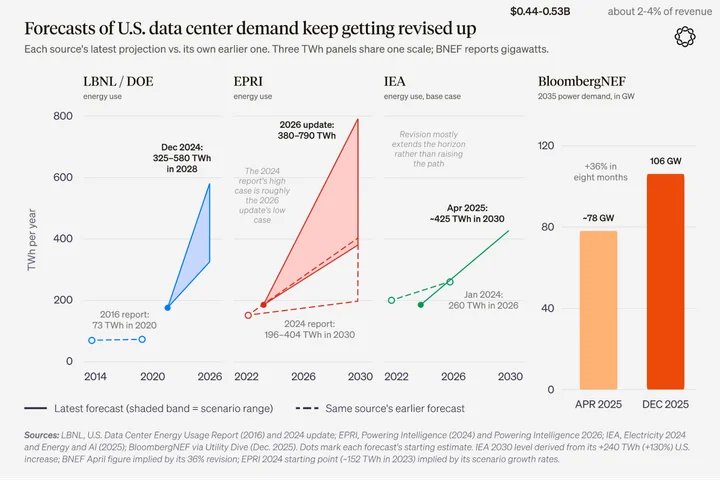
In share terms, data centers used about 4.7% of U.S. electricity in 2024. LBNL now projects 9.5% to 15.3% by 2030, and EPRI up to 17% by 2030.
Supply looks worse. NERC expects summer peak demand to rise 224 GW over the next decade and warns that 13 of 23 regions could face shortfalls by 2030, starting with the Midwest as early as 2028. DOE found that only 22 GW of the roughly 209 GW of generation planned by 2030 can run on demand, and that scheduled retirements could raise outage risk a hundredfold.
If the grid can’t connect the forecast demand, timelines will slip, and grid construction will set the pace of AI this decade. Anyone who can deliver power sooner than the grid can will be able to charge for it.
Generation
Every source of new power can be judged on three things: how soon it can deliver, what it costs, and whether it runs on demand. For most of the grid’s history, cost mattered most, because a utility that waited a few extra years for the cheapest plant lost little. For an AI campus, every month without power is a month of idle chips losing value. In a 1 GW facility, that is $2.8 to $3.3 billion of chip depreciation a year, whether or not the chips are running, or roughly $8 million for every day the power isn’t there.
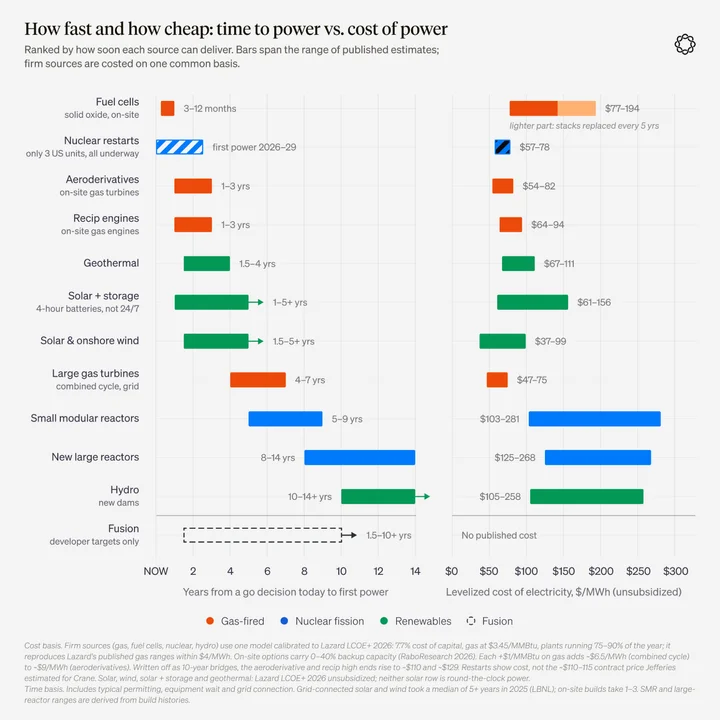
The cheapest firm power, a large combined-cycle gas plant, is among the slowest to arrive. The fastest options, fuel cells and smaller on-site engines, cost more for every megawatt-hour. Solar and wind are cheap, but they are not firm. Nuclear restarts come closest to all three, but only three retired U.S. reactors are being brought back, and all of them are already spoken for.
Faced with that trade-off, the largest buyers have declined to choose. Instead they are placing bets across nearly every technology at once:
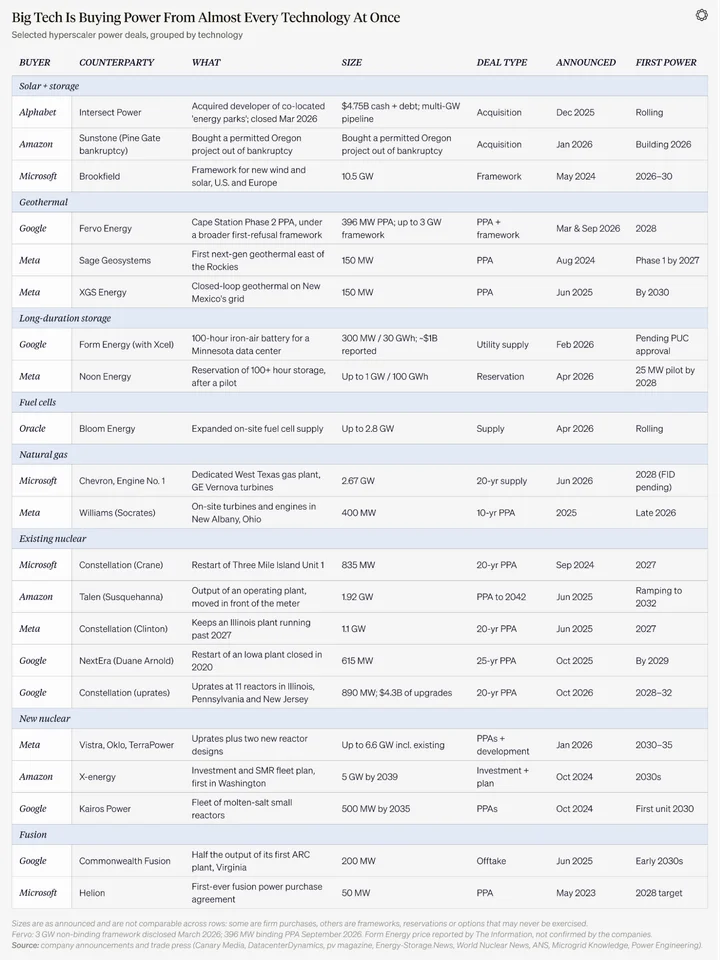
The sections that follow take each source in turn, starting with the one carrying the most weight today.
Gas Turbines
The grid can’t connect load fast enough, so the industry is increasingly building its own power. SemiAnalysis expects more than 40 GW of U.S. data center capacity to run behind the meter by 2028, meaning power plants built on site, outside the grid’s interconnection queue. That would supply more than half of the new data centers coming online that year. In 2026, if you’re building your own power plant, it almost certainly runs on gas.
That puts the AI industry in line for gas turbines. Wood Mackenzie counted about 110 GW of turbine orders at the end of 2025, against 60 to 70 GW of worldwide manufacturing capacity a year (a snapshot that excludes slot reservations and predates 2026’s surge).
Running one year of 2026 accelerator output entirely on new gas would take about 40% of everything the major turbine makers can build in a year. For 2028’s output it would take about 70%. And data centers are competing for those slots with everyone else: at GE Vernova ($GEV), about 80% of the roughly 100 GW it had under contract in Q1 2026 was with utilities, power producers and industrial customers, and only about 20% was tied explicitly to data center load.
As a result, a large turbine now takes about five years to deliver.
The Oligopoly
The large-frame gas turbine business is essentially an oligopoly of three: GE Vernova, Siemens Energy ($SMERY), and Mitsubishi Heavy Industries ($MHVIY). Together they hold about two-thirds of global manufacturing capacity, and all three are sitting on enormous backlogs:
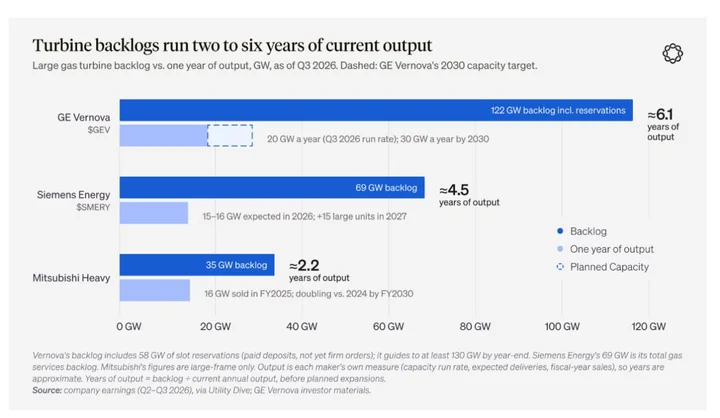
The textbook response to the backlog would be to build capacity as fast as possible. Still marked by the gas turbine bust of the early 2000s, and in GE’s case by a $22 billion write-down of its power business in 2018, all three are instead expanding cautiously and letting customers carry the risk:
- Slot reservations. Customers pay deposits to hold a production slot and forfeit them if they don’t convert to a firm order, so the manufacturer gets paid either way.
- Incremental expansion. GE Vernova’s plan works out to about 11% a year and Mitsubishi’s to about 12%, against backlogs several years deep.
- Higher prices. GE Vernova’s first-half 2026 orders were priced 10 to 20% higher per kilowatt than its Q4 2025 orders, and Wood Mackenzie expects turbine prices to reach $600/kW by the end of 2027, nearly triple 2019 levels.
For shareholders, the turbine makers’ discipline extends pricing power, and the deposits cushion the downside if the cycle turns.
Buyers ar
Read the full report
This report is part of Delphi Pro.
- 800+ Pro reports across every major sector
- Talk directly with our analysts
- Private community of funds and builders
Already a Pro member? Log in
0 Comments