The Case For Plasma One: Stablecoins Are Eating The World
AUG 11, 2026 • 14 Min Read

1. Stablecoins Are Eating the World
CT has been guilty of over-indexing on shiny narratives before. In 2017 it was ICOs, in 2020 DeFi summer, in 2021 NFTs and play-to-earn. Each cycle promised to rewrite finance and delivered a leveraged drawdown instead.
Stablecoins stayed sticky through all of it. They are dollars, and demand for dollars predates every cycle on that list. The internet is dollarising without anyone running a points campaign.
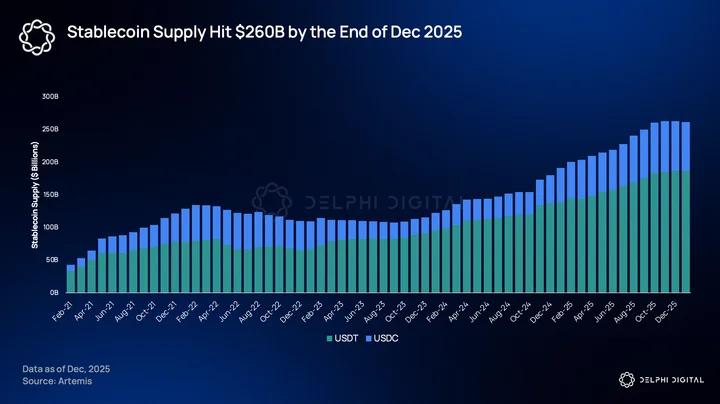
Supply has grown from roughly $5B in 2019 to above $320B today. Monthly transfer volumes rival traditional payment networks. In Argentina, Nigeria, and Turkey, stablecoins are not trading pairs. They are savings accounts. Argentina crossed 200% inflation in 2023. Nigeria’s naira lost over 60% of its value since 2022. For those households, holding dollars is how you stop bleeding purchasing power.
But stablecoins are money without a financial network. Users reach them through centralised exchanges, Telegram brokers, or wallets that assume comfort with gas fees and key management. Someone who wants a checking account has to behave like a DevOps engineer. New financial networks become the default way money moves when three things line up.
A better way to hold or move money, the rails built around it, and a breakout product that pulls usage in until the network becomes too useful to leave. PayPal did it for web payments, neobanks for mobile banking. Stablecoins have the money. They do not yet have the network or the product.
Plasma One is designed around this shift. Its premise is deliberately unexciting by crypto standards by treating stablecoins as primary money and designing the entire stack around that reality and Plasma One is explicitly designed for dollar flows, high-frequency payments, and consumer-grade financial behavior
We might be wrong. Crypto has punished certainty before. But infrastructure tends to follow demand, not narratives. Stablecoins already have demand. Plasma One exists because most of the systems, access and privileges given to people in the western world are not accessible to the masses in the rest of the world.
2. Plasma One: The Global Money Account
Plasma One is a stablecoin-native account and payments application backed by its own layer one chain, Plasma and is designed to act as a primary dollar account and not just another crypto wallet. It is built for users who already rely on stablecoins as money and need a system that can safely absorb savings, spending, and transfers without forcing repeated exits into legacy banking rails.
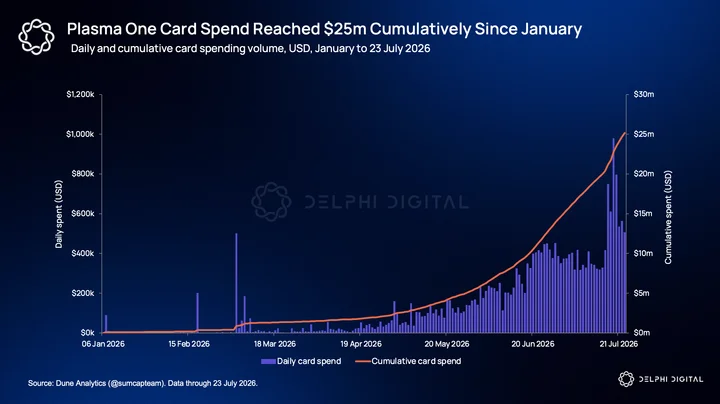
Now publicly launched on both iOS and Android, Plasma One has recorded $32.0 million in card spend across roughly 221,000 transactions since January 2026. July closed at $15.2 million across 109,435 transactions, 69% above June’s $9.0 million. By 4 August it had added another $2.2 million. Figures run from the private beta in January through the public launch on 17 June 2026, and are drawn from Plasma One’s Dune dashboard as of 4 August 2026
Crypto, while heavily fueled by speculation, is now broadening its horizons with stablecoins but the infrastructure is still fragmented. Users hold balances across centralized exchanges, P2P brokers, wallets, and card programs because none of these systems were designed to hold meaningful savings reliably. Most of the options available to users are simply too reflexive in nature.
Plasma One is designed to consolidate that behavior into a single stablecoin-denominated account layer. It targets markets where three particular issues have been rampant. Sustained inflation or FX instability, visible onchain stablecoin usage, and weak consumer banking infrastructure.
Plasma is a product-first chain because it is built around the concrete needs of Plasma One, not around abstract notions of general-purpose chains. The usual order is reversed. Instead of shipping a chain and hoping applications discover product–market fit, Plasma is going-to-market with its own neobank and cards platform.
Those requirements begin with how stablecoins are meant to behave. If stablecoins are to function as everyday money, simple transfers cannot feel metered or heavy. Plasma One relies on gasless or feeless USDT transfers so payments are predictable and final, independent of network congestion or token volatility.
To better understand why Plasma One is built this way, let’s dive into where demand for Plasma One comes from.
3. The Cost of Using Rented Rails
Neobanks were the breakout products of the 2010s. Revolut, Nubank, and Chime proved that millions of people would switch from legacy banks if you gave them a faster interface. But the interface was all that changed. Underneath, the same rails handled the money. SWIFT for cross-border. Visa and Mastercard for cards. Local ACH for settlement. Each layer added cost and a new way to fail.
A decade of neobanks later, cross-border transfers still take one to three days and cost 1-3%. Card transactions pass through four or five intermediaries before they settle. FX spreads take back what the better interface saved. Regional access hangs on banking partnerships that take months to sign and one letter to lose.
Neobanks made the product better. The rails were not theirs to fix, and the companies that owned them had no reason to make them cheaper. Plasma One is built around a different relationship. The account provides distribution, while Plasma provides a settlement layer designed around the account’s needs. Plasma One still depends on external banks, issuers, and card networks, but the chain gives it greater control over stablecoin transfers, account economics, and reconciliation. The chain gives the product more control over how money moves.
4. Inflation and Everyday Dollar Demand
Somewhere past 20% annual inflation, sustained for a few years, a currency stops being something people will save in. Turkey’s CPI peaked above 85% in late 2022. Wages did not keep up, and at the peak close to two-thirds of Turkish bank deposits sat in foreign currency and gold.
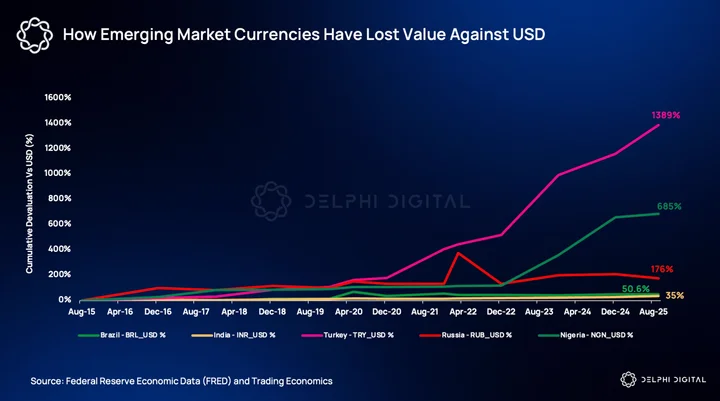
People reach for dollars through whatever channel is available. In India, consumer apps let residents buy U.S. stocks for as little as $5. The draw is dollar exposure, not necessarily the stocks themselves. The rupee has lost roughly half its value against the dollar since 2010. Where even that route is gated, dollar accounts serve only a small share of the population and FX conversions carry spreads of 2–5%.
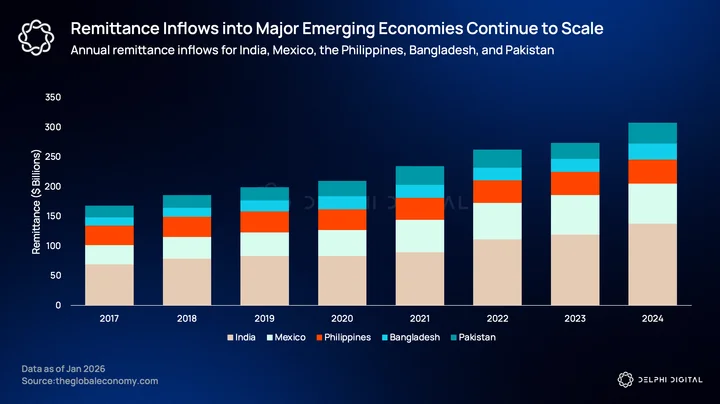
Remittances expose the same problem. India and the Philippines receive more than $150B a year between them, while traditional operators charge 5–7% per transfer. A household sending $300 a month can lose roughly $200 a year to fees.
This is where stablecoins change the economics. Once funds are onchain, stablecoin transfers can clear for less than 1%. They do not eliminate the friction of acquiring dollars or converting them back into local currency, but they materially reduce the cost of holding and moving dollar value. The remaining challenge is making those dollars usable for everyday spending.
5. Stablecoin Card Spend at Scale
Cards are how stablecoins reach everyday spending. Volume on stablecoin-linked cards has grown from roughly $230M a month in January 2023 to $1.5B by August 2025, an $18B annualised run rate. Peer-to-peer stablecoin payments barely moved over the same window, from $1.4B to $1.6B a month. That growth may be the clearest product-market fit crypto has found since perpetual futures. This time, the demand comes from spending rather than leverage.
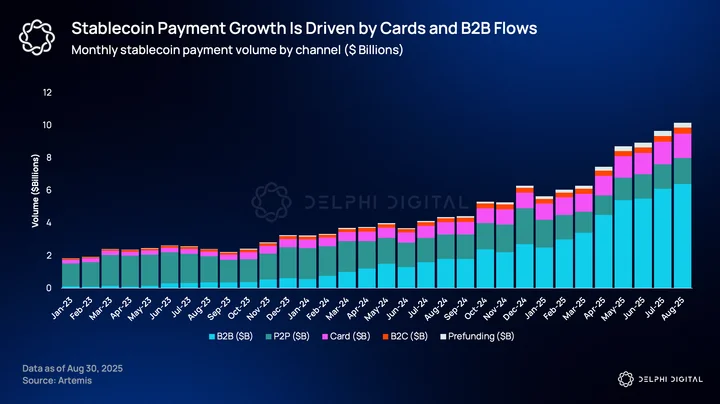
Visa captures over 90% of on-chain crypto card volume, and its stablecoin-linked settlement reached a $3.5B annualised run rate in Q4 2025, up 460% year-over-year. That is still under a fifth of the $18B flowing through stablecoin-linked cards. The rest converts to fiat before it settles.
Exchange-led cards from Coinbase, Crypto.com, Binance, and Bybit treat stablecoins as fuel rather than the unit of account. The stablecoin funds the purchase and disappears into fiat rails before it reaches the merchant. Call the detour cost 1% across FX and reconciliation, and the $14.5B that converts is spending roughly $145M a year turning dollars into dollars.
All the data converges on a single point. Cards are already the primary distribution rail for stablecoins. Neobanks already shape how users hold and spend them. The competitive frontier is no longer adoption; it is whether stablecoins remain an intermediate asset or become the balance that survives end-to-end through accounts, payments, and savings. Plasma’s opportunity sits precisely at that seam.
6. What’s Still Broken
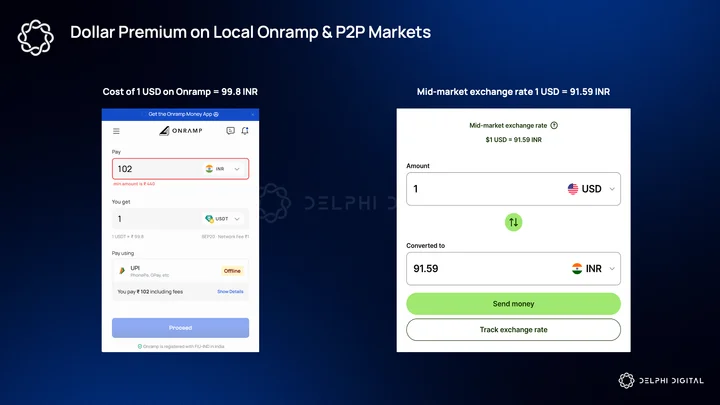
Banks are hostile to ramp providers in India, Argentina, and Nigeria, which pushes users onto P2P networks where the dollar trades at a persistent premium over spot. Crypto cards decline more often than traditional debit at peak hours or during banking outages. If a card fails at a grocery terminal, the user does not come back. A trading perk can absorb that failure rate. Rent cannot.
Temporary account restrictions on the major crypto neobanks are common enough to matter, usually triggered by a reconciliation mismatch rather than crime. Legacy cards carry statutory and network-scheme limits on a cardholder’s liability for fraudulent charges. An on-chain transfer has no chargeback path, so the user eats the loss. Regulatory caps hold balances well below what a primary account requires.
7. Reliability Over Incentives
Most crypto neobanks respond to broken infrastructure with incentives. Cards decline too often, so they offer cashback. When yield swings, a points campaign follows. The incentive pays users to tolerate the failure.
Plasma One’s target users have already been through this. Someone whose account was frozen over a compliance mismatch, or whose card declined at a grocery terminal, is not comparing APY spreads. They are gone. A 1-2% difference in yield does not bring back a user who could not pay for groceries.
Incentives can pull users in. They cannot make anyone stay after the product has failed them. Plasma One’s bet is that this kind of reliability has to be owned, from chain to card settlement. It cannot be rented.
8. XPL Token Economics
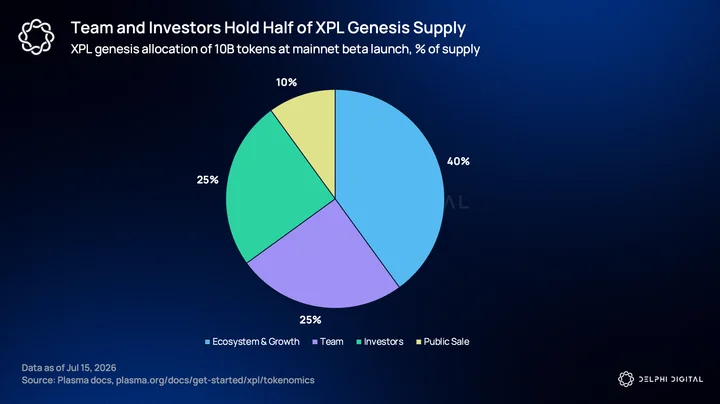
XPL has a 10B genesis supply. Ecosystem receives 40%, team and investors 25% each, public sale 10%. Validator-reward inflation starts at 5% annually and tapers to a 3% floor, beginning once external validators and stake delegation go live.
Tier locks reduce liquid XPL supply. Validator staking will add another locking mechanism when external validators and stake delegation go live. Plasma also burns base fees under EIP-1559. Ordinary USDT transfers stay gasless, funded by a Foundation paymaster, so the burn comes from other activity on the chain.
Cashback works in the opposite direction. Plasma One pays rewards in XPL, so cashback creates potential recipient sell pressure, which is separate from protocol emissions and scheduled token unlocks. The 2% to 4% figures are headline rates. Effective cashback steps down across monthly spend bands, and category limits apply, so emission grows more slowly than card volume. The token economy holds if tier locks and staking grow faster than cashback selling.
US public-sale tokens fully unlocked on 28 July 2026. Team and investor tokens hit their one-year cliff on 25 September 2026, when a third of each allocation, roughly 1.7B tokens, unlocks in a single day. The rest vests monthly through September 2028.
9. How Plasma Compounds
Every piece of infrastructure Plasma One builds becomes shared. A fiat ramp stood up in Nigeria serves any future product on Plasma. A merchant integration wired for Plasma One cards carries any card product launched after it. Compliance tooling calibrated to reduce false-positive freezes benefits every application on the network.
General-purpose chains accumulate developers. Product-first chains accumulate users, balances, merchants, and corridors. Each new market Plasma One enters opens that market for the network. Each partner, ramp, or merchant acquired for one product lowers the cost of launching the next.
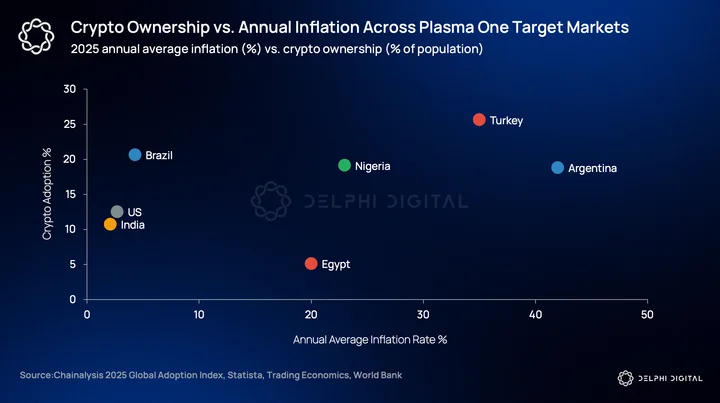
Plasma One is targeting the regions where this compounding matters most. Sustained inflation, visible stablecoin usage, and weak consumer banking infrastructure across LATAM, Africa, Southeast Asia, and MENA. The network grows around household and merchant demand, so infrastructure built for one corridor today carries traffic from multiple products tomorrow.
10. The Moat
Plasma’s moat is not chain performance alone. Its alignment with Tether provides USDT liquidity and access to the surrounding ecosystem, but liquidity is portable. Defensibility depends on converting it into balances, transactions, and local access through Plasma One.
Plasma controls more of the stack than most crypto card companies. Running both the chain and application allows it to coordinate account flows, rewards, and settlement, even while relying on external issuers, processors, and banks. Local ramps and compliance integrations deepen this advantage because they are slow to build, specific to each market, and reusable across future products.
Tron carries roughly 45% of global USDT supply but lacks a first-party consumer product. Plasma is betting that product-led distribution can build better rails faster than liquidity alone. The opening is credible, but the moat depends on reaching enough scale for users, integrations, and liquidity to reinforce one another.
The infrastructure flywheel explains how Plasma can retain users and defend its distribution. The remaining question for XPL holders is how that product value reaches the token. Plasma One’s account tiers are the first direct answer.
11. Tiers and Token Demand
Plasma One has three account tiers. Lite is free, with a Visa Signature card and 2% cashback. Core costs $199 per year or requires a 12-month lock of 20,000 XPL, and raises base cashback to 3%. Platinum requires a 12-month lock of 100,000 XPL, raises base cashback to 4%, and upgrades the card to Visa Infinite.
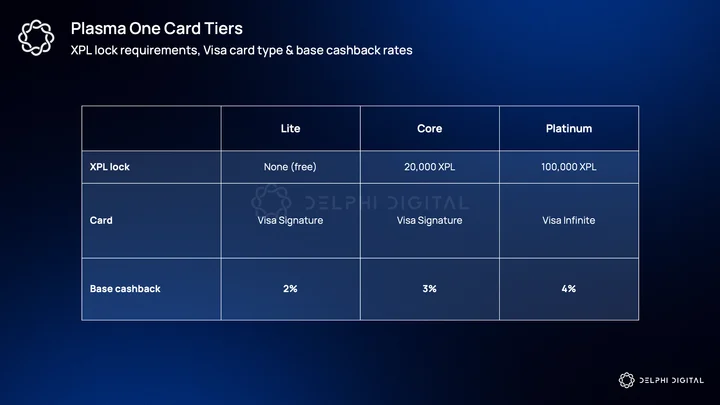
The AI benefits scale with the tier. Core adds 5% cashback on AI spending and bundles ChatGPT Go. Platinum doubles that to 10% and bundles Claude Pro and ChatGPT Plus, roughly $40 a month of subscriptions. No major crypto card offers a cashback tier for AI spend.
This is the first XPL demand tied to product usage rather than emissions or speculation. Platinum is pure lock. Core routes to either locked XPL or recurring revenue, depending on which the user picks. Both scale with active accounts, and accounts churn more slowly than traders.
12. What to Watch
Five variables will determine whether Plasma One’s early traction develops into durable scale.
Tron remains the clearest competitive benchmark. Its much larger USDT base gives it a distribution advantage, but Plasma currently has the stronger first-party consumer product. A move by Tron into neobanking would increase competitive pressure, while also validating the size of the opportunity Plasma is pursuing.
Plasma’s validators remain team-operated as of mid-2026, which allows the network to iterate quickly during its early development. As deposits and institutional usage grow, expanding the validator set will become an important milestone for strengthening neutrality and reducing dependence on the founding team.
Regulatory clarity could work in Plasma’s favour. The GENIUS Act will introduce new compliance requirements through 2026 and 2027, raising costs across the sector. Platforms that build compliance into their infrastructure early may be better placed to absorb those costs and gain access to banking partners as weaker competitors fall behind.
XPL rewards require careful balance. Cashback increases token circulation, while tier locks and validator staking remove supply from the market. XPL rewards require careful balance. Cashback increases token circulation, while tier locks and validator staking remove supply from the market. Because the headline rates step down across monthly spend bands, emission grows more slowly than card volume. The most useful metric is therefore net XPL locked relative to rewards distributed and scheduled unlocks. The most useful metric is therefore net XPL locked relative to rewards distributed and scheduled unlocks. Continued account growth would make that balance easier to sustain.
Expansion across emerging markets will take time because ramps, banking relationships, and compliance systems must be built country by country. That slows the rollout, but it also creates barriers once those integrations are operating. Progress should be measured through the pace of new corridors, partner concentration, and usage growth within each market.
13. Conclusion
Stablecoin demand is already established. Plasma’s wager is that owning the application, chain, and settlement layer can turn that demand into a durable financial network. Plasma One’s early card activity shows genuine consumer usage.
For XPL, the key question is whether product growth creates more durable demand than rewards create sell pressure. Tier locks and validator staking can absorb supply, while cashback and scheduled unlocks work in the opposite direction. The model strengthens only if locked XPL grows faster than emissions and redemptions.
The thesis should now be judged on repeat card spend, retention, account reliability, stablecoin balances, and net XPL locked per active user. If those metrics improve as Plasma enters new markets, Plasma One can become the consumer layer stablecoins have been missing.
0 Comments