
An Introduction to Futures and Perpetual Swaps
In the past year, we’ve seen an influx of new market participants to crypto, including large financial institutions and respected investment funds. This wasn’t an overnight process — it started happening over the course of the last bear market and has continued into the current bull market. While this was brewing on the sidelines, crypto exchanges were building the necessary infrastructure and products to cater to this growing audience.
The biggest difference between the market today and during the last cycle is the proliferation of derivatives — notably, perpetual swaps. Perpetual swaps are derivatives that let you buy or sell the underlying asset at any point in time. They’re basically futures contracts with no explicit expiration date. And because of that, they’re usually bunched in with futures. Perpetual swaps are also called perpetual futures.
Perpetual swaps rely on two critical aspects to be useful: an index price and a funding rate. In order to ensure a perpetual contract is trading at its fair value, it needs to anchor itself to an index price. This index usually comprises BTC-USD price feeds from multiple spot exchanges such as Bitstamp, Bitfinex, Coinbase, and others. But for the perpetual contract to trade in line with the market, there needs to be an incentive for arbitrageurs to restore price parity. That’s where the funding rate kicks in.
When a trader goes long or short using a perpetual swap, they have to pay a small percentage in funding fees on a periodic basis depending on the ratio of longs to shorts. Depending on whether the price of the perpetual is above or below the index price, exchanges use funding to create incentives to converge market price and the index price.
If a BTC-USD perp is trading at $56,000, and its index is trading at $55,000, the funding rate is positive for longs (they pay fees) and negative for shorts (they receive fees). This creates an incentive for traders to short the perp and earn funding. If enough people act on this incentive, the perp’s price falls to meet the index price. This particular strategy is called a “basis trade.” Traders who do this offset their exposure to the perp by doing the opposite action in the spot market. In the example above, a trader could short $10,000 of BTC-USD perps at a price of $56k, buy $10,000 of BTC spot at a price of $55k, offsetting their exposure while collecting the funding fees.
Given the simplicity and utility of perps, it has become the instrument of choice for most traders.
The State of Crypto Perpetuals
In Jan. 2020, BTC futures registered monthly volumes of $427 billion as open interest ranged between $2.6 – $4 billion. Compare that to Jan. 2021, when Bitcoin futures volume hit $2.2 trillion and open interest eclipsed $20 billion. As serious money flows into the industry, it’s impossible to ignore the derivatives market. Options open interest and volume also surged during the course of the last year, further pointing to growing derivatives adoption.
Perpetual products already have obvious product market fit. According to CoinGecko, roughly 85% of daily BTC futures volume comes from perps. But given Bitcoin’s dominance amongst the institutional crowd, many believe it’s the only important asset to track futures flow for. The data for ETH futures and perps, however, begs to differ.
While perpetual swaps make up the bulk of crypto futures volume, there are standard futures on exchanges like BitMEX and FTX amongst others. Furthermore, there has been growth in regulated CME Bitcoin Futures volume, which confirms the uptick in institutional interest.
From Jan. 2020 to Jan. 2021, ETH futures volume grew from $41 billion to $764 billion — an 18x increase. Currently the focus is on BTC and ETH as the stalwarts of crypto, but perpetual contracts for other crypto assets routinely account for billions of dollars in daily volumes.
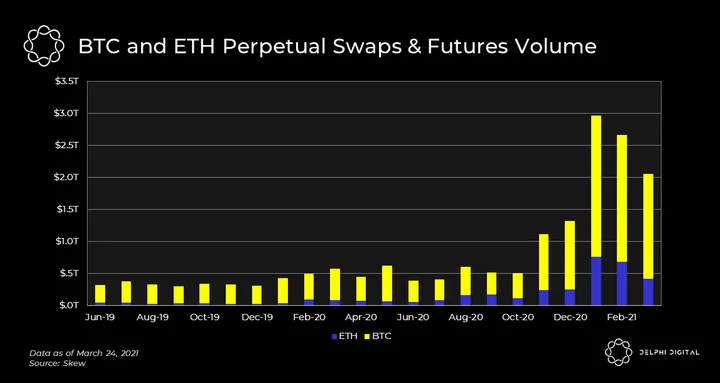
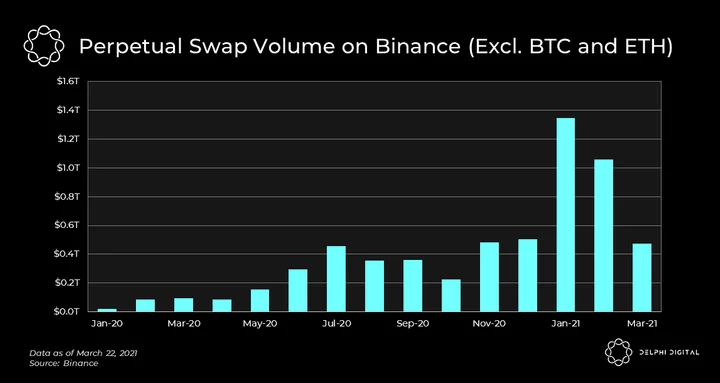
As adoption continues to increase, demand for speculation and hedging instruments will increase as well, boosting perp volume. That said, even if the crypto market stays at the same level it’s at today, the Total Addressable Market (TAM) for DeFi derivatives is still massive. Growth in non-BTC and ETH perps has been exponential over the course of the last year, growing from less than $100 billion of volume in Apr. 2020 to over a trillion dollars of volume in Jan. and Feb. 2021
Centralized crypto spot markets are already being being disrupted by decentralized challengers like Uniswap. The same cannot be said of derivatives yet, as DeFi volumes are orders of magnitude lower than CEX derivatives. We expect this to change soon, as 2021 potentially marks the beginning of efficient and scalable decentralized derivatives.
Decentralized Perpetuals and Futures Protocols
Decentralized derivatives is one of the hottest narratives in DeFi at the moment. But when it comes to actual
Read the full report
This report is part of Delphi Pro.
- 800+ Pro reports across every major sector
- Talk directly with our analysts
- Private community of funds and builders
Already a Pro member? Log in
0 Comments