
Automation. Multi-polarity. Demographics.
These are the three macro forces we will invest behind in the decade ahead. The value of human labor is being undercut by synthetic intelligence. The hegemon which built the current world order is actively undermining it. The pace of reproduction and the arc of a human lifespan are evolving.
These megatrends overlap and reinforce one another. Dropping birth rates and aging populations provide incentives for automation. Automation increases self-sufficiency, reducing the need for incremental interconnectedness in a multi-polar world. Fewer young men point to more automated warfare. Near term, the investments in automation, in self-sufficiency, in rearmament, in healthcare point towards unsustainable government finances which will reinforce the need for productivity boosts brought on by automation.
While the quarterly fluctuations will be material, these are structural forces unlikely to slow. On a ten-year time horizon, it is better to be positioned with them as persistent tailwinds.
The quarterly fluctuations are arriving on schedule.
In late November, the Nasdaq is ~13% below its October 6 record following a blue tsunami and an investor base increasingly anxious about exactly what Jensen has been doing with his 60 “direct reports.”
Capex euphoria has cooled to a critical look at cyclical financing, payback calculations, and neo-cloud yield spreads. Nvidia alone has shed ~US$2 trillion of market value since that peak, and even Texas has gone blue, an exclamation point on the political headwinds facing a continued acceleration in data center capex.
And yet, the underlying progress does not appear to be slowing…
Anthropic’s S-1 revealed what is the most compelling scaled business in history. The same week the tech indices erased US$2.5 trillion, METR published a detailed report on the acceleration of AI research within Anthropic: models are now improving at roughly 1.9x their 2024–25 pace, and perhaps 80% of that acceleration is attributable to AI doing AI research. All six AI Futures Project forecasters now expect a superhuman AI researcher sometime in 2027, and put 35–65% odds on AI that can automate essentially all white-collar work before 2028.
Paradoxically, perhaps the (first) AI capex bubble is popping AND AI takeoff is well-underway…
Dislocations like this strike us as compelling opportunities to buy into core AI beneficiaries. We are four years into the largest technological revolution the world has ever seen. We will shortly be joined by billions of new economic actors in the form of agents, followed by their embodied counterparts. The acceleration in production, in scientific discovery, in workplace disruption will be unprecedented.
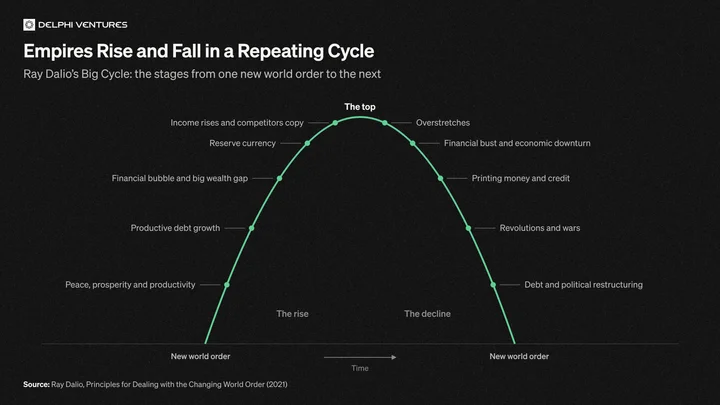
We are entering a fourth turning.
This onslaught is coming at a time where existing institutions are already stretched to the brink: >85% of US voters are frustrated with the opposing party. Global debt crossed $365 trillion in the first half of 2026 (~310% of world GDP), and advanced economies now spend more servicing government bonds ($3.3 trillion a year) than the world spends on defense ($3.1 trillion) or AI ($2.6 trillion). Half a million march the streets of France. The European experiment feels more precarious by the day. The Strait of Hormuz remains contested. Fiat currencies are a fifty-five-year-old experiment. The US is pulling back from its role as global hegemon.
And yet, as investors, as young people, as parents, we have never been more optimistic. The Economic Possibilities for Our Grandchildren have never been more promising. Instead of B2B SaaS and consumer internet marketplaces, the entrepreneurs of the 2020s dream of data centers in space, interplanetary travel, abundant clean energy, aging reversal, and machine gods.
History is on the move once again. Ambitions are moving in lock-step. Our industrial-era institutions are shaking while the machine age is struggling to be born.
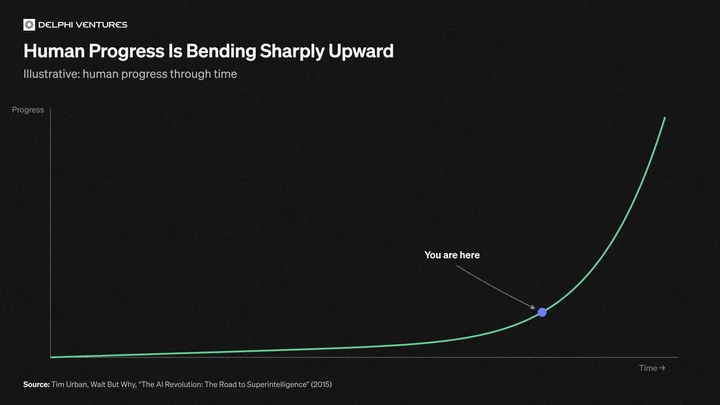
It’s impossible to say what the world will look like in 2035, but it promises to be much weirder. Much more unpredictable. Much more amazing.
All at once.
1. AI and Automation
We can now turn silicon and energy into intelligence. (Please read that one more time). Bottlenecks emerge – compute, data, power – and are struck down, increasingly with the aid of the synthetic counterparts now being cultivated.
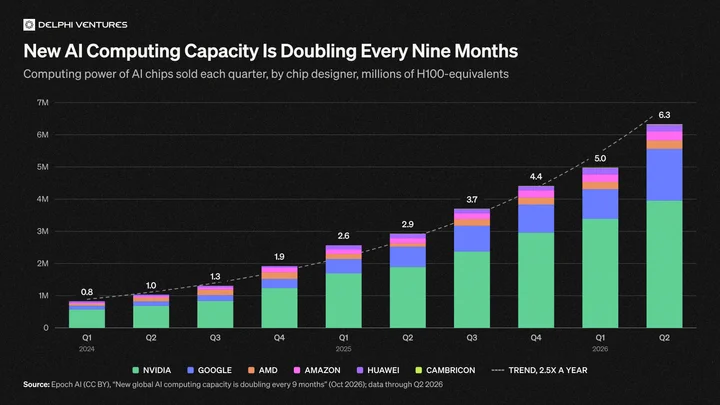
Crucially, though, it seems we are reaching a point where intelligence is now helping to build greater intelligence.
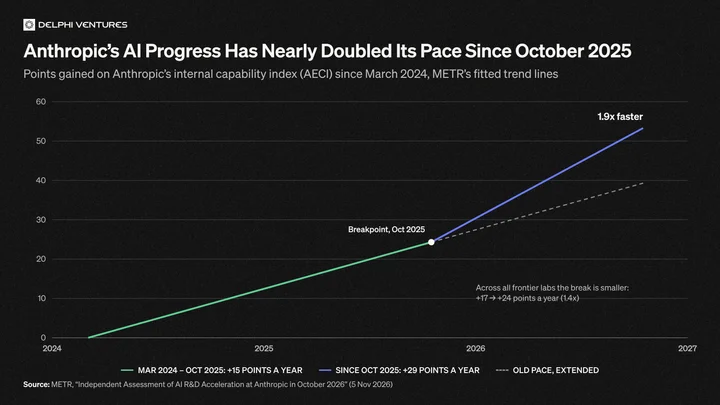
Compute growth – while massive – is likely to slow as we hit physical and political constraints, yet capabilities continue to accelerate. Anthropic staff self-report a ~12x uplift from the latest internal model, and by August Claude was leading roughly a quarter of Anthropic’s model R&D tasks. Intelligence has become an input to its own production.
All of this while inference costs continue to plummet…
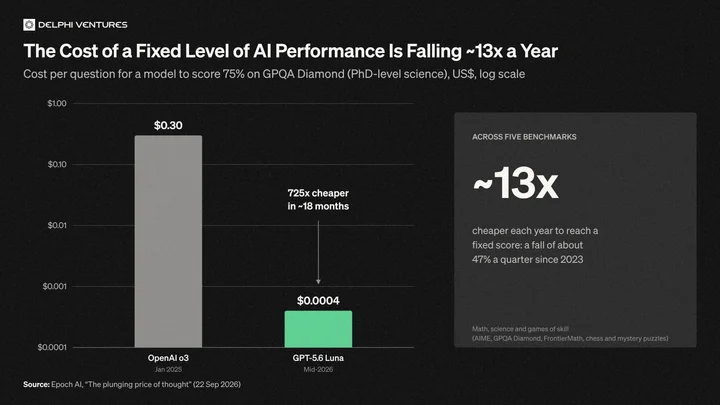
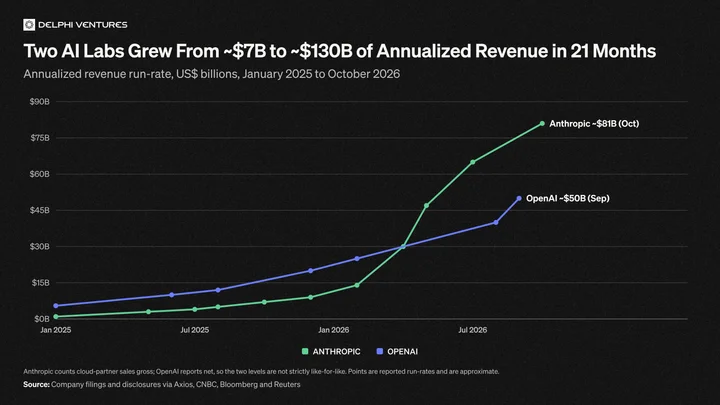
While the traction is inflecting…
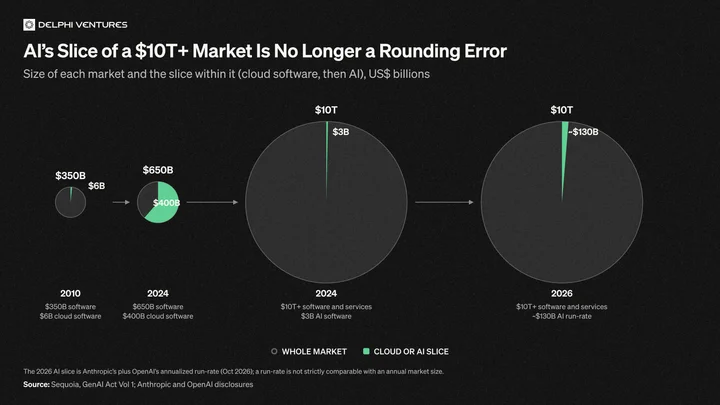
Targeting a TAM of a significant portion of all white collar services globally…
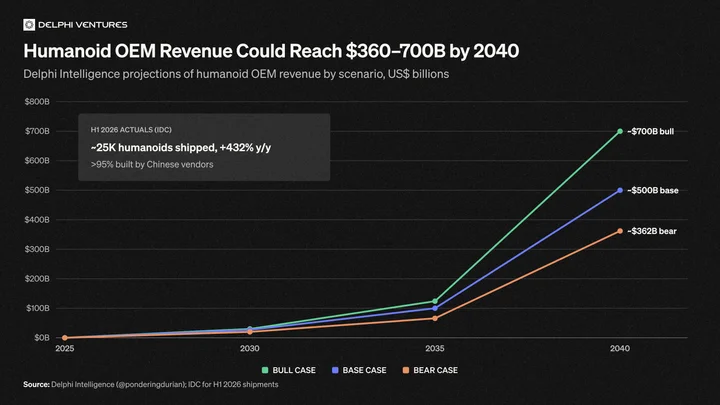
Likely expanding to physical labor as well… (probably much too conservative) …
Perhaps a concise way of saying this is: “the demand for intelligence, so far, appears uncapped.”
So far, every collapse in the cost of tokens has only served to catalyze greater demand. Each 10x down in price drags a thousand workloads above the waterline that were previously uneconomic.
So, why the sell-off?
On the one hand, investors are reacting to a financing air pocket. Nearly US$1 trillion of planned 2027 hyperscaler capex against ~US$130bn of run-rate revenue at the two leading labs feels precarious. Funding has migrated from cashflows to credit. 40 of 41 local ballot restricting data centers passed. Nvidia — the cycle’s backstop and de facto bank of AII — has a chief headed for a public grilling on Capitol Hill. (Though Jensen the white has now been reinstated 🙂 )
One by one, giant pools of capital – the allocators from Wall Street, to Canadian pensions, to Gulf sovereigns – are nursing their first real losses on the trillions required to build an artificial god.
Yet their wavering faith will prove temporary.
We likely have 12-18 months of dissonance where allocators in New York fret, while SF researchers (and their synthetic counterparts) continue their RSI alchemy, increasingly behind closed doors – compute becoming more and more efficient. On the other side of their releases, the hyperscaler ROI will become abundantly evident – cashflows returning in droves to kick-start the infra build out once again. Even with a slow-down in the buildout, AI research itself, increasingly, seems likely like a verifiable domain, as Dwarkesh Patel argues in his latest essay.
Ironically, the political and capital markets backlash will only serve to entrench the incumbents, providing fatter margins to those with the existing compute and distribution channels to serve the greatest asset in history: intelligence – greater than humans, at a fraction of the cost.
Four Worlds for 2027
| Scenarios | What it looks like | Our odds |
|---|---|---|
| Takeoff | AI automates most AI R&D by end-2027; white-collar automation follows fast | ~30% |
| Fast but jagged | ~2x acceleration persists where truth is cheap to check (code, math, cyber); messy real-world work lags; no automated researcher by end-2027 | ~45% |
| Pacing | Binding regulatory or voluntary slowdown of frontier development, layered on state-level build moratoria | ~15% |
| Fizzle | The measured acceleration proves to be benchmark overfitting; progress reverts to the old trend | ~10% |
The exercise is less about the odds than about which positions survive all four:
| Position | Takeoff | Jagged | Pacing | Fizzle |
|---|---|---|---|---|
| Verification, evals, agent security | ++ | + | ++ | ~ |
| Permitting and grid infrastructure | + | + | + | ~ |
| Slow-depreciating physical bottlenecks (power, packaging, EUV) | ++ | + | − | − |
| Embodied data and components | + | + | ~ | ~ |
| Frontier lab equity | ++ | + | ~ | −− |
| Per-seat application SaaS | −− | − | ~ | + |
| Leveraged GPU landlords | − | ~ | − | −− |
++ strong tailwind · + tailwind · ~ neutral · − headwind · −− strong headwind
The Next Wave
Over time, the machine god’s appetite has evolved, needing more and different inputs to feed its growing ambitions. LLMs milked decades of internet text. Diffusion models, the photos. Generative video models were the obvious next step. Agentic workflows, RL, swarms… the goalposts keep moving as capabilities expand.
The capitalist system has proven remarkably adept at getting Moloch what it needs.
However, this first era of AI still feels trapped somehow. Overly wedded to language. Overly digital. Chained in the data centers. Requiring verification.
Perhaps the next great capex wave will be less about compute than about digitizing the data that (increasingly efficient) compute needs.
The original promise of the internet of things. An internet of intelligence. Interactive networks of ambient, distributed AI, mixing cloud and edge, the digital and the physical, reasoning and latency, performance and cost. Human and bot. Learning continuously. Taking in real world inputs. Experimenting constantly. Refining constantly.
Embodied intelligence. AI for science. Automated labs. BCI read / write.
The next phase of AI looks much closer to Jarvis but at global scale. Injecting AI capabilities not only into white collar workflows but into the entire value chain of production.
2035 looks much less agentic workflows and much more Elon-pilled: SpaceX x xAI x Tesla x Optimus x Neuralink x Starlink all coordinating and complementing each other, ideally across much broader swaths of the economy in modular networks.
Ubiquitous intelligence infiltrating factories and supply chains the world over.
Investment Themes
- The agentic economy comes to life
- Indexing, discovery, payments, commerce will all be rapidly redesigned for an economy in which agents become the primary consumers and producers of digital information.
- Networks which most efficiently orchestrate data, compute, and intelligence will be immensely valuable – from vertically integrated companies to fully distributed networks and hybrid stacks in between.
- Identity, permissions, and containment for agents become foundational, and AI-native security a central spend bucket.
- The demand for intelligence will continue to outpace supply – but beware of rapidly depreciating inputs
- Invest behind physical bottlenecks that depreciate slowly: power, interconnect, transformers and turbines, EUV, advanced packaging, photonics, space-based networking.
- APIs to the real world are the next logical frontier.
- The trillions in data center capex will increasingly be diverted towards helping digitally native intelligence understand and have agency in the world of atoms.
- 3D printing, novel materials, precision manufacturing, and anything that reduces extended supply chain dependencies in specialized categories will have structural tailwinds.
- The next phase of AI will tilt towards the edge: hybrid edge-cloud networks which recognize the trade-offs between cost, latency, and privacy.
- BCI data (and the data flywheels around collecting it) will prove immensely valuable.
- Macro implications.
- Yields may soften into a slowdown, but capital remains scarce: G7 sovereign borrowing costs are the highest since 2008.
- The pivot left arrived on schedule. Expect data center moratoria, AI-specific taxes, ratepayer protections – this could lead to a recession in late 2027 before ROI payback on the phase 1 build arrives.
- Prime is the new subprime. Be cautious on credit leveraged to professional-class incomes which are likely to prove tenuous as services deflation becomes evident.
- Initial inflationary spike in inputs – memory, power, energy – followed by massive deflation in services and then goods.
- “Catchup growth” from globalization reverses – AI winners start pulling away; China may be the last emerging economy to climb the manufacturing-led path to relative prosperity.
Potential Sweet Spots
- Verification is the new compute. Value migrates to making truth cheap where it is currently expensive – RL environments and graders for messy, long-horizon, physical-world work (bio, robotics, EDA, law, materials).
- Agent containment and AI-native security. Sandboxes, egress control, agent identity and permissioning, secure agent-to-agent collaboration, weights security for labs, model interpretability, and self-hostable defensive models. RL environments for cybersecurity is an interesting intersection.
- Data flywheel for Embodied AI. Bet on leaders that ship real volumes early and in-house core components – the flywheels will compound quickly in what is one of the largest TAMs in history.
- Power at the grid edge. Solid-state transformers and power electronics, microgrid controllers that let a campus island itself and sell power back at peak, grid-forming inverters and long-duration storage, and orchestration software that turns training runs into flexible, interruptible load.
- Compute markets. As the neocloud shakeout plays out, someone has to price, hedge, redeploy and finance the residual value of millions of GPUs: secondary marketplaces, residual-value insurance, compute futures and, given our roots, on-chain compute credit.
In short, prepare for a world with ubiquitous intelligence increasingly bottlenecked by its ability to interact with and change the physical world.
However, these rising intelligence networks are no longer emerging in a globalized world under the security umbrella of the US hegemon but amidst the world’s great divorce. The end of post-Cold War globalization and a return of great power competition. The titans of blood and soil, iron and steel were never dead, only sleeping.
2. Multi-polarity
The second election of Donald Trump in 2024 was a referendum by the American people on the existing world order. An order first emerging in 1945 and entering hyperdrive in 1989 with a triumphant American liberalism remaking the world in its image. Global supply chains, free capital flows, a shrine built to a singular, all-powerful deity: the American consumer.
It has now been rejected.
The peace dividend and material abundance brought post-Bretton Woods has been undeniable, yet its very structure held the seeds of its ultimate demise. The inevitable tensions of liberalism and national interest. Of meritocracy and inequality. Of global capital and domestic labor. The Triffin dilemma proving inescapable: a democratic society enjoying reserve currency status hollowing out domestic industrial production in exchange for paper IOUs, waking up decades later to find a near-peer rival with a different view of societal flourishing underpinning production of the material goods to which it has become addicted. The supply chains which underpin its multinational corporations. The factories which fuel its military might. The lenders which enable its fiscal deficits.
The twin pillars of national security vulnerabilities and the relative stagnation of middle America kick-started a countdown on the eighty-year-old world order.
Whatever else changes in Washington after November, tariffs, export controls, industrial policy are all now bipartisan.
So… what now?
The hegemon which built the post-Cold-War world order at the end of history is now turning on it. The leader which policed the seas, fostered global supply chains, insured safe passage of energy and goods, ran deficits to fuel the machine’s endless consumption, and opened its capital markets to the world as a safe haven in which to recycle those trade surpluses, is well…

Nation states are now left scrambling to shore up the obvious vulnerabilities emerging in its wake. This renewed focus on redundancy, energy security, technological sovereignty, and military rearmament in a more hostile, multi-polar world is undoubtedly bullish for fiscal deficits, commodities, and the secular inflationistas, all inconveniently occurring at a time of unprecedented global debt.
The obvious investment opportunity then is front-running each pole as it races to shore up its own house amidst the divorce.
But the second order implications may be less obvious.
The End of the World is Just the Beginning
As Peter Zeihan lays out in his book by the above title: globalization is fragile. Globally optimized supply chains, the free flow of energy, the low cost of insurance, the dearth of military conflicts, the ability to tap the lowest cost labor — all combined under an American hegemon to allow for a symbiotic relationship where rich countries could continue to consume disinflationary goods and poorer countries could climb the agriculture → low cost manufacturing → urbanization → services ladder to greater material wellbeing.
This system is being unwound.
Ever since the freezing of Russian assets and the blocking of the Strait of Hormuz, there is no longer a guarantee that US treasuries can be quickly converted into energy. There is no longer a guarantee of American-sponsored security.
As nation states race to shore up dependencies from global supply chains… while they rearm amidst American retrenchment… while they diversify away from US treasuries… while they look to shore up energy reserves… while there is an AI capex supercycle underway… the mispricing of commodities, energy, and hard money on a ten-year horizon is clear. Central banks bought 321 tons of gold in Q3 alone, up 42% year on year, and three-quarters of reserve managers now expect the dollar’s share of global reserves to fall over the next five years.
However, the country which enabled such a system — the United States — is also the one best positioned to withdraw from it with minimal consequences. The US is surrounded by friendly neighbors. It has the most powerful military in the world. It is energy independent. It is food independent. It is leading the AI revolution. It will need to cut back on consumption to properly reindustrialize, but that is uncomfortable, not catastrophic.
The US pulling back from the existing world order is a bigger problem for everyone else, and almost no one — with the exception of China — has been preparing for it. We have seen this with natural gas in Europe after the war in Ukraine. We have seen this with the energy crisis unfolding across East and Southeast Asia in the wake of the closing of the Strait of Hormuz. We have seen it in France, now paying more to borrow than Italy or Greece as cost-of-living protests fill its streets.
The Great Game
In a game of modern mercantilism, the US is best positioned to become more autarkic. China is naturally in a significantly worse position — ringed in by rivals on the Pacific, energy dependent, food dependent, tech dependent — but that is exactly why it has been investing existentially in renewables, semiconductors, military build-up, and food security. China has been keeping its exchange rate artificially low for decades, reinvesting surpluses into areas of strategic vulnerability in preparation for a multi-polar world.
Other countries have not.
Under the mass industrial paradigm, many developing economies’ biggest asset was abundant, low-cost labor as capital scoured the globe for ever cheaper inputs. In a world where sea lanes are hostile, insurance prices increase, and energy prices remain elevated, capital and compute rich countries will invest in automated production at home. The demographic dividend becomes a demographic liability.
While the 2000s–2020 were decades of globalization, harnessing abundant human labor, and convergence as “developing” economies “caught up” to their “developed” counterparts, the decade ahead promises to reverse these mega trends. Countries with abundant capital, elite frontier technical talent, scale AND the political will to fully implement AI and robotics will reaccelerate. The rest of the globe will likely be carved in two: those blessed with the relevant natural resources or niche industrial processes to serve the AI, robotics, and military supercycles, and those left over with large swaths of rapidly depreciating human labor.
The pair trades are pretty clear.
Potential Seed Sweet Spots
- Reshored processing, and permission-free supply. Rare-earth separation and magnet-making (China still owns ~90% of processing), uranium enrichment and HALEU (every SMR startup’s silent dependency), and the de-DJI-ification of the Western drone stack – motors, flight controllers, optics.
- Permission-aware supply chains. Sub-tier mapping, export-license tracking and compliance agents, chokepoint-exposure intelligence, and financing for strategic buffer inventory. Essentially, the agentic software stack which assists a vast reshoring effort.
- Lights-out labs. Robotic, AI-directed labs for chemistry, biology and assay work, sold as a service, plus continuous-flow manufacturing for drug ingredients that today route through China and India.
- Drone-proofing critical infrastructure. Cheap drones have become the most efficient way to take a refinery, substation or data center offline. The neo-primes are building for militaries; the underserved buyers are utilities, ports, refiners and hyperscalers that need low-cost detection and response
- Long the repricing of risk itself. As the US stops underwriting the sea lanes, the world’s insurance premium goes up: parametric war and political-risk cover, supply-chain-disruption insurance, and cover for export licenses that lapse.
- Stablecoin plumbing. As official-sector dollar recycling reverses, street-level dollar demand in emerging markets paradoxically rises. In the medium to long term, we are also bullish alternative stores of value – Gold, Bitcoin, Zcash.
3. Demographics (& Human Enhancement)
In 1950, four countries had birth rates below replacement. In 2024, that number was 136 (71% of the globe). China recorded 7.92 million births in 2025, down 17% in a single year and the fewest since 1949, against 11.31 million deaths; its fertility rate is now below 1.0. Marriage registrations fell another ~10% in the first nine months of 2026. In Italy, Portugal, Greece, Japan and Korea, over one-third of the population will be >65 by 2050. 10k US boomers turn 65 every day, and the Social Security retirement trust fund is now projected to run dry in late 2032.
We are living longer and having fewer babies.
The impact on fiscal budgets, healthcare costs, and workforce participation are obvious. The industrial-era welfare state is predicated on maintaining birth rates above replacement; a ponzi fueled by contributions from ever more youthful participants. With the rapid inversion in demographics brought on by modernity, the model is broken.
So… who is going to foot the bill for the outstanding liabilities?
The most obvious, and likely, solution is a combination of debasement and a sprint for automation. A cocktail of higher taxes, money printing, agentic productivity, and robots.
Continued AI acceleration makes the long-term fiscal math more palatable – in the developed world at least – where the capital exists to invest in the automation necessary to overcome demographic declines. However, as it becomes clear that Piketty was simply a century early, and the return on assets significantly outpaces the returns to labor, the politics will get chippy. As the core dependency ratio shifts from workers per retiree to claims on the machines per citizen, expect more extreme candidates promising to renegotiate the social contract on behalf of the young, and hostility to immigration to increase. November’s midterms offered a preview: the next House will seat eight democratic socialists, the most in U.S. history, several of whom ousted long-serving incumbents in primaries.
Historically, immigration was the answer to aging populations. It will remain so. However, automation will increasingly take share as the policy prescription of choice for a citizenry keen to protect its heritage and its share of machine-age abundance.
Additionally, aging populations may prove surprisingly productive in the decades ahead.
Evading Death
As opposed to the massive capital investment and spiking valuations across AI and robotics, market enthusiasm at the intersection of AI x Bio remained surprisingly muted until this year. The sector’s come-down from the 2021 highs was brutal, but the ungodly compute coming online is providing novel insights into previously locked molecular mysteries — protein folding, polygenic traits, cellular mechanisms — increasingly wrestled into the realm of the legible.
To paraphrase Demis Hassabis: if math is the language of physics, then machine learning is the language of biology.
In many ways, this is the holy grail of the trillion-dollar capex buildout.

As our understanding of biological mechanisms becomes more precise, it’s hard not to see these figures rising significantly. GLP-1’s are just the tip of the iceberg.
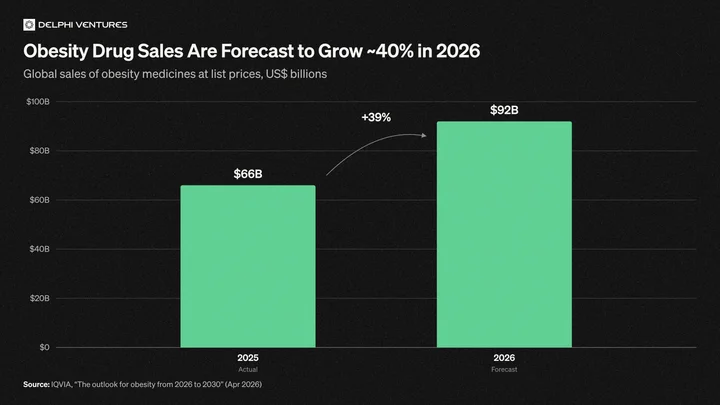
Yamanaka factors show clear signs that cellular aging reversal is possible – and in June, for the first time, the approach was dosed in a human. Longevity-focused companies from NewLimit to Altos Labs to Retro are receiving billions in funding. Each is going after specific organ diseases given the structure of the FDA, but the grand ambition is to treat aging itself.
It is likely that many young people today will live to reach 120, being much more productive later in life.
Once you can edit genomes and reverse aging in cells, it seems likely the majority of post-scarcity disposable income would slide in this direction. In the grand scheme of economics, the only real currency is time. By training our millions of GPUs on life’s most atomic units, the 21st century’s greatest achievement may just be that we learn how to manufacture more.

In the medium term, my hope is that AI’s greatest gift to humanity is expanded lifespan, which would boost later-life productivity significantly, helping us tread water demographically until the robots are deployed at scale.
In the long run, my hope is that the deflation brought on by AI will lead to a recovery in fertility. Embryo screening. Fertility advances. Synthetic wombs. Cost reductions in childrearing. A 50% reduction in the number of hours worked. I suspect the 21st century will see a material shift from crafting identity around work to crafting identity around individual passions and family.
Life is precious. The universe needs more humans, not less. We hope our investments can play a small part in creating more of it.
Investment Themes
- Regulatory-grade clocks. Aging clocks need longitudinal multi-omics data which is scarce; the value of continuous biosensing data will prove immense.
- Read / Write Access to the Brain: thought is the UX of the future. We are already seeing impressive strides at decoding brainwaves with big medical and consumer implications. Collecting this data at scale will be a gold mine for improving UX, AI / robotics models, and medical outcomes – all before the real sci-fi outcomes of writing to the brain arrive late in the 2030s.
- Human augmentation: restoration (and eventually enhancement) of vision, speech, hearing, mobility through a combination of carbon and silicon-based approaches.
- The fertility frontier: Synthetic wombs are still early, but in-vitro gametogenesis (making eggs and sperm from stem cells), IVF automation, and polygenic embryo screening all present real opportunities.
- The capital dependency ratio: the 60–80 cohort is the richest underserved consumer market in history. Decumulation fintech, longevity-risk products, and late-life productivity tools remain underexplored.
Potential Seed Suite Spots
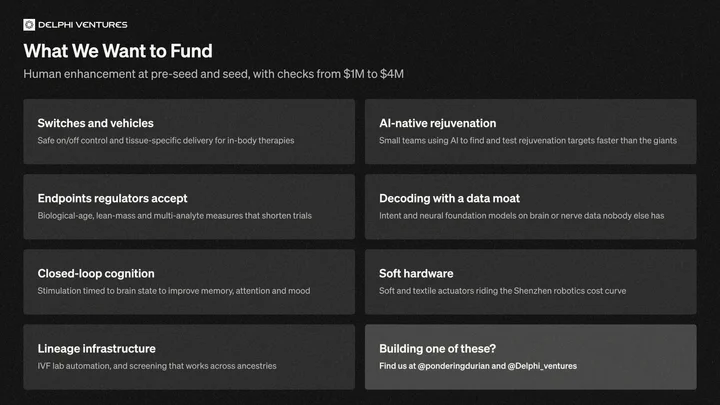
The Tug of War: The Paradox of Modernity
So, it seems we are caught in a catch-22. Without technological acceleration, we will be stuck in a demographics, deficits, degrowth doom loop. With technological acceleration, we risk more elevated p(doom) scenarios and runaway inequality fueling further polarization.
Global debt is ~$365 trillion, ~310% of world GDP. The demographic pyramid is inverted. Fiscal deficits are elevated and only projected to increase. Across almost every vector, massive investments are needed in reindustrialization, national security, climate transformation, grid capacity and more.
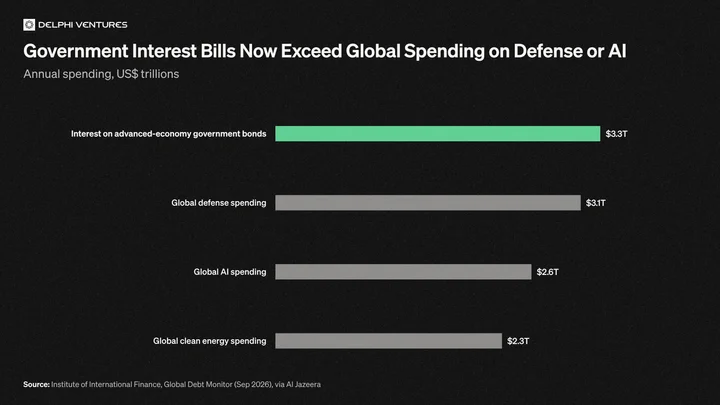
As Ray Dalio reminds us, in every debt crisis where debts are denominated in a local currency, governments inevitably print. Stuck between austerity, mounting debts, and rising yields… the inevitable outlet is the currency.
To quote Keynes quoting Lenin: “There is no subtler, no surer means of overturning the existing basis of society than to debauch the currency.”
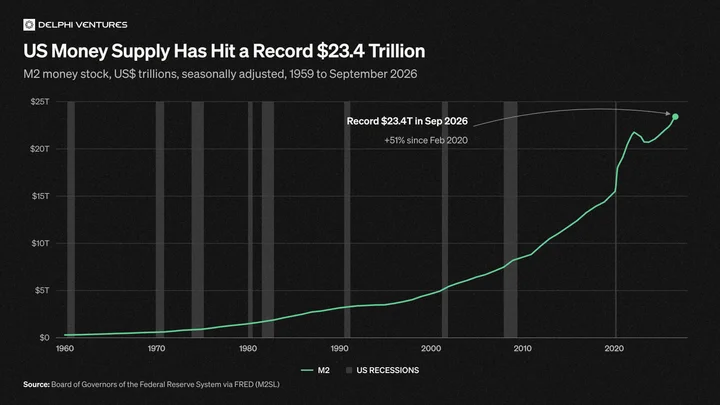
These discontents are erupting in real time. Half a million marched in France in a single October Saturday. US parties are being tossed out emphatically in each subsequent vote. Populist politics are on the rise globally.
Rising living costs are a major culprit. Money creation is outpacing production. Deficits — when looking at the reversal in globalization, the costs of rearmament in a multi-polar world, the rising costs of healthcare in aging societies — are only set to increase.
Paradoxically, automation is the only real outlet available to stall the fiscal doom loops in which most nation states have found themselves, and yet the structural inequality it delivers will almost certainly receive the backlash which will make it difficult to implement. The biggest barriers now are political. November was a clear signal. Perversely, however, greater regulation may only serve to entrench incumbents.
The obvious question becomes: what pace of acceleration will society tolerate and how do we make sure the gains are more broadly distributed?
To me, four futures unfold before the West which are dynamic and reciprocal in nature:
- Techno-feudalism: Continue on our current trajectory without adjustments: capital is rapidly converted into agentic and embodied intelligence with massive gains held by narrow pockets in SF and New York. Owning small slices in the compute and data flywheels is the answer, but if unchecked will likely lead to political blowback, combatted via centralization of state power not dissimilar to…
- Chinamaxxing: fear and political discontents empower a more authoritarian, repressive state enabled by advanced technology: greater capital controls, higher taxes, more surveillance in exchange for greater safety, convenience, stability, and public works. However, this overcorrection could create a backlash from the makers in a world where capital and talent are mobile, fueling the…
- Flight to the network: Balaji’s libertarian unraveling of the industrial-era institutions: capital flight for friendlier low-tax jurisdictions, crypto wallets, distributed AI, and fiscal strain on those left behind. Or…
- We muddle through to the age of abundance. We find our way through the narrow corridor, accelerating enough to avoid the fiscal doom loop with enough diffusion / redistribution to keep broader society onboard — leading to a golden age within the existing institutional framework, not a complete overhaul.
Before the intelligence boom, scenarios two and three seemed surprisingly high probabilities. The Delphi Ventures thesis was therefore heavily wedded to crypto: building a better, uncorrupted parallel system of exchange and collaboration while the structural realities of demographic inversion, rising deficits, political division, and debasement took their toll.
The barbell approach between hard assets and alternative internet-based stores of value is still a compelling way to hedge these megatrends: front-running nations as they shore up dependencies — longing commodities, energy, and defense against fiat and bonds. Front-running debasement and confiscation in Bitcoin, Zcash, and the distributed agentic economy against non-G2 emerging markets and bankrupt municipalities.
However, with the intelligence revolution emerging in November 2022, it increasingly seems likely we just might have found a golden ticket: a productivity boom over the next ten years which can overpower the overhang brought on by demographics, deficits, and debasement. But it is a delicate balance to get right.
Previously, we were backing entrepreneurs building outside of existing institutions. We will continue to do this. However, given this evolution, we will also invest in the very best people within the existing paradigm, because it is being reborn before our eyes.
Yes, the challenges are daunting. We are staring at massive debt loads, spiraling deficits, political polarization, cost of living crises, the return of war and great power politics, and rogue AI risks. Watching the X feed, it’s hard not to feel the doomers are ascendant.
Don’t fall for it.
By 2035, the world and near orbit will be awash in accelerated compute. Your work will be less tedious, your lifespan longer, our ambitions grander.
The future belongs to the optimists. Invest accordingly.
We certainly are.
Thanks to @ZeMariaMacedo for the initial idea for this article, @cannngurel and @redphone for the feedback, and Neco from @Delphi_Design for the graphics.
@PonderingDurian, signing off
0 Comments