Worse Comes to Worst
Do you ever wonder, like, wtf is going on? Why everyone, everywhere, seems so on edge? In an age where AI bests the Turing test, rockets land themselves, and biology becomes programmable, what’s our problem?
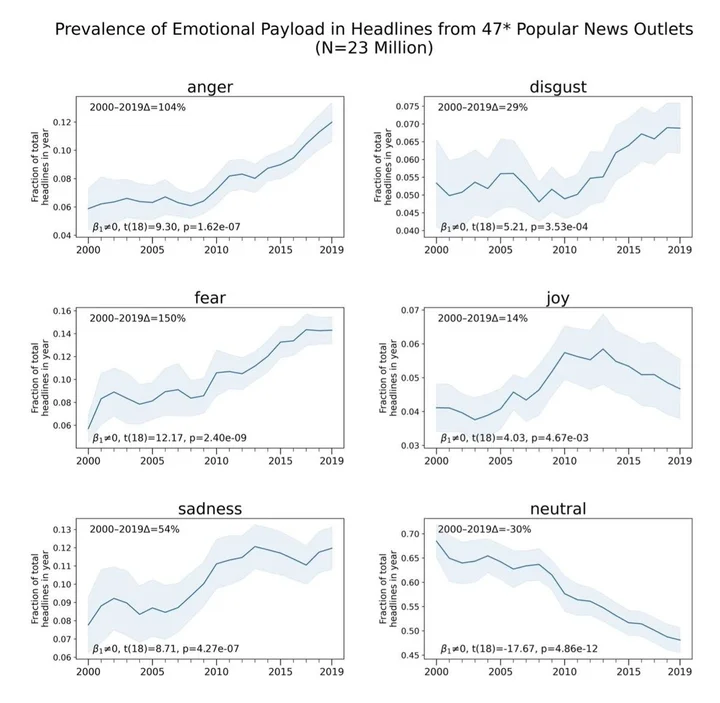
Imagine, for a moment, a world where crisis, conflict, and war run rampant. A world of failed institutions, corporate cynicism, and individual greed. A world where the past is brighter than the future. This may just sound like a bad dream, but for many people, and perhaps even for you, it’s no fantasy. It’s reality.
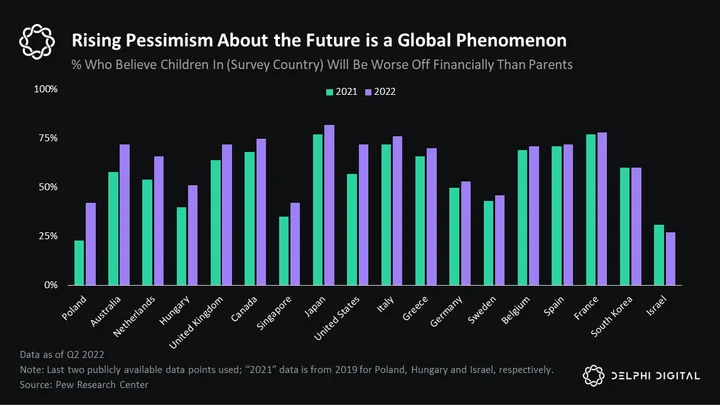
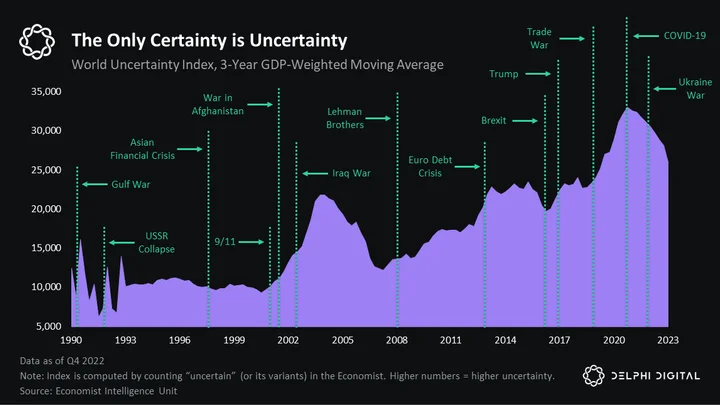
You might think I’m exaggerating, but the capital-T Truth is our world faces a series of interlocking and converging crises that threaten to undo decades of progress and prosperity. From economic collapse, to war, to social unrest, we are certainly living in uncertain times.
But there is hope. There’s a way out of this mess. And it starts with understanding what’s really going on and how we can change it.
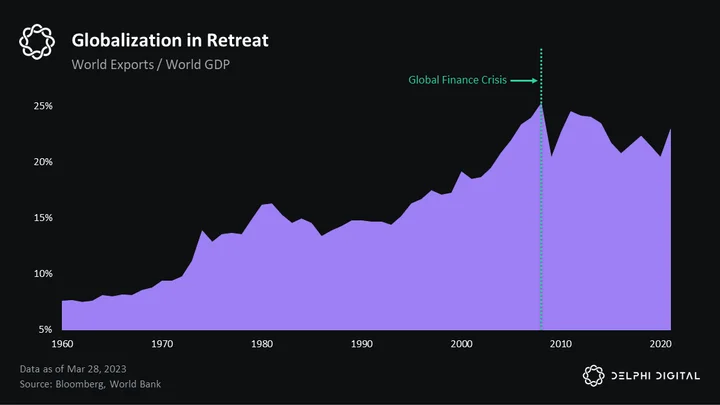
At present, the zeitgeist appears split. The intellectual bourgeoisie — exemplified by the World Economic Forum (WEF) — have coalesced around the idea that our moment is a “polycrisis” and prescribed a diet of austerity and bugs.
Meanwhile, the, uhh, less intellectually inclined lay the blame on politicians and the “other side.” A diagnosis that, similar to the WEF, lacks depth and is reminiscent of writing “Jesus” on my high school religion exams; it’s always the right answer.
Inventing highfalutin vocabulary words and playing the political blame game is always tempting but never satisfying.
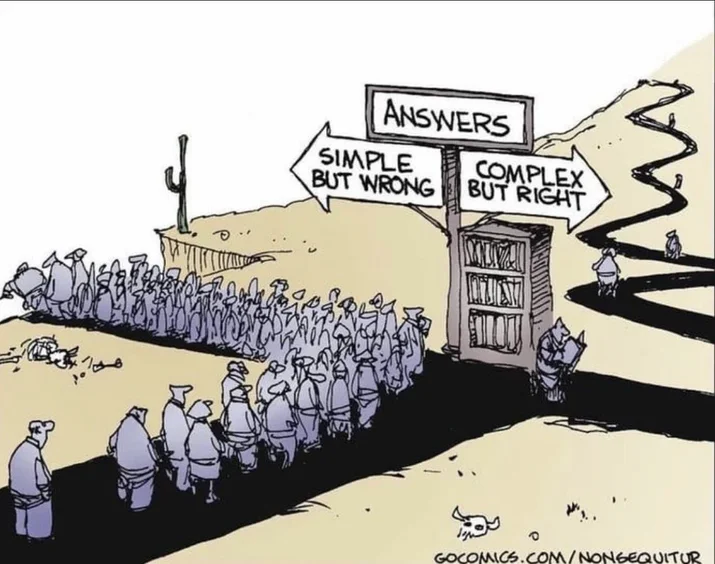
“The test of a first-rate intelligence is the ability to hold two opposed ideas in the mind at the same time, and still retain the ability to function.” – F. Scott Fitzgerald
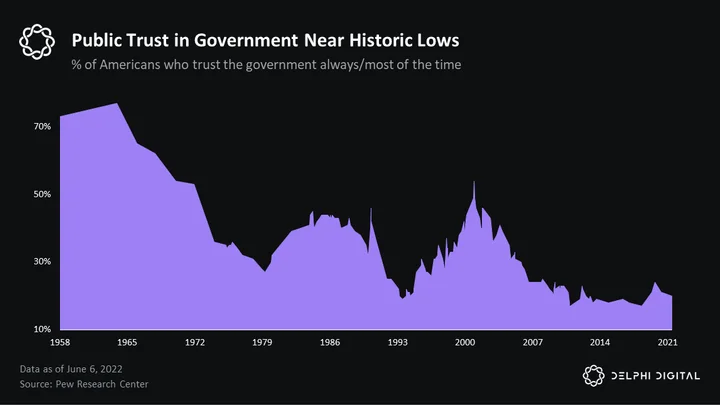
Our condition transcends whichever political party happens to be in office. The rise of populism, authoritarianism, and outright war suggests that, on a global scale, people are deeply unhappy with the status quo and have lost faith “in the system.”
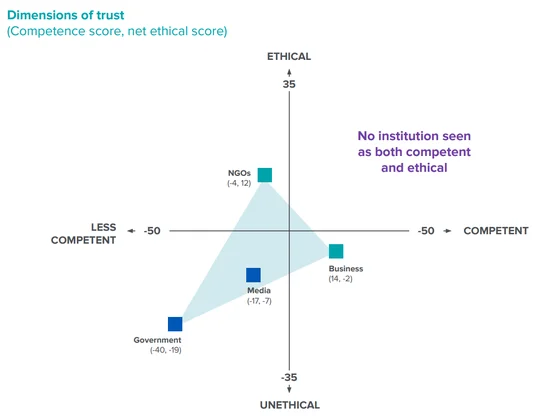
The drivers of our current moment are complex, plentiful, and vary by region or locale. Yet, all are unified by a common affliction: the decay and dysfunction of our economic system. It’s a system designed for a different era that’s proven incapable of adapting to the challenges of today. It’s a system reliant on growth-at-all costs, rampant consumption, and reckless debt. A system that enriches the few at the expense of the many. And a system that’s cracking under its own weight, dragging many of us down with it.
As the eternal political proverb reminds us: “it’s the economy, stupid!”
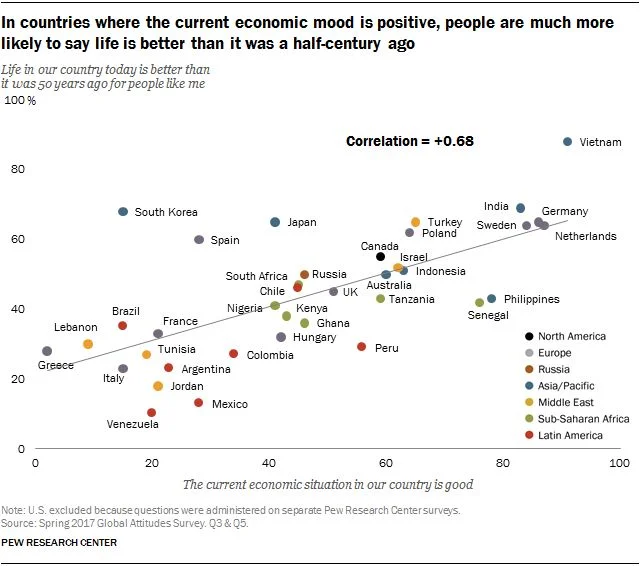
This report has three goals: (1) answer “how we got here” by examining the intricate relationship between money, the economy, and our failing institutions; (2) steelman the case for why we stand before a historic inflection point; and (3) tease a new economic system — to be presented in a subsequent report — that’s more empowering, dynamic, and born of the Internet age.
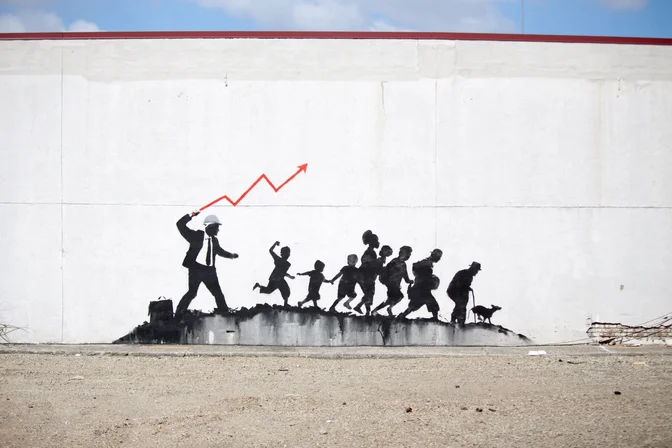
Banksy’s “Coney Island Adventure”
We Didn’t Start the Fire
To understand the economy, we must first understand that which flows through it: money. Over the long arc of history, monies have come and gone, often dying as Hemingway describes bankruptcy: “gradually, then suddenly.” From seashells to metal coins to gold bars to pieces of paper, “money” has been a moving target.
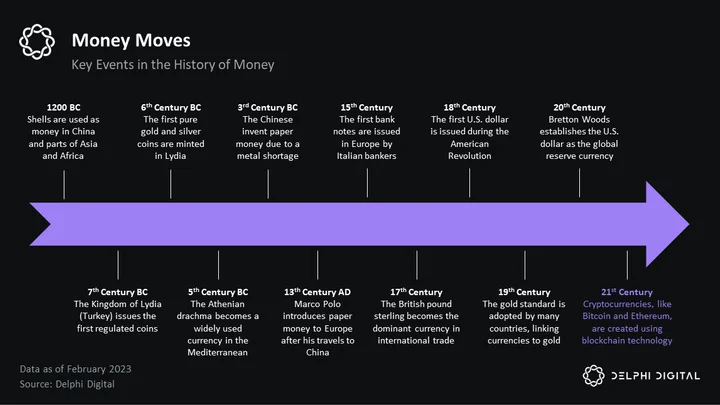
For a surprisingly long time, money was a physical thang. We’ll call this period the “commodity age,” a span of time where money meant something you could touch, like gold, silver, copper, and salt.
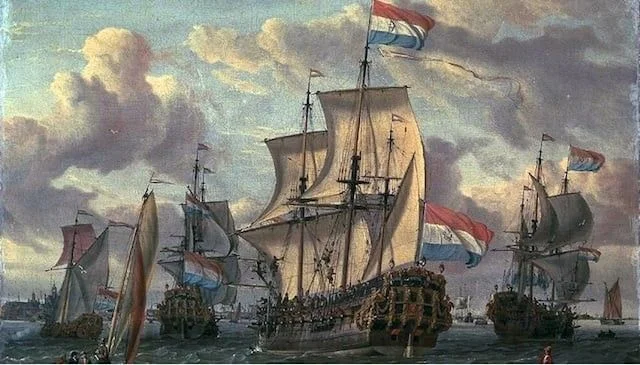
The Dutch East India Company – the most valuable company in history – mainly used Dutch guilders to settle trade, which were made of silver and bore the image of a lion
“Commodity money” was convenient back in these halcyon days. Commodities had intrinsic value and every economy consumed them, so naturally, they were widely accepted as a means of payment. They were also widely recognizable and durable, making them suitable for the often treacherous trading routes of the time.
As money, commodities had their benefits. Financially, they provided a check on money creation and debt issuance. The only way governments could print more moolah or issue more debt was through the arduous task of mining, an endeavor that required significant time and capital. The high input costs associated with pamping the Kool-Aid ensured no country could afford it and kept systemic leverage in check.
These constraints, while valuable in theory, carried significant downsides. Economies were tethered to volatile raw materials and fickle supply chains — leaving them vulnerable to supply shocks. These shocks often triggered bouts of severe inflation and deflation.
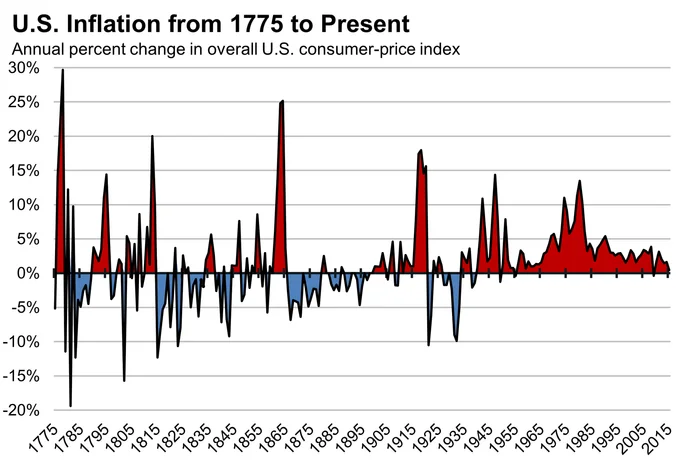
Think today’s inflation is bad? Just talk to your great-great-great-great grandmother!
Commodities also served as a limiting factor on economic growth. Money can be thought of as economic energy because, like energy, it flows through the economy, enabling transactions and economic activity to take place. Just as energy is required to power machines and move objects, money is required to facilitate the exchange of goods and services in the economy.
When there’s less money supply in the economy, it’s similar to a decrease in the available energy supply. Just as a decrease in energy supply would limit the ability to power machines and accomplish work, a decrease in money supply limits the ability to engage in economic transactions and generate economic growth.
Less money supply means that there is less money available to buy goods and services, pay for investments, and fund entrepreneurial ventures. This can lead to a decrease in consumer spending, business investment, and job creation. As a result, economic growth is likely to be limited.
As one might expect, frequent supply shocks and finite economic growth were rather, uhh, unpopular amongst the plebs. Any politician with the misfortune of being in office during an outbreak of commodity-induced turbulence was promptly asked to exit stage right. With time, politicians realized that to stay in power, they would need more flexibility and autonomy over monetary policy.
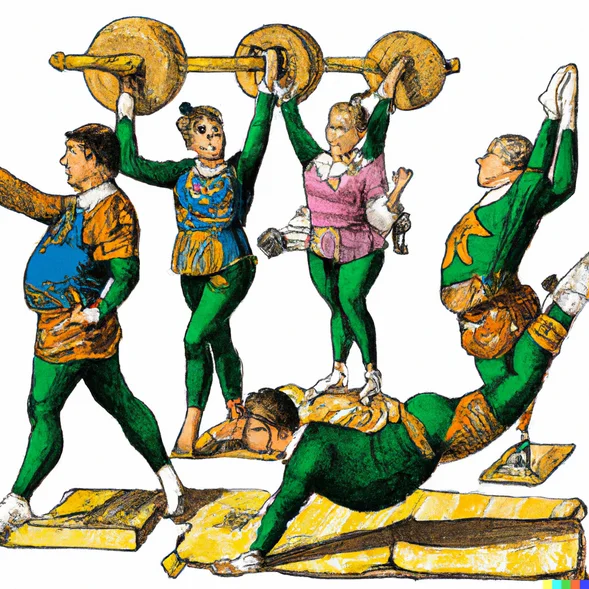
“Central bankers doing gymnastics” – DALL·E
In order to address these limitations, countries began issuing currencies backed by commodities. These currencies were, in effect, claims on the underlying commodities held by the state. The value of a given currency depended on the amount of a specific commodity that it could be traded for. For example, 100 Monopoly Bucks backed by 2 tons of silver had more value than 100 Shekels backed by only 1 ton of silver.
During the Tang Dynasty in the 7th century, the Chinese government became the first to issue paper money in the form of “jiaozi” (交子) or “exchange bills.” The paper guap was used to facilitate trade and commerce and was ba
Read the full report
This report is part of Delphi Pro.
- 800+ Pro reports across every major sector
- Talk directly with our analysts
- Private community of funds and builders
Already a Pro member? Log in



0 Comments