
Introduction
Since early 2021, crypto derivatives have taken off at a wild pace. But the success of DeFi derivatives’ has been restrained to a select few exchanges. Most derivatives traded in crypto today are tied to the price of a crypto asset. While there is obvious market-fit for these instruments, there’s an entire world of derivatives beyond single-asset instruments. An interesting type of derivative, ones centered around interest rates and yields, started to pop up in DeFi early last year. But their existence has gone broadly unnoticed by the market.
While extremely popular in TradFi, yield derivatives and fixed income products have struggled to attain usage. When looking at an aggregate of the DeFi derivatives market, we can see that yield derivatives – including fixed income – are largely overshadowed by asset perpetuals on protocols like dYdX.
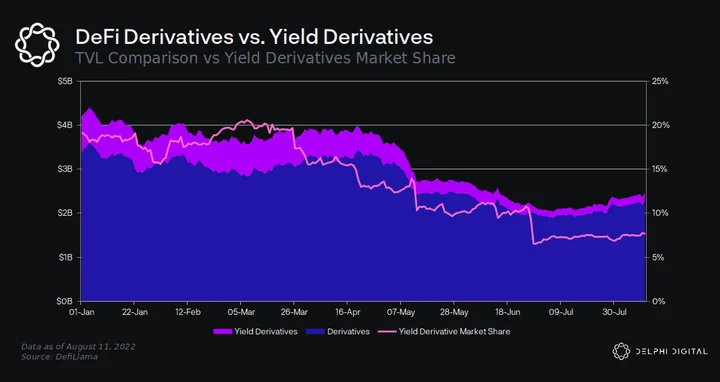
On the surface, this is surprising. At around $340T, interest rate derivatives (IRDs) are the largest market in TradFi. IRDs include instruments like interest rate swaps (IRS), forward rate swaps, and zero coupon bonds. Meanwhile, fixed income products, like T-bills and corporate bonds, are some of the most popular financial instruments, with a cumulative size of roughly $120T. In fact, these markets are so large that there is even debate on how to measure them.
DeFi fixed income and yield derivatives seemed like a sure bet to those who believed DeFi trends would converge with TradFi soon. But their total TVL is less than $200M cumulatively despite being live for more than 18 months.
This report will briefly survey a select group of yield derivative and fixed income protocols, explain their mechanics, and analyze their recent performance. We will hypothesize as to why these protocols have struggled with adoption, which will allow us to understand what existing or new protocols need to do in order to grow this market.
TradFi IRS and Fixed Income Refresher
Before we get into the nitty gritty of DeFi interest rate derivatives, let’s briefly gloss over how interest rate derivatives work.
The most common variation of rate derivatives in DeFi is the interest rate swap (IRS). APWine, Pendle, and Element are all variations of an IRS. However, IRS in DeFi and IRS in TradFi work very differently.
In TradFi, Traders don’t trade IRS like perpetual contracts or options. People aren’t “degen trading” these instruments – for the most part. IRS are almost always traded OTC with custom terms. Additionally, these specialized derivatives are most often used by commercial banks, corporations, or other large institutions to hedge interest rate volatility or speculate on where rates will go.
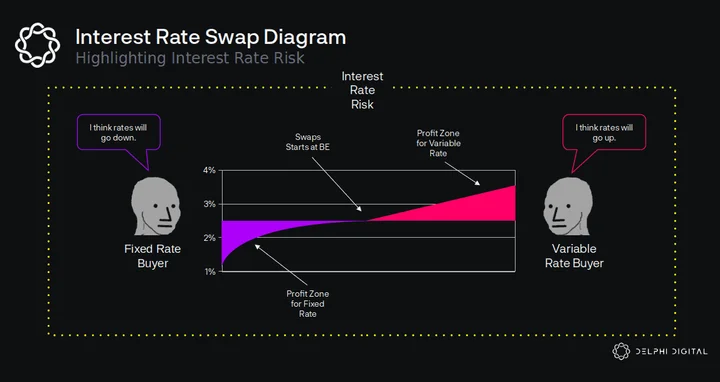
At a high-level, IRS swaps occur when one entity wants to lock in fixed retur
Read the full report
This report is part of Delphi Pro.
- 800+ Pro reports across every major sector
- Talk directly with our analysts
- Private community of funds and builders
Already a Pro member? Log in
0 Comments