The Path to DeFi's ETF Moment: The Rise of Morpho, Curators, and Mullets
APR 21, 2025 • 26 Min Read
The Path to DeFi’s ETF Moment: The Rise of Morpho, Curators, and Mullets
The state of DeFi today suggests crypto has largely exhausted its early addressable market, serving the segment of users willing to interact with protocols directly through self-custodial wallets.
Today, total value locked in DeFi sits at about $90B, down from over $180B in 2022, even with the circulating supply/market cap of stablecoins growing significantly.
DeFi’s inability to expand the pie and grow TVL can be attributed to three critical failures:
- ETH significantly underperforming as an asset (comprising a large portion of DeFi TVL), yet we can’t expect the industry’s expansion to merely be driven by higher prices. There has to be more value to offer to a wider range of users.
- Protocols naively expect mercenary onchain capital to mature into “loyal users” who will suddenly overlook better yield opportunities across the ecosystem.
- Despite offering compelling alternatives to traditional finance products, DeFi suffers from a devastating distribution and UX problem (likely a cause-effect relationship: UX sucks, which makes distribution an uphill battle).
For DeFi to grow beyond previous highs and achieve mainstream adoption, DeFi and CeFi must converge and embrace one another. This fusion would create undeniably better alternatives to TradFi products with more compelling yields and crypto flexibility, while being seamlessly integrated into apps real people use daily.
In this report, I’ll outline why vaults, curators, and “DeFi mullets” may help DeFi cross the chasm, effectively ushering in what will later be seen as DeFi’s “ETF moment.”
Blackrock, Vanguard & State Street: The Original Curators
In the early ’90s, asset management was expensive, exclusive, and slow. Active mutual funds dominated the landscape despite charging high fees, being narrowly distributed through broker networks, and relying on brand rather than performance. While passive investing existed in the form of index mutual funds and institutional mandates, it was niche, clunky, and hard to access: requiring large minimums, no intraday trading, and limited distribution.
However, that all changed in 1993 when State Street launched SPY, the first U.S. ETF. For the first time, investors could buy the entire S&P 500 in a single, low-cost, liquid trade. Retail loved the access. Institutions loved the structure. Capital flooded in.
Since SPY’s launch, ETFs have gone from effectively zero to over $14T in AUM globally, including $10T in the U.S. alone, in just over 30 years. But the impact wasn’t just better packaging, ETFs fundamentally changed the economics of investing. They made market access cheaper, more efficient, and less reliant on intermediaries. Beta became commoditized, fees fell across the board, and distribution shifted from sales networks to self-directed platforms.
The firms that leaned in early, BlackRock, Vanguard, and State Street, now dominate, managing ~74% of all U.S. ETF assets.
More recently, we in crypto have felt the ETF effect too.
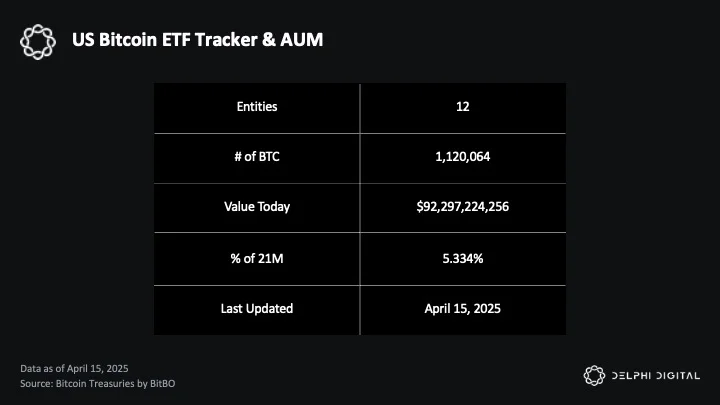
Since launching in January 2024, U.S. spot Bitcoin ETFs have attracted over $92B in AUM, now holding 5.3% of total BTC supply across 12 products. The largest, BlackRock’s iShares Bitcoin Trust (IBIT), alone holds 572K BTC, more than 2.7% of supply, with nearly $47B in assets.
These ETFs didn’t generate new demand, they unlocked it, giving institutions a compliant, familiar wrapper to access BTC without touching native infrastructure.
DeFi’s ETF Moment
If ETFs were the infrastructure breakthrough that allowed traditional asset managers to scale passive investing and attract trillions in capital, then vaults and curators are playing that same role in DeFi today, albeit at a much smaller scale. It’s still early.
Curators function like decentralized asset managers, but with some critical advantages: they’re non-custodial, liquid, and permissionless. Depositors don’t need to “hand over” their capital, they can enter or exit at will. And curator incentives scale directly with TVL.
In many ways, this is asset management reimagined for the internet of value:
- Seamless UI abstractions like vaults are to DeFi protocols what ETFs were to mutual funds
- Curators are to DeFi what BlackRock and Vanguard were to TradFi
- DeFi is the infrastructure making it all possible
Top curators like Steakhouse and Gauntlet, for example, are already managing over $1B in TVL between them, each with their own strategies and product lines, from institutional-grade vaults to more degen (riskier collateral) offerings.
But vaults and capital curation aren’t new to crypto. We’ve been here before, just with worse tooling, rigid design, and misaligned incentives.
Curation 1.0: Aave and the Legacy of Pooled Capital
To understand today’s emerging curator economy, we first have to examine its foundations. Large-scale onchain lending was pioneered, and for years dominated, by protocols like Aave.
Aave’s approach to capital allocation is what you might call Curation 1.0: capital efficient on the surface, but limited in flexibility, risk pricing, and adaptabilit
Read the full report
This report is part of Delphi Pro.
- 800+ Pro reports across every major sector
- Talk directly with our analysts
- Private community of funds and builders
Already a Pro member? Log in
0 Comments