From Capital Markets to Crypto Treasuries: A New Corporate Blueprint
The Rise of Public Crypto Accumulators
Crypto is no longer just a speculative asset class or ETF product. It is becoming a programmable treasury layer; a capital strategy for public companies. A new class of firms is emerging that design their capital structure not to build crypto products, but to systematically acquire crypto assets. These are public crypto accumulators: companies that use equity, debt, and reflexive investor demand to build long-term positions in digital assets.

This model first gained attention in 2020 when MicroStrategy adopted a Bitcoin standard, using convertible bonds and at-the-market equity programs to accumulate billions of dollars in BTC. But this is no longer a Bitcoin-only play. Ethereum (ETH), Solana (SOL), and Ripple (XRP) are now the most actively accumulated altcoins by public firms, each representing a different blueprint for how crypto can be used on the balance sheet.
These companies are not miners, exchanges, or token issuers. Some are legacy firms pivoting into digital assets, others are new entrants using public markets to gain long-term token exposure. Regardless of their origin, they now operate as financial engines designed to convert capital market access into crypto accumulation.
This is Part 1 of a two-part series, focusing on this growing trend. We dive into the structural enablers behind the trend, the companies pioneering it, and how ETH, SOL, and XRP are being used strategically within public capital structures. Part 2 will examine the systemic consequences: how public accumulation is transforming token liquidity, reshaping price reflexivity (both to the upside & downside), and creating new incentive structures that may alter how crypto assets are designed and governed.
This report is structured around three guiding questions:
- What new conditions are enabling public companies to accumulate crypto through capital markets?
- What makes an altcoin viable for public treasury adoption and how do ETH, SOL, and XRP fit that profile?
- What corporate strategies and archetypes are emerging from public crypto accumulation?
The First Public Crypto Accumulator
Public crypto accumulation did not begin as a widespread strategy. It started as an edge case with one company experimenting with a bold treasury pivot. But what began as a macro hedge against fiat debasement has since evolved into a repeatable capital structure for long-term crypto accumulation. Increasingly, companies are exploring how to systematically acquire crypto not through mining or crypto-native operations, but through the tools of public capital markets.
What Is a Public Crypto Accumulator?
A public crypto accumulator is a company that does not operate a crypto business, but actively acquires crypto through financial engineering. These firms are capital structure optimizers: using equity issuance, debt instruments, and reflexive investor demand to build long-term crypto exposure on the balance sheet.

This model operates through a compounding flywheel, typically unfolding in five steps:
- Funding: The company raises capital through equity or debt (often convertible) issuance.
- Acquisition: The raised funds are used to purchase crypto assets, which expand net asset value (NAV) per share.
- Narrative Momentum: As crypto holdings grow, the stock begins trading more like a crypto proxy, attracting investor flows and thematic attention.
- Premium Emergence: Market enthusiasm can drive the share price above NAV, enabling the company to raise additional capital at a premium to book value.
- Recursive Growth: That new capital is used to buy more crypto, further increasing NAV and restarting the cycle.
The result is a reflexive system. As crypto holdings rise, equity/debt demand grows, which enables further accumulation. This is not passive exposure but an active, compounding mechanism for acquiring crypto using the public capital markets as fuel.
Why Now? The Structural Breakpoint
The emergence of the accumulator model is not happening in a vacuum. Several key structural shifts across accounting, macroeconomics, investor demand, and regulation have made it viable for public companies to systematically accumulate crypto assets on their balance sheets.
Macro Tailwinds and Monetary Instability
The case for public crypto accumulation is being shaped by a series of structural macroeconomic shifts that have unfolded since 2020. Persistent inflation, expanding sovereign debt burdens, and the erosion of real yields have made investors begin searching for more attractive assets held as long-term reserves.
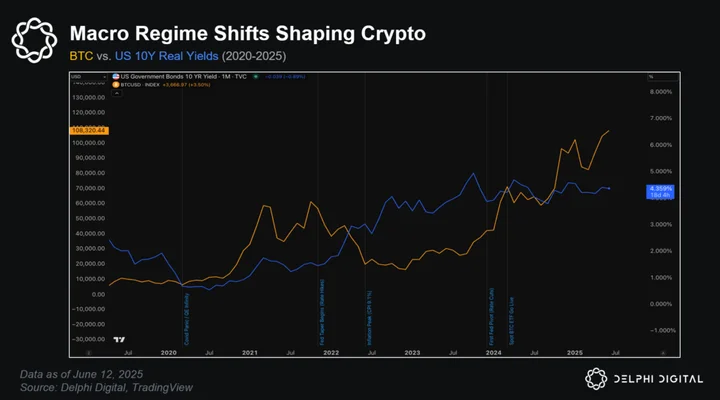
From the onset of COVID-era quantitative easing in March 2020, to the start of the Fed’s aggressive rate hikes in late 2021, to the peak in inflation in mid-2022, and the first signals of rate stabilization in late 2023, Bitcoin has consistently responded to turning points in the global liquidity cycle. The launch of spot ETFs in early 2024 added another structural catalyst, solidifying Bitcoin’s position within traditional portfolios.
For public companies, these events reinforced a key strategic logic. Crypto, particularly Bitcoin, behaves not only as a long-duration asset but as a directional macro instrument. It reacts to shifts in real yields, central bank positioning, and broader liquidity conditions. As a result, its accumulation is no longer a speculative bet. It is increasingly viewed as a treasury strategy shaped by structural macro alignment.
Institutional Normalization via ETFs
The arrival of spot Bitcoin ETFs marked a turning point in how crypto is accessed through public markets. For the first time, large asset managers could allocate to Bitcoin through regulated, familiar investment vehicles.

The response was immediate. In the weeks following their launch in January 2024, ETFs like BlackRock’s IBIT and Fidelity’s FBTC attracted billions in inflows, signaling strong institutional demand and validating Bitcoin’s role in traditional portfolios.

Sustained inflows into spot ETFs have provided a persistent source of bid pressure, even amid broader macro and crypto-specific volatility. It has become increasingly apparent that institutional capital is
Read the full report
This report is part of Delphi Pro.
- 800+ Pro reports across every major sector
- Talk directly with our analysts
- Private community of funds and builders
Already a Pro member? Log in
0 Comments