The Rise of Ethena: Unpacking The Emerging Synthetic Dollar
APR 18, 2024 • 40 Min Read

Report Summary
This report discusses the disruptive potential of the Ethena protocol in the stablecoin market, particularly through its novel synthetic dollar, USDe. It explores how Ethena is challenging the existing stablecoin duopoly by leveraging synthetic assets to provide a high-yielding, delta-neutral product that integrates seamlessly with the decentralized finance (DeFi) ecosystem.
Key points from the report include:
1. Market Context and Ethena’s Strategy: Ethena aims to disrupt the stablecoin market dominated by Tether and Circle by introducing a synthetic dollar that offers higher capital efficiency and attractive yields derived from crypto-native sources like staked Ethereum (ETH) and perpetual futures funding rates.
2. Technical Architecture: USDe is backed by a delta-neutral position, combining staked ETH with a corresponding short position in ETH perpetual futures, which helps maintain its stability irrespective of ETH price fluctuations.
3. Market Response and Risks: Despite its innovative approach, USDe carries risks such as counterparty, negative funding, redemption and liquidity, and auto-deleveraging risks, which the Ethena team addresses through various risk management strategies.
4. Scalability and Future Prospects: The report analyzes Ethena’s scalability, influenced by the size of the perpetual futures market and the collateral used. It also discusses Ethena’s impact on the broader DeFi landscape, including its potential to recalibrate interest rates across traditional finance (TradFi), centralized finance (CeFi), and DeFi.
5. Collaborations and Integrations: Ethena’s integration with other DeFi protocols like MakerDAO and Pendle enhances its utility and could lead to broader institutional adoption.
Overall, the report paints a detailed picture of Ethena’s ambition to reshape the stablecoin market and its implications for the future of digital finance.
Intro
The stablecoin duopoly is being challenged. After rapidly scaling supply from zero to over $2.2B in less than a month, USDe is now the fastest growing “stablecoin” of all time. At the root of this early success lies Ethena’s fundamentally different approach behind what the market has conceptualized as a “synthetic dollar”.
Moreover, by democratizing access to the delta-neutral basis trade and allowing it to seamlessly compose with the rest of DeFi, Ethena has been able to find early product-market-fit addressing the market’s insatiable appetite for yield. Simultaneously, structuring USDe as a “synthetic dollar” has allowed Ethena to take full advantage of the inherent network effects that come with being a monetary asset.
In this report we will explore the opportunity for Ethena and dissect how USDe/sUSDe work under the hood. We will also highlight why what Bloomberg called, “the closest thing to a risk-free bet”, is not entirely risk-free. Lastly, we will entertain the second order implications that Ethena carries for the rest of DeFi.
The Opportunity For Stablecoins
Stablecoins are among the few crypto use cases that have found meaningful product-market fit to date. Not only have they proven themselves as an effective monetary safe haven, but stablecoins continue to play an important role oiling the cogs of both DeFi and CeFi.
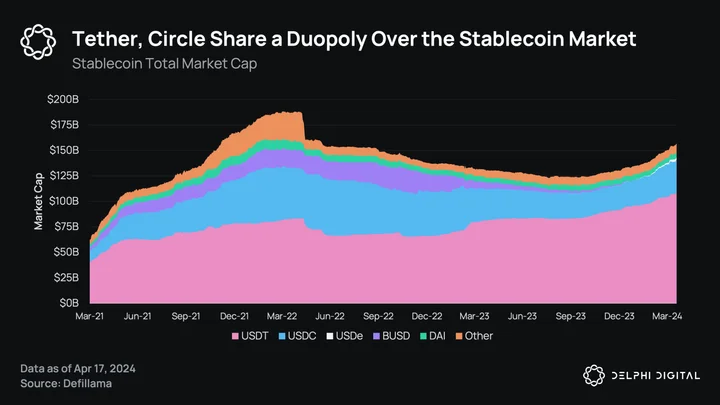
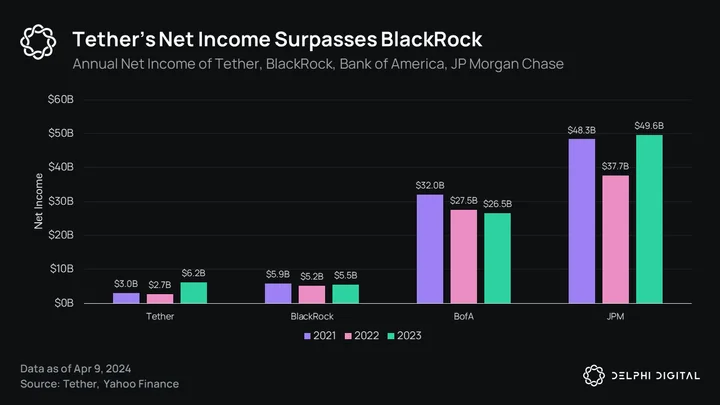
Presently, Tether and Circle maintain a stranglehold over the stablecoin market with a combined 90% market share. Tether alone booked $6.2 billion in net income last year which is more than Blackrock, the world’s largest asset issuer. Importantly, none of this value was distributed back to stablecoin holders.
While in a more dynamic market structure new entrants would erode Tether’s margins by reallocating these profits in the form of native yield, the stablecoin market is far from perfectly competitive. Inherent liquidity network effects and tendency for stablecoin standards to get deeply embedded in the fabric of both DeFi and CeFi have resulted in high barriers to entry for emerging alternatives.
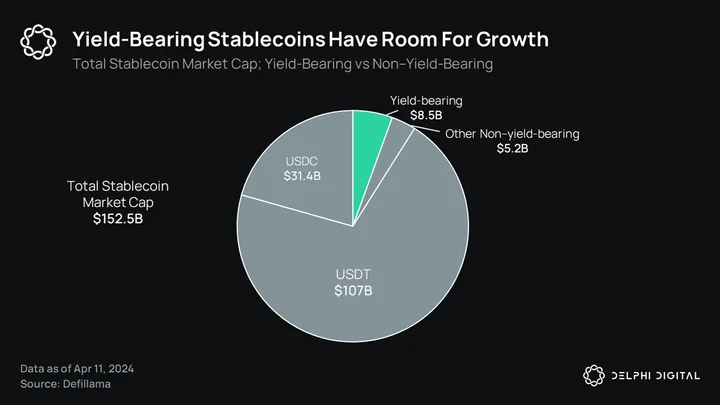
Consequently, the market’s demand for a sufficiently liquid yield-bearing stablecoin remains unmet. With yield-bearing stablecoins representing just 5.6% of the total stablecoin market cap today, it is evident that the existing models are not sufficient.
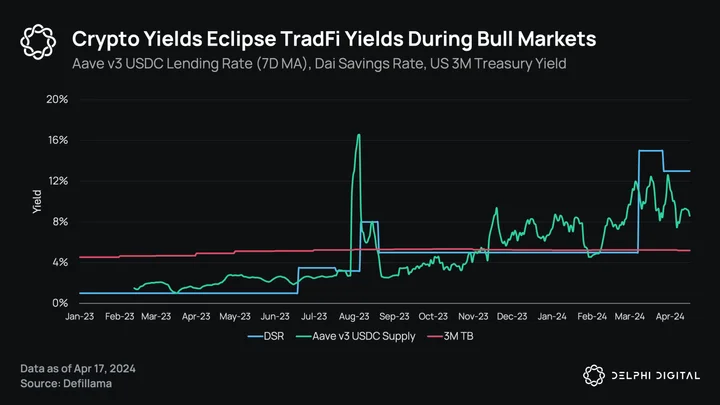
On the one hand, RWA-backed stablecoins seem to be playing the wrong game. While bringing TradFi interest rates to crypto may be an attractive value prop during bear markets, these products become increasingly less attractive as soon as crypto-native yields eclipse treasury yields.
Conversely, Collateralized-Debt-Position (CDP) stablecoins have the opposite problem. While this model taps into “crypto-native” interest rates to some extent, capital efficiency quickly becomes their limiting factor. Said differently, the scalability of CDPs such as DAI is undermined by the need to collateralize 1 DAI with significantly more than $1 worth of debt.
Given the aforementioned, it seems pertinent timing to explore how Ethena is taking a fundamentally different approach to breaking the back of the Tether/Circle duopoly.
The Ethena Approach
Unlike existing stablecoin models that use RWAs or CDPs as collateral, Ethena’s USDe is backed by a “delta-neutral” ETH position. In other words, each USDe is collateralized by a long staked ETH (stETH) position which is simultaneously offset by an equivalent ETH perpetual futures contract (ETH-PERP) short position.
Positive Delta (stETH) + Negative Delta (Short ETH-PERP) = Delta-Neutral (USDe)
Consequently, if the price of ETH moves from $3000 to $2500, the short ETH-PERP position will subsequently offset the $500 price swing. Similarly, if the price of ETH increases to $3500, the short ETH-PERP position will subsequently decrease $500.
Recently, Ethena also onboarded BTC as additional collateral. Similarly, BTC will be paired with an equivalent short BTC-PERP position to engineer the same delta-neutral backing. The only difference is that ETH collateral can be staked to earn additional yield while BTC cannot. Therefore, irrespective of illiquidity constraints, Ethena will likely over-index on their stETH allocation.
Given that the Ethena model comes with fundamentally different risks relative to CDPs and RWA-backed stablecoins (as we will discuss later), the market has been quick to label USDe as a “synthetic dollar” and not a true stablecoin. While this categorization seems fair, it is worth noting two structural advantages that the USDe model has over existing yield-bearing stablecoin designs.
First, Ethena is more capital efficient than CDPs. USDe’s delta-neutrality means that only $1 of collateral is needed to mint 1 USDe. Consequently, Ethena is able to scale more effectively than CDP stablecoins such as DAI.
Secondly, USDe is able to harness the two highest yielding sources of crypto-native yield:
- Staked ETH yield
- Perpetual Futures Funding Rates
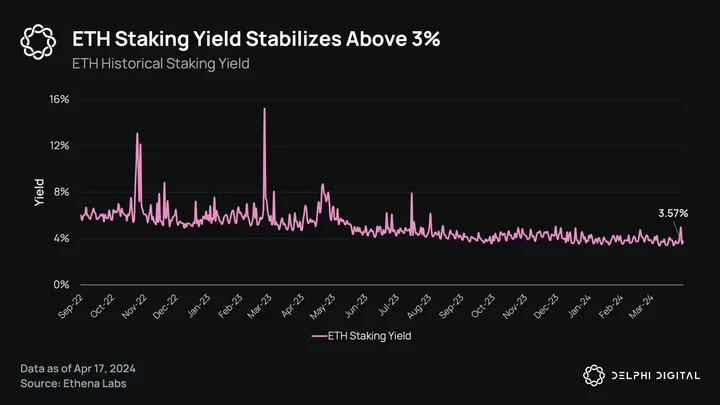
Contextually, staked ETH yields have historically averaged around 4-5% annually with more recent figures sitting at around 3.4%. Ultimately, this yield is a function of three things: (1) consensus layer inflationary rewards (2) execution layer fees paid to Ethereum stakers and (3) Miner Extractable Value (MEV) paid to Ethereum stakers.
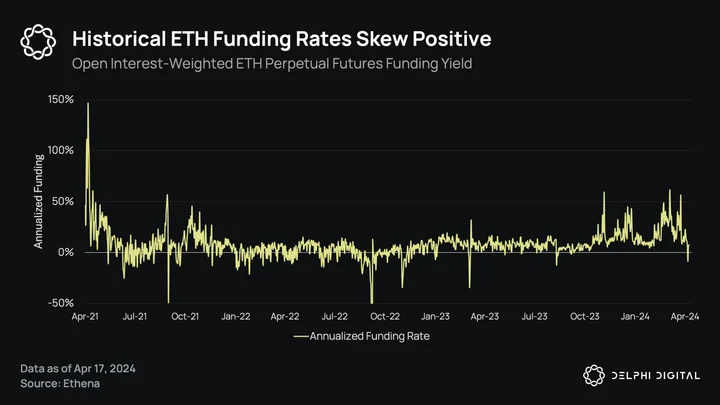
While staked ETH yields alone have historically been higher than treasury yields on average, the majority of USDe’s yield comes from the second leg of the delta-neutral trade. Given that the natural resting state of ETH and BTC perps funding rates on has been long-biased, market participants who are short this delta exposure have historically enjoyed lucrative funding rates.
Ethena ultimately takes both of the aforementioned sources of yield and packages them into a unified fungible token. Backtesting this strategy shows that USDe would have generated some handsome yields.
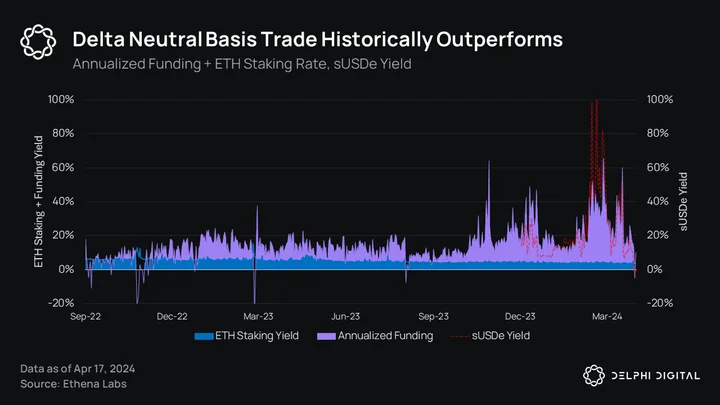
It is also worth noting that that BTC funding rates have almost directly mirrored ETH funding rates. Therefore, although yields generated by the BTC collateral may only tap into the short leg of the trade, this is where the majority of the yield comes from. Consequently, BTC yields will be competitive with ETH, especially when funding rates are elevated.
How Ethena Differs
So while the existing models have attempted to dethrone the Tether/Circle duopoly by either bringing TradFi rates on-chain or harnessing DeFi rates through the less capital inefficient CDP model, Ethena is taking a fundamentally different approach.
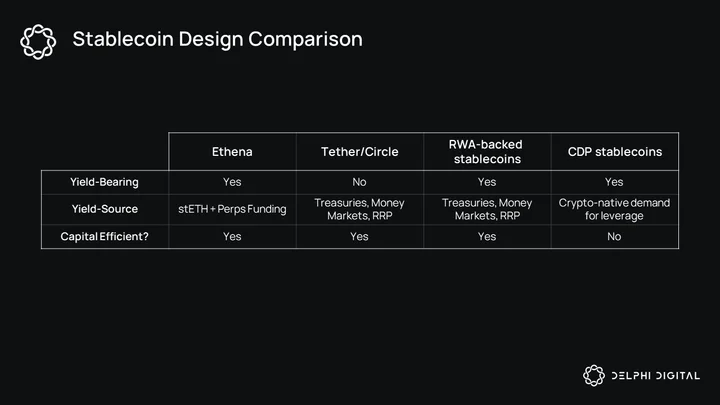
At its core, Ethena is very simply arbitraging the structurally high funding rates unique to perpetual futures markets through a fungible product that is able to compose with the rest of DeFi. Structuring this product as a synthetic dollar therefore seems to be more of a strategic byproduct to harness the inherent network effects that come with being a “stablecoin”.
While in theory, the adoption of USDe should cause funding rates to ultimately converge to simply reflect the risk-free rate plus a risk premium, as we will discuss, this is the goal. A future where this happens implicitly assumes Ethena is able to achieve massive scale.
Ethena’s Architecture
Now that we have a high level understanding of Ethena’s design, let’s explore how USDe and sUSDe function on a more granular level. Architecturally, Ethena can be best understood through three core mechanisms: (1) minting (2) redeeming and (3) staking USDe.
Ultimately, end-users do not handle minting and redemption. Instead, they will either interface directly with liquidity pools or indirectly via Ethena’s front end which then routes this flow through said liquidity pools.
Subsequently, each swap creates an arbitrage opportunity for whitelisted authorized participants (APs) to rebalance these liquidity pools. Importantly, only APs are able to mint and redeem USDe and therefore capture these brief dislocations.
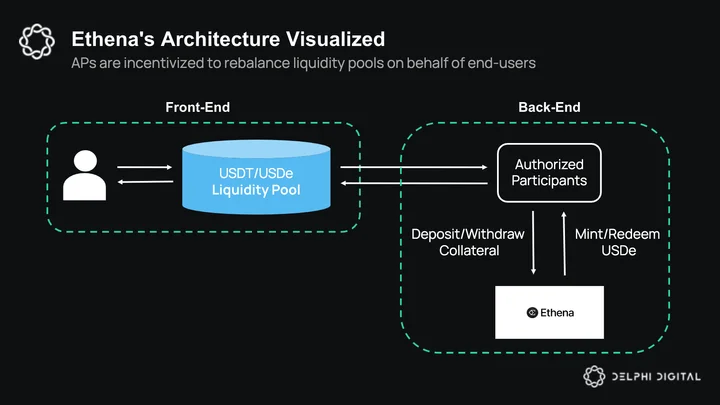
For example, if someone came in and swapped 1000 USDT for 1000 USDe on a Curve pool, this would subsequently cause USDT to trade at a marginal discount relative to USDe. APs are then incentivized to mint USDe to purchase the discounted USDT and thus rebalance the pool. In the process 1000 fresh USDe is created.
On the back-end, USDe is minted when APs deposit accepted collateral such as ETH, LSTs, BTC and other stablecoins into Ethena. The protocol then routes this collateral through an internal swap function that purchases staked ETH or BTC and pairs it with an offsetting 1x short perpetuals position on a centralized exchange. Importantly, while the derivatives position exists on the exchange, collateral assets are custodied off-exchange to dampen counterparty risk (more on this is the “Risks” section).
Conversely, in a scenario where USDT is trading at a marginal premium to USDe, APs could exploit this market dislocation by buying the discounted USDe and redeeming it for $1 worth of collateral. On the back-end, the AP would receive the stETH from Ethena who would then unwind the equivalent short position.
The net effect of this dynamic is that liquidity pools should maintain an efficient 1:1 stable swap ratio while the complexity of minting and redeeming USDe is simultaneously abstracted away from the end user.
Lastly, in order to receive the yield generated by the underlying collateral, users are required to stake their USDe for sUSDe through the Ethena front-end. Unlike other staked token models such stETH, sUSDe is not a “rebasing” but rather a “reward-bearing” token. This means that instead of being paid yield in new tokens, the price of sUSDe increases over time to reflect value accrual within the staking smart contract. sUSDe is also subject to a 7 day unlocking period (more on this in the “Risks” section).
Learning From Past Failures
It is worth noting that while the “delta-neutral” model has been tried before, Ethena seems to be learning from the mistakes of past failures.
Although directionally correct, projects such as UXD and Lemma’s USDL ultimately failed to find meaningful product-market fit for three main reasons:
- Limiting to perp DEXs for scaling – In the pursuit of “decentralization”, these projects seemed to have missed the bigger picture that CEX liquidity is necessary to scale.
- DEXs are subject to security risk – The Mango attack in October 2022 that caused UXD to de-peg showed that while DEXs may be “decentralized”, they still come with inherent risk.
- Increased negative funding risks – UXD and Lemma did not harness native yield from the long leg of their delta-neutral position. In the absence of this additional buffer, these projects were more exposed to the risk of prolonged negative funding rates.
Ethena ultimately circumvents the aforementioned pitfalls by (1) utilizing CEX perps liquidity (2) aligning the incentives of CEXs as both shareholders and stakeholders in the Ethena ecosystem and (3) harnessing stETH as an additional source of yield to offset negative funding periods.
Although this model is certainly an improvement from previous designs, it still comes with inherent risks. While there have been numerous uniformed takes such as conflating USDe and Terra, the Ethena team has done a good job highlighting USDe’s risks, including those that could have been easily obfuscated.
The following section is dedicated to exploring these risks, their relative likelihood, as well as some of the risk management strategies that the Ethena team has put in place.
Ethena’s Risks
There are four primary risks underpinning Ethena: (1) Counterparty risk (2) Negative funding risk (3) Redemption and liquidity risk and (4) Auto-deleveraging (ADL) risk.
Counterparty Risk
Ethena’s architecture relies on two primary counterparties to function: (1) Centralized Exchanges (CEXs) and (2) Off-exchange settlement providers (OES providers).
CEXs ultimately handle the trading of Ethena’s perps positions while OES providers handle the custody and settlement of Ethena’s collateral. Although the incentives of both counter-parities are well-aligned with that of Ethena, there are still inherent risks that come with relying on external entities. To dampen these risks, Ethena has integrated a handful of risk management solutions:
- Diversified exchange risk – Ethena is integrating with numerous CEXs including Binance, Bybit, Bitget, Deribit, and OKX. Consequently, in the event that the functionality of one exchange is undermined, Ethena’s risk is diversified. Importantly, these exchanges also have both a tangible and intangible vested interest in the success of Ethena.
- Off-exchange settlement – Ethena retains full control and ownership of collateral assets via off-exchange custody and settlement. Consequently, if any of the aforementioned exchanges were to experience some idiosyncratic event, Ethena would retain full control over the collateral assets and could subsequently redeploy on another exchange.
- Additional custody measures at OES level – Ethena currently uses Copper, Ceffu and Cobo for off-exchange custody and settlement. It is worth noting that, under Cooper’s legal structure, users’ funds are a part of a bankruptcy-remote trust. This means that in the event of Copper’s failure, users’ funds are not a part of the Copper estate.
- Frequent PnL settlement – To further mitigate CEX counterparty risk, Ethena has the ability to settle its PnL between 8 to 24 hour cycles depending on the custodian. Consequently, Ethena is only exposed to the maximum losses that could occur within this window.
- Solvency verification – Ethena enables users to verify the existence of both protocol collateral as well as Ethena’s derivatives positions. Currently, this is done through direct read access to the custodial wallet APIs, exchange sub-account APIs and on-chain wallets. This week Ethena also released third party attestations of the collateral by custodians which will be done on a monthly basis going forward. Ethena is also onboarding addtional external providers who ultimately attest to the accuracy of the collateral and hedges.
The net effect of the aforementioned measures is that Ethena’s exposure to counterparty risk is meaningfully limited.
It is also worth noting that counterparty risk is not unique to Ethena. Moreover, whether you are holding USDT, USDC, or USDe, you are implicitly trusting some counterparty; it is simply a question of who the counterparty is and the degree to which they should be trusted.
If you hold USDT or USDC, you are implicitly trusting Tether and Circle and the banks custodying their assets. While historically this was seen as a “safe bet”, Circle’s exposure to Silicon Valley Bank (SVB) in March of last year underscored these inherent risks.
Additionally, Ethena seems to circumvent some of the censorship risks that come with a heavy reliance on the existing banking system. Moreover, with no nexus to US customers, custodians or CEX venues within the US, Ethena seems to have some regulatory insulation.
And although CEXs are by no means immune to regulatory risk, there seems to at least be less of an incentive from the United State’s financial-regulatory-complex to censor Ethena given that it does not inherently undermine our fractional reserve banking system like Tether and Circle do. Arthur Hayes highlighted these structural incentives in his “Dust on Crust Part Deux” thought piece.
Also, while DAI and other CDP stablecoin may not come with explicit counterparty risks in the traditional sense, you are still accepting meaningful trust assumptions as the end user. Moreover, by holding DAI, you are implicitly trusting both the integrity of the code as well as the collective ability for the DAO to effectively govern the protocol.
Moreover, as CDPs continue to size up their RWA and USDC/USDT holdings, you are concurrently making the same aforementioned trust assumptions as FIAT-backed stablcoins. DAI’s RWA’s are also managed by off-chain entities, some of which reside in the US, which therefore poses meaningful trust assumptions not dissimilar to any centralized issuer.
To be clear, this is not to deflect Ethena’s counterparty risks. While Ethena has put some clever precautionary measures in place, USDe is still subject to meaningful counterparty risk. That said, so are all stablecoins. It becomes more of a question of what you receive in return for holding that stablecoin and taking said risks. And in the case of USDT and USDC, this is nothing more than better liquidity.
Therefore, though a “risk-adjusted return” lens, given Ethena’s yields, USDe may be a more attractive alternative for some.
Negative Funding Risk
One of the more pertinent questions circulating CT is what happens when funding rates flip negative?
As alluded to earlier, the natural resting state of perps funding has historically been long biased. Therefore, rates were negative just 20% of days over the last 3 years. When accounting for the additional buffer that stETH yields provide, this number is closer to 11%.
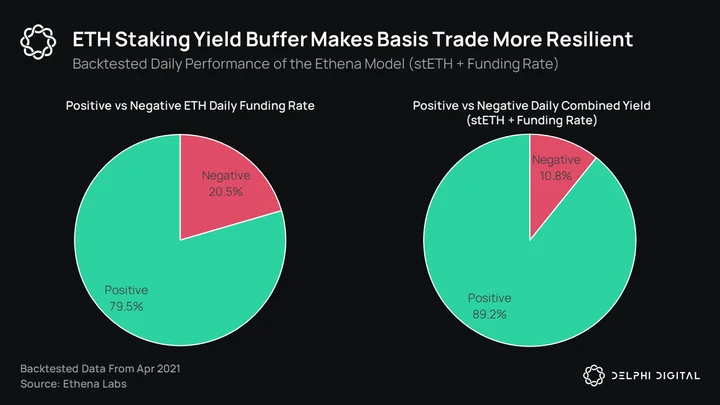
In the event that yields do in fact flip negative, an reserve fund ultimately serves as a buffer to ensure that USDe is able to maintain its 1:1 peg. Moreover, both Ethena and Chaos Labs have done extensive research into calculating the optimal size for this reserve fund.
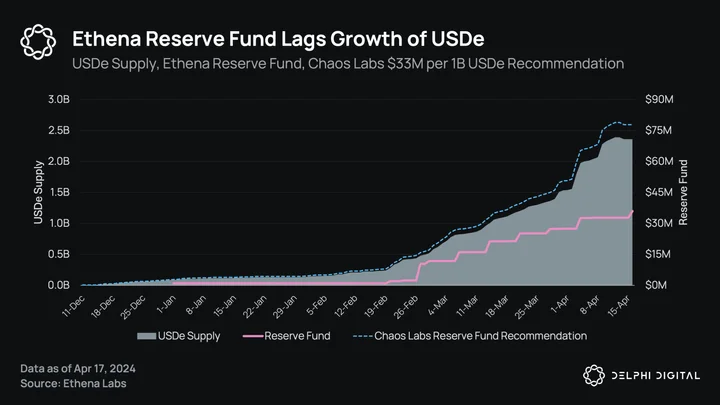
Ethena’s research found that $20m per $1bn of USDe would survive almost all bearish forecasts while Chaos Labs recommended a fund size of closer to $33m per $1bn USDe.
Presently, the reserve fund is valued at just over $32M relative to USDe’s supply of $2.3B. While this is meaningfully less than what Chaos Labs recommends, Ethena is currently allocating 80% of revenues to the reserve fund. Ethena added $5m to the reserve fund last week alone. At this rate, Ethena should reach Chaos’ target fund size within 9 weeks.
While the Ethena team has certainly proceeded with caution around funding risks, one of the more valid criticisms of the aforementioned analysis is that the historical data does not reflect the material impact that Ethena will have on funding rates going forward. Consequently, rates may actually flip negative and remain negative for longer periods than the team anticipates. Thus, a larger reserve fund could be necessary.
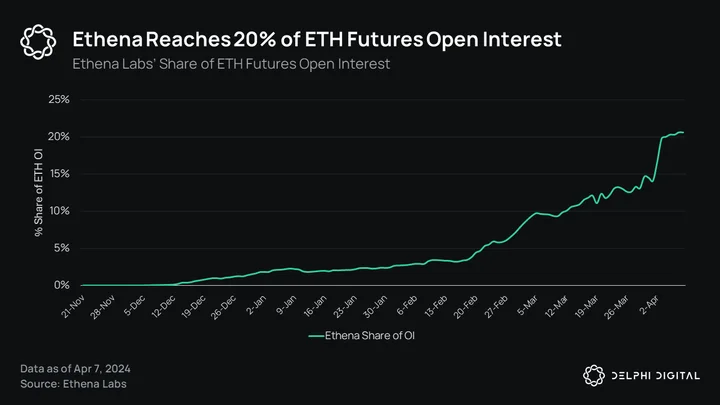
Intuitively, this makes sense. Funding rates are ultimately a function of supply and demand. Ethena inherently introduces more supply into the market, which, without enough counterparties to suck up each dollar of new supply, should push funding rates lower. Ethena already constitutes over 20% of ETH-PERP open interest (OI).
It is also worth noting that Crypto is unique in that a large share of trading volume today actually comes from retail. Importantly, there is inherently more demand from retail to long rather than short crypto assets which could therefore be propping up funding rates to some degree. In other words, there may be a “degen premium” baked into the structurally higher funding rates on CEXs.
As the introduction of an ETH ETF increases TradFi’s participation, we could see an erosion of this “degen premium” as more sophisticated market actors dilute the existing share of “long-biased” retail traders. We likely see more institutions putting on the delta-neutral trade themselves to arbitrage the same market dislocation that Ethena has identified. This would cause funding rates and thus Ethena to become increasing less attractive from a risk-adjusted standpoint.
That said, It is worth briefly mentioning one counteracting force that could keep funding rates slightly elevated. Some CEXs such as Binance and Bybit have positive baseline funding rates. This effectively means that funding rates automatically snap back positive by default. Given that these exchanges collectively constitute 50% of CEX open interest, this could keep rates marginally higher.
While this certainly helps Ethena to some degree, the net effect of the aforementioned headwinds is still going to be an inherently lower natural resting state for sUSDe yields going forward. Consequently, maintaining a 1:1 USDe peg over the long-run may necessitate a larger reserve fund than Ethena currently anticipates based on historical data.
However, it is worth noting that Ethena does have a multi-billion dollar treasury which could be used to sell ENA tokens for to build up an additional stablecoin war-chest. While this would more of a last resort, the treasury could serve as an effective tool to help mitigate the aforementioned risks until Ethena is able to size up the reserve fund accordingly. This is one of the less commonly cited tools that Ethena has access to.
Redemption and Liquidity Risk
Another one of the most important questions circulating CT is what happens in the event that funding rates remain negative for long enough to drain the reserve fund?
The most commonly cited response is that there is an “anti-reflexive” dynamic baked into the Ethena design itself. In other words, when rates begin to flip negative and the reserve fund starts to run low, redemptions would cause Ethena to unwind the equivalent short positions and subsequently funding rates would mean-revert back to the upside.
While theoretically true, this logic does have some holes in it.
Moreover, the idea that redemptions will cause sUSDe yields to revert positive implicitly assumes two things: (1) stronger demand from the rest of the market to short ETH-PERPs wouldn’t cause rates to remain negative and (2) there is enough liquidity in the market to absorb USDe redemptions.
Let’s first address assumption #1.
While yes, USDe redemptions are a natural force pushing funding rates higher, if there is equal or stronger demand from the rest of the market to short ETH-PERP, funding rates could remain negative for long enough to drain the reserve fund. Consequently, the principal balance of USDe would slowly erode below $1 as funding payments would be made from the collateral balance once the reserve fund is drained.
It is worth noting that this would be a slow “bleeding out” rather than a reflexive collapse to zero. Assuming the max negative funding rate on Binance of -100%, this would imply a loss of 0.273% per day. Also, by this point there probably wouldn’t be many USDe holders anyways. Most users would exit as soon as they can get a better risk-adjusted return elsewhere.
However, this brings us to assumption number #2.
While the aforementioned dynamic is a non-issue when funding rates slowly grind lower and USDe holders have plenty of time to exit, this may not be the case in a left-tail event where funding rates violently flip to the downside. In the absence of enough liquidity to absorb mass redemptions, the “anti-reflexive” logic begins to break.
Playing this scenario out, there would be two kinds of users looking to exit, (1) those holding USDe and (2) those holding sUSDe, who are subject to a 7 day un-staking period.
USDe holders would exit first, causing Ethena’s delta-neutral positions to quickly get unwound. Again, it is important to note that USDe holders would sell their USDe through liquidity pools and not redeem directly. Redemptions will therefore be carried out by whitelisted APs who would buy USDe at a marginal discount from liquidity pools and redeem it for the underlying collateral. On the back-end, Ethena would unwind the equivalent short perp positions by buying them back and putting the AP with the collateral.
While the buying back of the perps positions would actually experience some positive slippage in a liquidity constrained environment, the wave of LSTs being sold into the market would experience meaningful negative slippage, especially the less liquid LSTs.
It is worth noting that Ethena dampens this risk by selling their more liquid collateral first (i.e., ETH and BTC). An event where $1B of ETH was quickly dumped into the market could certainly cause some brief dislocations, however the ETH/ETH-PERP spread importantly should not dislocate meaningfully enough to undermine USDe’s delta-neutrality.
Presently, given that funding rates constitute a much higher percentage of sUSDe yields, Ethena holds just 12% in LST collateral. Consequently, the aforementioned risk is currently negligible as over 90% of collateral would need to be redeemed before Ethena would experience any meaningful risks around insufficient LST liquidity. Generally, the Ethena team plans to minimize their LST exposure going forward by primarily holding ETH and BTC for this exact reason.
That said, as funding rates trend lower, Ethena may begin to size up their LST allocation as LSTs would constitute a much more meaningful share of sUSDe yields. In the event that Ethena held closer to 30-50% in LSTs and all of Ethena’s ETH and BTC collateral has been sold, the only thing left would be the less liquid LST for APs to redeem. This is where Ethena would face real risk around redemptions.
Moreover, if the market is unable to absorb the mass LST selloff, this would cause said LSTs to de-peg from the price of ETH and thus undermine the delta-neutrality of USDe. Additionally, given that LSTs tend to be used as collateral in highly levered money-markets, an LST de-peg could also catalyze a liquidation cascade, further undermining USDe’s delta-neutrality.
Consequently, APs redeeming USDe would end up being put with LST collateral that may be trading at a discount on a mark-to-market basis. If APs were only receiving $0.90 of collateral on the dollar, this would subsequently get passed on to end-users in the market. USDe would de-peg to $0.90 or less as a result.
As USDe depegs, those holding sUSDe would first have to unstake their sUSDe. As alluded to earlier, this is subject to a 7-day unstaking period. Consequently, most users would probably look to circumvent this duration risk by selling their sUSDe directly into the market instead. In the absence of enough counterparties willing to take the other side of this trade and assume the duration risk themselves, this would cause sUSDe to de-peg as well.
As both USDe and sUSDe de-peg, the more pertinent risk is around liquidations. Given that a large share of USDe and sUSDe holders are leveraging their exposure through high liquidation loan to value ratio (LLTV) lending pools through protocols such as Gearbox, a de-peg to even just $0.95 could cause a major liquidation cascade. Once again, in the absence of enough liquidity to absorb this selling, both assets would further de-peg, exacerbating this reflexive dynamic.
However, it is important to note that this would not be a reflexive de-peg to zero like UST. Moreover, eventually liquidations would flush-out the remaining leverage in the system and selling pressure would ease. At this point, the marginal buyer would step in and scoop up USDe at a handsome discount to its fundamental value and eventually USDe would re-peg as a result.
Therefore, the aforementioned scenario would not actually undermine the solvency of Ethena as a protocol. Ethena’s reputation would simply take a hit. It is also worth noting that the aforementioned scenario ultimately hinges on a chain of contingent and very unlikely assumptions:
- Funding rates violently flip negative
- USDe holders all redeem simultaneously
- Ethena hold a large share of LSTs at the time
- Redemptions eat away at all of the more liquid collateral
- The market lacks the liquidity to absorb LST redemptions
- DeFi is levered to the brim; a lot of leverage will likely leave the system post-shards farming
- The Ethena team does not intervene
Therefore, while still theoretically possible and maybe even worth putting further risk measures in place (i.e., beefing up the reserve fund even more or only allocating to Lido stETH given its enhanced liquidity), the aforementioned scenario would constitute a “left-tail” event.
Auto-Deleveraging Risk
The final primary risk is around auto-deleveraging (ADL) on centralized exchanges.
This occurs when an exchange incurs “bad debt” due to violent price action during a high volatility environment. ADL is the process of socializing the cost of this “bad debt” across other profitable traders who get forcibly liquidated at the bankruptcy price of a bankrupt user.
This means that while Ethena’s positions may be directly immune to this volatility given that they are only 1x leveraged, they still may be indirectly exposed through ADL.
For example, imagine a trader went 100x long ETH-PERP with 10k USDT as margin. If ETH suddenly gapped down 4%, there would only be enough margin to cover a 1% move. Consequently, if the trader’s position was not liquidated in time, the delta would be considered “bad debt”. In a high volatility environment, this “bad debt” could quickly accumulate at scale.
Typically, these losses would be covered by an exchanges’ reserve fund. However, in the event that the reserve fund is fully depleted, ADL occurs. The remaining losses would then be covered by the more profitable and higher leveraged traders at the time. These traders would subsequently get liquidated at the bankruptcy price of the bankrupt user.
Therefore, in the event that Ethena was selected for ADL, this could force Ethena to take meaningful losses and thus undermine the “delta-neutrality” of Ethena’s position. This could then cause a panic and begin to catalyze the aforementioned liquidation cascade. And although Ethena’s exchange risk is spread across numerous CEXs, these risks ultimately apply to all exchanges.
That said, it is worth noting that while an ADL event should be taken seriously, they are historically highly unlikely, especially for more liquid assets such as ETH and BTC. For context, there have not been any major ADL events in over five years despite meaningful volatility. Also, most exchanges today have “reserve funds” that would serve as an additional buffer to an ADL event.
Also, if ADL were to occur Ethena would be able to immediately open their positions again on either the same exchange or another exchange. Consequently, the Ethena reserve fund would cover any marginal losses and Ethena would quickly redeploy to maintain USDe’s delta-neutrality. Also, the fact that Ethena settles PnL frequently should help mitigate the chances of being selected for ADL.
Other Risks
There are a handful of additional risks worth noting as well:
- LST de-peg risk – LSTs, specifically the less liquid ones, could de-peg independent of the aforementioned redemption scenario. This could happen as a function of either slashing events or an exogenous liquidity crunch. In addition to the aforementioned risk measures (i.e., holding smaller percentage of LST collateral), it is also worth noting that Ethena will only begin to get incrementally liquidated once the collateral value falls below a “maintenance margin”. Importantly, the maintenance margin increases as the size of the derivatives position increases. Consequently, stETH prices would have to diverge 65% from ETH before incremental liquidations would begin.
- Oracle risk – Ethena uses an internal PMS system to determine the price that it assigns to collateral or received assets during the minting/redeeming of USDe. The internal system evaluates pricing across Ethena’s trading venues in addition to DeFi exchanges, OTC markets as well as oracle providers such as Chainlink and Pyth. Ethena implements multiple layers of security to ensure that if errant data is ingested or the system produces an unreasonable pricing value, the protocol does not offer that price to the user. Back-up oracle feeds also provide an additional layer of safety in this regard.
- Smart Contract Risk – Smart contract exploits represent a large share of hacks in DeFi and crypto more broadly. To mitigate these risks, Ethena has undergone audits with Zellic, Quantstamp, Spearbit, Cantina, Pashov, Code4rena and more recently announced a public bug bounty program with Immunefi. Additionally, most of the complexity of Ethena’s operations sit off-chain.
- Unknown, unknowns – Lastly, as is the case with any deeply complex and interconnected system, there may be hidden tail-risks. While these risks can be obvious in hindsight, they are often beyond the scope of the human intellect at the time.
Ethena’s Scalability
So how big can Ethena actually get?
Given that each dollar of USDe must be backed by an equivalent dollar amount of short perp positions, Ethena’s scalability is ultimately constrained by the size of the perpetual future market for major cryptocurrencies.
Contextually, total open interest on ETH contracts is sitting at around $8bn today, excluding CME. The Ethena team believes that owning more than 30% of total OI starts to introduce liquidity risks around being able to safely unwind these shorts. Therefore, in this context of just using ETH as collateral, USDe should be able to safely scale to about $2.4B.
While this alone would make Ethena the fourth largest stablecoin by market cap, there are a few things worth noting.
First, as the price of ETH moves up, open interest will scale at an even greater rate. Chaos Labs’ recent analysis found that for every 1% increase in ETH’s market cap, open interest increases by 1.2%-1.45%. This is likely a function of traders needing more leverage for their returns to move the needle. Consequently, in a world where ETH scales to $5000, at 30% of OI, USDe could theoretically support a $4.8B market cap.
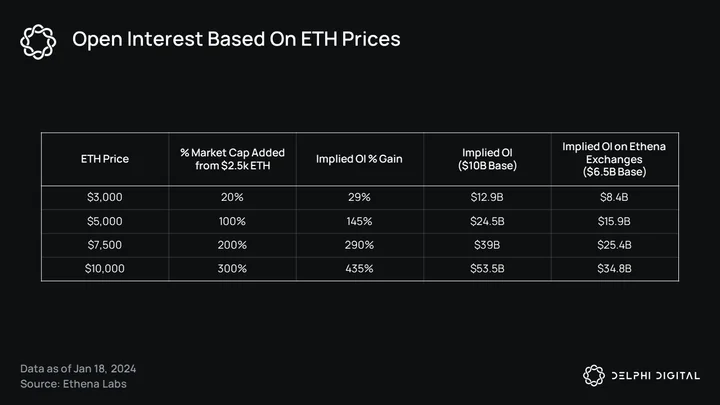
While this alone would scale USDe to a similar market cap as DAI, this implicitly assumes ETH is the only collateral asset backing USDe. As mentioned earlier, Ethena recently added BTC as additional collateral to further augment Ethena’s scalability. While BTC has no embedded yield like stETH and thus is slightly less attractive as a collateral asset, it adds a fresh $16bn of OI for Ethena to tap into.
Therefore, assuming a 30% market share of BTC OI, this would allow USDe to safely add another $4.8B to its market cap. Collectively, this this would enable USDe to scale to a total market cap of $7.2B using current OI data. Assuming sUSDe yields average around 30% and 50% of USDe is staked, Ethena would generate just under $1.1B in annualized earnings.
Similarly, BTC OI will simultaneously scale as BTC’s price scales. Using similar assumptions as ETH, BTC hitting $80k would leave Ethena with more than $26bn of BTC OI to tap into. Therefore, in a world where ETH hits 5k and BTC hits 80k, USDe could theoretically scale to over $12B. Once again, assuming 30% sUSDe yields and 50% of USDe is staked, Ethena would generate $1.8B in annualized earnings. Contextually, this is 19x Maker’s earnings and 27x Aave’s earnings.
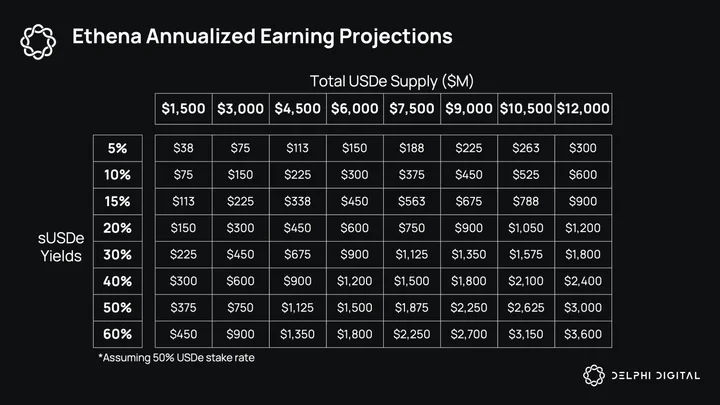
While the aforementioned scenarios certainly hinges on some optimistic assumptions, it is worth noting that even under more bearish forecasts, Ethena would still be one of the most profitable crypto protocols to date. If Ethena is simply able to maintain current USDe supply of around $2B, and sUSDe yields remain elevated at around 40%, Ethena is estimated to generate around $400M in annual earnings at a 50% stake rate.
This alone makes Ethena one of the most profitable crypto protocols of all time.
The Bigger Picture For DeFi
Now that we have a nuanced understanding of Ethena on a more granular level, let’s zoom out and explore the broader implications for CeFi, DeFi and TradFi.
Historically, yields across the aforementioned markets have been deeply dislocated. While in an efficient market context, all interest rates should theoretically distill down to the risk-free rate plus a premium paid for risk, this has not been the case.
Using (1) the 3 month t-bill (2) the delta-neutral basis trade and (3) DAI Savings Rate (DSR) rate as proxies for the “risk-free” rate in TradFi, CeFi and DeFi respectively, we can contextualize this dislocation.
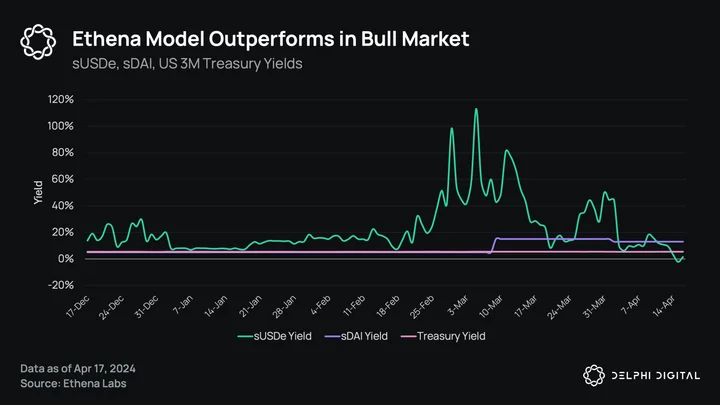
Although TradFi and DeFi rates have begun to converge as MakerDAO and other DeFi protocols continue to onboard RWAs, CeFi rates are still meaningfully disjointed. While there should be some spread given that the delta-neutral basis trade is more risky than simply buying treasuries or depositing your USDC into Aave, a spread as high as 10000 bps at times seems unreasonable. Rather than reflecting a true “risk premium”, this spread seems to be more indicative of the complexity and inaccessibility of the delta-neutral trade.
At its core, this the fundamentally value prop of Ethena – Ethena is effectively eroding the “inaccessibility premium” baked into CeFi rates by democratizing access to the delta-neutral trade and allowing it to compose with the rest of DeFi. USDe is therefore very simply a tokenized arbitrage vehicle that reconciles DeFi, CeFi, and TradFi rates.
Importantly, this reconciliation has second order implications. Given that USDe is effectively recalibrating DeFi’s baseline interest rates, the rest of DeFi has been begun to play catchup. This has led to two key integrations worth noting.
MakerDAO x Ethena x Morpho
Despite historically maintaining a relatively conservative posture, MakerDAO is ironically leading the charge in adjusting to Ethena’s second order implications.
The first move from Maker was to raise the DAI savings rate (DSR) from 5% to 15%. For those less familiar, the DSR is effectively the “risk-free rate” that DAI holders receive for staking their DAI. With sUSDe yields averaging upwards of 40% over the past three months, this seemed like a necessary step to maintain the incentive for holding and staking DAI. Other protocols such as Frax have also followed suit. These are early signs of the aforementioned DeFi/CeFi rate convergence.
MakerDAO’s second move has been a little more controversial. After deploying 100m DAI through the Direct Deposit Module (D3M) into Spark’s sUSDe/DAI and USDe/DAI markets on Morpho Blue, Maker recently voted to increase this number to a total cap of 1B DAI (22% of DAI backing). This will be deployed incrementally based on the overall health of the protocol and cash flow rates from the D3M.
For those less familiar, Morpho Blue is a modular lending primitive that allows any third party to create and manage their own lending pools. Spark, which is one of Maker’s subDAOs, is handling the management of the sUSDe/DAI and USDe/DAI pools.
The net effect of this integration is that users are able to deposit sUSDe or USDe into these lending pools on Morpho and subsequently borrow DAI in return. Not only does this inherently foster more demand for DAI, but additionally Maker gets to reap the APY paid by borrowers given that Maker is effectively the “lender” in this context.
Presently, borrowers are paying 20% APY on the 100M DAI currently deployed. This number should in theory hover below sUSDe yields as borrowers effectively arbitrage the spread. Importantly, this is what makes this such a lucrative integration for Maker – as long as sUSDe yields remain high, Maker is able to take full advantage.
To contextualize things, if Maker was to inject the additional 900M DAI today, and APYs remain where they are, assuming the cap was filled, this would generate $200M in annual revenue for Maker. While this is certainly optimistic, this alone is nearly triple that of Maker’s current annualized revenue.
As one would expect, this move from Maker has not been without criticism. While on the surface it may seem like a “risk-free” bet, there is no free lunch.
The biggest risk is ultimately around liquidations and the oracle mechanism. Given that these loans have relatively higher liquidation loan to value ratios (LLTVs), a brief de-peg or oracle malfunction could trigger unwarranted liquidations despite the fundamental value of sUSDe or USDe not actually changing. Subsequently, this could catalyze a cascading effect where liquidations beget more liquidations.
To mitigate these risks, Spark has made the difficult decision to “hard-code” the oracle. This means that the price of DAI and the price of USDe or sUSDe are fixed at par. In other words, as far as the oracle is concerned, the two assets cannot de-peg from one another.
This subsequently begs the question of how liquidations are then triggered. Importantly, as is the case with any liquidation, fixed-rate loans are liquidated based off of the loan to value ratio (LTV).
LTV = (Size of Loan) / (Collateral Value)
However, unlike variable-oracle loans that usually become eligible for liquidation based on a change in the denominator (i.e., collateral value), fixed-oracle loans are liquidated based on changes in the numerator (i.e., size of the loan).
More specifically, liquidations only happen when the interest accrued puts the position as liquidable. To incentivize healthy liquidations, Morpho has a clever mechanism where borrow rates double roughly every 5 days when a market is at max utilization. This enables positions to be liquidatable fairly quickly under a fixed pricing mechanism.
While this model functions smoothly under most conditions, there are some unique scenarios worth noting that could cause things to break.
First, in the event that USDe de-peged and its fundamental value fell below the LLTV of the loan, given that the oracle is unaware of USDe’s price, bad debt could accrue. Borrowers would effectively be borrowing more than the value of the collateral. This underscores the importance of setting slightly lower LLTVs for hard-coded lending pools. Maker has thus over-indexed on allocating to pools in the 77%-86% LLTV range.
The second risk is around liquidations incentives.
Under Morpho’s design, liquidators receive a “liquidation bonus” to incentivize healthy liquidations. This bonus is a fixed percentage of the asset being liquidated which is paid in return for repaying the liquidatable loan. However, the important nuance is that when using fixed oracles, the asset is not valued based off of its market value but rather off the oracle price which is fixed at par.
Therefore, if USDe de-pegged to $0.85 and the liquidation bonus was only 5% on a 95% LLTV loan, this would mean that the liquidator would be paying $0.95 to repay the loan to only receive $0.90 ($0.85 + 8% liquidation bonus) in return. Consequently, there would be no incentive to liquidate loans under a market value of $0.90 for USDe given that liquidators would effectively be taking a loss.
Therefore, the only party that would have the incentive to liquidate this position would be Maker themselves given that they ultimately own the loan. Subsequently, Maker would repay the loan by minting some DAI and quickly burning it in an atomic transaction. In the process of closing the loan, Maker would now take possession of the sUSDe, which importantly is no longer worth $1.
Assuming sUSDe is valued at mark-to-market on the MakerDAO balance sheet, these losses would subsequently be backstopped by MKR holders who ultimately end up eating the bad debt. So although MakerDAO may not appear to be directly exposed to Ethena’s risks on the surface, there is still some indirect exposure. Consequently, the same risks that apply to Ethena simultaneously apply to Maker, albeit to a slightly lesser degree.
While the aforementioned analysis highlights the risks that MakerDAO implicitly assumes, it is important to ultimately view this integration through a “risk-adjusted” lens. If funding rates remain significantly elevated, Maker has the opportunity to possibly double their revenue. So while yes, there are certainly risks that could come at the expense of MKR holders, the upside seems to be meaningfully asymmetric.
That said, this asymmetry does not necessarily get passed on to other lending protocols using DAI as collateral. Instead, protocols such as Aave seem to bear the risks of the integration without participating in any of this upside. Consequently, Aave recently passed a proposal that reduces the DAI liquidation threshold by 1% for every additional 100M DAI that MakerDAO allocates through the D3M. In theory, this means that as the risk of DAI increases, Aave decreases their exposure accordingly.
Ethena x Pendle
One of the more compelling features of USDe’s composability is the possibility of engineering DeFi’s first scalable yield curve.
For those less familiar, Pendle is a DeFi protocol that allows users to separate yield-bearing tokens into principal tokens (PT) and yield tokens (YT). Users can either buy the PT to lock-in a fixed yield or the YT to speculate on how much the token’s yield might change.
While Pendle has primarily found initial product-market-fit with users buying YTs to speculate on points farming opportunities, there seems to be a much greater opportunity sitting at the intersection of Pendle and Ethena’s respective architectures.
Morever, if Ethena was able to separate sUSDe into different maturities (e.g. 1MsUSDe, 3MsUSDe, 1yrsUSDe, 3yrsUSDe etc.), Pendle could subsequently create a marketplace for yields on top. The net effect would be a scalable yield curve where users can speculate and lock-in the future sUSDe yields.
While this integration may seem trivial, fixed income products are deeply fundamental to how TradFi and importantly how DeFi will ultimately function at scale. The ability for larger institutions to hedge forward interest rates could have the net effect of unlocking idle capital previously constrained by the volatility of DeFi markets.
Consequently, over the long run, this integration between Ethena and Pendle could serve as an inflection point for the institutional adoption of DeFi.
$ENA
To date, Ethena’s launch has been one of the most successful protocol launches in crypto history. A huge share of this success ultimately boils down to Ethena’s well-executed airdrop campaign.
Thus far, Ethena has broken the campaign into two seasons. The first season utilized Ethena’s version of points called “shards”. Shards were primarily used to incentivize liquidity provisioning for USDe on Curve pools. At the conclusion of season one, 5% of ENA’s total supply was dropped to shard holders.
Season two, which will run until September 2nd, or until USDe supply hits $5bn, is effectively doing the same thing but rebranding “shards” to “sats”. Users will be able to earn “sats” through similar incentive programs such as USDe LPing or using USDe to interact with other DeFi protocols such as Maker, Morpho, Gearbox, and Pendle.
Although Ethena has not yet disclosed the exact amount, “sats” holders will be airdropped some share of ENA tokens at the conclusion of the season two campaign. As highlighted in this post, the ENA token will be used to vote on governance proposal on matters such as:
- General risk management frameworks
- USDe backing composition
- Exchange exposure
- Custodian exposure
- DEX integrations
- Cross chain integrations
- New product prioritization
- Community grants
- Sizing and composition of Reserve Fund
- Distribution allocation between sUSDe and Reserve Fund
Given the aforementioned, ENA is currently more of a governance token than anything. That said, once the reserve fund is large enough, there could be a future proposal to implement either a revenue share or buyback and burn mechanism to return some of the value created by Ethena back to tokenholders.
Presently, Ethena is generating just under $200m in annualized earnings based off of the past 30 days making it the most profitable DeFi protocol today by a meaningful margin. Given that Ethena pays out yield on sUSDe but not USDe, Ethena’s profitability is ultimately a function of the delta between the supply of sUSDe and USDe.
While Ethena’s earnings will certainly take a hit post-shards campaign as there will be inherently less of an incentive for holding USDe, this should be significantly less than what most projects experience. This is because stablecoins are one of the few crypto verticals that come with inherent network effects. In other words, as more asset pairs get denominated in USDe and more protocols begin to accept sUSDe as collateral (e.g. MakerDAO), these standards will only get more deeply embedded into the fabric of DeFi. USDe adoption could be extremely sticky as a result.
Consequently, through a fundamental analysis lens, Ethena therefore could build out one of the most profitable businesses in all of crypto. Not only will they have some of the highest margins in DeFi, but more importantly, these margins will remain insulated as any emerging competitor will struggle to achieve the same secondary market utility that USDe has. Said differently, while code may be a commodity in crypto, you simply can’t fork USDe’s “moneyness” at scale.
Looking Ahead For Ethena
Coming off the back of arguably the most well-executed protocol launch in crypto history, USDe is now the fifth largest stablecoin with a 2.3B market cap. Moreover, as the market continues to demonstrate its insatiable appetite for yield, the road to $10B seems obtainable.
Additionally, Ethena’s moat only seem to be expanding. By aligning its incentives with that of other protocols, Ethena’s USDe standard has quickly proliferated throughout DeFi. Consequently, Ethena’s market position should remain defensible as inevitable competitive forces attempt to erode its margins.
That said, Ethena’s impact on crypto markets is not without second order implications. Importantly, as USDe continues to scale, certain risks around negative funding, insufficient redemption liquidity, and liquidation cascades may scale concurrently.
And although the Ethena team has done a great job at highlighting said risks and implementing risk management strategies accordingly, there may be certain risks that dynamically change over time. Therefore, it will be increasingly important to remain intellectually flexible and constantly re-underwrite one’s thinking going forward.
Lastly, as Ethena continues to reconcile yields across DeFi, CeFi and TradFi, it seems we are entering a new paradigm for interest rates. With protocols such as Maker, Morpho, and Synthetix leading the way, expect other projects to find ways to integrate DeFi’s new baseline yield.
0 Comments