
Introduction
Crypto derivatives refer to financial contracts, such as futures and options, that derive their value from underlying assets like BTC and ETH. These contracts enable traders to speculate on or hedge their positions without having to purchase the underlying assets.
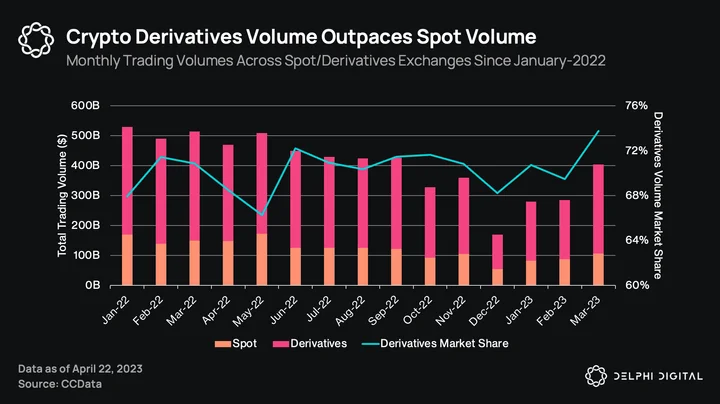 In March, both centralized and decentralized exchanges saw an increase in crypto derivatives volume for the third consecutive month, a notable achievement as this marked the first three-month streak of increases since January 2022. Moreover, since the beginning of last year, the trading volume of crypto derivatives has consistently outpaced spot volume and maintained a market share of over 65%. This trend clearly indicates the preference of crypto traders for derivatives over spot trading.
There are several reasons why derivatives trading dominates the crypto market. Derivatives, unlike spot trading, offer the ability to use leverage to amplify potential returns (and losses), have higher flexibility in terms of trading strategies, and serve risk management and hedging purposes.
There are many derivatives that exist today, but in this report, we will focus on perpetual futures, which are the most widely used derivative instrument in DeFi. In fact, during the peak of the last bull market in Q3 2021, perpetual futures saw over $13T in volume. Even in the current bear market, perpetual futures trading platforms continue to thrive, enabling traders to go long or short assets as they please.
While this is the trend for the fungible token market, the same level of interest has yet to be seen in NFT derivatives. This is because holding NFTs has more utility beyond the potential for investment gains, such as providing a unique digital identity, exclusive access to token-gated communities, and opportunities for airdrop rewards. As a result, the success of NFT derivatives will rely heavily on professional NFT traders entering the market rather than the current user base of NFT collectors. Therefore, the future of NFT derivatives is intricately linked to the level of interest shown by experienced NFT traders.
The Issues With NFTs
NFTs have experienced remarkable growth in the past three years, but there are some glaring issues with this new asset class. One of the main problems is their long-only nature, which means that opportunities for profit are scarce if floor prices are not rising. NFTs are non-fungible, which presents a host of other problems and flaws that the market has not addressed.
For instance, blue-chip collections like BAYC and CryptoPunks have high floor prices that make them inaccessible to most participants. This high entry barrier prevents retail investors from getting financially involved, and even attempts such as NFT fractionalization have left fractionalized NFT holders with liquidity issues.
Fees are another significant issue that cut into potential profits, depending on which marketplace the trader is buying or selling their NFTs on. OpenSea, for example, has reinstated its 2.5% marketplace fees, and collections like BAYC also have creator royalties of 2.5%. This means that a holder of a BAYC NFT looking to sell it would have to pay 5% in fees, which eats into their profits significantly.
Even with the onset of prosumer marketplaces such as Blur and OpenSea Pro, NFTs still function like a “spot” asset class and lack the flexibility in strategies that we see in their fungible token counterparts.
Enter NFT Perpetuals
For NFTs to reach their true potential in scale and liquidity as an asset class, more focus is needed to improve the NFT trading experience. Perpetual futures are a new primitive in NFT trading, providing traders with a better NFT trading experience in terms of friction, sizing, and leverage.
The Virtual Automated Market Maker (vAMM)
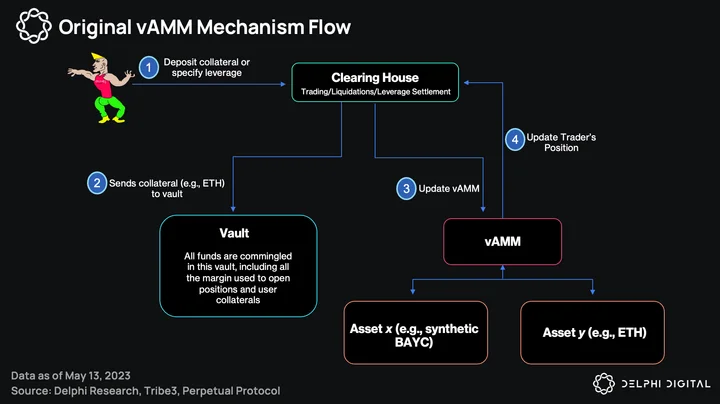
NFT perpetuals protocols today use a modified virtual AMM (vAMM) model for price discovery and store all the traders’ collateral in a smart contract vault. This acts as an independent settlement market where all profits and losses are directly settled in the collateral vault.
From a high level, vAMMs have the following features:
-
No liquidity or liquidity provider is required.
-
Powered by the same constant product formula, x*y = k, as typical AMMs.
-
Traders are long or short a given ass
Read the full report
This report is part of Delphi Pro.
- 800+ Pro reports across every major sector
- Talk directly with our analysts
- Private community of funds and builders
Already a Pro member? Log in
0 Comments