
Introduction
Less than ten months ago, you’d find it hard not to come across an article foreshadowing a blockchain-powered digital future where we all live in virtual worlds with our virtual friends inside our virtual real estate.
In 2021, we saw how a series of bullish announcements sparked the interest of investors, and subsequently, the price for digital land quickly reached never-before-seen heights.
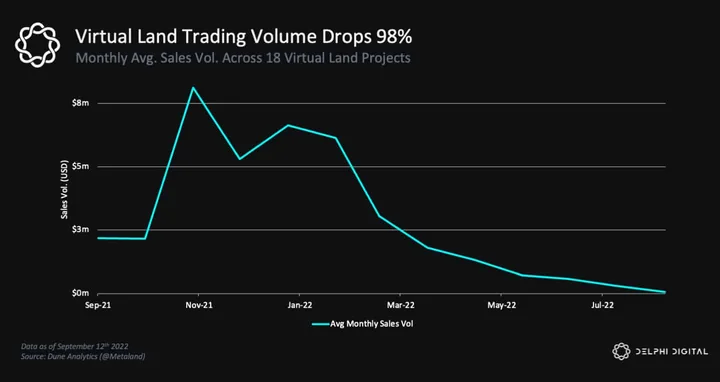
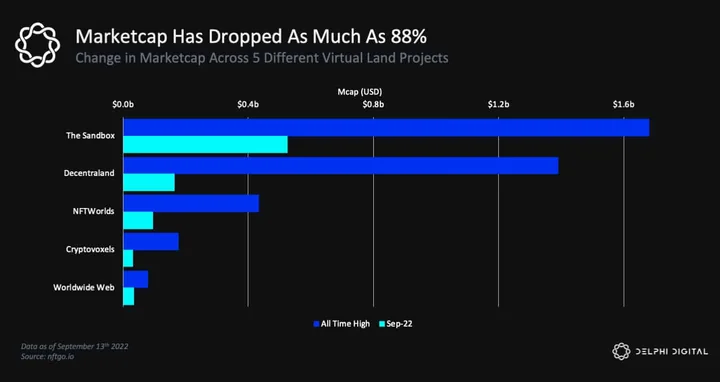
Unfortunately, those prices were fueled predominantly by speculation, and very little real value was produced. Presently, virtual land trading volume is down 98% and as much as 88% for the market caps of land assets. With our feet firmly on the ground, we now wonder where it all went wrong.
This report will outline the blockchain-based digital land market and focus on The Sandbox by analyzing historical data, identifying trends, and highlighting potential opportunities.
A Peak Into the Metaverse
Digital land, also known as virtual worlds, has been around for decades and has undergone several hype cycles. More recently, in late 2021, we saw interest build with firms like Citibank valuing virtual worlds at an $8 to $13 trillion market by 2030.
Around this time, Epic raised $2B with Sony and Lego’s parent firm to build their own virtual worlds and experiences. Additionally, in the first half of 2022, we saw $120B invested in metaverse-related projects, more than double the total amount raised in 2021.
What started the hype cycle was when in October 2021, Facebook rebranded to Meta and announced that they were spending $10B on Metaverse development. Shortly after, Greyscale released a report detailing how the Metaverse could bring in $1 trillion in annual revenue.
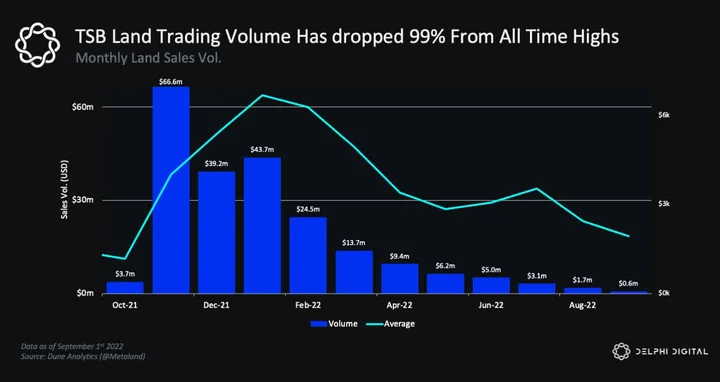
This collection of bullish announcements caused blockchain-based digital land projects like The Sandbox (TSB), Decentraland (DCL), and NFTWorlds (NFTW) to garner a lot of public and private attention. There have been just over 100K total land sales as of Q2 2022, valued at almost $2B (TSB land sales represent ~17% of this).
However, many have likened this boom to the real-world housing bubble in the early 2000s, and maybe they are right. Prices are falling, digital land trading volume has dropped considerably in 2022, and investors are questioning if this was all just a big scam or if this is an opportune time for entry.
The Value of Digital Land
Before we get into The Sandbox (TSB) and the virtual world they have created, we first need to look at how we perceive value and what creates demand for digital land.
Demand is created when something is useful to someone in some way.
However, the paradox of value tells us why usefulness alone isn’t always enough to increase the price. After all, despite being one of the most valued resources on our planet, water demands less of a premium than diamonds in certain countries where it is readily available.
At the same time, just making something scarce does not automatically increase the price either. For a product to be correctly priced, there must be a relationship between supply and demand.
If a thing is both useful and limited in supply, the demand created is greater.
So what drives demand for digital land that can be created by anyone for a relatively low cost and doesn’t inherently improve our lives for the better?
There are exceptions to the rule; Veblen goods, for example, show us that demand can sometimes be correlated to social signals and status. In this sense, digital land resembled a Veblen good as speculation drove prices up and created more FOMO in the market.
So how does TS
Read the full report
This report is part of Delphi Pro.
- 800+ Pro reports across every major sector
- Talk directly with our analysts
- Private community of funds and builders
Already a Pro member? Log in
0 Comments