
Intro
2023 has been a somewhat slow year for blockchain gaming. Although there are many reasons to remain optimistic for the future, the sector fell short of mainstream levels of adoption despite several notable game releases.
However, several noteworthy industry developments occurred throughout the year, along with a significant uptick in market attention in Q4. For this reason and many more that we will highlight in this report, we are excited for the new year and believe there has never been a better moment to prepare yourself for what is to come.
The Year So Far
The total combined market cap of 183 gaming projects has remained roughly between $4B and $7B throughout the year (as much as 86% lower than the ATH in 2022). Compare this to DOGE, a meme coin with arguably zero utility, and it is easy to say there is a lot of room for future growth.
Helping to facilitate that growth is market sentiment and the return of market liquidity. If the current momentum is maintained, 2024 is shaping up to potentially be the year we enter the slope of enlightenment and start to feel the beginnings of true scale.
Further supporting this is that this year we saw even more industry giants dip their toes into Web3. Including Zynga’s casual gaming platform Sugartown, Sony subsidiary Sony Communications Network Web3 joint venture with Startale Labs (and the strong connection it has with Astar), and Roblox CEO’s recent acknowledgment of the value in ownership-based asset agency via blockchain rails.
Additionally, after some initial rumors of an NFT marketplace in the works, Amazon has continued to strengthen its Web3 initiatives with multiple Amazon Prime Gaming partnerships with notable blockchain games. This is in addition to the launch of Amazon Web Service’s blockchain offerings, which include Amazon Managed Blockchain (AMB) Query and AMB Access.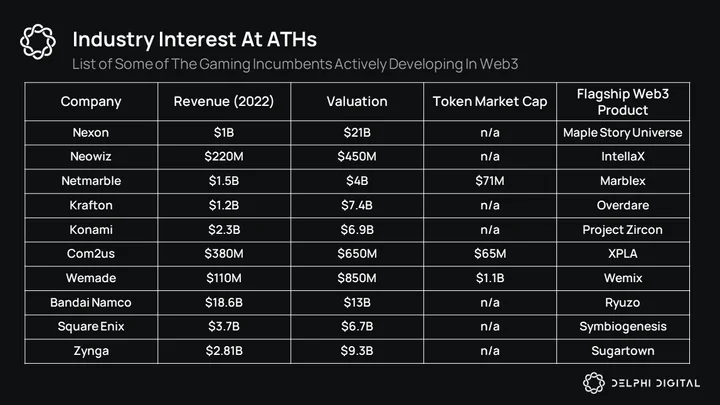
There is also the release of some more notable blockchain-powered UGC platforms to look forward to, such as Nexon’s Maple Story Universe and Krafton’s Overdare. Evidently, industry interest from gaming incumbents is at all-time highs.
Following Epic’s progressive stance on blockchain games listed on the Epic Games Store (EGS), self-publishing was unlocked on the discovery platform in late 2023. This move was less for the betterment of blockchain gaming and more a move to try and capture market share from Steam in the two platform’s ongoing rivalry (it should be noted that Epic maintains its distance, stating the games’ publisher is responsible for all asset transactions, customer service, refunds, and fraud).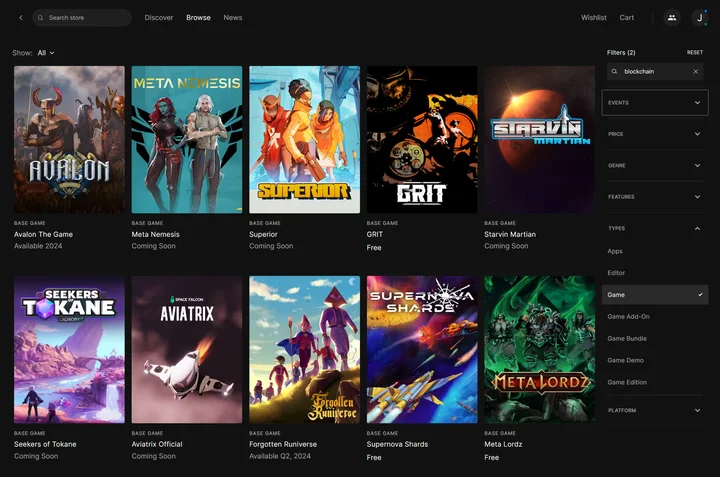
That said, it undoubtedly had some positive downstream impact for Web3, with 81 blockchain games on EGS at the time of writing — up from 70 at the end of October, and many more reported to be arriving soon. Not all these games are playable, and most use the platform to boost discoverability early on (along with listing on Steam).
In regulatory updates, sizable progress has been made for blockchain gaming over the past year. Although much more progress still needs to be made, we saw Android take a more progressive stance toward both blockchain integrations in mobile games (which went into effect on December 7th), as well as the advertising guidelines these games must adhere to (a positive change from the original outright ban).
However, there were some negative implications from the SEC related to the legality of some of the token models and GTM strategies used by blockchain projects. In June, as a part of the SEC’s case against Binance (a recently settled case), a handful of gaming tokens (Decentraland’s MANA, The Sandbox’s SAND, and Axie Infinity’s AXS) were highlighted as potential securities. In a separate case, the SEC went after Impact Theory, a Web3 community business, and labeled the project’s NFT collection as securities.
Blockchain Game Funding
It should be no surprise that 2023 has been a tough year for game funding. A total of 133 deals were disclosed, and $1.18B in funding was raised (note that funding data from December 2023 is absent from these figures). Although the monthly number of disclosed deals has remained relatively stable, averaging 15 deals per month, the funding amount has steadily declined.
Unsurprisingly, when we zoom out, a similar trend extends to the start of the bear market in Q1 2022. The average yearly funding amount has dropped by 66% since 2022 and 56% compared to the year prior.
The total number of deals dropped by just under 50% from 2022, illustrating the relative decline in VC interest since the height of last cycle’s bull market.
However, this figure was almost the same as the number of deals closed in 2021 (135), not including December metrics. This suggests that the standards held by VCs operating in the space have increased, and valuations have also become more representative of wider market conditions.
Somewhat encouragingly, the traditional gaming industry is going through a similar downturn. Q3 funding in 2023 fell 64% year-on-year (YoY), compared to Web3 gaming’s 66% decline. Compared to Q3 2021, Web3 game funding fell “only” 73%, compared to traditional gaming’s 85%.
Covid played a large role in the fast and easy money available in 2021-2022. The metaverse hype train and P2E craze were just extra fuel for the fire that moved the spotlight slightly towards blockchain integrations.
This bubble is further supported by the fact that the number of Web3 gaming deals fell 48% YoY in Q3’23. This is compared to traditional gaming’s relatively smaller decline of 34%, not to mention the numerous crypto market disasters over the past ~2 years.
That said, more concentrated and calculated bets should be considered an overall positive for the industry. Further, funding data remains a lagging indicator of growth and interest. VC funding is often reactive rather than proactive, and this is particularly true for gaming, where the success of the application layer strongly influences future funding.
It will only take a short series of bullish announcements or the discovery of a killer app/business model for the funding landscape to reverse. With many well-funded, quality blockchain games releasing in the coming 12 to 24 months and the more recent in-flow of capital to secondary markets, we may have reached the bottom of the funding cycle. If so, private markets will start to reflect this reversal over the next six months.
Key Themes & Future Trends
With that out of the way, the remainder of this report will dive deeper into some of the key themes, as well as the notable trends to look out for in 2024. We will also highlight the projects we are most excited about and the key
Read the full report
This report is part of Delphi Pro.
- 800+ Pro reports across every major sector
- Talk directly with our analysts
- Private community of funds and builders
Already a Pro member? Log in
0 Comments