
The Crypto Conspiracy
Suddenly, financial titans of the world have collectively decided that it’s time to enter crypto.
BlackRock has filed a Bitcoin ETF, Chairman of The Federal Reserve Jerome Powell has said “we see stablecoins as a form of money” and “crypto has staying power”, Deutsche Bank has applied for a regulatory license to operate a crypto custody service, NASDAQ is about to launch its crypto custody business, Soros Fund Management has said “Crypto is here to stay” and on top of that all, Citadel, Fidelity & Charles have all teamed up to launch crypto exchange EDX.
ALL of this has happened over the past 2 weeks on the heels of increasing regulatory scrutiny against crypto incumbents.
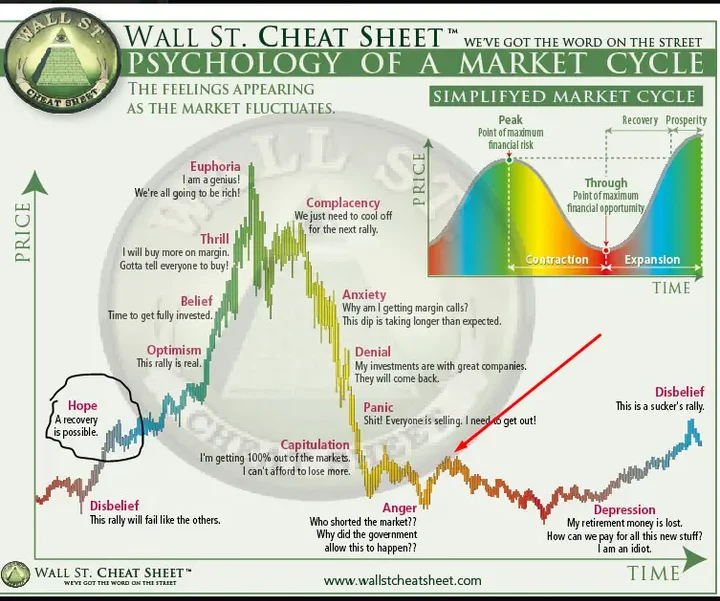
It is interesting to say the least how well crypto seems to follow these 4 year cycles, revolving around the halving. If you aren’t familiar with how crypto cycles work, it goes something like this:
1. Bitcoin goes up for some reason.
2. New capital enters the market, makes money on bitcoin, and then chases riskier bets.
3. Those risky bets get riskier until the market gets overheated and collapses.
4. New capital leaves the market and bitcoin stabilizes as it falls into the hands of long term believers.
Right now, all eyes are on bitcoin as it feels like “the cycle” has completely reset, putting us back at Stage 1 where bitcoin goes up for some reason, only this time, the reason seems to be that institutions are entering the industry to solidify crypto as an investable asset class.
I don’t want to try to make predictions here, but merely observe as somebody must have told the world’s biggest money managers about the 4 year cycle. The timing of it all is certainly strange as these titans act as vultures trying to feast upon an industry that has been bruised and battered. As it stands, the crypto market has been held back mainly by a lack of liquidity.
Liquidity generally doesn’t find it’s way into this market for 2 reasons:
1. Capital wants to enter the market, but can’t
2. Capital doesn’t want to enter the market
Let’s focus on #1, capital that wants to enter the market, but can’t:
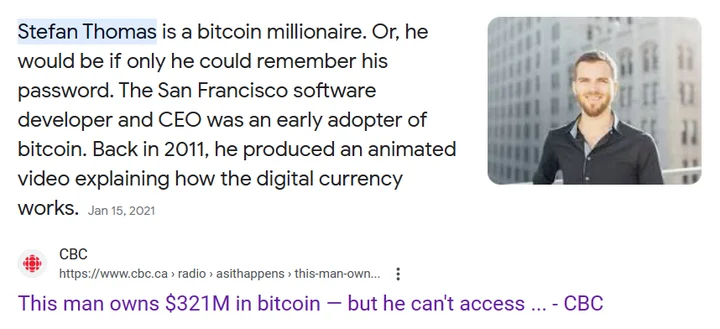
One of the most contentious topics around crypto in general is the idea of self-custody. Part of the underlying value of a decentralized permissionless network, is the idea that ownership of that network can be held in a wallet that users have sole control over. In theory, this can be better than a bank account which relies on a counterparty. The problem with self-custody is plainly that the level of competence required to securely custody your assets is too high. If you lose your private keys, get phished, accidentally send your coins to a wrong address…they’re simply gone forever and there is nothing that you can do about it. The risk/reward trade off just doesn’t make sense for most investors.
Investors want to purchase assets with a brokerage account, and rely on a trusted third party to secure them. This is generally just how the financial world works. But, right now if you live in the United States, you can’t buy bitcoin, or any cryptocurrency with a brokerage account. If you’re an investor who wants to buy gold for example, you’d be able to just buy a gold ETF with your brokerage account. BlackRock is trying to make the process of buying bitcoin as simple and secure as the process of buying gold, by filing a Bitcoin ETF. If this ETF is approved, capital that was previously unable to enter the market will now have the opportunity to do so.
Now let’s talk about #2: Capital that doesn’t want to enter the market:
There are 3 main reasons why investors generally don’t want to enter the crypto markets:
1. There’s a lack of liquidity
2. There’s a lack of security
3. They have a lack of confidence in the asset class itself
It seems clear that BlackRock, Deutsche Bank, NASDAQ, Citadel and more are going to cover #1 and #2 by giving that much needed liquidity and security to investors. On #3, lack of confidence. As a crypto enthusiast, I could sit here and tell you all of the reasons why this technology is important, undervalued, novel and more…but I won’t do that. I’ll simply leave that up to BlackRock, the world’s largest money manager.

The way the world works, for better or worse, is that the vast majority of people simply delegate their viewpoints on certain topics to those that are more knowledgeable than themselves. This is intuitive…why do research for yourself, when you could simply just trust the experts?
The problem here lies within that the incentives of all actors are not known by all parties. If you’re Larry Fink, CEO of BlackRock and you’re bullish on Bitcoin, you’re actually incentivized to talk poorly about it so that you can buy it cheaply. In 2017, Larry fink claimed that bitcoin was “an index of money laundering” and now he is filing a bitcoin ETF. The point here is that not only will the world’s largest money manager validating crypto as an asset class give confidence to everyday people, it will give confidence to other money managers as well. Essentially, the floodgates have opened.
As we know, The SEC has been ramping up its aggression against this industry recently, suing both Coinbase and Binance, the two largest crypto exchanges. The timing of it all is interesting to say the least, with government agencies attempting to damage native industry incumbents, followed immediately by some of the world’s largest players swooping in like vultures.
Yesterday, Jerome Powell of the Federal Reserve stated both that crypto was an investable asset class, along with stating that stablecoins are good. There has never been a time that there has been a more coordinated endorsement by established financial players, leaders and market forces of this asset class. And it comes right on the heels of nearly unprecedented pressure on the industry by regulators.
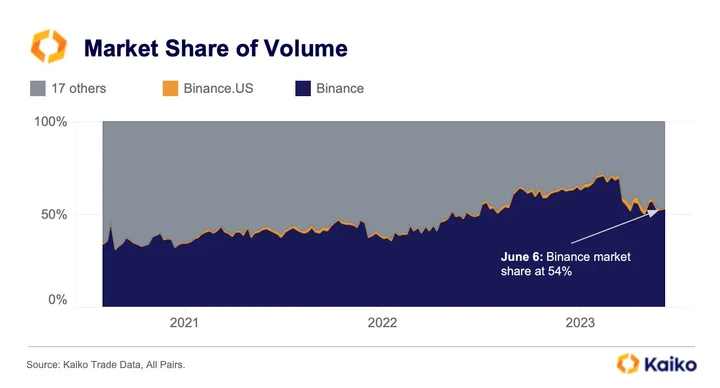
Currently, Binance holds 54% of crypto trading volume and is located off-shore. This will be a very interesting metric to watch as new players make their way into the market.
Initially, the actions of the SEC came across as a rogue regulator trying to crush an industry, potentially to overcompensate for his lack of oversight with FTX. But now, the picture seems somewhat clearer in that this coordinated effort may be less about industry *crushing* and more about industry capture by the United States.
Seemingly overnight, crypto has been legitimized as an asset class by the leaders of the “real world” where assets aren’t digital and money isn’t magic. What has been seen as a conspiracy against crypto, may have actually been one for it.
😭 Meme of the Week

📖 Delphi Reads (Alpha Feed Unlocked)
History may favor the bulls
Kevin explore the possibility of a market that isn’t tied to the early 2000s, the GFC, or the late 1970s. Rather, we may be in an environment similar to 2015-2016.
For starters, stocks are tracking that period almost to a tee. He brings us back into his days as an equity strategist and uses his experience to help navigate the current climate.
Which happens first?
Yesterday we had a bit of a spirited debate internally about where we are in the market cycle, whether BTC would continue outperforming, and if/when a classic “alt season” setup would appear.
There were plenty of strong arguments for and against overweighting BTC right now, but many responses boiled down to everyone’s individual time horizons (as is often the case during these types of debates). Thus, Kevin poses a question.
Narrative traders on the move
The overall market has been pretty starved for reasons to buy as opposed to selling. BTC is an exception, given Blackrock’s ETF filing is in the works, resulting in a Bitcoin dominance move above 50% (last seen in Apr. 2021).
In such market conditions, outperforming BTC is equivalent to generating the highest ROI. Priyansh gives his insight towards altcoins on the move.
0 Comments