Transaction Ordering Policies & Value Accrual in L2s: Timeboost, OP PGA, Fastlane, and OEV Network
SEP 16, 2024 • 16 Min Read

Report Summary
Overview: This report discusses the recent focus on transaction ordering policies and value accrual mechanisms in Layer 2 (L2) networks like Arbitrum, Optimism, and Polygon. It compares the proposed Timeboost system on Arbitrum with other systems like Optimism’s Priority Gas Auction (PGA), Fastlane on Polygon, and OEV Network by API3. These mechanisms are critical for capturing Maximum Extractable Value (MEV), reducing harmful behaviors, and distributing value fairly across the network.
Key Takeaways:
- General Context:
- MEV extraction across L2 networks has become significant, with over $3.9 billion in atomic arbitrage and $400 million in sandwich attacks occurring on major L2 platforms.
- The focus on value accrual highlights how different networks design transaction ordering mechanisms to balance user experience, efficiency, and the fair capture of MEV.
- Timeboost (Arbitrum):
- Current System (FCFS): Arbitrum currently operates on a First Come, First Serve (FCFS) basis, which often leads to latency races and network spam as participants compete to capture MEV opportunities.
- Proposed System (Timeboost): Timeboost introduces an auction system where participants bid for faster transaction inclusion via an “express lane.” The winner receives a 200ms advantage over other transactions. This shifts competition from pure latency to bidding and prediction, reducing network congestion and ensuring that MEV opportunities are captured more strategically. Proceeds from the auctions will go to ArbitrumDAO.
- Optimism’s Priority Gas Auction (PGA):
- PGA Overview: Optimism uses a Priority Gas Auction system based on Ethereum’s EIP-1559. Transactions are ordered by bid size in an English auction format, allowing participants to view each other’s bids.
- Value Capture: MEV captured through this system is distributed to the auctioneer (the sequencer in this case) and validators. However, PGA faces issues with spam in low-fee environments, which can congest the auction process.
- Fastlane (Polygon):
- System Overview: Fastlane runs a priority auction similar to Optimism’s PGA but focuses on providing Polygon validators with a 500ms advantage for transaction ordering. It was designed to reduce transaction spam and increase validator revenue.
- Auction Dynamics: Bidders don’t need to place deposits, which makes the system prone to spamming by bad actors. However, Fastlane captures real-time MEV opportunities, making it competitive for searchers.
- Value Capture: All auction proceeds are directed to Polygon validators.
- OEV Network (API3):
- Specialized for Liquidations: Unlike the generalized systems above, OEV Network is designed specifically for Oracle-dependent transactions like liquidations. It operates on Arbitrum Orbit and captures MEV by auctioning the right to use Oracle price updates for liquidations.
- Value Capture: Auction proceeds from OEV Network are shared between the OEV Network and the lending protocol being liquidated. This system ensures more value is retained by protocols instead of being lost to block builders and validators.
- Value Accrual and Auction Mechanics:
- Timeboost and Fastlane: These systems direct auction proceeds to DAOs or validators, helping to fund ecosystem activities and improvements.
- OEV Network: This system distributes value more equitably by allowing lending protocols to capture value that would otherwise go to validators and searchers.
- Conclusion:
- Transaction Ordering Systems Impact Network Value: The design of transaction ordering policies plays a significant role in how value is captured and distributed across the network.
- Timeboost’s Advantage: Arbitrum’s Timeboost system strikes a balance between MEV capture and user protection, potentially creating a more efficient L2 system.
- Future Considerations: The systems can be calibrated based on data to improve sustainability, and Arbitrum’s Timeboost will allow for flexibility in adjusting auction parameters as needed.
This report provides a detailed comparison of how different L2 networks approach the problem of value accrual through transaction ordering policies, with each system designed to address specific needs of the network and its users.
- General Context:
Recently, there has been an increasing focus on value accrual within blockchain networks. In this memo, we will explore Arbitrum’s newly proposed transaction ordering policy, Timeboost. We will also compare it with other mechanisms like Optimism’s Priority Gas Auction (PGA), FastLane, and OEV Network proposed by API3. We will examine how these transaction ordering policies influence value capture at both the application and base layers.
As highlighted by Flashbots’ research on L2 MEV, over $3.9 Bn in atomic arbitrage volume and $400 Mn in sandwich attacks volume have occurred across major Layer 2 networks such as Arbitrum, Optimism, zkSync, Scroll, and OP Stack-based rollups. Understanding how this value is generated and who captures it is crucial in further designing and optimizing networks.
Transaction ordering policies are a critical aspect of network design, as they directly affect value capture, incentives, and strategies employed by third parties such as searchers. For instance, low-fee networks are vulnerable to spam and DDoS attacks, and the way transactions are ordered impacts how quickly they are processed.
Currently, Arbitrum chains use a First Come, First Serve (FCFS) transaction ordering system at the sequencer level. However, a new proposal under consideration by ArbitrumDAO suggests that Arbitrum One and Nova should adopt Timeboost. In contrast, Optimism uses a modified Priority Gas Auction model based on EIP-1559, while FastLane is employed within Polygon’s ecosystem. API3’s OEV Network is specifically designed for Oracle-reliant transactions like liquidations.
In the sections that follow, we will delve into these transaction ordering mechanisms and assess their potential impact on value capture.
Timeboost
Timeboost is a newly proposed transaction ordering policy for Arbitrum chains. It aims to capture all available MEV for the chain owner while protecting users from harmful types of MEV behavior without sacrificing UX (by preserving fast block times and not adding further delays).
First Come, First Serve Transaction Ordering Policy
Arbitrum chains currently order transactions on a First Come First Serve (FCFS) basis. Transactions are sequenced into blocks based on their order of arrival at the sequencer. In this case, MEV opportunities, like arbitrage, are captured by those whose transactions reach the sequencer first. So, profiting from MEV opportunities usually boils down to winning a latency race. To reduce latency, competitive searchers spend heavily on building low-latency infrastructure and trying to co-locate their systems closer to Arbitrum One’s and Arbitrum Nova’s sequencer.
With FCFS, transactions are included as and when they arrive, ensuring fast block times, up to 100ms. Additionally, without a public mempool-like structure, negative symptoms of MEV, like frontrunning and sandwich attacks, are eliminated. This is in contrast to what is seen on Ethereum Mainnet, where negative symptoms of MEV from Sandwich attacks is multiple times higher than MEV from arbitrage.
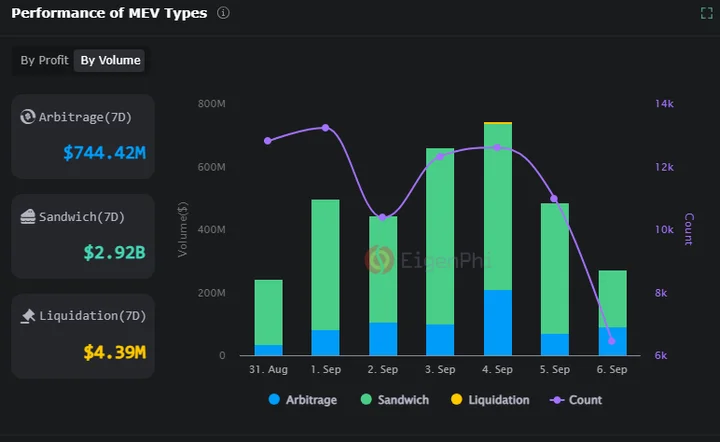
Since the sequencing of transactions depends on the chronological order in which they arrive, searchers are incentivized to spam to improve the odds of their transaction being sequenced first. This is also a common MEV strategy known as back-running. This is a problem in low-fee chains because spam strains the chain’s infrastructure and contributes to congestion.
While FCFS is a simple and straightforward ordering policy that reduces harmful MEV while preserving fast block times, FCFS contributes to spam on the network, which can result in congestion and strain on the network. Additionally, under FCFS, searchers are able to capture most, if not all, of the MEV in opportunities they identify and act on, leaving none for regular users, projects, and the DAO.
How Does Timeboost Make a Difference?
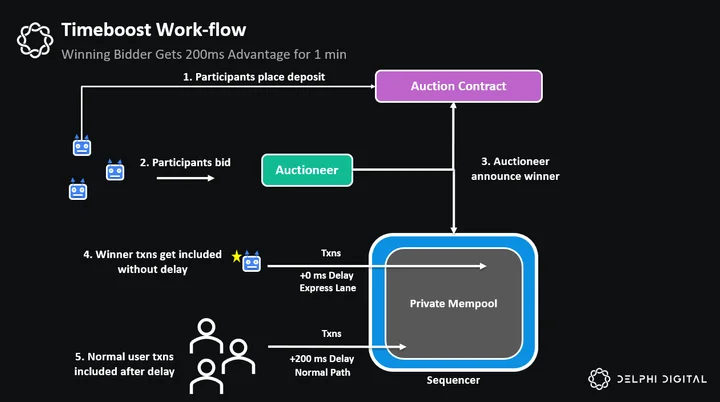
Timeboost introduces an auction where participants can bid for faster transaction inclusion in a dedicated “express lane”. By default, the auction winner gets a 200ms time advantage for transaction inclusion over other transactions. So, with Timeboost, to win a MEV opportunity over other participants, searchers have to bid the highest to access the express lane to be first or use better strategies on alpha before others can even identify them. This shifts the competition from pure latency to a prediction & bidding process. All the proceeds from the auctions go to the ArbitrumDAO (in the current proposal). The ArbitrumDAO then has the authority and flexibility to choose how the funds are spent.
With Timeboost, transactions on Arbitrum can follow two paths. One is the Express lane, where the express lane controller (winner of the auction) can submit their transactions and receive no delay in their transaction being sequenced. Normal transactions submitted outside the express lane will experience a 200ms (default) time delay for transaction inclusion. The express lane controller can also endorse transactions sent by others with express lane treatment. This would be possible as express lane transactions arrive at a separate RPC endpoint exposed by the sequencer.
Auction Set-up
Auction Contract
The funds used by a prospective auction participant to place bids are deposited into this contract on L2. Given that Timeboost runs a sealed-bid second-price auction, it collects the 2nd highest bid from the highest bidder.
Autonomous auctioneer
This off-chain server collects bids from all auction participants and submits the top two bids to the auction contract on-chain, at most 15 seconds before the next round.
The auction winner will then control the express lane for the next round. During the round that the auction winner controls the express lane, they, or any entity they designate control to, will have a 200 ms advantage over other transactions for a duration of 1 minute. Searchers who have this advantage can capture MEV in two main ways. Arbitrage (CEX-DEX or DEX-DEX) and backrunning (liquidations). These two types of MEV do not harm users, unlike sandwich attacks and frontrunning.
Auctions are held and resolved every minute to determine the controller of the express lane for the following minute. The auctioneer accepts bids in the first 45 seconds and may take an additional 15 seconds to resolve. The winner or the current Express Lane license owner will have a 200 ms advantage for 1 minute.
Auction participants in Timeboost have to make a deposit to bid. The minimum bid amount is set at 3 ARB or 0.001 ETH, depending on which asset the DAO chooses to implement. There is also a limit on how many times a bidder can place bids each round. Currently, this limit is set at 5 bids each round per-address. This helps prevent bidders from excessively spamming the auctioneer contract and performing a DDoS attack.
Auction Dynamics
Winners could make use of the express lane in the following ways.
- Given that Timeboost hosts ahead-of-time auctions, there are two components of MEV capture. One is based on predictions of future MEV opportunities; another is by identifying and capturing MEV in real-time when in control of the express lane.
- Competitive searchers can build price prediction models that would allow them to predict the size of MEV opportunities up to 15s into the future in scenarios like CEX-DEX arbitrage and liquidations. With this prediction, these searchers can decide whether to participate in the auction for express lane control & can choose how much to bid. It is important to note that the transactions are not publicly visible in a mempool, given that transactions on Arbitrum chains are directly sent to the sequencer. With FCFS, searchers would have to be the fastest and engage in spam to be the first to capture MEV as it arises. With the Timeboost, the express lane controller has a 200ms time advantage to be first, improving their chances of capturing profitable MEV opportunities that they predict.
- Another strategy could be to continually try and win express lane control over longer periods of time, even at a short-term loss, and then re-sell those rights to other market participants for a long-term gain/profit. This is basically a secondary market for express lane rights.
- Express lane controllers may also share their lanes with other parties. This is likely in scenarios where both parties stand to gain the most when the opportunity is shared (MEV gained from sharing > MEV extracted alone).
Value Accrual
Auction proceeds are sent to Arbitrum DAO’s treasury. The use of the proceeds is up to the DAO to be determined. Proceeds from the auction can be collected in either ETH or ARB within the Arbitrum Treasury. This decision is up to the DAO to collectively make.
FastLane
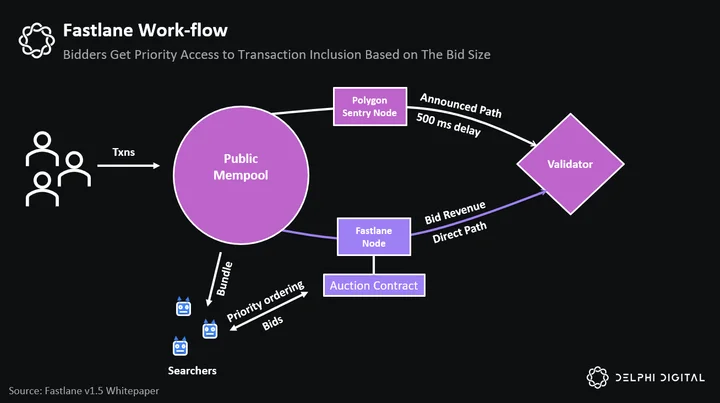
FastLane builds smart contracts and infrastructure that allow validators, apps, oracles, and wallets to capture MEV. One of their designs is used by validators to order transactions on the Polygon network. To set some context, Polygon also faced transaction spam issues. Transactions on Polygon follow two paths: direct and announced. In the direct path, transactions are directly propagated to a pre-determined number of validators and have a 500ms advantage over transactions in the announced path, where transactions are broadcasted in Polygon’s validator network. This path can be slower because most validators are not peered, i.e., not connected through a p2p network. Instead, they are connected through a set of sentry nodes that listen to transactions and then propagate them to validators.
Sentries were placed to prevent DDoS attacks by controlling the flow of transactions to validators, but they also ended up being a bottleneck, causing delays. So why is spam here an issue? Transactions are randomly sent through either the direct or announced path. So, to be first and capture MEV opportunities, searchers have to spam transactions to increase their chances of being sent first through the direct path.
FastLane helped reduce transaction spam and increased validator revenue.
PFL Nodes: These modified Polygon nodes act as intermediaries between searchers and participating validators. They connect to other PFL nodes, creating a dedicated network for transaction bundle propagation.
Validators opt into the FastLane on Polygon by peering their nodes with at least one PFL node and modifying their existing sentry nodes to prevent random direct propagation of transactions. This ensures that all transactions intended for the FastLane system go through the PFL nodes and the auction mechanism.
PFL Auction Contract: The contract manages auctions for transaction ordering. Searchers submit bids through this contract to win priority ordering. The contract optimistically executes the searcher’s transaction and then reverts it if the searcher’s bid is not paid in full by the end. This allows validators to sort transactions by bid amount without relying on simulations. If the bids aren’t paid in full, the MEV opportunity will be made available for the next bidder.
Auction Set-up
FastLane uses Priority Gas Auctions to order transactions. Searchers using FastLane can have their bundles included over other transactions with a 500ms advantage. Searcher bundles are ordered based on their bid value. The higher the bid, the higher the priority. Unlike Timeboost, Bidders on FastLane are not required to place any deposits to bid. This can make it easier for bad actors to spam bids to congest the auction and cause delays. This is a problem faced by many low-fee chains. Additionally, there is no one single winner in FastLane auctions. Priority ordering is given based on bid size to several participants.
Auction Dynamics
FastLane runs an English auction where bids are visible to other bidders. But the auctions last randomly until the bids are propagated to the auctioneer. While searchers may see each other’s bids, it doesn’t mean they can view all bids in the auction and form their strategy around it, as they can’t rely on a +1 bidding strategy. The random auction duration adds this uncertainty to the process. Unlike Timeboost, there is no base bidding price. Bidding values can vary based on the amount of MEV that stands to be captured at any given moment.
Given that bundles are prioritized based on bid value and Polygon runs a public mempool, FastLane is open to capturing all MEV opportunities, good and bad. Searchers can capture any real-time MEV opportunity, given that the FastLane runs in real-time. When an auction is in real-time, the winner of the auction can make use of the opportunity right after being rewarded. Searchers do not have to predict MEV opportunities in the future and place bids based on expected revenue that may have complications & uncertainty involved.
Value Accrual
All the proceeds collected through FastLane auctions go to Polygon validators. On the other hand, Atlas helps capture MEV on the app layer, but it is out of scope for this post as it is concerned with L2 transaction ordering policies. FastLane & Atlas are mutually exclusive solutions and don’t require the other to operate.
Optimism’s Priority Gas Auctions (EIP-1559)
Optimism and, consequently, Base, which is based on OP Stack, use Priority Gas Auctions based on EIP 1559. OP Mainnet uses a private mempool, but OP Bedrock will be using a public mempool.
Optimism’s PGA uses priority ordering based on the bid size, similar to FastLane. It runs an English auction where bids are visible to other bidders. This can lead to bidders changing their strategies based on the bids they observe. Certain strategies rely on spamming bids to overwhelm the auctioneer. This is especially problematic in low-fee chains as spam becomes an issue unless preventive measures such as deposits are in place or if there are any limits on the minimum and maximum number of bids that each participant can place.
EIP-1559 doesn’t change the amount of blockspace supplied, so it should not change the level of fees (keeping the demand equal). If the spam results from users not knowing how much to bid precisely, EIP-1559 provides a clear price that users must pay to have an inclusion guarantee.
But suppose the spam is caused by sophisticated actors who want to get their MEV transactions included and are involved in a priority gas auction against other sophisticated actors. In that case, 1559 is unlikely to help.
Value accrual dynamics here are similar to FastLane’s, which also runs a priority gas auction. Much of the capture MEV would flow to the auctioneer (sequencer in this case), and some would be left with searchers.
OEV Network
API3’s OEV Network is designed explicitly to capture MEV from liquidations. It is not a generalized transaction ordering policy like Timeboost & FastLane. Individual lending protocols can integrate with the OEV Network while the rest of the chain continues to use its own ordering mechanism. OEV Network operates as an Arbitrum Orbit chain whose sole purpose is to host auctions to capture OEV. In our report here, we have detailed how the OEV Network operates and compared it with similar solutions.
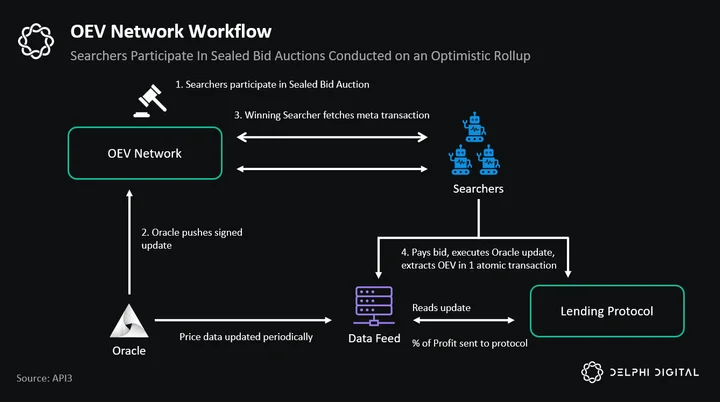
OEV Network auctions off the right to use an Oracle price update. This ensures that only the winning bidder can successfully liquidate a position. This contrasts block space auctions between searchers and block builders on Ethereum, where competing searchers lose ~80-90% of their liquidation revenue to block builders in the form of bribes to have their OEV transaction included.
OEV Network Architecture
dAPIs/Oracles – API3’s dAPIs are data feeds from first-party sources operated by the data providers.
Auctioneer Node – OEV Network auctions are conducted by the Auctioneer Node. The auctioneer node is responsible for selecting and announcing the winning bidder.
Bonding Contract – Bidders must deposit collateral on OEV Network in binding contracts to place bids. The collateral is set to be about 10% of their bid.
Auction Set-up
To participate in OEV Network auctions, liquidators bridge ETH to OEV Network to create a deposit. This amount will be used to place bids in auctions. The winning searcher then performs liquidations on the respective chain where the opportunity was present. To complete the liquidation, the searcher performs an atomic transaction in which it executes the Oracle price update, extracts OEV, and pays the bids. To ensure that searchers pay their bids when the data feed is updated, the bid amount will be included in the meta transaction utilizing the signature all the Oracle nodes added individually. This way, searchers must pay their bids to use the price update to capture OEV.
Initially, OEV Network will also operate using an English auction and later transition to a First-Price Sealed-bid Auction (FPBSA) that is fully on-chain. Bidders submit their bids to the auctioneer in an encrypted format in this auction. Searchers would be unable to learn who their competitors are and how much they are bidding, preventing the drastic increase in the number of bids that will be placed on the chain. Only the auctioneer is allowed to view bidder identities and their bids. Once the auctioneer has viewed the encrypted bid values, the highest-paying bidder will be chosen as the winner. This also ensures that searcher bidding strategies are hidden.
Value Accrual
Liquidations are a competitive “short-tail” MEV strategy. Searchers engage in intense bidding wars in these auctions, using their war chest capital or flash loans to outbid one another. Consequently, despite capturing substantial value (OEV), searchers pay or bribe off over 80-90% of their revenue to block builders and validators to have their MEV transaction successfully included.
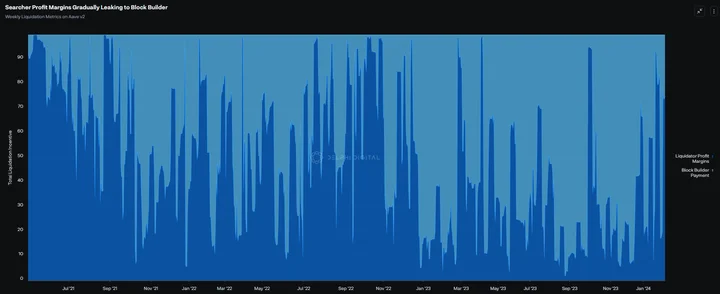
With OEV Network, auctions are held at the oracle level instead of the block builder level. This way, all the auction proceeds are captured by the OEV Network and shared with the lending protocol related to the liquidation.
Conclusion
As stated above, auction designs heavily influence value capture and user experience. Timeboost, Optimism’s PGA, FastLane, and MEV-Boost are all down-stream auction designs where the auctioneer captures bid proceeds and from where the value flows to the validators or to the chain. OEV Network, on the other hand, is an auction held more upstream at the oracle level. Unlike other designs where the implementation is at the chain level, OEV Network requires integrations from individual lending protocols. Each integrated lending protocol can get a share in the auction proceeds.
Sharing extracted value with the originators of order flow, i.e., users and protocols, should be an essential consideration for most of these designs.
Even with the addition of Timeboost, Arbitrum can still maintain a maximum of 450 ms block time. It protects users from front-running and sandwich attacks as Arbitrum operates with a private mempool. Users sending their transactions to an Express lane controller would have to trust not to be front-run or sandwiched. To this end, a reputation system could be established to moderate Express lane controllers. Bid proceeds from Timeboost are directed to Arbitrum DAO’s treasury as revenue.
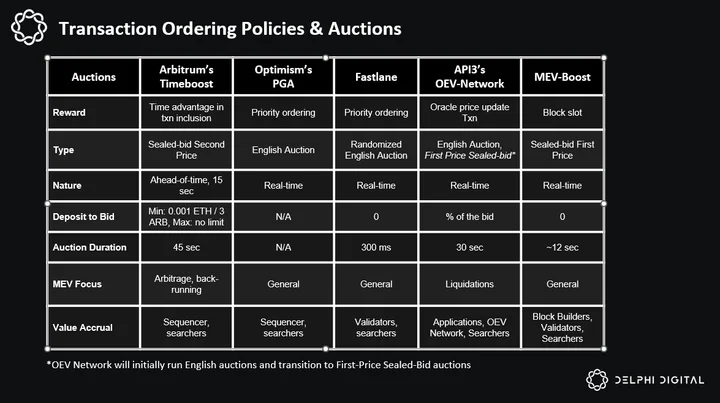
It is important to note that most, if not all, of the parameters of each of the designs above, can be calibrated based on historical data and predictions that may improve the design’s performance and sustainability. On 09/05/2024, Arbitrum updated their Timeboost proposal to include granting the sequencer operator the ability to make changes to the duration of delay, max bids, and minimum bid price and also to have the ability to disable Timeboost in case of an emergency or to respond to market conditions for the duration of 2 years.
Note: You can find our version of this post on the Arbitrum forum here.
Resources
Arbitrum’s Timeboost
Constitutional AIP: Proposal to adopt Timeboost, a new transaction ordering policy
FastLane
https://www.FastLane.xyz/PFL_WHITE_PAPER_1_5.pdf
OEV Network
https://members.delphidigital.io/reports/api3-the-state-of-oev#api3s-oev-network-6fbb
MEV-Boost
https://docs.flashbots.net/flashbots-mev-boost/introduction
https://ethresear.ch/t/proposer-block-builder-separation-friendly-fee-market-designs/9725
0 Comments