Introduction
Over the last 30 years, video games have evolved into an important part of the entertainment industry. It generated an estimated total of $184B in revenue in 2023, reaching around 3B gamers in total. Additionally, mobile proliferation across the globe, with Android users spending over 2.5T hours in screen time in the first half of 2023 alone, continues to reduce entry barriers and onboard new gamers. Users are hungry for more content, and live operations (LiveOps) have become the answer to optimize the long-term monetization of loyal players. Over 60% of playtime went to games older than six years, a remarkable number that underpins the value of providing fresh content regularly.
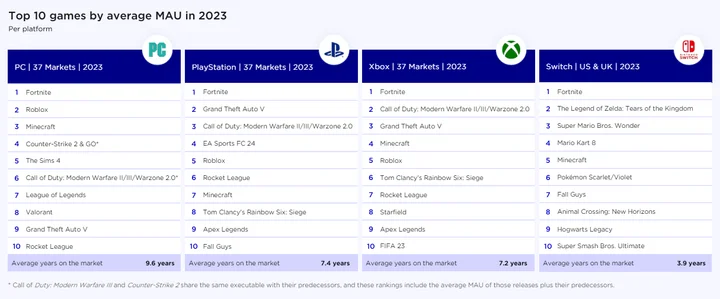
Source: Newzoo | PC, Xbox, PS coverage for 37 Markets (excl. China & India) | Switch coverage for US & UK | 2023
Over the years, advancements made to game design tools have greatly improved the content creation process. Some big platforms have further simplified, tailored, and bundled these tools to let users create content for their own ecosystem. What started out as simple modifications of games—commonly referred to as mods—has evolved into a thriving ecosystem of creators who can participate in the revenue generated from their work. Today, user-generated content (UGC) drives industry-leading platforms like Roblox and Minecraft, entertaining hundreds of millions of players.
The Evolution of Modding
Modding can be considered the first true scaled use of UGC. Mods like Castle Smurfenstein – a community-modified version of Castle Wolfenstein that turned Nazi enemies into smurfs – kicked off a trend in the 1980s that saw community members manipulate the games’ code to introduce new features for everyone to download. During that period, modding was cumbersome, but when id Software introduced Doom WAD files in 1993 to store maps, sprites, and textures separately from the main game engine, modding became easy enough for large creator communities to form. The vast amount of available content and clever shareware distribution strategy quickly propelled Doom to become one of the most played games at the time, reaching an estimated 20M players within two years from release.
Over the years, many popular games have come from the modding community. One of the most notable examples is Counter-Strike, which originated as a Half Life mod built by a single coder in 2000. Valve went on to hire the modder, licensed the game, and made Counter-Strike into one of the biggest video game franchises in history, grossing an estimated $6.7B in lifetime revenue.
Some of the biggest forever games originated from mods. Player Unknown Battle Ground (PUBG) – the now iconic shooter that inspired Fortnite’s battle royale and sustainably sees hundreds of thousands of concurrent players – evolved from an old ARMA 2 mod. DotA 2 – one of the most played games of the last decade – started as a mod of Blizzard’s Warcraft III called Defense of the Ancients. This was also the inspiration behind Riot’s League of Legends (LoL), a game that went on to dominate the video game industry for years to come. LoL still boasts an estimated 130M+ monthly active players nearly 15 years after release, with estimates putting its lifetime revenue over $15B.
Nowadays, some of the biggest franchises have fostered thriving modding communities that provide user-created content and features via downloadable add-ons. A game like Skyrim has over 69,000 mods available on Nexus and another 27,000 on the Steam Workshop that provide players with fresh content to consume more than ten years after release.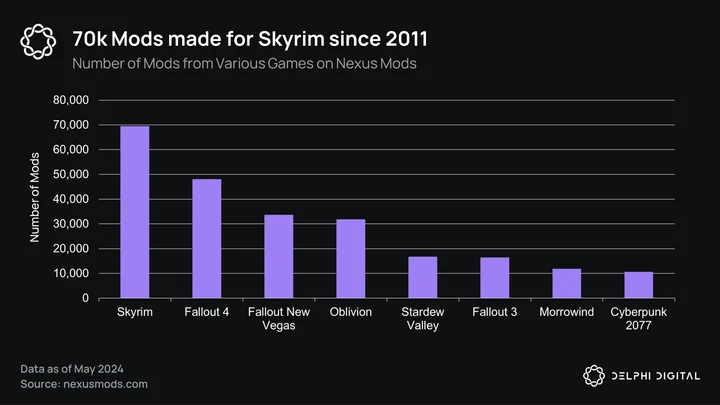
Bottom Up vs. Top Down
While LiveOps can significantly increase long-term revenue, producing regular content costs time, resources, and expertise. This has led some big studios to build out UGC platforms with the aim of reducing those costs in the long run by tapping into their vast communities. The typical playbook dictates a bottom-up approach, as UGC needs a large player base and some sort of proven game loop to unlock its true potential.
Fortnite
Fortnite started as a base-builder x zombie shooter in late July 2017. In September 2017, Epic Games decided to release a battle royale mode that took advantage of the base-building mechanic designed for their PvE game “Save the World” to create a fresh game loop.
This unconventional battle royale game then exploded in popularity over the following years, reaching an estimated peak player base of over 290M monthly active users. Quickly scaling to that size meant that the team had to produce content at a high pace, which led to a few rushed releases in their early days.
In December 2018, they released the Fortnite Creative platform, a
Read the full report
This report is part of Delphi Pro.
- 800+ Pro reports across every major sector
- Talk directly with our analysts
- Private community of funds and builders
Already a Pro member? Log in

0 Comments