
A Brief Introduction to Vega
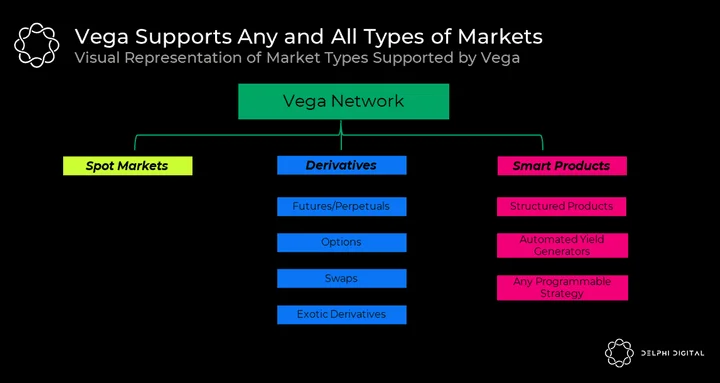
Vega is a standalone blockchain with a single purpose: being the base layer for a diverse asset marketplace. Every attempt to build a decentralized exchange has been focused on a single market type. Uniswap is the most liquid on-chain spot market; dYdX is the most liquid on-chain perpetual futures market. Vega draws from both of these, acting as an all-encompassing layer to trade any asset.
Expirable futures, perpetual futures, options, swaps, spot assets, complex structured products — any fungible asset— falls under the purview of Vega. Later in this report, we’ll highlight the unique products this sort of marketplace enables.
Vega is built using the Tendermint Proof of Stake consensus algorithm, thereby making it an unofficial member of the Cosmos ecosystem. However, the network relies heavily on Ethereum. The first bridge Vega has built is one that enables ERC-20 tokens to be migrated to Vega. In fact, even the native VEGA token is an ERC-20 – and will remain so for the foreseeable future. Though it seems reasonable to expect a bridge to a Cosmos Hub soon, the Ethereum bridge will be live first.
As mentioned earlier, most attempts at decentralized asset exchanges have been rather focused on either spot or one type of derivative. dYdX, MCDEX, Perpetual Protocol, Futureswap, Drift, and several others support perpetual futures (and perhaps expirable futures eventually). Opyn, Hegic, Dopex, Lyra, Primitive, Psyoptions, and others are building on-chain options products.
Some examples that stand out are Levana (leveraged tokens and perpetuals), GMX (spot swaps and perpetuals), and Zeta Markets (options and expirable futures). Because of Vega’s wide scope, all of these exchanges are essentially competitors.
It seems pretty ambitious to tackle so many assets and markets at once, and the task at hand is massive. So how exactly does Vega plan to do all of this?
A Framework for Comprehensive Markets
To understand how Vega enables so many markets, we need to first learn how it functions from the bottom up.
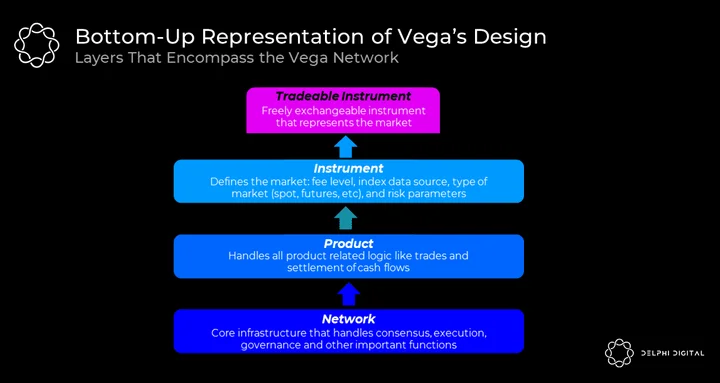
First, we have the network layer. This is the main blockchain, or the Vega Network. It’s a Proof of Stake chain that runs on the Tendermint consensus mechanism. And as such, it can theoretically process over 10,000 transactions per second (TPS), which is probably overstating near-term realizable throughput. As you can imagine, all transactions on Vega are run through the network layer. All on-chain consensus is done via Vega nodes — who need to stake a certain amount of VEGA tokens to be functional validators.
State changes such as trades, creating or closing markets, withdrawals, deposits, liquidations, etc are propagated amongst nodes so they can mutually reach consensus and validate transactions. The parameters of the network are defined in a strict manner to ensure smooth and predictable functioning.
Next up is the product layer. This piece is essentially the core markets on Vega, and handles things like trades, execution logic, and settlement of cash flows. A product in the Vega network can be described as the base market, which can vary from being a spot market to calls expiring on Dec. 31, 2025 and more.
The product layer can be set up in many ways. It can be an open orderbook, a batch auction, or even a virtual market that uses an oracle to establish pricing. While the network layer has strict parameters, the product layer is much more vague — intentionally, to allow for more customization and innovation.
Once the product layer is established, the instrument is defined and set up. An instrument is, very simply, anything that can be
Read the full report
This report is part of Delphi Pro.
- 800+ Pro reports across every major sector
- Talk directly with our analysts
- Private community of funds and builders
Already a Pro member? Log in
0 Comments