The Launchpad Wars: Pump.fun, Raydium, and the Future of Solana's Memecoin Economy
MAY 02, 2025 • 16 Min Read
Vertical Integration vs. Creator Alignment: Pump.fun and Raydium’s Battle for Solana’s Memecoin Economy
Pump.fun didn’t just ride the memecoin boom, it engineered it. While just 2 of the top 10 memes on Solana by market cap may have originated on the platform ($PNUT and $FARTCOIN), the sheer volume of tokens launched and trading activity they’ve generated has redefined token generation and memecoins at large.
In just over a year, the Solana-based launchpad has transformed from upstart to kingmaker, becoming one of crypto’s most profitable businesses while redirecting billions in trading flows from Ethereum to Solana. With over $670 million in fees generated since its January 2024 inception, Pump.fun has achieved what few DeFi protocols ever manage: massive, sustained revenue, without token incentives.
While its yearly revenue currently ranks 10th overall in DeFi, Pump’s growth trajectory tells a more compelling story. In the past 30 days alone, it generated $75.15 million in fees, vaulting to 3rd place behind only stablecoin issuers Tether ($555 million) and Circle ($190 million) and earning double the fees of Solana itself ($33.71 million).
But Pump, clearly, isn’t satisfied with dominating just one segment of the market. By launching PumpSwap, their own AMM for trading graduated tokens, they’ve executed a textbook vertical integration play. No longer content to hand off their tokens to Raydium after launch, Pump now controls the entire value chain, potentially doubling their already impressive revenue by capturing both token creation and their post graduation trading.
It’s a bold strategy that could cement Pump’s control over Solana’s memecoin economy. But in reaching for more, they’ve also created an opening for new challengers.
PumpFun’s Grip on Solana Trading
At this point, Pump.fun isn’t just participating in Solana’s meme economy, it is the meme economy.
In fact, at its peak in November of last year, Pump-related assets (coins launched on Pump.fun) made up nearly 60% of all monthly DEX activity on Solana, meaning that coins launched on Pump.fun generated nearly two-thirds of all trading activity across Solana. Even today, in a much less frothy market, Pump assets are still driving ~40% of monthly DEX transactions.
The dominance is just as clear when looking at volume. Pump-related assets accounted for over 40% of all Solana DEX volume at their height. Even now, they consistently make up about 25% of total DEX volume, a staggering figure for a single launch platform.
And no protocol (outside of maybe Solana itself) has benefited more from Pump’s rise than Raydium.
Because all graduated Pump tokens initially funneled their liquidity into Raydium’s pools, they became a massive source of trading volume and fee generation for Raydium’s AMM. Over the past 90 days, Pump-related assets made up about 40% of all swap volume on Raydium, helping drive a large share of the $900M+ in total fees Raydium generated last year. This figure, notably, exceeded Pump.fun’s own fees for 2024.
In other words: Raydium made more total fees than Pump, largely because Pump fed them the flow. Looking at actual protocol revenue though (not fees) Raydium generated $154.2M in 2024, with $62.4M of that share(~40%) coming directly from Pump.fun memecoin trading.
Still an impressive number but not quite the level of pure revenue Pump.fun generated in the same span.
(*Note: Raydium’s reported “fees” include liquidity provider payouts — total fees minus LP share = protocol revenue. For Pump.fun deployed pools Raydium takes 12% or 3bps of 25bps*.)
PumpSwap: Verticalizing the Stack
On March 20th, Pump.fun made a decisive move: All new tokens graduating from its launchpad would migrate their liquidity to PumpSwap, Pump’s own AMM, cutting Raydium out of the flow entirely.
The impact was immediate. By reclaiming the trading volume it had previously funneled to Raydium, Pump effectively killed the single largest driver behind Raydium’s growth over the past year and redirected that future revenue stream back to itself, overnight.
Since launching just over a month ago, PumpSwap has already processed more than $14 billion in cumulative volume, averaging around $450 million in daily trading. Over that same stretch, PumpSwap has generated over $33 million in fees, with around $25.9 million distributed to liquidity providers and $6.5 million captured directly by the protocol as revenue (roughly $226k per day).
PumpSwap currently charges a 0.25% trading fee, splitting 0.20% to LPs and 0.05% to the protocol. When comparing revenue figures, it’s worth noting that Pump.fun previously charged a migration fee (6 SOL) for pools going to Raydium (which accounted for 12% of their daily revenue), but have since removed that fee, with tokens now migrating to their own pools. Today PumpSwap’s revenue as a percent of its average daily revenue is less than it was when charging migration fee, though.
That said, when you add it all up, Pump.fun is now pulling in over $2.5 million in daily fees across its launchpad and AMM, with some days closer to $3 million, depending on market conditions. Even during the April market slowdown, Pump still generated around $1 million per day in revenue from its launchpad alone, plus another $226k per day in revenue (and another $1 million+ per day in LP fees) from PumpSwap trading activity.
In short, Pump didn’t just launch a DEX. It built a vertically integrated trading empire, consolidating token creation, liquidity, and trading under one roof.
The $PUMP Endgame: Strategic Fee Capture and Token Potential
At a high level, Pump.fun’s decision to launch PumpSwap was about capturing more value and taking full control over liquidity. While coins that already graduated to Raydium will continue trading there, memecoin capital rotates fast – constantly chasing new launches, momentum, and trends. And almost all of those new launches still happen through Pump.fun.
That means moving forward, all future Pump tokens will initially deploy on PumpSwap. Trading volume could still flow to other venues, but won’t happen as easily as when liquidity was siphoned to Raydium automatically.

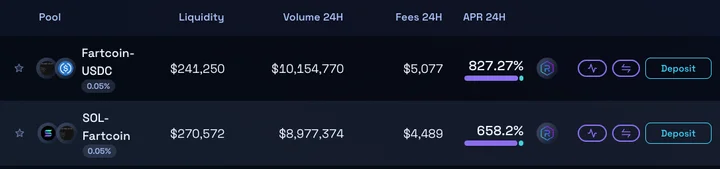
That said, the reality is more nuanced than simply “Pump token volume = PumpSwap volume.” For example, despite launching on Pump.fun with liquidity initially going to Raydium’s pools, Fartcoin now sees substantially higher trading volume on Orca, with the Fartcoin/SOL pair on Orca generating over $52M in 24-hour volume compared to just $8.9M on Raydium.
If Raydium wants to recapture these volumes, though, they’ll now have to actually compete and earn it, which represents a significant uphill battle compared to the previous passive flows they have enjoyed.
The move also addresses sustainability concerns. Pump has been called extractive in the past, (though this label largely stems from Pump’s outsized success rather than its competitive fee structure, and criticism about SOL-to-USDC conversions which overlooks that Pump must operate as a business with fiduciary responsibilities to investors, not a speculative SOL treasury), and plenty of people have questioned the durability of the business. They wonder whether the launchpad could survive long-term or if it would eventually flame out.
Launching PumpSwap expands their revenue capture, increases stickiness, and makes the business model look a lot more sustainable, even if the market never gets as frothy as it was last year. It’s worth noting, however, that non-Pump tokens currently contribute less than 1% to PumpSwap’s AMM volume, highlighting both their strategic advantage by verticalizing the stack and a potential vulnerability.
we’re also investing in creating a more sustainable ecosystem
coming soon, a percentage of protocol revenue will be shared with coin creators
if it succeeds, millions of dollars will go towards aligning creators with their communities and incentivizing higher quality launches
— pump.fun (@pumpdotfun) March 20, 2025
Their fee structure offers further insights into future plans. Currently, PumpSwap charges 0.25% fees (0.2% to LPs, 0.05% to the protocol), but they’ve already signaled plans to distribute protocol fees back to creators. This setup could be extremely bullish if they ever decide to launch a $PUMP token. In that scenario, earnings from Pump.fun’s core business could flow to equity holders and early investors, while PumpSwap trading fees could flow to $PUMP holders, not their existing investors.
A key aspect of this strategy is centered around sustainability and addresses core user behavior concerns about memecoin longevity. With creator revenue sharing, coin creators would have stronger incentives to stick around and contribute to their communities for the long run, potentially transforming the often fleeting nature of memecoin projects into something more durable and ecosystem-supporting.
The potential revenue is substantial: as mentioned, Raydium generated over $150 million in revenue last year, with Pump-related assets responsible for around 40% of that volume. Even if PumpSwap only captures 75% of the volume Raydium did via Pump (this assumes Raydium will be able to successfully compete and retain ~25% of launches previously occurring on Pump.fun), PumpSwap alone could generate upwards of~$100 million in annualized revenue, with significantly higher figures for LP fees.
And that’s in the current market environment. If meme trading activity heats up again, those numbers could scale dramatically, with protocol revenue potentially flowing directly to a future $PUMP token.
LaunchLab: Raydium’s Creator-First Counter
Before PumpSwap launched, Raydium had no reason to build a rival launchpad. They directly benefited from every Pump.fun graduation, passively collecting swap fees as tokens migrated to their AMM. But once Pump.fun launched its own DEX and kept the flow in-house, Raydium had no choice but to build competing infrastructure or watch their volume steadily drain away.
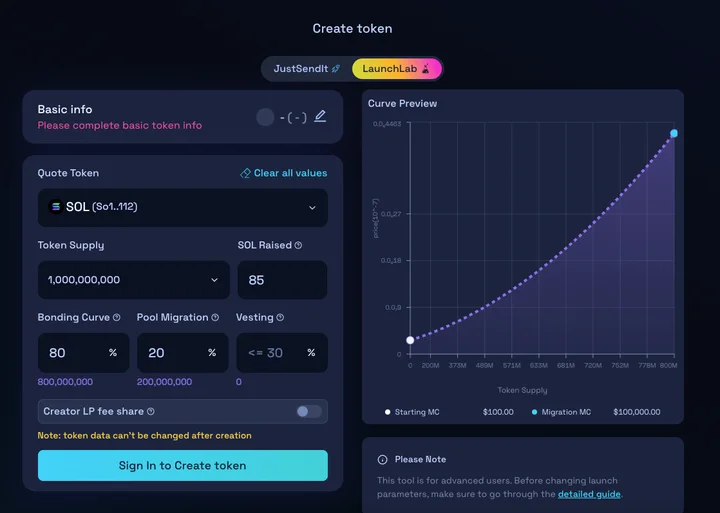
LaunchLab represents Raydium’s strategic response with two distinct offerings: a simple JustSendIt mode (85 SOL threshold, one-click creation) and a more advanced LaunchLab Pro with customizable bonding curves, vesting terms, and revenue sharing options.
What about trading fees? 💸
For tokens launched through the LaunchLab UI, fees are simple and ecosystem-aligned:
Base trade fee: 100bps (1%)
• 50% → Community Pool (for creators + traders — more soon)
• 25% → $RAY buybacks
• 25% → Program fee (infra & ops)LaunchLab is…
— Raydium (@RaydiumProtocol) April 16, 2025
The key differentiation is Raydium’s creator alignment strategy. While both platforms charge a 1% trading fee during the bonding curve phase, LaunchLab distributes it more transparently: 50% to a community pool, 25% for $RAY buybacks, and 25% for infrastructure. Creators can also earn 10% of trading fees from the AMM post-graduation and leverage third-party frontends for custom branding and launch experiences.
To jumpstart adoption, Raydium has launched an airdrop campaign with 150,000 RAY ($450K USD) being distributed to LaunchLab creators & users in its first week post-launch, and an additional 50K RAY ($150K USD) being distributed daily since last Friday (April 25). The platform also offers built-in referral rewards, with users earning 0.1% on trades made through their links.
It’s a modular and slightly more creator/ecosystem “aligned” approach – creators can have a share in rewards which can be used to rebuy tokens and some of the Raydium fees stay in the ecosystem (buying back their own token). It may appeal to more structured teams with existing communities, especially those who want to monetize launch activity or route fees back to holders.
Still, it’s unclear how much that flexibility actually matters in practice. Most memecoins rotate quickly, and once tokens graduate, trading shifts to secondary markets where custom branding, frontends, and bonding curves become irrelevant. Raydium is betting that composability, ownership, and token incentives justify maintaining the same 1% fee rather than undercutting Pump.fun.
Furthermore, the added complexity of vesting, custom curves, and variable fee structures contradicts one of Pump.fun’s core features which has made it so widely adopted – the certainty that there’s no supply overhang since initial liquidity of all Pump.fun launched coins is burned. Siloed frontends with team-specific fees dilute Raydium’s brand-building potential, an area where Pump.fun has excelled. Pump.fun’s standardized structure and consistent rules have fostered trader trust and familiarity, while LaunchLab’s variable approach could create a more confusing and fragmented user experience, potentially hindering wider adoption.
LaunchLab in Practice: The Letsbonk.fun Case Study
Despite having what may be structural disadvantages in the long run, LaunchLab has shown some strong early traction, particularly through letsbonk.fun, which has quickly become the platform’s most active instance.
Introducing https://t.co/YRGAhlNDki, the @BONK_inu community’s self‑serving launchpad for meme coins!
For too long, the meme coin market’s been plagued by predatory actors—now it’s time for a change.❗️❗️❗️
Our core team has been building on Solana for 4+ years, contributing… pic.twitter.com/3GPD3Lfk5g
— Letsbonk.Fun (@bonk_fun) April 25, 2025
Since launching on April 16th, Raydium’s LaunchLab crossed $100 million in daily volume for the first time on April 28th, with letsbonk.fun driving over $57 million of that volume. Built by the Bonk team in partnership with Raydium, letsbonk.fun positions itself as a community-aligned alternative to “extractive” launchpads. Backed by one of Solana’s most recognizable meme coins, letsbonk.fun charges a 1% bonding curve fee plus a 0.25% Raydium platform fee, with a portion used to buy back $BONK, directly tying platform success to token value.
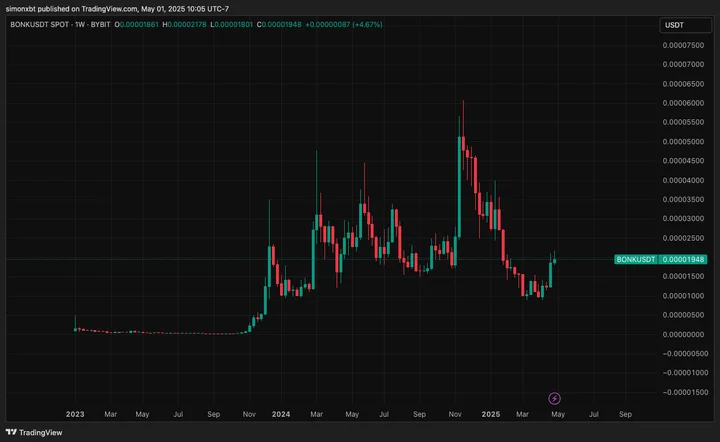
The narrative has clearly resonated with the market. Hosico Cat ($HOSICO), the biggest success story from letsbonk.fun so far, reached a peak market cap of ~$40 million, contributing significantly to both platform volume and broader ecosystem buzz. The launch activity has also coincided with positive price action for $BONK itself, which has climbed from around .000016 to .000020, creating a reflexive relationship between launchpad success and token performance.
Bonk has generated over $1 million in just four days since launching their LaunchLab GUI. To be fair, LaunchLab does offer valuable functionality that Pump.fun doesn’t; it gives anyone the ability to distribute a bonding curve to their own community, monetize it, and even earn fees post-migration. This democratizes the token launch process in ways that could appeal to established projects with existing communities.
This formula, established meme projects leveraging their brand to launch tokens that generate fees used to buy back their own token, could potentially be replicated by other older meme projects looking to revive interest. Projects like $PENGU, or $WIF – for example – might see this as a path to recapture attention in a crowded market by leveraging their existing communities and creating new utility for their tokens.
While token launches and volume spiked dramatically to nearly $40 million and 7,500 launches on April 27th (with letsbonk.fun alone accounting for approximately 4,700 of those launches), they’re already quickly retracing toward previous levels, with an average of around $10 million in daily volume and 1,900 launches since going live. This high concentration in a single instance represents both a success story and a significant risk for LaunchLab’s ecosystem.
The decline in activity suggests the initial enthusiasm may not be sustainable, contrasting sharply with Pump.fun’s steady 30,000+ daily launches. Still, it’s extremely early in this competitive landscape, and definitely something to monitor closely in the coming weeks. If more established projects follow Bonk’s lead and successfully launch their own instances with sustained volume and successful tokens, we could see a trend where LaunchLab gradually pulls market share from Pump.fun.
PumpFun vs. Raydium: Who Wins?
The narrative that Pump.fun is extractive has created an opening for competition, but the reality is more nuanced. Pump’s model: no vested insider allocations, transparent bonding curves, and locked liquidity, offers remarkable accessibility. Its simplicity, brand recognition, and powerful network effects have made it the default launchpad for memecoin trading this cycle.
Raydium’s LaunchLab represents a calculated attempt to challenge this dominance by targeting a different segment: creators who value control over fees, branding, and liquidity management. This approach could gain traction,especially if the next wave of $100M+ memes launch through Raydium’s infrastructure. Success here could trigger a reflexive cycle, especially across Crypto Twitter where sentiment already leans toward viewing LaunchLab as a “community-friendly” alternative (whether that’s really true or not) that keeps value within the ecosystem, potentially redirecting attention and volume away from Pump.
However, this positive feedback loop faces significant barriers. LaunchLab introduces friction that Pump.fun deliberately eliminated. It’s more complex, slightly more expensive depending on whether projects add additional fees, and lacks the viral simplicity that fueled Pump’s explosive growth. Currently, both creators and traders default to Pump because it’s faster, easier, and deeply embedded in the cultural fabric of Solana meme trading.
Meanwhile, Pump.fun is leveraging its market-leading position to stay ahead. They’ve already signaled plans to introduce creator revenue sharing for PumpSwap, not out of necessity, but from a position of strength. Their substantial lead provides strategic flexibility to observe market developments and respond selectively only when genuine competitive pressure emerges.
The most likely outcome is continued Pump.fun dominance unless LaunchLab begins consistently producing breakout successes, not isolated cases like letsbonk.fun that may be short lived (time will tell), but a sustained pattern of winners that shifts creator mindshare. In this scenario though, Pump would likely bring their creator revenue sharing to market more quickly and compete back for market share while also turning the narrative that they are “extractive” on its head. While Raydium may capture certain segments of the market, completely displacing Pump.fun’s central position seems improbable in the near term.
Conclusion: Pump.fun’s Market Control and the Competitive Horizon
Pump.fun looks well-positioned to keep growing, even without a fresh wave of users. The platform has shown surprising resilience through tough market conditions, and with the launch of PumpSwap, it’s positioned itself not just as a meme launchpad but as a core piece of Solana’s trading infrastructure. Opening up a revenue-sharing path through the AMM could set the stage for a potential $PUMP token, offering swap revenue to tokenholders while preserving the core launchpad economics for equity holders.
Raydium had no choice but to compete, but LaunchLab feels more like a defensive reaction than a true disruption. Without Pump feeding it liquidity, Raydium likely won’t come close to recapturing its ATH volumes, and while $TRUMP (which wasn’t launched through Pump.fun) helped drive Raydium’s peak volume in January through elevated SOL-USDC volumes, Raydium’s consistent high volume in the preceding months was substantially powered by Pump token activity. Since PumpSwap’s launch, Raydium is already showing slowed volume growth as this crucial liquidity source diverts to Pump’s own AMM. The fundamental landscape has shifted, with Pump now controlling both sides of the value chain. The idea of displacing Pump.fun through a more complicated launch experience feels unlikely at best.
That said, more competition at the margins is ultimately healthy. Even if LaunchLab and similar attempts don’t dethrone Pump, they’ll pressure the ecosystem to improve: pushing fees lower, making revenue sharing more accessible, and forcing platforms to offer creators and speculators better terms. It’s a dynamic similar to what played out between Uniswap and SushiSwap during DeFi summer: the incumbent won, but the trenches got better for everyone. Pump’s hints at changing their fee structure for PumpSwap already suggest that they are ready to respond to competitive pressure, despite their dominant position.
This market-leading status gives Pump.fun tremendous optionality: they can wait, watch, and selectively adopt only the most successful innovations from competitors while maintaining their core advantage of simplicity and brand recognition.
Pump.fun remains firmly in control. But the arms race has started.
0 Comments